The Initial Search and Connection
After several days of reading and reflecting on “Zhuan Falun,” along with Qing Ling’s strange experiences, we both felt a great urge. Clearly, this was not just an ordinary book, but a path, a guidance that we had been fortunate enough to encounter. But as I’ve said, to continue, especially to learn the five exercises correctly, we needed to find an instructor. Searching online in China was clearly useless.
The idea of seeking out Mr. Chen, my wife’s uncle’s friend who had inadvertently mentioned Falun Gong at the family dinner, kept circling in our minds. Although he had seemed a bit hesitant when talking about it then, he at least knew of it and had said many of his neighbors practiced it. That was the only and most plausible lead we had at this point in Shanghai.
“We have to find a way to meet Mr. Chen again,” Qing Ling said to me one morning as we were preparing to leave the hotel. “We can’t just sit around and wait. I’ll call my aunt and see if there’s a way to invite Mr. Chen over, or get his phone number so we can contact him directly.”
I thought her idea was reasonable. Though I was a bit reluctant to bother her aunt and uncle’s family again, this was important. Qing Ling then called her aunt. Fortunately, her aunt didn’t ask many questions, just thinking we wanted to thank Mr. Chen for his visit the other day, so she happily gave us his phone number.
With the phone number in hand, Qing Ling called Mr. Chen directly. She chose her words carefully, saying that we were very appreciative of his sharing about health practices the other day, and had a few more things we’d like to ask him, wondering if he would be free to meet us for a short while. At first, over the phone, I could hear Mr. Chen’s voice sound a bit hesitant; he probably guessed what we wanted to ask about. But perhaps the sincerity in Qing Ling’s voice convinced him. In the end, Mr. Chen agreed to meet us that afternoon at a small teahouse near his home, a place that seemed discreet and less frequented.
At the appointed time, Qing Ling and I found the teahouse. It was a small place, tucked away in an alley, with a very quiet atmosphere. Mr. Chen was already waiting at a corner table. He looked as kind as he did before, but his eyes seemed more cautious.
After a few polite greetings, Qing Ling got straight to the point, but still in a very gentle and respectful tone. “Mr. Chen, the other day you mentioned the Falun Gong practice that many of your neighbors do. Actually, we also had the fated connection to read its main book, ‘Zhuan Falun,’ and we feel the principles within are incredibly profound and meaningful. We would very much like to learn more, especially to learn the exercises, but we don’t know where to start, and we don’t know anyone here.”
Qing Ling paused, looking at Mr. Chen with an expectant and somewhat pleading gaze. “We know this might be a sensitive issue, but we are truly sincere. We were wondering if you could… help us? Or perhaps introduce us to someone who practices this?”
Mr. Chen was silent for a moment, looking at us, then out the window. I could clearly see the hesitation on his face. Helping strangers learn about a practice that was under the government’s watch was certainly not a simple matter. The atmosphere in the teahouse suddenly became a bit tense. Qing Ling and I also held our breath, waiting.
Finally, Mr. Chen sighed softly, then turned back to look at us, the caution in his eyes having lessened, replaced by a sense of understanding and perhaps even a bit of empathy. “I never thought you two would have such a fated connection with that book,” he said, his voice lowered. “It’s true, the True Fa is not easy to come by. I understand your sincerity.”
He paused for a moment, then continued, “This matter… it is indeed a bit inconvenient to speak of publicly. But since you have the heart to learn, I can’t bring myself to refuse. Actually, I have a close friend, also a neighbor, who has cultivated in Falun Gong for many years. He is a very good, very knowledgeable person. Perhaps… I can introduce you to him.”
Hearing Mr. Chen say this, Qing Ling and I felt a great weight lift from our shoulders. A tremendous joy and hope filled our hearts.
“That would be wonderful!” Qing Ling said quickly. “We truly don’t know how to thank you.”
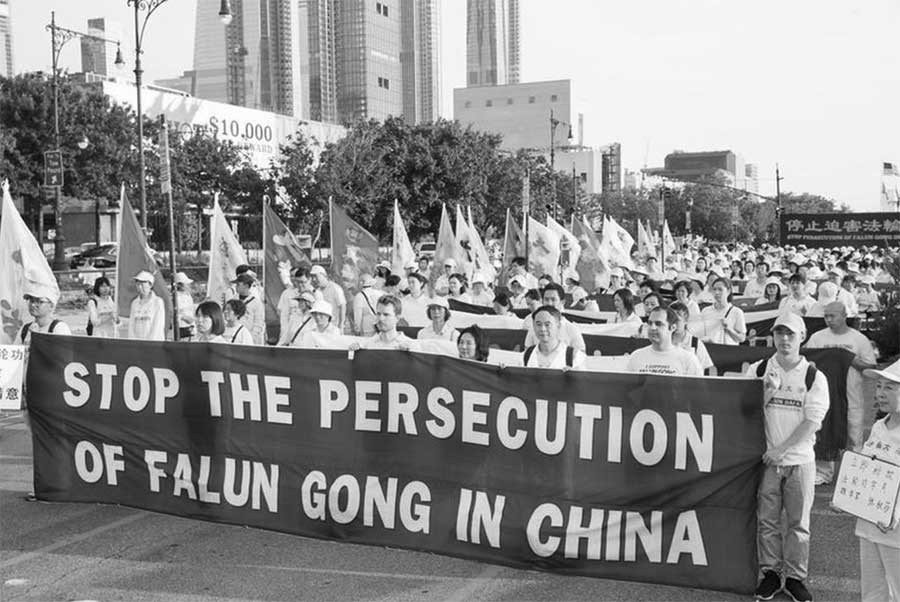
Mr. Chen waved his hand. “It’s nothing. Helping someone with a fated connection find something good is also a good deed. But you must promise me to be extremely careful and discreet in everything. These days…” He left the sentence unfinished, but we both understood.
After that, Mr. Chen gave us the address and phone number of his friend, whose name was Liu Wei, though everyone affectionately called him Uncle Liu. Mr. Chen advised us to call and make an appointment in advance and to make it clear that he had referred us. He also added that regarding the specifics of learning the exercises, we should discuss it directly with Uncle Liu. He was a long-time practitioner with a lot of experience and would surely find a suitable and safe way to help us under the current circumstances.
The meeting with Mr. Chen was brief, but it opened a crucial door. We left the teahouse with great hope. Finally, after so much searching, perhaps we were about to have direct contact with those who were truly walking the path of cultivating in Falun Dafa.
Studying the Fa, Doing the Exercises, and Integrating into the Community
Leaving the teahouse with Uncle Liu Wei’s contact information, we felt an indescribable joy and hope. That very afternoon, after returning to the hotel, Qing Ling called Uncle Liu. She carefully introduced us, mentioned that Mr. Chen had referred us, and expressed our wish to learn more about Falun Gong and the exercises. On the other end of the line, Uncle Liu’s voice sounded very warm and open, but also held a certain caution. He said he was very happy that someone wanted to learn, and after Qing Ling reiterated Mr. Chen’s introduction, Uncle Liu arranged to meet us at his home the following afternoon for a more convenient discussion. He also gave us detailed directions.
At the appointed time, we found the address Uncle Liu had given us. It was a small apartment in an old residential complex, nothing remarkable. Uncle Liu, a slender middle-aged man with a benevolent face, opened the door and welcomed us with a kind smile. After inviting us in, pouring us water, and perhaps observing that we seemed normal, he began to open up more.
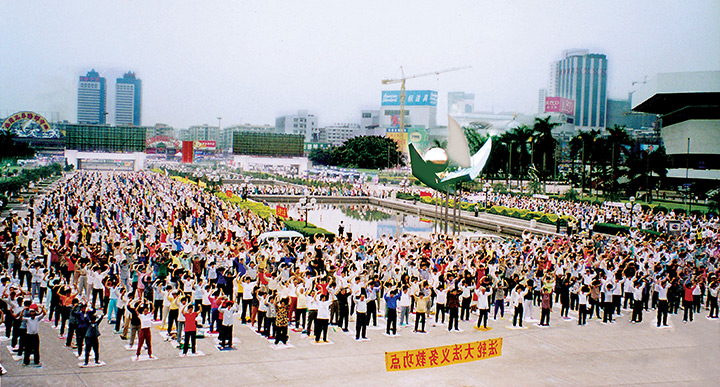
The joy and relief of finding someone who could guide us was quickly followed by Uncle Liu’s enthusiasm and sincerity. After talking with us and sensing our sincerity and eagerness to learn, Uncle Liu offered to set aside time to teach us the exercises. He said, “Doing the exercises requires quiet and concentration. I will teach the two of you privately at my home. Falun Gong has five exercises, four standing and one sitting meditation. Learning is completely free of charge; not a single cent is collected.”
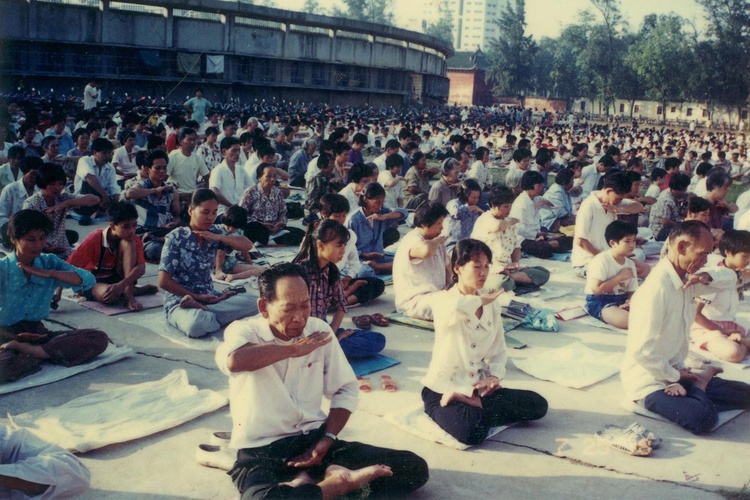
And so, our first lesson began right there in the small living room of Uncle Liu’s apartment. The space was not large, but it was very clean and quiet. Uncle Liu even invited a friend of his, another long-time practitioner, a very kind-faced elderly woman surnamed Chen (whom we would also grow very fond of), to help guide us more thoroughly. The two of them took turns demonstrating each movement of the first exercise, “Buddha Stretching a Thousand Arms.” The movements looked graceful and gentle, but when I tried them myself, I found it was not at all simple. My stiff body struggled to achieve the relaxation and softness they displayed. Especially with the stretching movements, I could clearly feel the stagnation in my seldom-used joints and muscles.
The second exercise, “Falun Standing Stance,” which involved holding the wheel posture, was a real challenge. After holding the “Holding the Wheel in Front of the Head” position for just a few minutes, my arms ached terribly, and my whole body began to tremble. I glanced at Qing Ling; she seemed to be doing a bit better than I was, but her forehead was also beaded with sweat, her brows slightly furrowed as she tried to endure. Yet, Uncle Liu and Mrs. Chen stood firm, their faces placid, as if they were holding something very light.
“Keep it up,” Mrs. Chen encouraged kindly. “Everyone is like this at the beginning. It’s a little sore, but once you get past it, you’ll feel very comfortable. What’s important is willpower.”
Their patience and goodwill moved us deeply. They showed no impatience or criticism of our clumsiness. They meticulously corrected each small posture, explained the requirements of each movement in detail, and repeated them until we had grasped the basics. Over the next few days, we regularly went to Uncle Liu’s home at the pre-arranged times to learn and do the exercises with them. Gradually, we learned all five exercises. The fifth, the sitting meditation “Strengthening Divine Powers,” which required the full- or half-lotus position, was another challenge for my stiff legs. But remembering Qing Ling’s experience and everyone’s encouragement, I tried to persevere. Though I couldn’t sit for long or completely empty my mind, I began to feel a warm flow of energy spreading through my body when I did the exercises, a strange feeling of comfort and refreshment after each session.
But practicing Falun Gong was not just about doing the movements. Uncle Liu explained to us that the core was to cultivate our mind-heart nature according to the principles of Truthfulness-Compassion-Forbearance, and that reading the book and studying the Fa were extremely important.
One afternoon, after a few days of getting to know them and doing the exercises, Uncle Liu invited us to stay for dinner and then join a group Fa-study session with a few of his other friends. “We often gather together to read the book and share our understandings in the evening. It’s just a small group, at a private home for discretion and safety. If you two don’t mind, you can stay and join us.”
This invitation made us feel very honored. We understood that in the current situation in China, inviting strangers, especially foreigners, to a group Fa-study at a private home was an act of great trust on their part.
That evening, after a simple but warm vegetarian meal at Uncle Liu’s home, a few more of his friends arrived. The small living room was tidied up again. Inside, about seven or eight people were already sitting upright on mats on the floor. Besides Uncle Liu and Mrs. Chen, there were a few new faces. There was a young man who was a taxi driver, a middle-aged woman who was a retired textile factory worker, and a man who looked weather-beaten but had very kind eyes, said to be a farmer from the suburbs who could only come in occasionally. The atmosphere in the room was very warm and somewhat solemn.
The Fa-study began. People took turns reading passages from “Zhuan Falun.” The reading was clear and reverent. Although I had read it on my own before, listening to it being read and studying with everyone in such an atmosphere, I felt the Fa principles seeping deeper into my mind. After finishing a lecture, people began to share what they had enlightened to, their experiences in cultivation, and how they had measured themselves against the Fa to overcome difficulties and conflicts in their lives, work, and families.
There were no heated debates or flowery words. Only sincerity, frankness, and a desire to improve together. One person shared how they had tried to endure being misunderstood by others; another told of how they had tried to think of others first when facing a problem. They did not hesitate to speak of their own shortcomings, their bad attachments, and how they were striving to rectify themselves according to the requirements of the Great Law. Qing Ling, with her fluency in Chinese and cultural sensitivity, also shared her initial understandings of the Fa principles and received everyone’s empathy and encouragement.
I sat and listened silently, my heart full of emotion. Here, there was no distinction between professor or worker, engineer or farmer, old or young. Everyone was equal, learning from each other, helping each other to become better on the path of cultivation. There was no form of organization, no leader, no collection of money, no worship rituals. Only the book of the Great Law and a heart that wanted to genuinely cultivate. The pure, kind atmosphere and the sincere bond between these people created an invisible but incredibly powerful spiritual strength. It was completely different from any organization, religion, or group I had ever known.
In the following days, we gradually integrated into this small but warm community. We not only studied the Fa and did the exercises with them, but also heard more stories and met more people. Each person had their own circumstances, their own fate, but all shared a common faith in Truthfulness-Compassion-Forbearance, a desire to become a better person, to return to their original, true self. This integration not only helped us understand Falun Gong more deeply but also strengthened our determination and faith in the path we had chosen. We felt that we were not alone on this journey.
Miraculous Stories and Living Testimonies
The more time we spent with the new group of practitioners at Uncle Liu’s home, the more of their personal stories we heard. These were not high-level theories or abstruse philosophies, but very ordinary life experiences that nonetheless held strange and wonderful things, living proof of the power of Falun Dafa to change people.
During the informal chats after reading the book together, or while sipping tea, people would naturally talk about their path to cultivation. What initially caught my attention, as a medical professor, were the stories of health improvements.
Mrs. Chen, the elderly woman with the kind smile we had met, had previously suffered greatly from a severe heart condition and arthritis that made it very difficult for her to walk, leaving her almost bedridden. She said her doctor had told her that her illness could only be managed with medication, and her quality of life was declining. However, since she started practicing Falun Gong a few years ago, not only did her spirits lift, but her health also improved in an unbelievable way. Now, she could walk briskly, take care of all her own needs, and even help her children with housework.
“At first, I just thought I’d practice to get healthier,” she laughed, a radiant smile unlike that of someone who had been seriously ill. “But Uncle Liu told me that to cure an illness, you have to not only do the exercises but also cultivate your heart,” she said, pointing to her chest. “You have to get rid of attachments like competitiveness, resentment, and baseless worries. I tried to follow what Master Li taught in the book, to live by Truthfulness-Compassion-Forbearance. Gradually, I felt my heart become lighter; I no longer complained about my fate or got angry with my children. And then, the illnesses just got better, I don’t even know when.”
According to what I had learned in medicine, Mrs. Chen’s recovery was almost inexplicable. But it was impossible not to believe the truth right before my eyes: an elderly woman full of vitality, with a rosy complexion, walking briskly. And she was not the only one. Mr. Li, the young taxi driver, spoke of the chronic migraines that had tormented him for years, for which no medicine had helped, severely affecting his work. Yet, after just a few months of cultivation, the headaches became less frequent and then disappeared entirely. Ms. Hong, the retired factory worker, shared how her long-term insomnia and neurasthenia were gone, helping her find joy in life again.
I listened, an inner conflict between my medical knowledge and these incredible realities stirring within me. Clearly, these cases went far beyond the explanatory power of modern medicine, which usually focuses only on the physical body. But I could not deny the health and cheerful spirit radiating from the very people telling the stories. They did not seem to be exaggerating or fabricating anything. Moreover, they all emphasized a common point: health improvements always went hand in hand with the process of improving their mind-heart nature, of living according to the principles of Truthfulness-Compassion-Forbearance. It seemed there was a very close, profound connection between one’s mental state, morality, and physical health that our science had not yet touched upon.
However, the stories that moved and impressed Qing Ling and me the most were the sharings about the changes in their moral character, in their way of life.
There was a man named Qiang, who was said to have been a heavy alcoholic and a troublemaker in the neighborhood. He recounted his unsavory past with a sincere, slightly embarrassed tone, telling of how he had made his wife and children suffer and caused his neighbors to avoid him. “Back then, I lived without thinking of tomorrow. As soon as I had money, I drank, and when I was drunk, I’d cause trouble. My wife cried more times than I can count,” he said. “Fortunately, someone introduced me to Falun Gong. Reading the book ‘Zhuan Falun,’ it was like I woke up. I understood that the cause of my suffering was the karma created from my past misdeeds, and to change, I had to cultivate my mind-heart nature and be a good person.” He said the process of quitting alcohol and changing his temperament was very difficult, but by persevering in reading the book, doing the exercises, and always reminding himself to be truthful, compassionate, and forbearing, he gradually succeeded. Now, Mr. Qiang had completely given up alcohol, become a responsible husband and father, and lived harmoniously with everyone. Looking at his gentle demeanor and modest speech now, it was hard to imagine the person he used to be.
Uncle Liu also once shared that he used to be someone who cared a lot about fame and gain at work, often calculating his own interests, and sometimes even using unfair means to compete with colleagues. “After learning the Great Law, I understood that the things ordinary people fight for their whole lives are actually just illusions,” he said with a pensive look. “What one can truly carry with them is karma and virtue. As a person, you have to live truthfully and kindly, and always think of others first in everything you do. So I changed my perspective, stopped competing, worked diligently, and treated people more sincerely. My heart became tranquil, and life felt much lighter.”
Qing Ling listened to these stories with special attention. She told me that the moral values they were practicing, such as sincerity, kindness, and forbearance, though similar to the teachings in traditional Chinese culture she had studied, were expressed here in a much more practical, specific, and systematic way. It was not just theory in books, but something each person strove to follow in every thought, word, and deed, every day.
Every story, every person we met in this small group, was a living testimony. They did not need to use any profound words to convince us. The positive changes in their health, the growth in their moral character, the peace and kindness that radiated from them were the most persuasive proof of the wonder of Falun Dafa. These stories and these people gave us more strength, solidified our faith, and encouraged us to take our first steps on the path of cultivation with greater determination.
Internalizing the Principles of Truthfulness-Compassion-Forbearance
The stories we heard about the changes in health and lifestyle were truly impressive. But what drew Qing Ling and me in and made us want to learn more was the common thread that ran through all of them: the principle of Truthfulness-Compassion-Forbearance. These three words were clearly not just a slogan, but the true foundation for all the positive changes we saw in them.
During the Fa-study sessions or when talking with Uncle Liu and the others, we didn’t hear them analyze these three words in any high-level way. Instead, we heard them recount how they had tried to measure themselves against Truthfulness-Compassion-Forbearance in very specific life situations.
We realized that, to them, Truthfulness (Zhen) was not simply about not telling lies, but also about being true to one’s own heart, being upright and not deceitful in everything one does. Mr. Qiang, the former alcoholic, shared that his first step toward change was to truthfully acknowledge his own mistakes, without evading or blaming anyone else.
Compassion (Shan), from their stories, was not just about doing ordinary good deeds. It was about tolerance, about always trying to think of others first, even when one might be at a disadvantage. Mrs. Chen told of a time when there was a mistake and she was shorted on her pension payment. Instead of getting angry or demanding it back, she thought that perhaps the other person was also facing difficulties, so she chose to let it go gracefully. “I’m cultivating Compassion; I can’t make things difficult for someone over a little money and disturb my own peace of mind,” she said with a kind smile.
And Forbearance (Ren), perhaps, was what we heard them mention most when facing difficulties. It was not a weak submission, but a remarkable inner strength. We heard Ms. Hong tell of how she had endured the ridicule of her former colleagues when they learned she practiced Falun Gong, not arguing back but just quietly doing her job well. We heard Uncle Liu tell of how he had forborne unfair situations at work in the past, not competing but seeing it as an opportunity to pay off karma and rectify himself. It seemed that, to them, every conflict, every unfavorable event, was a “test,” an occasion to practice Forbearance, to regain composure and view the problem from a cultivator’s perspective.
What particularly caught our attention was their constant emphasis on “looking inward” when encountering problems. Instead of pointing fingers and blaming others, they would turn inward and ask themselves: “Did I do something wrong?” “Do I have some bad attachment (like competitiveness, jealousy, fear…) that caused me to encounter this?” This way of looking at problems was very strange to us, and we admired it greatly. It was completely different from the common habit of always finding fault with others first.
Listening to these sincere and simple sharings, watching how they treated each other and everyone on a daily basis, Qing Ling and I gradually came to feel the depth of the principle of Truthfulness-Compassion-Forbearance. It was no longer a set of foreign words, but came alive through each person, each story. We began to look at ourselves, realizing how many shortcomings we had, how many selfish thoughts, how many hot-tempered reactions had become habits.
An urge to change, to follow these good things, began to form in our minds. We understood that the path ahead was to constantly strive to practice, to live by these three golden words. That was the true core of cultivation, the key to becoming a better person, to returning to one’s true nature. The light of Truthfulness-Compassion-Forbearance, though only just revealed through these initial experiences, was enough to illuminate our way and give us a firmer faith in the path we had chosen.
This article is an excerpt from the book “RED DUST, GOLDEN LIGHT” – which tells the story of Professor Wang Ming and his wife’s journey to uncover spiritual mysteries and many hidden truths in China.
If you wish to experience the full journey of thought and the unpublished insights of the work, please click the button below to own the complete book.
To explore more works from THE LIVES MEDIA, visit our book collection.