DAY ONE
Henry Lowell:
Good morning, Professor! Thank you so much for agreeing to make time for this interview, or rather, this conversation today. I am honored to represent the readers of THE LIVES MEDIA and to hear you share about your life, your career, or any reflections or messages you may have for our readers or the younger generation, from the perspective of an accomplished physicist and Nobel laureate.
Professor Adam:
(smiles, nodding slowly)
Good morning, Henry.
Thank you for arriving so early. I hope the morning air on this hill… isn’t so quiet it makes you drowsy.
I hear you mention the word “accomplished.” If we had met ten years ago, I might have smiled with pride. But now… I only think of one thing:
There are things I once believed to be the pinnacle, only to realize—they are merely the back of a curtain.
And that curtain… not everyone wishes to lift it.
Henry Lowell:
Yes, Professor… Personally, I find your home wonderful. It’s quite simple, but I love a place with such a tranquil setting and an open view like this. Regarding what you wish to share, I hope you will share whatever you feel needs to be shared, or what you believe would be helpful to the public. As you know from the letter I sent you, I’m not the kind of journalist who hunts for sensational scoops, digs into private lives, or seeks out meaningless, curiosity-driven topics just to attract an audience.
Professor Adam: (nods slightly, his gaze drifting out the window)
I know. And that is the only reason I agreed to meet you.
To be honest, I have declined many interview requests. Not because I am arrogant or wish to hide anything. But because… most of them only want me to repeat the things I have said before—things within the old frame of reference, where science is the center and everything else is just a “hypothesis.”
But there comes a time when I can no longer pretend I haven’t seen what I have seen.
(He pauses. Takes a sip of tea. His breath is slow. A light breeze stirs the white curtain behind him.)
So, if you ask what I want to share…
I want to share the moment I stopped explaining, and started truly seeing.
You see, people often think a physicist is someone who asks questions. But there are times when the question itself is the barrier. And in that moment—I stopped asking.
Henry Lowell:
I’m not sure I fully understand what you mean, Professor. Are you suggesting we begin with a specific topic or event that occurred, one that led to a new level of thought, a new realization or discovery for you? Or what was it you saw, specifically?
Professor Adam: (smiles, his voice deepening)
Hmm… perhaps you’re looking for a clear starting point.
If I were forced to choose one moment, one “event” powerful enough to make me re-examine my entire system of thought… it wasn’t when I read a strange book, or met an Eastern master, or found convincing proof that modern physics was wrong.
No. It was much simpler than that.
It was… an unremarkable evening.
(He leans back slightly in his chair, his eyes closing for a moment as if watching a film in his memory.)
That day, I was simply sitting. Not researching, not formally meditating, not expecting anything.
But I remember it so clearly:
I no longer felt that I was “sitting.”
The space around me… didn’t change, yet I was no longer within the concept of “here.”
And then I saw—as clear and bright as day—an image I never thought I would encounter in my life.
(The Professor pauses. Silence. The wind brushes past the blades of grass beneath the porch. Even the distant birdsong seems to fall quiet for a moment.)
A being—stood there.
Not dazzling, not thundering, but his entire form emanated a light that wasn’t blinding, wasn’t hot, yet it pierced through every layer of thought.
I knew, instantly, that it was the Lord.
There was no need for explanation. No argument accompanied it. It was simply a knowing—deep, certain, absolute.
And He spoke—not through sound, but like a stream of thought transmitted directly into me:
“When you stop trying to understand, you will see.”
From that moment on, everything I had ever taught, ever written, ever believed… wasn’t negated. But it became… no longer enough.
Henry Lowell:
Oh, so you mean a spiritual event happened to you, and you met the Lord? Could you share more about that event? And from that point on… did anything in your perspective change distinctly?
Professor Adam: (nods slightly, his voice slow and steady)
Yes. It was a… spiritual event.
Though I know that just by saying those two words, half of those in academia who once admired me will turn their backs.
But the truth does not need to be accepted to exist. It only needs to be witnessed.
And that day, I witnessed.
(The Professor leans forward slightly, as if to regain the thread of a memory that is flowing back.)
I was sitting, as I often did each evening, on the wooden chair on the porch—right in this very spot. You see?
(He points out the glass window—where early morning clouds are drifting gently past the mountainside.)
There was no strange light. No heavenly music. No hallucinations.
But just in that moment… I felt as if I slipped out of my physical skin.
And then, I saw a space—with no walls, no roof, no floor—but there was light.
A light that did not reflect, did not emanate from anywhere, yet was present everywhere, so pure it made me feel transparent.
At the center of that light was an image—a figure, standing still, needing no words.
I recognized it was the Lord.
Not because I had studied religious doctrine, but because that presence carried a layer of meaning that no language could conceal or describe.
I felt… as if I were seen through completely, yet felt no shame.
I felt… as if I were forgiven before I had even erred.
And at the same time… I felt that I had never left Him.
(The Professor pauses for a moment. His voice seems to tremble slightly—not from emotion, but from the echo of something too real.)
And from that moment on…
I no longer tried to “understand the universe.”
I began to learn how to be present in it.
I no longer pursued the light.
I learned to see from behind it.
(He looks up at Henry. For the first time in the conversation, their eyes meet—not as a journalist and an interviewee, but as two beings recognizing some faint point of intersection… amidst the waves of life.)
Henry Lowell:
Yes, I can feel that the moment was very sacred and a blessing for you… I’ve read many accounts and religious texts on this subject. I haven’t experienced it directly, but I believe such events are real. I imagine not everyone has the grace to meet the Lord as you did. Besides the message you mentioned, did the Lord convey any other messages for you personally, or through you for the world?
Professor Adam: (bows his head slightly, silent for a long moment)
Yes…
You are right—not everyone has that grace.
But I also don’t think He chose me because I was worthy.
Perhaps… it was precisely because I had gone too far in the direction of reason that I needed a bell loud enough to make me stop.
And that light—it did not come to bestow a reward.
It came to remind.
(The Professor looks up. The early morning light slants through the glass, casting a soft glow on his cheek, making his features at once bright and solemn.)
As for the message…
He did not speak as the prophets do in the scriptures.
There were no commandments, no revelations, no prophecies.
But I perceived one thing very clearly—not with my ears, but as if the very structure of my consciousness was “implanted” with a new understanding.
And it was simply this:
“Salvation comes not from understanding, but from returning.”
Returning to what?
Not to a church. Not to a dogma.
But returning to the most primordial nature—the state where a person knows shame when doing wrong, knows silence in the face of beauty, and knows how to shed tears without reason.
(The Professor pauses. A leaf falls past the window. He watches it drift silently to the ground without turning his head.)
He did not tell me what I must say to the world.
But I know this:
If there is one thing I should do before I leave this mortal realm, it is to recount that moment—with absolute honesty.
Not to prove anything.
But simply to reopen a door that so many have closed, not knowing that… behind it, is their own self.
Henry Lowell:
Yes, for a physicist, such a spiritual experience would, by common logic, be a blow to atheism, wouldn’t it? Before meeting the Lord, were you an atheist? Or were you a religious believer?
Professor Adam: (nods gently, his hands clasped in his lap, his gaze directed not at Henry, but toward a memory that seems more distant than time itself)
You’ve asked the right question.
I was not a believer.
I was a physicist in the truest sense… not just of the rationalist school, but almost completely atheistic.
Not because I hated religion or rejected faith.
But because… I had no place for it in my equations.
I used to believe that if it couldn’t be measured, it wasn’t worth believing.
If it couldn’t be replicated under controlled conditions, it was just a story.
And that was the cage I used to live in.
(He looks out the window, his gaze deep but not sad.)
When a person places so much faith in formulas and laws that they exclude all possibilities beyond their scope of measurement, they are not doing science—they are confining themselves within an invisible belief.
I once held that belief.
I used to think it was “science,” but now I know: it is also a form of creed—only one without a God.
So, yes—when I met Him, I did not feel offended, I did not feel confused. I only felt…
very small.
Not because I was wrong.
But because I… had never been broad enough to see that truth does not need to reside in a laboratory.
And the strangest thing is this:
The moment I accepted that I did not know everything—the truth began to reveal itself.
Henry Lowell:
Yes, as a freelance journalist who travels here and there, I’ve had many opportunities to meet people from different positions, cultures, levels of knowledge, and religious beliefs… So I can somewhat understand your situation, Professor. It’s possible that what we once considered truth, the highest achievement, can suddenly seem small or flawed when our mindset and entire system of thought shift.
Professor Adam: (turns to look at Henry, this time with a warmer gaze, as if having found a rare note of empathy)
I appreciate that, Henry.
Not many in the media world are willing to pause to understand—instead of reacting, analyzing, or chasing a headline.
Yes… it is just as you say.
There are things we once saw as solid as laws of nature, which turn out to be merely the peak of a small hill—that we had mistaken for a mountain.
When I stood at the “pinnacle” of my career—where people gave me titles like “great thinker,” “icon of science”… I used to believe I could see further than most of humanity.
But in truth, I was only standing on the shoulders of limitations I dared not admit.
And then… a ray of light—not from a laboratory flashlight, but from a depth I had never defined—shattered that entire structure.
Not with a crash. Not with drama.
Just a silence so real that all assumptions no longer had a place to stand.
(The Professor leans back gently, his eyes gazing into the distance as if the story has not yet left him.)
You know…
Science is a wondrous thing—if we use it as a lantern to light the way.
But if we turn it into a dividing wall, the light from the other side will never get through.
And it was precisely when I put that lantern down…
that I truly began to see the light that doesn’t emanate from any source.
Henry Lowell:
Yes, I remember a very famous quote by Newton, where he said something to the effect of, “What we know is a drop, what we don’t know is an ocean.” I understand that statement to contain both humility and a brilliant, open perspective for welcoming new, undiscovered truths. But modern empirical science seems to have gone to an extreme, believing only in what can be verified by experiment. What cannot yet be verified is often explained away superficially or denied, labeled as “superstition.”
In your opinion, Professor, through the spiritual experience you described, and through your shift toward exploring a spiritual or broader path, as I understand it, do you see modern science as boxing itself in?
Professor Adam: (exhales softly, his gaze still fixed on the misty sky in the distance)
Yes… Newton said that, and I believe… he wasn’t just being humble; he was pointing out a very real limit of human perception.
And for that very reason, I feel even more troubled when I see modern science—instead of continuing in that open-minded spirit—shrinking back into its own shell.
Henry, if you say “empirical science is boxing itself in”—I would not object.
But I want to be more specific:
Modern science is not wrong because it doesn’t know everything. It is wrong when it assumes that what it does not yet know does not exist.
(His voice is not harsh, but gentle, like a sigh that has been held back for too long.)
Since when did we begin to believe that only the verifiable is truth?
Since when did we start teaching students that if it cannot be measured, it is not worth our attention?
Meanwhile, the history of science—from Newton himself, Galileo, to Tesla—all began with intuitions that no device at the time could verify.
And now, when people encounter a phenomenon that science cannot yet explain, instead of being silent and continuing to observe—they immediately file it away in the drawer of “superstition, delusion, and illogic.”
In truth, that is not the scientific spirit. That is the fear of losing control.
(He turns his head, his eyes looking directly at Henry—a gaze not sharp, but deep and calm like an undisturbed lake.)
I was once part of that system.
And I understand: not everyone wants to step out.
Because when you step out of the framework of measurement, you are no longer “part of the system”—no longer getting a pat on the back at conferences, no longer being cited in journals.
But… if one day you get to see what I have seen,
you will understand:
No glory is worth trading for the truth.
Henry Lowell:
Yes, I understand that your worldview is now based on a new frame of reference, one that is no longer that of a Nobel laureate. So what should I call you now? A religious believer? A cultivator (a practitioner)? Or a spiritual master? And with this new worldview, I assume you will have many completely new perspectives or discoveries compared to before. What would you like to begin sharing from this new perspective?
For example, do you still see Einstein’s theory of relativity as correct in this new frame of reference? Or what are your thoughts on the universe, on extraterrestrial beings? Could you open up each of these angles for me and the readers of THE LIVES MEDIA?
Professor Adam: (smiles faintly, gentle but not evasive)
You ask what I should be called?
To be honest, Henry… that is a question I have asked myself—many times.
After that experience, I no longer felt comfortable when someone called me a “renowned scientist,” but I also didn’t dare call myself a “cultivator,” and certainly not a “spiritual master.”
I once lived in the frame of reference of science, and then I stepped out—but not to join a new one.
I did not switch from physics to religion, from the laboratory to the meditation hall.
I simply… took a step back, and looked at both.
(He pauses for a few seconds, as if to let that sentence settle where it needs to.)
So you can call me whatever you wish. But if I had to choose, I would want to be a witness.
Not an explainer. Not a preacher.
Just someone who saw something, and is recounting it—truthfully.
(He takes a sip of tea. The wind from the mountainside carries the scent of the morning sun and a faint, woody aroma from the porch.)
As for the new worldview…
Yes, it changes many things—not by negating the old, but by re-asking the fundamental questions.
You just mentioned Einstein’s theory of relativity.
Correct—I used to teach it, used to rely on it to write dozens of papers. And I still believe it is correct…
but correct within the frame of reference of three-dimensional space, linear time, and the limits of physical perception.
But now, I know that:
There are dimensions of space where the speed of light is no longer the limit.
There are spaces where time does not flow, but coils and twists.
There are beings who do not need to travel by distance, but by the vibrational frequency of thought.
So, if Einstein had lived longer, if he had had the chance to see what I have seen…
Perhaps he would have written a new chapter for his Theory of Relativity—the Relativity of the Perceptual Plane.
The universe?
Not a ball that exploded and is gradually expanding.
But a layered structure of consciousness—the deeper you go, the more profound the realities you encounter, and the more ancient the beings.
Extraterrestrial beings?
They don’t come from other planets.
But from a dimension right next to ours, a place you can cross with just a single shift in the beat of thought.
And the greatest danger is not that they are here—but that we do not know we are being watched.
But… that is a story for later.
If you wish, we can unravel each layer, one by one.
I don’t have all the answers—but I have fragments of memory, and a few silences that I believe…
we should walk through together.
Henry Lowell:
Alright, I will continue to call you “Professor”… You just mentioned that the speed of light is no longer a limiting constant… it seems it’s quite relative when viewed from different frames of reference? I recall reading somewhere that time on a spacecraft seems to be slower compared to time on Earth… and if time is a relative concept, then velocity and even spatial distance also seem to be relative concepts, which would mean the speed of light isn’t an immutable constant, correct? Would you please elaborate on this detail first? We can move on to other topics afterward…
Professor Adam: (nods slowly, a hint of satisfaction in his eyes)
Yes… you have just touched upon one of the key points that many in the scientific community—even physics lecturers—acknowledge in theory but forget in the practice of perception.
The speed of light, as you say, is not truly an absolute constant.
In the theory of special relativity, Einstein defined it as such:
The speed of light in a vacuum is constant—when measured from an inertial frame of reference.
But… “constant” here does not mean it is immutable across all planes of reality.
It is only constant within the set of conditions that the theory permits.
(The Professor raises his hand, as if drawing an invisible coordinate axis in the air.)
Imagine this:
If the entire physical world we live in is a single plane, Plane A, then the laws of physics—including the speed of light—only apply strictly within that plane.
But when you step into another plane—another dimension, where the spacetime structure is distorted or has a different vibrational frequency—then concepts like “distance,” “time,” or “velocity” no longer hold their original definitions.
In another spatial plane that I was once able to perceive,
light doesn’t need to “travel”—it simply “is present.”
It doesn’t propagate at a certain speed like a wave—but is simultaneously present at its destination the moment the thought originates.
In that case, the concept of “velocity” collapses.
Because when time is a form of consciousness, velocity is merely the rate of change of an illusion.
(He pauses, placing his teacup on the table, his voice slowing as if drawing from a deeper part of his experience.)
The speed of light is merely a limit within three-dimensional space and linear consciousness.
But within a multi-dimensional structure of perception,
light is just a lower manifestation of a much higher form of transmissive crystal—what some ancient wisdom traditions refer to as “luminous conveyance.”
And I believe… that is why the flying saucers observed by humanity do not move like aircraft—but seem to “leapfrog” through space.
They do not accelerate beyond the speed of light.
They bypass the concept of speed—by leaving the frame of reference of light.
If needed, I can illustrate further with personal experience—or a few hypotheses that have been overlooked in the history of physics.
But first, perhaps you should tell me:
Am I going too far for the readers of THE LIVES MEDIA?
(…..)
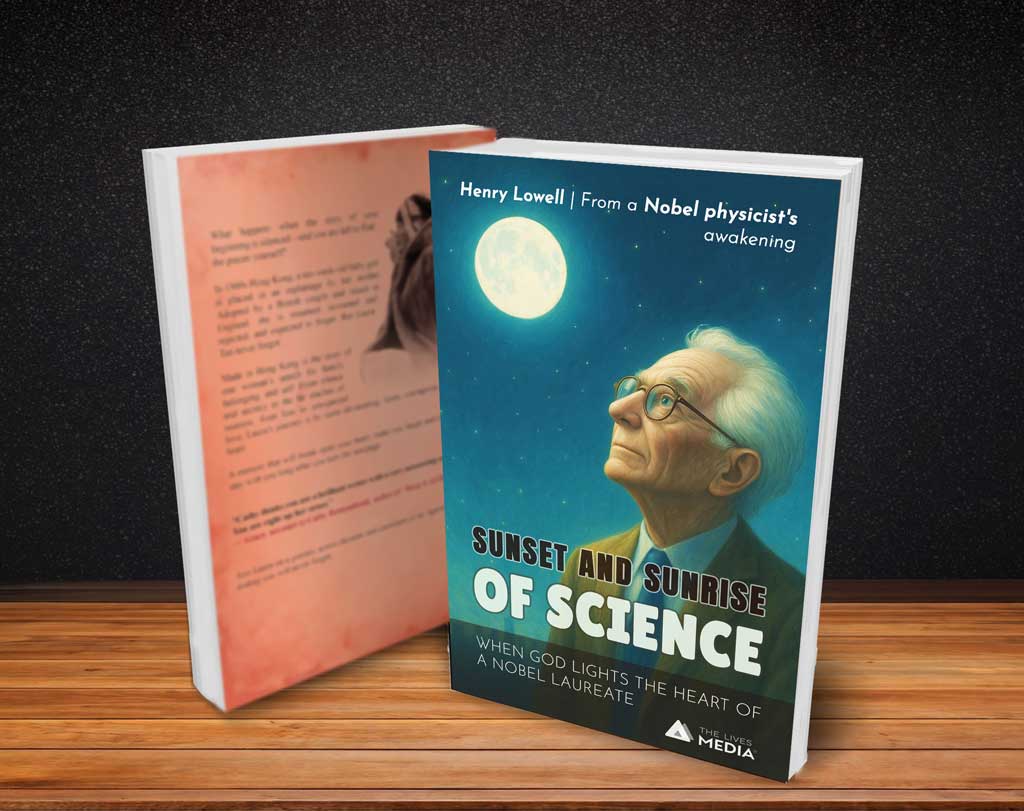
This article is an excerpt from the book “SUNSET AND SUNRISE OF SCIENCE” – a vision that transcends conventional dialectical thinking to embrace revelations from God.
If you wish to experience the full journey of thought and the unpublished insights of the work, please click the button below to own the complete book.
To explore more works from THE LIVES MEDIA, visit our book collection.