DAY FOUR
Avery Lin:
Hello again, Uncle Ma…
Yesterday, I had the chance to hear your recollections from 1996 to 1999—that is, from the moment you encountered Dafa until just before the persecution began…
Today, would you continue sharing about the atmosphere right before the “storm,” and your journey afterward? Would that be alright?
Ma Changsheng:
(Uncle Ma smiled gently, his eyes still holding that calm, profound gaze. He nodded softly.)
Hello, Avery Lin. Please, have a seat. I was just waiting for you.
Yes, yesterday we talked about a truly special time, those years when the light of Dafa illuminated countless hearts and gave them a path forward.
(Uncle let out a gentle sigh. A glimmer of nostalgia passed through his eyes—not of sorrow, but of deep appreciation for the past.)
You want to hear about the time before the “storm” and what followed… Very well.
That was a period when even heaven and earth seemed to shift, and people were tested in profound ways.
To help you understand, before the gale struck, the atmosphere in China toward those of us cultivating Dafa… you know, it used to be very different.
(Uncle paused for a moment, as if gathering the vivid memories.)
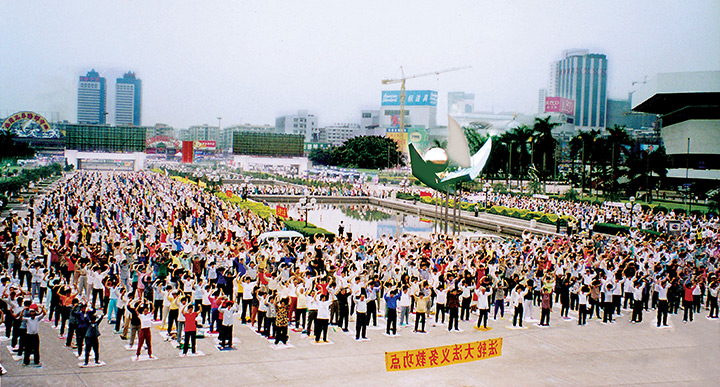
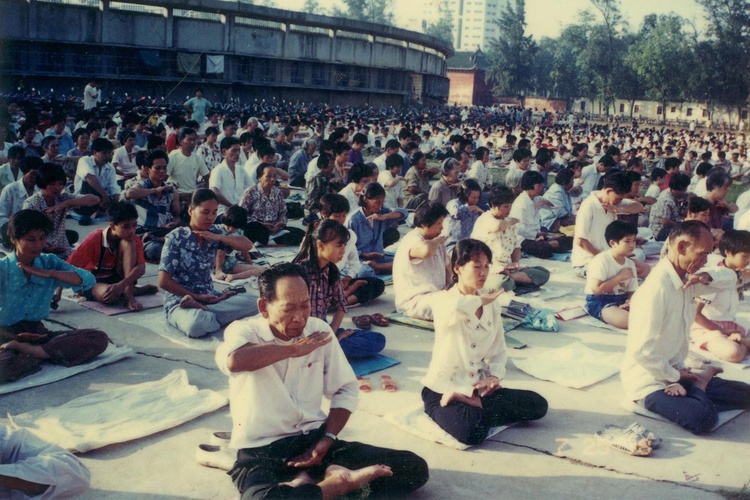
Before 1999—especially from around 1994 or 1995 onward—Falun Dafa was widely spread.
From cities to countryside, from intellectuals to working-class people, you could see people practicing everywhere.
Practice sites sprang up in public parks, gardens, schoolyards…
Every morning and evening, the music for the exercises would echo gently as people moved slowly, gracefully, and peacefully.
It had become a beautiful part of daily life for many.
What I found most precious was the change from within.
People learned to live by the principles of Truthfulness-Compassion-Forbearance.
They began thinking of others first.
Conflicts within families and in society began to dissolve naturally.
Health improved significantly—many people who had been deemed incurable regained their vitality.
There were no campaigns, no pressure—everything was voluntary, born of real experience and the benefits Dafa brought into their lives.
Even local authorities at the time had a generally positive view.
They saw citizens becoming healthier, society becoming more stable, healthcare burdens decreasing…
There were commendations, articles of praise in the media.
Everything seemed to be moving in a very wholesome, positive direction.
(Uncle Ma slowly shook his head, a shadow of concern briefly crossing his face.)
But then… dark clouds began to gather.
At first, they were just faint wisps, but they gradually amassed—foreshadowing the coming storm.
Would you like to hear about those early signs, before we talk about the “storm” itself and what happened afterward?
Avery Lin:
Yes, could you tell me how you and those around you felt at the time?
Ma Changsheng:
Yes, speaking of our mindset and emotions back then… there were many layers to it, Avery Lin.
When the first signs appeared—like some local newspapers publishing distorted, slanderous content about Falun Gong—many of us were initially surprised, even disbelieving.
Because we knew exactly what we were practicing.
We knew Falun Gong taught people to be kind, to be better human beings, and it brought peace and health to society.
Many of us thought it must be a misunderstanding by a few reporters, or that someone who didn’t understand had written things that weren’t true.
Most practitioners at that time were still very open-minded and good-natured.
We believed in the goodness of people.
We believed that if we were sincere and kind, the misunderstandings would naturally be resolved.
So, when those articles appeared, the natural reaction for many was to visit the newspaper offices or write letters to relevant departments, explaining the truth—what Falun Gong was, the benefits it brought.
It was all done peacefully, with one single hope: that people would understand the truth.
Many of us, including myself, continued to practice daily in the parks, to study the Fa together.
Our faith in Master and in Dafa was unwavering.
We believed that Truthfulness-Compassion-Forbearance are universal values—they couldn’t possibly be wrong.
At times, we even thought, perhaps this is just a test—to see whether we, as cultivators, could remain steadfast and compassionate in the face of false words.
However, Avery Lin, as such incidents increased, as secret instructions began circulating from higher levels telling workplaces and agencies to “keep an eye on” Falun Gong practitioners,
some people—especially older ones who had lived through past political campaigns—began to feel a growing unease.
They sensed something unusual was happening.
In our Fa study groups, we began quietly discussing these concerns,
but overall, our faith in the righteousness of Dafa remained firm.
As for me personally, given all I’d experienced and enlightened to from the Fa, I began to sense a field of negative energy forming.
I understood that anything truly good being spread in this world—especially in this End Time—would attract tribulations, would be interfered with by old forces that don’t want humanity to be saved.
I tried to keep calm, to observe, and to remind myself and fellow practitioners to become even more diligent, to truly take the Fa as our teacher, and to measure all our actions against Truthfulness-Compassion-Forbearance.
Emotionally, it was a mix.
There was the calm faith of a cultivator, but also some sorrow at seeing something so good being misunderstood and deliberately twisted.
But never did we feel fear or consider retaliating with force.
Our only weapon was kindness—and the truth.
That was the time just before the “storm” truly hit—
a time when innocence and strong faith still prevailed, even as unsettling waves had begun to stir.
Avery Lin:
According to the historical information I’ve read, the situation back then was extremely tense, leading to the peaceful appeal of tens of thousands of people outside Zhongnanhai.
Later, the CCP used that incident as one of their excuses, claiming that “Falun Gong surrounded Zhongnanhai” with alleged rebellious intent…
What were your thoughts at the time, and did you take part in that peaceful appeal?
Ma Changsheng:
(Uncle Ma nodded, his expression growing more serious.)
Yes, Avery Lin, you’re right. The April 25, 1999 incident was a turning point—a moment after which everything began to change rapidly.
Before that, as I mentioned, there had already been smear campaigns and covert interference.
But the real escalation began with a slanderous article written by a scholar named He Zuoxiu, published in a youth science magazine in Tianjin.
Some practitioners in Tianjin went to the magazine’s office to clarify the facts in a peaceful manner.
All they hoped for was a retraction, to restore the reputation of Falun Gong.
But instead of engaging in dialogue, the Tianjin authorities deployed riot police, who beat and arrested some practitioners.
When others went to request their release, Tianjin police told them that the arrest order had come from Beijing, and that if they wanted to resolve the issue, they should go to Beijing and file their complaints there.
That one sentence, combined with the unjust arrests, made many feel they could no longer remain silent.
As cultivators, we had no political ambitions, no desire to oppose anyone.
We simply wanted a lawful and free environment to practice, to become better people following Truthfulness-Compassion-Forbearance, and to see our Teacher treated with respect, and Dafa books published legally.
When news of the Tianjin incident spread, many practitioners—including myself—felt a responsibility to speak out peacefully.
There was no organization, no formal call to action.
It was a spontaneous response, driven by conscience and the belief that the government would listen to the people’s legitimate concerns.
(Uncle Ma paused, his gaze distant.)
That day, I was also in Beijing, near the National Petition Office, which we had learned was the proper place to voice our concerns.
I joined thousands—tens of thousands—of practitioners from all over.
What struck me most, and what was later most severely distorted, was the extraordinary calm and order of the crowd.
We stood silently on the sidewalks, along the streets, under the guidance of the police.
There were no slogans, no provocative banners, no pushing, no traffic obstruction.
Everyone acted conscientiously—even picking up cigarette butts discarded by officers.
Many brought Dafa books and read quietly.
The atmosphere was serene and dignified.
There was only one goal: to have a conversation, to present the truth.
The so-called “siege of Zhongnanhai” that they later broadcast so widely, Avery Lin, was a complete fabrication and distortion.
Zhongnanhai is the central government compound—highly sensitive.
Not a single practitioner had any intention to “surround” it.
We stood only where the police directed us, far from the main gates.
Moreover, if we had truly intended to “siege” it as they claimed, given the CCP’s nature, would they have allowed tens of thousands of people to stand there for an entire day without being violently suppressed?
Our intentions were simple:
- Release the unlawfully detained practitioners in Tianjin.
- Allow legal publication of Falun Gong books.
- Ensure a lawful, interference-free environment for practitioners.
That day, Premier Zhu Rongji came out to speak with a few representatives.
Afterward, the detained practitioners were released, and things seemed to calm down temporarily.
Everyone quietly left the area, even cleaning up every bit of trash—leaving not a single scrap behind.
At that moment, I and many others held a flicker of hope—that our peaceful sincerity had been heard, and the government might view us more fairly.
But deep down, with what I knew of the regime’s true nature, I also sensed that this might only be the calm before a far greater storm.
Because the rapid growth and spiritual values Dafa brought—completely at odds with their atheist, struggle-based ideology—had stirred deep jealousy and fear in certain powerful figures.
They could not tolerate such a large group of people believing in divine beings, upholding Truthfulness-Compassion-Forbearance—concepts they dismissed as “superstition” and threats to ideological control.
The excuse of “surrounding Zhongnanhai” was just one of countless lies fabricated to justify a brutal persecution they had already been secretly planning.
Avery Lin:
Then could you share some scenes or specific events you personally witnessed when the persecution officially began?
Ma Changsheng:
(A moment of silence. His eyes drifted far away, as if returning to those turbulent days. His voice grew heavier.)
When the persecution officially began on July 20, 1999, Avery Lin, it felt like the sky had fallen.
Everything changed overnight.
The faint hope we had after April 25 suddenly turned into a suffocating nightmare.
I remember vividly—on that morning, and for many days thereafter—every national and local TV channel, every radio station, every newspaper, began broadcasting slanderous, venomous content attacking Falun Gong and our Teacher.
Vicious words, outright lies, edited footage—repeated around the clock.
Society’s atmosphere instantly turned oppressive, suspicious, hostile.
Neighbors, coworkers, even family members—those who once praised Falun Gong—now began to look at us differently.
Some were afraid.
Some kept their distance.
Some, believing the propaganda, even turned critical.
It felt like the whole world had turned against us.
One scene I’ll never forget was when key volunteer coordinators—the ones who selflessly ran our practice sites—suddenly disappeared.
Word spread quickly among practitioners: so-and-so had been taken overnight, another was summoned by police and never returned.
I personally witnessed police storming the home of a fellow practitioner—a local volunteer.
It was around 2 or 3 a.m.
Loud pounding on the door, harsh shouting, a child crying, the wife pleading…
They ransacked the home, confiscated Dafa books and Teacher’s photo, then handcuffed him and dragged him away.
The flashing lights of the police car vanished into the night, leaving behind an eerie silence and a lasting sense of terror.
We realized this was no longer a misunderstanding.
This was an organized, deliberate crackdown.
The parks and plazas where we once joyfully practiced together each morning were now guarded.
Police, security patrols stationed everywhere.
Anyone approaching would be driven away, identified, even arrested if they tried to practice.
The Dafa books we cherished like life, the gentle music of the exercises—they suddenly became “contraband.”
Many homes were raided by police and local officials.
Some tried to explain, others wept as books were stuffed violently into sacks.
We were forced to surrender our books, to sign statements renouncing our practice—under threat of losing our jobs, our children being barred from school, and our families being implicated.
Immense pressure fell upon each individual, each family.
Many who had only sought better health and peace of mind were suddenly forced to choose between their faith and their everyday safety; between truth and temporary survival.
Those were days of fear, confusion, pain—and a silent yet powerful indignation.
I, like so many fellow practitioners, felt tremendous sorrow.
Sorrow for our Teacher being vilified.
Sorrow for Dafa being slandered.
Sorrow for the people deceived by such vicious propaganda.
Yet deep within, our faith in Truthfulness-Compassion-Forbearance, in the righteousness of Dafa, remained unshaken.
I knew—this was the greatest test.
The tribulation that every cultivator must face.
And no matter how hard it got, we had to hold firm to compassion, and use the truth to counter every lie.
Avery Lin:
That scene sounds truly terrifying…
So at that time, were you personally harassed by the police?
Ma Changsheng:
(Nods slightly, a faint smile crosses his face, though it cannot mask the gravity of the memories.)
Yes, Avery Lin. During that storm, who among the practitioners of Falun Dafa wasn’t given “special attention” by the authorities or police? I was no exception.
After the ban was issued, it wasn’t long before I received an “invitation” from the local police station, and later the district police. They didn’t call it a “summons” to arrest me right away, but used softer terms like “come in for a conversation,” or “clarify some matters.” But everyone knew the implications behind those words.
I remember once they held me at the station for an entire day. In a small office, several officers took turns “talking” to me. They started off mildly, asking when I began practicing Falun Dafa, whether I’d benefited from it, and gradually shifted toward requiring me to recognize the so-called “reactionary and superstitious nature” of Falun Gong, in line with the state’s propaganda. They handed me pre-prepared materials—slanderous articles—and asked me to read and “raise my awareness.”
(Uncle Ma pauses, takes a small sip of the tea Avery had poured, then continues.)
My mind was very calm at that time. I thought, this is my chance to speak the truth, to help them understand. I gently explained that Falun Dafa teaches people to be good through Truthfulness-Compassion-Forbearance, that it improves health and elevates moral character, and that it has no political motive whatsoever. I told them about the benefits my family and I had experienced, and the positive changes the practice had brought to society. I said what the TV and newspapers were saying was not the truth—it was slander.
Some of the younger officers just listened silently. I sensed a bit of curiosity in their eyes, even slight wavering. But others, especially older ones or those who seemed very “firm in ideology,” dismissed it all, saying I had been “deceived” or “brainwashed.” They demanded I sign a pledge to renounce Falun Gong, turn over my books and materials, and promise not to contact other practitioners, not to practice or “spread” the practice anymore.
I told them, “Officers, Truthfulness-Compassion-Forbearance are noble values that everyone should strive for. Falun Dafa teaches us to live by those principles, to be better and healthier people. What’s wrong with that? If you ask me to renounce Truthfulness-Compassion-Forbearance, to stop trying to be a good person, I simply cannot do it. The Dafa books are precious teachings that help me understand the meaning of life—I cannot hand them over.”
They changed tactics many times, from being soft to making threats.
They said if I didn’t cooperate, I could lose my job, my children could be affected, or I could be sent to “reeducation through labor.” Those threats, Avery Lin, carried real weight—especially when you have a family and loved ones to worry about.
But each time, I recalled Master’s teachings and the sacrifices of so many fellow practitioners. I told myself, as a cultivator, I must face this trial with uprightness and kindness. Fear would not solve anything; it would only embolden the evil.
There were also workplace officials, and the neighborhood committee head, tasked with “persuading” and “guiding” me. Some carried out orders mechanically, others appeared sympathetic and whispered, “Just try to get through this period—practice at home if you must, but don’t go outside.” I understood their dilemma.
As a result of those “conversations,” I was labeled a “special subject for surveillance.”
They didn’t arrest me outright—maybe because I wasn’t a lead coordinator, and my responses were always calm and reasonable, giving them no excuse for immediate action. But life was no longer peaceful.
I constantly felt watched, monitored.
Those were my early experiences when the persecution began. Compared to what many other practitioners endured—being arrested, tortured, imprisoned, even losing their lives—what I went through was relatively light.
But it was enough for me to understand the brutality and absurdity of this persecution.
Avery Lin:
From the information I’ve read, things became increasingly tense at that time. Some practitioners even went to Tiananmen Square to protest…
Did you witness that?
Ma Changsheng:
(Slow nod, a deep sorrow flickering in his eyes.)
Yes, Avery Lin.
When all avenues of peaceful dialogue were blocked, when every effort to clarify the truth to the authorities was shut down, when slander and vilification grew rampant in the state-run media, and when more and more practitioners were arrested, beaten, even brutally tortured just for not renouncing their faith, some chose to go to Tiananmen Square to make their voices heard.
It was an act born of desperation—but also of courage and unwavering faith in Truthfulness-Compassion-Forbearance.
They didn’t go to stir up trouble, or to overthrow anyone.
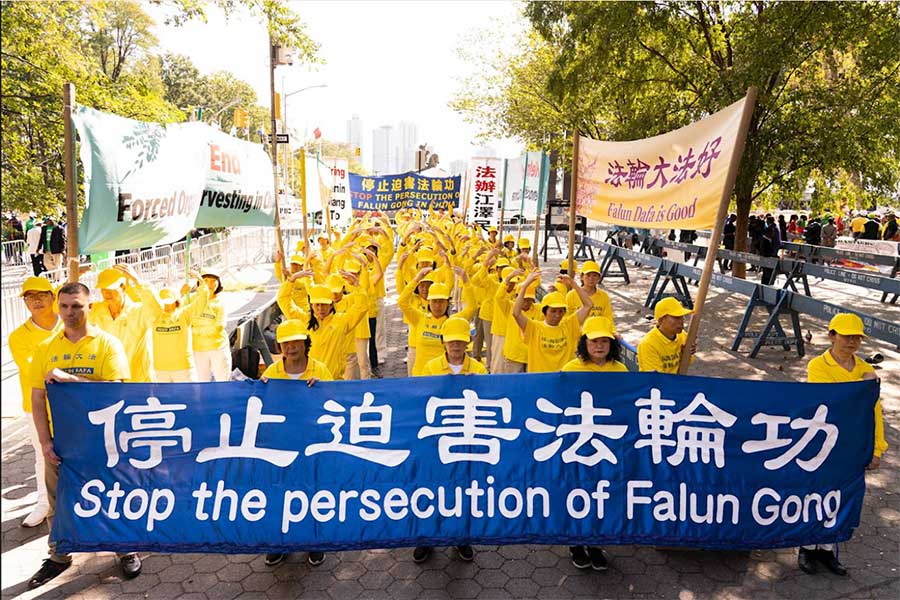
They only wanted to say to the world, to the people of China, “Falun Dafa is good!”, “Truthfulness-Compassion-Forbearance is good!”, and to call for an end to the unjust persecution.
Many carried small handwritten banners, or simply sat in meditation.
(Uncle Ma pauses, as if reliving the memory.)
I… I was there too, Avery Lin, on a few occasions.
I couldn’t just stand by while my fellow practitioners were being persecuted.
Even knowing it was an extremely dangerous place, where any “unusual behavior” would be immediately suppressed.
I remember one particular day very clearly.
That day, as usual, I wore my monk’s robe and had a shaved head.
From the time I was ordained until I obtained the Fa, I had kept the appearance and lifestyle of a monastic.
When I approached the square with a small group of practitioners, we hadn’t even done anything yet when police and plainclothes agents swarmed us.
They rushed in, shoving and violently arresting practitioners around me.
There was shouting, chaos.
I braced myself, expecting to be taken too.
But then some officers approached me, one of them stared at my robes and shaved head, and suddenly waved his hand and barked, “Let the monk through! This has nothing to do with you—go on!”
Another officer chimed in, “Let that monk go—don’t bother him!”
They assumed I was a monk from some local temple, unrelated to Falun Gong—so they let me go.
In that moment, Avery Lin, I felt a sorrow that’s hard to put into words.
I was “spared” not because they respected me, but because they had mistaken me—because they didn’t realize I too was a Falun Dafa practitioner, standing there with my fellow cultivators.
I wanted to say, “I am also a Falun Gong practitioner!”
But the others were already being dragged off too quickly, and the scene was too chaotic.
I just stood there, watching their backs fade into the crowd, my heart twisting in anguish.
The scenes at Tiananmen Square during those days were heartbreaking.
Peaceful practitioners, unarmed, only wanting to speak one honest sentence, were treated like dangerous criminals.
They were beaten, shoved into police vans, and then came days—weeks—of detention, torture in police stations, detention centers, labor camps.
Many never returned.
Each time I witnessed or heard about these events, I understood more deeply the true evil of the persecution—and the greatness of those practitioners who dared to stand up for their faith, for the truth, even at the cost of their freedom and their lives.
They were true cultivators of Truthfulness-Compassion-Forbearance.
Avery Lin:
Under such tremendous pressure from the persecution, the environment for cultivation must have completely changed…
How did you study the Fa and do the exercises back then? I assume going to the park wasn’t an option anymore… And spreading the Fa must have become even more difficult…
Ma Changsheng:
(Nods, his eyes gazing into the distance, carrying a deep and quiet sorrow.)
That’s right, Avery Lin. You’re absolutely right. From an open, public environment for cultivation—one that was even viewed positively by society—we were suddenly pushed into the shadows, hunted, and treated like enemies. The cultivation environment changed completely, just as you said—180 degrees.
As for Fa study and doing the exercises, going to parks or public places was no longer possible. Those places were now guarded by police and local security. Anyone showing signs of doing the exercises would be immediately stopped or arrested.
The Dafa books, especially Zhuan Falun, were as precious to us as life itself. Many had to hide them very carefully, because if found, the police would confiscate them instantly. Often, those confiscated books were destroyed in offensive, humiliating ways.
You know, Avery Lin, for those who still managed to keep their books, they only dared to read them at home—usually late at night or during the most discreet moments. Group Fa study had to move underground. Only those truly trusted would gather, usually at someone’s home, in small groups of just a few people, to read the Fa and share understandings. Those gatherings became incredibly precious, helping us maintain our faith and find direction amid the hardship.
Many even tried to memorize the Fa, because while books can be taken away, what’s in your mind and heart can’t be.
Master’s teachings became our compass, helping us discern right from wrong, truth from lies amid overwhelming propaganda and pressure.
As for the exercises, we had to move them indoors as well—often at dawn before the sun rose, or late at night when everyone else was asleep, just to avoid being reported by suspicious neighbors or even misunderstood family members.
Gone was the vibrant collective atmosphere of group practice. Each person had to persevere alone, quietly.
Sometimes, if conditions were safe and trustworthy, a few close practitioners might gather at someone’s house to do the exercises together—but even then, extreme caution was needed.
As for spreading the Fa—what we call hongfa—that became nearly impossible in the usual public ways.
But something even more urgent arose: clarifying the truth.
Do you know why we had to do that, Avery Lin?
Because the government’s propaganda machine was working at full force to slander Falun Gong, deceive the people, and incite hatred.
If we remained silent, lies would only spread further, poisoning public opinion and providing excuses for continued persecution.
We knew that speaking the truth wasn’t just about clearing Falun Gong’s name—it was about saving people from being deceived and unknowingly committing crimes against the Fa.
So how did we clarify the truth?
Mostly by starting with those we trusted—family, friends, coworkers, neighbors.
We shared our personal experiences with Falun Gong: the health benefits, the spiritual upliftment, the peaceful and compassionate nature of the practice.
We explained that what the media said was untrue.
Many practitioners even used their own savings to produce materials: buying paper, ink, typing and printing flyers that exposed the lies and told real stories about Falun Gong’s goodness and the brutality of the persecution.
Then they distributed them discreetly—into mailboxes, tucked into doorframes, left in public spaces.
Some even wrote short messages like “Falun Dafa is good” and “Truthfulness-Compassion-Forbearance is good” on currency notes to spread the message as money circulated.
Those with technical skills or resources tried to use the internet to email or post on forums, to get the truth out overseas or to people in China who could break through the firewall.
Avery Lin, all of this was extremely dangerous.
Being caught distributing such materials could mean long prison sentences, torture in labor camps or jails.
But many practitioners persisted—because they believed in the power of truth, and out of compassion—they wanted to save others.
It was an unequal battle: on one side, a vast state machine with tools of violence and media control; on the other, unarmed cultivators, equipped only with faith and kindness.
Yet precisely in such harsh circumstances, the faith of true practitioners was refined—and the difference between those who cultivated genuinely and those drawn by worldly motives became even clearer.
Just like the saying goes: fire tests gold; adversity tests the heart.
Avery Lin:
So in that situation, did you decide to stay in one place to avoid the “storm,” or did you have something else in mind?
Ma Changsheng:
(Gently smiles, a smile filled with many layers of feeling.)
Staying in one place—even if it might be called “safe”—didn’t sit well with my heart, Avery Lin.
Master was being slandered. Dafa was being defamed. So many fellow practitioners were suffering, and countless people were being deceived. How could I only care about my own safety?
We cultivators understand that when tribulations come, it’s time to show our character, to validate the Fa. Hiding is not the way.
I thought—I have to go. I have to reach places where the truth has yet to be heard.
That too is cultivation. That too is a way to fulfill the vow I made when I obtained the Fa.
Besides, the fact that I still retained the appearance of a Buddhist monk sometimes made things a little easier, like the situation at Tiananmen Square you just heard about—though it was a misunderstanding on their part.
So, after taking some time to steady my mindset and prepare, I set off on a new journey—a journey that lasted many years, spanning many provinces across the country.
I called it my time of spreading the Fa and clarifying the truth.
During those years, Avery Lin, I met all kinds of people—from everyday citizens to religious figures in other faiths.
In some places, I stayed briefly, just long enough to share the truth about Falun Dafa and the persecution before moving on.
In other places, if conditions allowed, I stayed longer to quietly help rebuild small Fa-study groups, helping practitioners there stay strong in their faith.
I maintained my lifestyle: eating vegetarian, observing precepts.
Even without a formal temple, my heart was always devoted to cultivation.
Whenever I met someone with a predestined connection, I would talk to them about the beauty of Truthfulness-Compassion-Forbearance, and the benefits of Falun Dafa.
And I would never forget to expose the lies that the authorities used to poison people’s minds.
Of course, that journey was far from easy. Danger was always present.
Police inquiries, surveillance, even arrests… those things were hard to avoid.
(Uncle Ma pauses for a moment, then continues.)
Let me tell you something…
During that time of “spreading the Fa and clarifying the truth,” things didn’t always go as smoothly as they did at Tiananmen, where I was let go due to a misunderstanding.
There were also times when I was truly arrested—interrogated, detained.
In fact, getting arrested didn’t always happen because of direct discovery by the police.
Sometimes, it came from fear, misunderstanding, or even betrayal from people you never expected.
Once, I remember being in a rather remote mountainous province.
I found an old temple—quiet and secluded. I thought maybe in such a tranquil place, I might meet genuine cultivators with whom I could share something.
I asked the abbot for permission to stay for a few days.
At first, the abbot was friendly—asked about Buddhism, the places I’d visited.
I used the opportunity carefully and gently to share about Falun Dafa, the principles of Truthfulness-Compassion-Forbearance, and the unjust persecution we were enduring.
He listened attentively, nodded, and even seemed to agree with much of what I said.
I gave him a few truth-clarifying materials I had with me.
But… Avery Lin…
(Uncle Ma stops, a trace of sadness crossing his face.)
Just a few days later, while I was meditating in my room, the police burst in.
They said someone had reported me for “illegally promoting Falun Gong.”
I knew immediately. It must have been the abbot.
Perhaps he was afraid of the authorities, worried his temple would be implicated, or perhaps he didn’t truly understand or believe what I said.
As they handcuffed me and led me away, I saw the abbot standing in a corner, avoiding my gaze.
I didn’t resent him, Avery Lin. I just felt sorry for him.
In this Dharma-ending age, the pressure of the secular world—the fear of power—is sometimes greater than one’s faith in truth and goodness.
That time, I was detained and interrogated for quite a while.
They tried every tactic—from tempting offers to harsh threats—trying to make me renounce my faith, to give up names of other practitioners.
But of course, I could never do that.
It’s one of the arrests I remember most—not because the police were especially harsh, but because of how it happened—from someone I had tried to share the truth with, with all sincerity.
It made me see more clearly the complexity of people’s hearts, and the challenges of clarifying the truth in such a special and difficult time.
Avery Lin:
I’ve heard that during the Dharma-ending period, many temples are no longer pure. Some monks in those temples are not true cultivators, and some even act as “agents” for the Chinese Communist Party…
So after you were arrested, were you tortured like many other practitioners?
Ma Changsheng:
(His gaze dims, carrying a deep, contemplative look. He gently nods.)
Avery Lin, you’re not wrong. In this Dharma-ending age, it’s truly heartbreaking that not every place draped in Buddhist robes still maintains the purity it once had. Temples can be exploited, secularized, and not every monk is a genuine cultivator.
Some, out of fear, personal interest, or under the spell of the regime’s words, have knowingly or unknowingly become tools for them—doing things completely contrary to the Buddha’s teachings. That abbot I mentioned earlier is one such example.
I don’t blame him. I just see it as a reflection of the chaos of our times.
(Uncle Ma pauses for a moment, then looks directly at Avery Lin. His voice remains calm but carries the weight of experience.)
As for whether I was tortured after being arrested, like many other fellow practitioners…
Avery Lin, you must understand—
The goal of the Chinese Communist Party in this persecution was never just to arrest us, but to “transform” us. They wanted to break our will, to force us to abandon our faith in Truthfulness-Compassion-Forbearance, to turn our backs on Master, to speak ill of Dafa. And to achieve that, they would stop at nothing.
I was no exception.
After being arrested at that temple, I was taken to a local police station, then to a detention center.
During those days, the “pressure” was no longer limited to questioning or verbal threats.
They used many methods, Avery Lin.
Some nights, they wouldn’t let me sleep—officers took turns interrogating me under bright, blinding lights, trying to wear me down mentally to make me easier to break.
They played slanderous recordings insulting Master and Dafa over loudspeakers, or said the words themselves—provoking, waiting to see my reaction.
As for physical mistreatment—there was no shortage of that either.
Even though I was elderly, they still forced me to stand or squat for long periods, not allowing me to move.
The meals were poor, the hygiene deplorable.
At times, because I refused to “cooperate,” refused to sign the “three statements” (a repentance letter, a pledge to renounce Falun Gong, and a statement to expose others), they resorted to harsher tactics.
I was beaten by a few younger officers—perhaps seeking merit, or inflamed by the propaganda they had consumed.
(Uncle Ma exhales—not a despairing sigh, but as if releasing the weight of past memories.)
But Avery Lin, as practitioners, when we face these things, we hold the Fa in our hearts.
I constantly recited Master’s teachings to myself, keeping righteous thoughts, not allowing fear or resentment to take hold.
I understood this was a demonic test, a tribulation.
They could harm my body, but they could never shake my faith in Truthfulness-Compassion-Forbearance.
I also tried to treat them with compassion—speaking the truth to them, even when they didn’t want to hear it.
Compared to what I know—what countless other practitioners endured: truly barbaric torture, crippling injuries, and even death in labor camps and prisons—what I went through was still “mild.”
But it was enough for me to grasp, on a deeper level, the cruelty of this persecution and the extraordinary steadfastness of those Dafa disciples.
They truly are genuine cultivators—willing to use their very lives to defend their faith.
(…..)
This article is an excerpt from the book “ENTERING THE WORLD“, which tells the story of a Chinese monk’s more than 60-year journey of seeking and practicing the Dharma.
If you wish to experience the full journey of thought and the unpublished insights of the work, please click the button below to own the complete book.
To explore more works from THE LIVES MEDIA, visit our book collection.