Author: Aiden Lee, Founder of THE LIVES MEDIA
Introduction: The Great Forgotten Question
For over a century, the intellect of humankind has painted a grand picture of the origin of all things. It is the story of the Big Bang. From a singularity of infinitesimal size and immense heat, a cataclysmic explosion gave birth to space, time, and all the matter we know. Over 13.8 billion years of expansion and cooling, it formed the galaxies, the stars, the planets, and ultimately, ourselves.
This is one of the greatest intellectual achievements, a story reinforced by complex mathematical equations and compelling observational evidence. It has given us an order, a timeline, a rational explanation for the existence of the physical world.
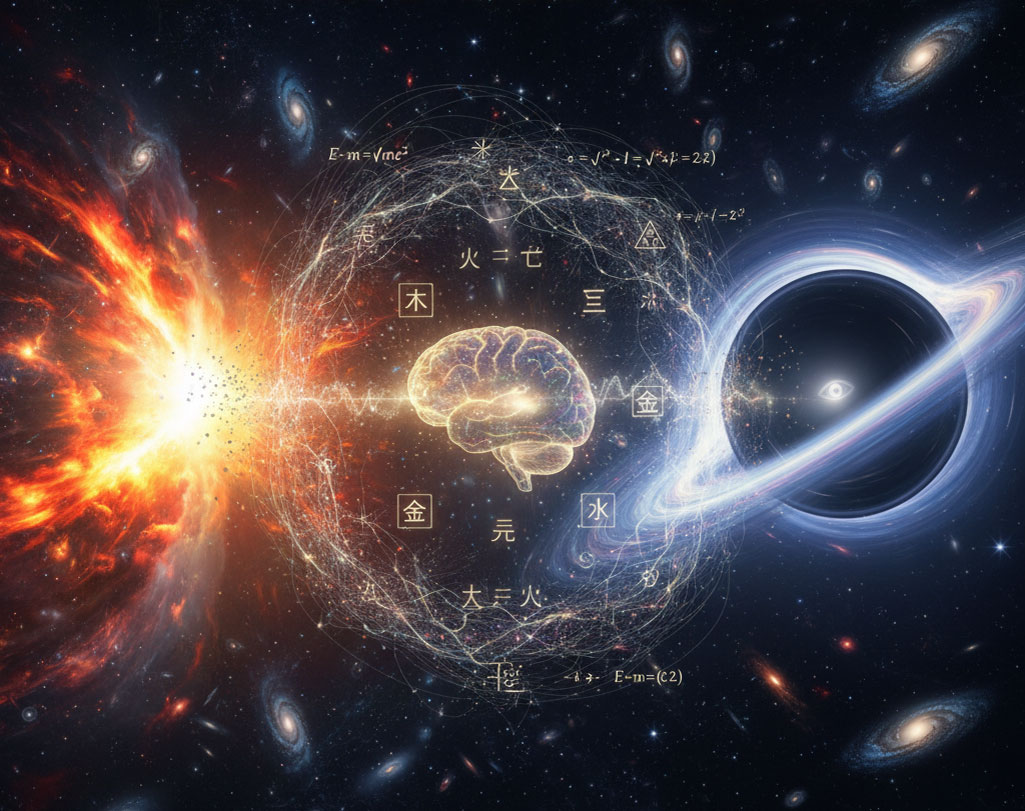
But even in its splendor, the story of the Big Bang leaves a silent void, a fundamental question that perplexes science itself: “What came before the Big Bang?”. If the universe was born from a single point, what created that point? Where did the colossal energy for that explosion come from?
This question pushes us to the boundaries of physics and touches upon an older, deeper debate in philosophy: “Which came first: Matter or Consciousness?”.
Modern science, with its premise that everything must be measurable, has tacitly chosen the side of matter. It posits that consciousness is merely a complex byproduct, a fleeting spark born from chemical reactions in the brain after billions of years of random evolution.
But another stream of wisdom, an undercurrent that has flowed through many civilizations, offers a completely different answer. It suggests that perhaps we have been asking the wrong question. Perhaps there is no “which came first,” because the two were never separate to begin with. And perhaps, this universe did not begin with a material accident, but with an Idea.
This article invites you, whether you are a scientist, a philosopher, or simply a curious mind, to momentarily set aside familiar answers and embark on a journey of discovery. This is not a journey to negate science, but to place it within a far grander context, where matter, energy, and consciousness intertwine in an endless creative dance.
The Foundation of Reality – When Consciousness and Matter Are One
To explore the possibility that the universe was born from an Idea, we must begin with the most fundamental principle, one contemplated by sages of both the ancient East and West for thousands of years. This is Monism.
It may sound complex, but its core idea is incredibly simple: all things in the universe, despite manifesting in countless different forms, originate from a single, unified substance. Accordingly, consciousness and matter are not two separate, opposing entities. They are merely two different states of expression of the same truth.
Imagine water. Water can exist in the liquid state we drink every day. When heated, it becomes invisible water vapor, diffusing into the air. When frozen, it solidifies into hard ice. Water vapor, liquid water, and ice look completely different and have entirely different properties, yet no one doubts that their fundamental essence is one and the same: H₂O. They are simply in different states of energy and structure.
This idea, while seemingly foreign to modern Western thought, is not alone. Even in the realm of quantum physics, pioneering thinkers like David Bohm, one of Einstein’s brilliant protégés, proposed a startling model of reality. He suggested that the physical universe we perceive is merely the “Explicate Order,” an unfolded expression of a deeper, more holistic and interconnected layer of reality called the “Implicate Order.”
Could it be that Bohm’s “Implicate Order” and the “One Being” of ancient wisdom are just two different names for the same truth? That at the highest level of existence, a pure Idea—a form of supreme consciousness—can “condense” itself to create matter.
Monism suggests that consciousness and matter are just like this. Consciousness can be likened to water vapor: subtle, pervasive, invisible, and unbound. Matter, on the other hand, is like ice: condensed, tangible, with clear structure and laws. They are not two different things, but rather two vibrational states of the same cosmic substance.
When we accept this principle, an incredible door of perception opens. If matter is just a “condensed” state of a deeper substance, then at the highest, most subtle level of existence, a pure Idea—a form of supreme consciousness—can “condense” itself to create matter.
This is not an entirely far-fetched concept. Many ancient scriptures describe how a divine being with profound powers could, with a single thought, create an entire Celestial Kingdom, complete with mountains, rivers, and countless living beings. To the beings living within it, that world is entirely real, with its own distinct physical laws.
So what about our universe? Perhaps it is no exception. It’s possible that the entire vast cosmos we observe, with its billions of galaxies and complex laws, is but the manifestation of a grand Idea from a being at a higher level.
If so, the origin of the universe was not a random accident born from nothingness, not a chaotic explosion without purpose. It was a deliberate act of creation, a symphony that began with a single, first note called Consciousness. And our story is not one of lifeless particles, but the story of the manifestation of a great Idea.
Different Maps of the Same Territory
If the material universe is the manifestation of an Idea, then as it “condenses” into our space, it must follow specific operational laws. It’s like a programmer writing the core “functions” for a virtual world, or a composer establishing the rules of harmony for a symphony.
Matter in our world is always what it is, with its own intrinsic laws. But the way humans describe and understand it changes depending on their methods, concepts, and level of awareness. In the effort to “map” this physical reality, humanity has created many different descriptive systems, among which two great maps have shaped the thinking of the East and West.
Imagine a soccer match. The same event is unfolding on the field, yet each person “sees” a different version of reality. The coach sees formations and tactics. The player is only concerned with the ball and the position of their teammates. The audience is immersed in emotions and goals. The security staff focuses solely on potential threats in the crowd. None of them are wrong. They are simply focusing on different aspects of the same event, with different purposes.
Likewise, the two great maps of our physical world are not in conflict; they are simply drawn from two different perspectives:
- The map of modern science is the Periodic Table of Elements. It is like the perspective of an analyst, a “technician” at the soccer match. It dismantles everything, examining each “building block” that constitutes all things: carbon, oxygen, iron… It answers the question, “What is this thing made of?”. This map is extremely effective for understanding material structure and developing technology.
- The map of ancient Eastern wisdom is the Five Elements. This is more like the perspective of a “coach.” It is less concerned with the “material” of each player and more with the movement, interaction, and balance of the entire game. It describes fundamental energy states: condensation and solidity (Metal); growth and upward movement (Wood); flow and flexibility (Water); emission and combustion (Fire); and stability and nourishment (Earth). It answers the question, “What is the energy dynamic at play?”. This map is extremely effective for understanding the dynamic equilibrium of nature and living organisms.
The most important thing to remember is: The map is not the territory. Both of these systems are lenses of perception, useful ways of describing reality. Matter itself does not “have” the Five Elements or “have” atoms in that sense. It simply exists. And most importantly, both of these maps, however useful, are only valid for describing the “playing field” of this visible realm (The Three Realms).
In other spaces, other dimensions, matter may operate according to entirely different laws, like a different sport with a completely different set of rules, requiring entirely new maps.
Beyond the Five Elements – A Worldview from Cultivation Wisdom
If the Periodic Table and the Five Elements are maps of the “playing field” where we live, do other “sports” exist—other worlds with completely different rules?
Modern science, with advanced theories like String Theory, has begun to acknowledge the possibility of other dimensions. But thousands of years ago, a system of wisdom in the East not only spoke of them but also described in detail the path to perceive and transcend this realm. This is the worldview of the cultivation world.
To grasp its depth, let us temporarily set aside the lens of science and explore this worldview as objective observers.
In this system of thought, a classic saying is passed down: “Beyond the Five Elements, outside the Three Realms.” This is not just a philosophy but a description of a concrete goal. “The Three Realms,” according to them, is precisely this visible three-dimensional space, the “playing field” where all things are governed by the physical laws we know. The goal of a cultivator is to break free from those constraints.
So how does one break free? According to them, cultivation is not merely about improving one’s morality; it is a material cause-and-effect process with its own strict logic. At this point, you might ask: how can moral concepts like character, virtue (De), and karmic debt (Karma) be material? This is perhaps the most difficult point for a materialist mindset to accept.
In this worldview, the answer lies in the fact that they are not abstract ideas. They are described as real substances that exist in other dimensions parallel to the human body. Accordingly, Virtue (De) is described as a white, pure substance, while Karma is a black, coarse, and heavy substance. The act of “improving one’s character” is the process of actively increasing the substance of Virtue.
And here is the crucial point: this substance of Virtue is considered the essential “raw material” for a subtle “alchemy.” The energy of cultivation uses Virtue to transform every particle in the body, gradually replacing the coarse matter of the Five Elements with a more subtle, higher-energy substance. Without enough of the “raw material” of Virtue, this transformation cannot occur.
One of the phenomena they present as evidence for this transformation is Sarira. After cremation, the remains of many accomplished cultivators leave behind gem-like relics with extraordinary physical properties that modern scientific analysis cannot fully explain. In their worldview, Sarira are considered the material traces of that process—matter that has been purified to an extremely high degree, becoming matter “beyond the Five Elements,” like a cocoon left behind after a being has transitioned to another level of existence.
The question is, how could they know about these things? They speak of a perceptual tool that transcends ordinary senses: the Celestial Eye (Third Eye). As described, the Celestial Eye does not see with ordinary light (photons) but has the ability to directly perceive other spatial dimensions and more subtle types of microscopic particles. With this tool, they claim it is possible to observe parallel worlds and beings in other realms.
Whether we believe it or not, the Eastern wisdom of cultivation has provided an incredibly vast and coherent model of reality. It opens up the possibility that the universe is multi-layered, that matter can be transformed, and that human perception can be expanded. With this lens in hand, even if only temporarily, let’s revisit the “mysteries” of science like the Big Bang and Black Holes in a completely new light.
Rereading the Big Bang – Bubble or Ocean
Science, with its increasingly sophisticated observational tools, has painted a grand story of origin: our universe is expanding. From this observed fact, an almost inevitable logical deduction was born: if we “rewind the film,” everything must have originated from a single point—a Big Bang.
This is a reasonable model, but it is built on an implicit assumption: that what we are observing is the entire Universe.
But what if we change our assumption about scale?
Imagine that all of reality is a boundless, eternal ocean. And our entire “observable universe,” from its birth to its demise, is equivalent to the moment a tiny bubble forms, expands, and then pops on the surface of that ocean.
Science, with its greatest telescopes, may only be studying the detailed physics of that bubble. They measure the expansion rate of the bubble’s membrane and call it the expansion of the universe. They infer the moment of the “explosion” that created the bubble and call it the Big Bang. They are not wrong. But they are studying the physics of a bubble and calling it Cosmology.
Through this lens, the question “What came before the Big Bang?” becomes as meaningless as “What existed before this bubble formed?”. The answer is: The ocean. The ocean was always there.
The Big Bang, even if it truly occurred, was perhaps not the event that created the Universe. It was merely the event that marked the beginning of our local material realm—the birth of a bubble. The cycle of formation-stasis-degeneration-destruction is not the breath of the entire ocean, but merely the short lifespan of a single bubble among countless others.
Therefore, the expansion we observe does not prove the beginning of all things. It only proves that the bubble we are inside is currently in its expansion phase.
The Galaxy as a Cosmic Vortex
If the observable universe is just a bubble, then what are the galaxies inside it? The current scientific model views them as collections of stars and planets held together by gravity. But this model has run into a major mystery. Imagine a carousel: those sitting on the outer edge must hold on very tightly or be thrown off. Science expected the same for galaxies: stars at the far edges should rotate much more slowly than those near the center.
But reality was shocking. Observations show that the outermost stars are rotating at an impossibly high speed, nearly as fast as the stars near the center. Scientists gave this phenomenon the rather dry name of the “galaxy rotation curve problem,” but its essence is truly mind-boggling: the entire galaxy is rotating like a solid disc, not a swirling vortex.
To explain why this “carousel” doesn’t fly apart, science proposed a hypothesis: there must be an enormous amount of invisible matter, called a “dark matter halo,” enveloping the galaxy and using its gravity to “hold on” to those reckless stars.
But perhaps we have been looking at it the wrong way from the very beginning.
Let’s try a different visualization: A galaxy is not a collection of matter, but a great vortex of energy, a self-organizing, holistic structure.
Science often focuses solely on gravity when looking at the cosmos. But we forget that there is another force that is trillions upon trillions of times stronger: the electromagnetic force. Furthermore, 99% of the matter in the universe exists in a state of “plasma”—imagine it as a super-hot, electrically charged “soup,” the stuff of which the Sun and lightning are made.
What happens if we look at a galaxy through that lens? In a plasma environment, energy currents don’t flow chaotically; they self-organize into invisible “rivers” or “filaments” of energy. It’s possible that galaxies did not form from dust, but were born at the very points where these cosmic energy rivers intersect and swirl. Galaxies are born where these filaments twist together, like vortices forming in a river. Whether it’s the orderly spiral of spiral galaxies or the more chaotic turbulence of elliptical galaxies, they all follow this same energy principle.
This also means that the vast majority of matter in the universe—perhaps up to 90%—exists in silence, in a tranquil ocean we cannot see, with only the rare “hot spots” of shining galaxies.
With this visualization:
- The Black Hole at the center is not a monster that devours matter. It is the eye of the storm—a region of calm and cold space, formed passively by the very dynamics of the vortex.
- The “flat rotation curve” (fast-rotating stars at the edge) is no longer a mystery. It is an intrinsic property of the vortex itself. Stars and gas clouds are not individual objects “about to be flung out.” They are particles being “swept along” by the flow of the entire energy structure, guided by magnetic “filaments.” Just as in an electrical circuit, a signal propagates almost synchronously throughout the entire circuit, rather than weakening with distance from the source.
Therefore, perhaps there is no “dark matter” at all. What we call the “effect of dark matter” is simply the manifestation of a different physical principle, a dynamic of plasma vortices that our purely gravitational model has yet to fully grasp. A galaxy is not a mechanical machine, but a living electrical circuit.
And this leads to a bold speculation: could the luminosity of a star be directly dependent on its speed? Just as a rock in space only ignites as a meteor when it enters the atmosphere at a sufficient velocity, perhaps a star is only “activated” and shines when it moves fast enough through the galaxy’s energy flow.
If this is true, then the images of galaxies we see are only their brightest “cores.” Surrounding them could be a “dark halo” many times larger, filled with slower-rotating stars that have “turned off their lights.” And perhaps the “dark matter” that science is searching for is not some mysterious particle, but the immense mass of ordinary celestial bodies that have fallen into silence and cold.
The Infinite Structure of Reality – From the Microcosm to the Macrocosm
After looking back at the Big Bang and galaxies, let us take a step back to contemplate the profound architectural principle of the universe. Is there a common design, a self-repeating pattern at every scale, from the infinitesimal to the immense? This principle can be found in nature, through a concept known as a fractal.
A fractal is a structure in which a small part, when magnified, looks identical to the whole. From a snowflake and a fern frond to the branching of rivers, nature appears to be a master fractal artist. When we apply this fractal lens to the cosmos, an astonishing order emerges.
Let’s try to build a hierarchical system to visualize this fractal architecture, clearly distinguishing between a “Fundamental Particle” (the spherical corpuscle of a given level) and an “Intermediate Structure” (a system formed from lower-level particles).
- Level +1: The Fundamental Particles are Celestial Bodies.
o Stars and planets, with their characteristic spherical shapes, are the “fundamental particles” of this level.
o From these Level +1 “particles,” more complex intermediate structures are formed: a Solar System (a central particle and satellite particles), a Galaxy (a population of billions of particles), a Galactic Cluster, and so on.
- So, What is the Fundamental Particle of Level 0?
o The journey of particle physics is the very quest for this answer. We have discovered the atom, but with its structure of a nucleus and orbiting electrons, it is clearly an “intermediate structure,” a miniature solar system.
o According to our fractal logic, a Fundamental Particle of Level 0 must be composed of countless Fundamental Particles from Level -1. But here, we encounter an interesting contradiction with current science. Physics states that a proton (a component of the nucleus) is made up of only 3 quarks. If so, neither the proton nor the quark can be considered a “Fundamental Particle” by our definition; they are merely very small “intermediate structures” on the path deeper into the microcosm.
o This does not mean that science is wrong. It simply suggests a staggering possibility: that even with our most powerful particle accelerators, we have likely not yet reached the true “Fundamental Particle” of Level 0, let alone known anything about the deeper micro-levels. What we know today may only be the surface layers of an infinite microscopic ocean.
From this perspective, the universe is not just a straight line from small to large. It is an infinitely layered structure in both microscopic and macroscopic directions. The smallest and the largest are not separate—they mirror each other like two sides of the same coin. Understanding the structure of a Solar System might help us envision the structure of an atom. And acknowledging the existence of infinite micro-levels opens the possibility that the very macrocosmic world we observe is itself just one “particle” within an even grander structure.
Beyond the Threshold of Observation
When faced with a multi-layered cosmology, the most important question is not “How does this model explain the data?”, but rather, “Is it possible that the very data we have is merely a picture of an infinitesimally small part of reality?”. Instead of trying to reconcile, let us try to ask questions about the very limits of our observation:
- Regarding the scale of the “Universe”: Science is studying the expansion of the “observable universe” and calling it the Big Bang. But could it be that this entire grand event, from its beginning to its end, is merely equivalent to the moment a bubble pops on the surface of an infinite ocean? If so, can the laws derived from observing that bubble be applied to the entire ocean?
- Regarding the nature of “Laws”: We measure the “arrow of time” through the law of entropy. But is this an eternal law of all spatial dimensions, or is it just a temporary “rule of the game” for this material realm, during the “Formation-Stasis” phase of a larger cycle? Just as the law of breathing only applies to a living body, do physical laws lose their validity when a cosmic cycle reaches its “Destruction” phase?
- Regarding the truth behind the “Data”: Are observations of “dark matter” or “dark energy” showing us new entities, or are they simply the “missing pieces” in an equation that we ourselves have imperfectly constructed? Are they signs that our tools and theories have reached their limits and are trying to measure something that lies beyond their capacity to measure?
These questions are not meant to deny the value of science. On the contrary, they are an invitation for science to bravely look at its own limitations, and in doing so, open a door to a science of the future—a science that not only observes the “shadow” of reality but can also learn about the “object” that cast it.
Conclusion: Reality Is a Mirror Reflecting Consciousness
When these pieces are assembled, a different picture of the universe emerges. It is not a lifeless machine born from a random accident, but a multi-layered, orderly, cyclical, and incredibly vibrant reality.
From the Idea that gives birth to matter, to local laws like the Five Elements, to realities that lie beyond those laws; from the beginning of a cycle (Big Bang) to the calm center of balance (Black Hole); from the resting ocean of matter (Dark Matter) to the infinite levels of microscopic and macroscopic structure—everything seems to be an expression of a profound wisdom. Science, with its instruments, is merely observing the ripples, the “hot spots” on the surface of an ocean whose depth it cannot yet fathom.
And perhaps, the answer does not lie only in the distant stars. If a human being is an intermediate structure made of microscopic particles that have existed since the dawn of time, then within each of us also lies the entire history and order of the universe.
When we look up at the sky, we are looking into the universe’s past. But when we look within, perhaps we are touching its very essence. To understand the universe, perhaps, is to begin by listening to our own breath. Because it may be that what is happening out there—the expansion, the balance, the light and dark, the stillness and motion—is merely a mirror reflecting the dance that is unfolding within ourselves?
THE UNIVERSE BEYOND THE BIG BANG – DETAILED CONTENT & A JOURNEY OFF THE BEATEN PATH
PROLOGUE – An Invitation to the Edge of the Map
Modern science has drawn a magnificent map of the material world known as the Big Bang. However, at the very moment of inception, the laws of physics suddenly collapse into silence. This book is a courageous invitation: to temporarily set aside familiar paths, step to the edge of the map, and bravely look into the infinite void that lies beyond.
PART I: THE FORGOTTEN FOUNDATION
Examining the limits of measurement tools and the silence of physical equations when facing the microcosm and consciousness.
- Chapter 1: The Great Question on the Fringes of Science: Why science remains silent before the “singularity” and the limitations of our extended senses.
- Chapter 2: Consciousness and Matter: Analyzing the two-way relationship, from the placebo effect to the mind’s power to sculpt physical appearance.
- Chapter 3: The Implicate Order and the Quantum Universe: Exploring the world of undivided wholeness through quantum entanglement and the observer effect.
PART II: THE MAPS OF REALITY
Deep diving into various systems of knowledge to decode the structure, flow, and transformation of the universe.
- Chapter 4: The Map of Structure: Re-evaluating the Periodic Table through the lens of a “mechanic” and its limitations in explaining life.
- Chapter 5: The Map of Flow: Redefining the Five Elements as five states of energy movement rather than primitive materials.
- Chapter 6: The Map of Transformation: Exploring the worldview of spiritual cultivation, where morality is material (Virtue and Karma) and the process of internal alchemy.
- Chapter 7: The Multidimensional Map: From String Theory to the “cracks” in reality at the Bermuda Triangle and the propulsion technology of Unidentified Flying Objects (UFOs).
- Chapter 8: The Realms of Existence: Decoding the “vertical” structure of the universe through vibration frequencies and the mystery of time in higher realms.
PART III: EVIDENCE FROM HUMAN EXPERIENCE
Using a multidimensional lens to reinterpret psychological and physiological phenomena traditionally considered mysterious.
- Chapter 9: Dreams – Gateways to Other Realities: Categorizing internal dreams (mind-generated) and external dreams (actual travel of the Primordial Spirit).
- Chapter 10: Inspiration: The four streams of creation, from individual effort to signals transmitted from higher dimensions.
- Chapter 11: Spirit Possession: Utilizing the “Car and Driver” metaphor to reinterpret Dissociative Identity Disorder and the struggle for conscious control.
- Chapter 12: Supernormal Abilities: When consciousness is strong enough to bend physical laws, such as instantaneous seed germination or subatomic alchemy.
PART IV: DECODING THE GREATEST MYSTERIES
Restructuring modern cosmological theories to find the unification between science and wisdom.
- Chapter 13: Extraterrestrial Life: Decoding the Fermi Paradox through the “Radio Frequency” metaphor—they are right here, but in a different dimension.
- Chapter 14: The Big Bang – A Bubble Bursting on the Ocean?! Proposing that the Big Bang can be likened to a small breath within the grand “Formation-Stasis-Degeneration-Destruction” cycle of a microcosm.
- Chapter 15: The Galaxy – A Living Circuit of the Universe: Explaining the rotation speed of stars through Plasma Dynamics instead of hypothetical Dark Matter particles.
- Chapter 16: Black Holes, Dark Matter, and Dark Energy: Reinterpreting the three “ghosts” of physics as effects of large-scale electromagnetic forces.
PART V: THE BIG PICTURE AND HUMANITY’S PLACE IN IT
Connecting the pieces to establish the position and purpose of humanity in an orderly and intentional universe.
- Chapter 17: Fractal Architecture: The principle of self-repetition from the atom to the supercluster—”As above, so below.”
- Chapter 18: Transcending the Boundary of Observation: Affirming that humanity’s next great frontier is not outer space, but the inner space of consciousness.
- Chapter 19: The Universe is a Mirror: Redefining the meaning of life, suffering, and death as mechanisms for the transformation and sublimation of existence.
CONCLUDING PART: LISTENING TO THE BREATH OF THE UNIVERSE
The greatest journey does not require a spaceship; it requires the courage to turn inward, face oneself, and purify the soul. Each person’s life is the most important laboratory for witnessing reality.
WISDOM IS WAITING FOR YOU
The world stands at the threshold of a cognitive revolution. “THE UNIVERSE BEYOND THE BIG BANG” is not just a book; it is a journey off the beaten path to help you find your own map within the ocean of reality.
Do not stop at the old map. Click the “BUY NOW” button to own the digital edition (ebook) and begin your journey of decoding the universe today.
To explore more works from THE LIVES MEDIA, visit our book collection.