The Peculiar Invitation and the Otherworldly Space
I stood silently before the dark wooden door numbered 603.
The room was tucked away in a secluded corner at the end of the ground-floor hallway—a place that seemed to have been forgotten by the pale fluorescent light of the convention center. I could still feel the coolness of the brass room number plate, tarnished with time. Under the dim light, the number seemed to vibrate softly, a vague sensation, as if it had been waiting for me.
About ten minutes earlier, I had been sitting in the main hall on the third floor, where PowerPoint slides displayed complex charts, flashing incessantly like the frantic pulse of a global healthcare industry in a perpetual race. Then, a sudden impulse reminded me of a tiny slip of paper, something I had intended to toss into the trash on the first day of the conference, still lying dormant in my vest pocket.
It was nothing eye-catching. An ivory-white slip of paper, bearing only a single, simple line of printed English:
“Ancient Healing Arts and Uncharted Possibilities”
And a name: Zhang Feng – from China.
Location: Room 603.
I remember a small smirk touching my lips. Partly because the title sounded somewhat cliché, like an advertisement for a weekend meditation retreat in some remote countryside. And partly, perhaps mostly, because I was a man of numbers, of peer-reviewed studies, of clear-cut data analysis. My wife, Qing Ling, with the subtlety of a linguist, often quipped that my thinking was as precise and exact as the mechanism of the Swiss watch I always wore. I usually just stayed silent, taking it as a tacit compliment to my steadfastness.
And yet, for some reason, the slip of paper had remained in my pocket for two days, amidst a packed schedule and important meetings. It was as if it possessed an invisible weight, waiting for a certain moment. It wasn’t until this afternoon, when a forty-minute gap suddenly opened up in my schedule and my mind was weary from the endless repetition of statistical charts, that my hand seemed to move of its own accord, touching my pocket—and slowly pulling out the slip of paper.
“A quick look couldn’t hurt,” I muttered, more a fleeting thought than a considered decision.
And so now here I was, in front of Room 603. The closer I got, the more the clamor and chaotic sounds from the main conference rooms seemed to be filtered out by some invisible wall, then dissipated. I could hear my own footsteps pressing into the thick carpet, each step like a small drop of water slowly falling into an unusually still space, a silence that was almost tangible.
I pushed the door gently. It gave a soft creak, like the sigh of old wood.
Inside… was a completely different world.
There were no dazzling projectors. No formal lectern. No cold white lighting or the amplified sound of a microphone echoing from the conference’s modern sound system. Instead, the room was illuminated by a soft, warm yellow light, emanating from a few rice paper lanterns hanging near the ceiling. A pure, herbal fragrance wafted gently to my nose—reminiscent of sandalwood but purer and more delicate, which, for some reason, had a surprisingly calming effect on my mind.
Only a dozen or so people were in the room, seated on simple wooden chairs. They sat upright, silent, all facing forward, as if listening to an invisible piece of music, a melody that could only be perceived in the depths of consciousness. No one was looking at their phone. No one was scribbling notes. No one spoke. The silence here was not a mere absence of sound, but a living entity, with form and substance, that enveloped and permeated every corner of the room. It made me hold my breath.
I froze for a few seconds at the threshold. My crisp business suit, my striped silk tie, the gleaming metal name badge pinned to my chest—all symbols of my status and confidence—now made me feel… out of place, like a discordant note in a symphony of stillness. But strangely, no one looked at me as if I were an uninvited intruder. Their gazes did pass over me, very quickly, but with no judgment or prying curiosity—it was more like the gaze of people who… had seen this, or something similar, before. A silent acceptance.
I took a quiet breath and tried to step in as lightly as possible, choosing an empty chair in the back row. The chair’s back was slightly reclined, its fabric worn, but never in my life had I sat down with such reservation and caution.
At the front, sitting on a plain wooden chair, slightly lower than the others, was a man. Zhang Feng, I presumed, based on the name on the paper. The yellow light from the nearest lantern cast a slanted beam across his cheekbone and one of his temples. His face, at a glance, might not have seemed remarkable—but it held something that made it impossible for me to look away. His gaze was not piercing, nor was it scrutinizing. It simply was—as placid and deep as an autumn lake without a ripple, embracing and serene.
I could not say I understood what was truly happening here.
I no longer remembered what I had expected upon deciding to enter this room. An erudite lecture on traditional medicine? A colorful demonstration of esoteric qigong? Or worse, some clever pitch for an unverified therapy?
The atmosphere here suggested nothing of the sort. Everything felt… strangely real. So real that I, a man who had always prided himself on his ability to control and analyze, began to feel a bit… disoriented.
I sat there, my hands resting on my thighs, trying to slow my breathing, to make it as light as possible so as not to disturb the almost sacred stillness that filled the space. Each minute passed as heavily as lead. A strange feeling, an unprecedented curiosity, crept into every corner of my mind—as if I were inadvertently standing on the edge of something vast, a world I had never known, a truth… that had never been named.
I shifted slightly in my seat, trying to merge with the thickening silence. My gaze drifted involuntarily toward the man named Zhang Feng, and I waited.
Waiting for what, I myself did not know.
The Serene and Mysterious People
I chose a discreet seat in the back row, trying to make myself inconspicuous, like an accidental spectator who had wandered into a pantomime already in progress.
Not a sound. Not a word. They just sat there—remarkably upright and natural—as if the posture were an extension of their very being. Their backs were straight, yet their shoulders were completely relaxed, their hands resting calmly on their laps. An inner stability, without a trace of effort or pretense.
I began to observe each person more closely.
Nearest to me was an elderly woman—perhaps in her sixties—wearing a simple, dark-brown garment, her silver hair tied neatly in a bun at the nape of her neck. Her eyes were not closed, but her gaze seemed to pierce through some ethereal mist, fixed on an indeterminate point far beyond the back wall. In another corner, a rather young man—his eyes bright yet tranquil, devoid of prying curiosity—possessed the solemnity of one who had weathered many storms, though he was likely not yet thirty. And in front of them, an old man sat at ease, his back resting lightly against the chair, his expression so placid that I thought he might have dozed off.
No one exchanged glances. No polite smiles, no subtle nods, not even a fleeting raise of an eyebrow. And yet, the presence of each person was… full, substantial.
I did not sense cold indifference, much less the air of “just being here for show” so common in other settings. They were truly there, completely present in each moment, in each breath. A peculiar feeling crept over me. It was as if something invisible—without sound, without form, immeasurable by any instrument I knew—was gently pervading the air. Could this be a form of energy that our science had yet to define, or was it merely my own illusion in this unique space?
I did not know where they came from, what they did for a living, or what their daily lives were like. I did not know if they knew one another. But here, in this room, they were like ancient, solemn stones in the midst of a great river: not seeking attention, yet possessing an unyielding stability and wordless secrets.
Once again, the feeling of being out of place washed over me. The designer suit, the prestigious professorship, the research papers cited hundreds of times in international journals—all the things that had once been my pride—now seemed to carry no weight at all in this room.
A silence… descended. But it was not emptiness. It was as if I were standing at the mouth of a deep, ancient well, a vague sense of anticipation stirring within me, as though some mystery was waiting to be discovered from its depths.
At the front, Zhang Feng still sat motionlessly, having not yet spoken a word. But then, he moved slightly.
Just a slight tilt of his head—like a breeze rippling across a still lake—and the entire room seemed to shift with him. I saw every gaze turn toward him in unison, slowly, naturally, without hurry or pressure. An unspoken agreement.
I, too, found my gaze drawn to him. Not entirely out of curiosity, but as if by some invisible force that left me no other choice.
The Encounter with Zhang Feng
After that slight tilt of his head, Zhang Feng remained silent for a few breaths. The room grew even more still. Then, without a word of introduction, without a single superfluous gesture, he began to speak.
His voice was deep, warm, and enunciated every word with a clarity that was neither fast nor slow—completely different from the eloquent, crowd-controlling style of the professional speakers I knew. He spoke in Chinese, a Mandarin with an ancient, rustic cadence, as if passed down from an era when people conversed with sincerity rather than through microphones or polished PowerPoint slides.
He spoke of qi. Of the invisible flows of energy within the body. Of the connection between the beat of the heart and the subtle fluctuations of the universe. Of the manifestations of the pulse—the silent signals sent by the body. These were all concepts I had skimmed through in books while researching Eastern traditional medicine, but had never truly taken seriously. Through the lens of a Western-trained medical professor, “qi” was as vague to me as “a courageous spirit” or “a passionate heart”—beautiful, evocative metaphors, but how could they be quantified, how could they be brought into a laboratory?
But the way Zhang Feng spoke was entirely different. He did not present a theory. He told stories. Stories of ancient physicians who cured incurable diseases, sometimes just by adjusting the patient’s state of mind before even resorting to medicine. Stories of complex cases where the pulse manifestations revealed things more profound than the most advanced modern blood tests. I listened, at first perhaps only out of politeness, but then found myself drawn in—not because I believed, but because I could not help but listen. There was something in his voice, in his calm storytelling, that truly held me.
Then, abruptly, he stopped.
The already quiet space now seemed to thicken, to congeal. An almost absolute stillness, without a single cough or a heavy breath, descended upon everyone.
He slowly swept his gaze across everyone in the room. And then—that gaze came to rest on me, the only stranger present.
There was no prying curiosity. No knowing, “I-see-right-through-you” look. Just a direct, placid, yet profound gaze. A strange sensation ran down my spine. Under that gaze, I felt that the things that defined me—the expensive suit, the diplomas—seemed to lose their meaning. Even the hidden corners of my mind, which I thought I had locked away securely, felt as though they had been touched.
He smiled faintly, a barely perceptible smile at the corner of his mouth. Then he spoke—his voice still even, not raised, carrying no hint of warning or judgment. Just a single sentence, uttered in the stillness, as if he were gently touching a hidden wound that I myself had intentionally forgotten.
“Your pulse,” he said, his eyes still on me, “is somewhat deep, and there is a blockage. Like a stream with a boulder in its path, preventing the water from flowing naturally. Your qi and blood are therefore stagnant. But more telling is the knot in your heart. An old matter that has not yet healed, an unnamable pressure, is making it difficult for the energy in your body to return to its natural state of balance.”
My entire body went rigid. A ringing filled my ears.
I had not spoken a single word to him. Not even a nod of greeting. And obviously, he had not come near me, had not used his slender fingers to touch my wrist—he had not “taken my pulse” in any way I had ever learned or known in all my years of medical research.
So… what had he just done? How did he know?
My inherent skepticism, the instinct of a scientist, immediately surged in my mind. Could this be just a sophisticated psychological trick? A well-prepared “cold reading”? Or had he taken the trouble to “investigate” me before this talk?
But no. How could he? What he had just said… how could a stranger possibly know? These were things I held alone in my heart, or at most, things my wife, Qing Ling, might have vaguely sensed. There were even things so private that not even she, the person closest to me, had ever heard me confess.
I sat there, my hands on my thighs, trying to keep them from trembling, but my chest was a tangled mess.
The scientific, rational part of me screamed for a logical explanation. But another part—the intuitive part I often dismissed, the part I rarely used—remained silent, observing.
I suddenly felt like a child standing before a giant map of the world for the first time, only to discover that behind the familiar paper lay a second map, with strange lines, with unnamed lands, more complex, more profound—a map without borders or a legend.
Confronted with this borderless map, I suddenly felt how limited my familiar tools of measurement had become. Could there be truths that lie beyond the grasp of scientific quantification?
The Wordless Conversation and the Deep Impression
After that strange remark aimed directly at me, Zhang Feng seemed to pay me no further mind. He continued his talk naturally, as if there had been no interruption, his voice as gentle and steady as the patter of fine rain on the eaves.
I remained seated in my spot, but my mind, however, could find no peace.
Every word, every idea he spoke of afterward—about the connection between qi and the mind, about the harmony between the small human being and the vastness of heaven and earth—now seemed like nothing more than sounds floating past my ears. My entire focus was spinning around a single, unanswerable question: How did he know those things about me?
I tried to maintain the calmest expression possible, not to reveal the turmoil within. But I knew my face must have been somewhat stiff, unnatural. Occasionally, when I looked up, I would catch his gaze sweeping past me, very quickly. In that gaze, there was no hint of an explanation, no flicker of apology. Only a… presence. Quiet. Profound. It was as if he could fully sense the small tempest swirling within me—and simply accepted it calmly, without judgment.
The feeling when our eyes met was hard to name. It wasn’t like a normal conversation, nor was it a deliberate attempt to persuade. It was more like a silent perception, a connection that needed no words, very vague, yet palpable.
I was not one to easily believe in spiritual matters. But in that moment, I knew something was reaching me—not through logical reasoning, but through that very silence and that penetrating gaze. It did not cause a great shock, but it was slowly etching a deep mark on my consciousness.
And perhaps, a part of me no longer wanted to resist that strange feeling.
When the talk concluded, the room maintained its astonishing stillness. Not a single round of applause. No one rushed forward to shake the speaker’s hand. People rose one by one, gave a slight bow toward Zhang Feng, and then departed quietly, with a solemnity and familiarity—as if this were not a special seminar, but an intimate gathering, a daily routine among people who seemed to have known each other for a long time… on some plane of consciousness I had not yet reached.
I found myself lingering, though I wasn’t sure why. When only a few people remained in the room, I instinctively stepped forward.
Zhang Feng looked at me, his eyes as calm and luminous as before.
“I know you must have many questions,” he said softly, his voice holding no surprise, as if he had anticipated this.
I just nodded slightly, not initially intending to say anything. But then the pent-up questions tumbled out, albeit hesitantly: “The matter of my… pulse… and also… how did you know those things…”
He smiled faintly, not interrupting my question, nor rushing to answer. After a few seconds of silence, he spoke slowly, his voice as light as a breeze:
“That is merely a rudimentary understanding of the intimate connection between a person’s body and mind. Your modern science has achieved extraordinary feats in understanding the body’s tangible structure, but perhaps it is still a bit bewildered when faced with the invisible aspects, the subtle energy flows.”
I remained silent, listening.
He continued, his voice still slow, but his eyes looked directly at me, holding something profound:
“There are things that cannot be explained thoroughly in a short talk. If you truly have the heart to understand more deeply—not through theories in books, but through your own experience—then perhaps, China is the place you should go.”
My heart skipped a beat.
He paused for a moment, then spoke his final sentence, his voice calm but heavy with weight, as if closing a familiar door while simultaneously cracking open an entirely new path:
“If you dare to embark on that journey, you may no longer be the same person you were before.”
He gave me another slight nod, and then, with a strange placidity, he blended in with the few remaining people and left the room. His figure vanished behind the door so quickly that I thought I might have witnessed an illusion.
I stood alone in the room, which was beginning to feel cold. The wind from outside Tokyo had begun to seep through the crack in the door.
But in my heart…
something had just been truly stirred. Very gently. But enough that I could no longer ignore it.
An Invitation to a Journey
The last of the figures had vanished behind the door. I stood there, in the middle of the empty room, trying to sort through my chaotic thoughts. Mr. Zhang Feng’s invitation to China, though vague, continued to echo in my mind. An inexplicable urge made me walk quickly out into the hallway, hoping I might see him again.
Fortunately, he had not gone far. He was standing alone at the end of the hall, near the exit, with a pensive look, as if waiting for something—or perhaps, for me.
He looked at me as I approached, his gaze retaining that same calm and profound quality, as if my seeking him out were entirely natural.
“Mr. Wang Ming, is there something more you wish to discuss?” His voice was low and even, like the wind rustling through leaves in a silent garden.
I just nodded slightly. “Indeed, there is much I wish to understand better. But… I don’t know where to begin, what to ask.”
Zhang Feng smiled, a rare but sincere smile. “You don’t need to try to ‘begin’ so formally. Sometimes, it is enough to simply let things ‘continue’ naturally.”
I fell silent, feeling my own smallness in the face of his words, which seemed simple yet held a layer of meaning I could not fully grasp. It felt like standing before a dense, ancient forest where all familiar maps had become useless.
“What I was able to share in the talk just now,” he continued, his voice still even, “is truly like a few drops on the surface of a vast ocean. If you truly want to understand, to feel, you need to step into the current yourself.”
I frowned slightly, trying to picture what he meant.
“This is not about you coming to study a subject,” he went on, seemingly reading my thoughts. “Nor is it about learning a new theory to add to your store of knowledge. It is simply about living—living fully, for long enough—in a place where the things you are searching for are still present in the very breath of daily life.”
With that, he slowly took a small slip of paper from his vest pocket. It looked as if it had been torn from an old, faded notebook. He handed it to me. On it, in clear handwriting, was an address in Guizhou province, China, along with a phone number.
“If you can find the time, this summer might be suitable,” he said. “There is no need to inform me in advance. Just come, if you truly wish to in your heart, and if you feel the time is right.”
I took the slip of paper, my palm vaguely sensing its fragility and the warmth left behind by his hand. A dozen questions were on the tip of my tongue, but something kept me from voicing them.
“You might consider bringing your wife along,” he added, his gaze still on me, a look that seemed to see right through me. “I have a sense she has a very natural connection to traditional culture. There are things there that she might well grasp even faster than you, without needing logical explanations.”
I looked up sharply, trying not to reveal the astonishment rising in my chest. He knew about Qing Ling. How was that possible? In just a few short minutes, how could he know such private things?
Zhang Feng seemed to pay no mind to my expression. He straightened up slightly. He was not a tall man, but as he adjusted the lapel of his jacket, I felt that his silhouette held an unusual strength.
“This will not be an ordinary trip, Mr. Wang Ming,” he said in a final, clear, and solemn tone. “Nor will it be a scientific experiment for you to verify. Consider this a fated beginning, an opportunity. The rest… depends entirely on your choice.”
He gave a slight nod in farewell, then blended into the bustling Tokyo crowd outside, vanishing as quickly as if he were merely a fleeting thought in my mind.
I remained, alone in the hallway that was beginning to fill with noise again.
The small note with its handwritten address lay in my palm, strangely warm. The ink at the end of a line was slightly blurred.
I had not yet made any decision. But a sense of unease, a faint call from a distant place, seemed to have begun seeping into the deepest corners of my soul.
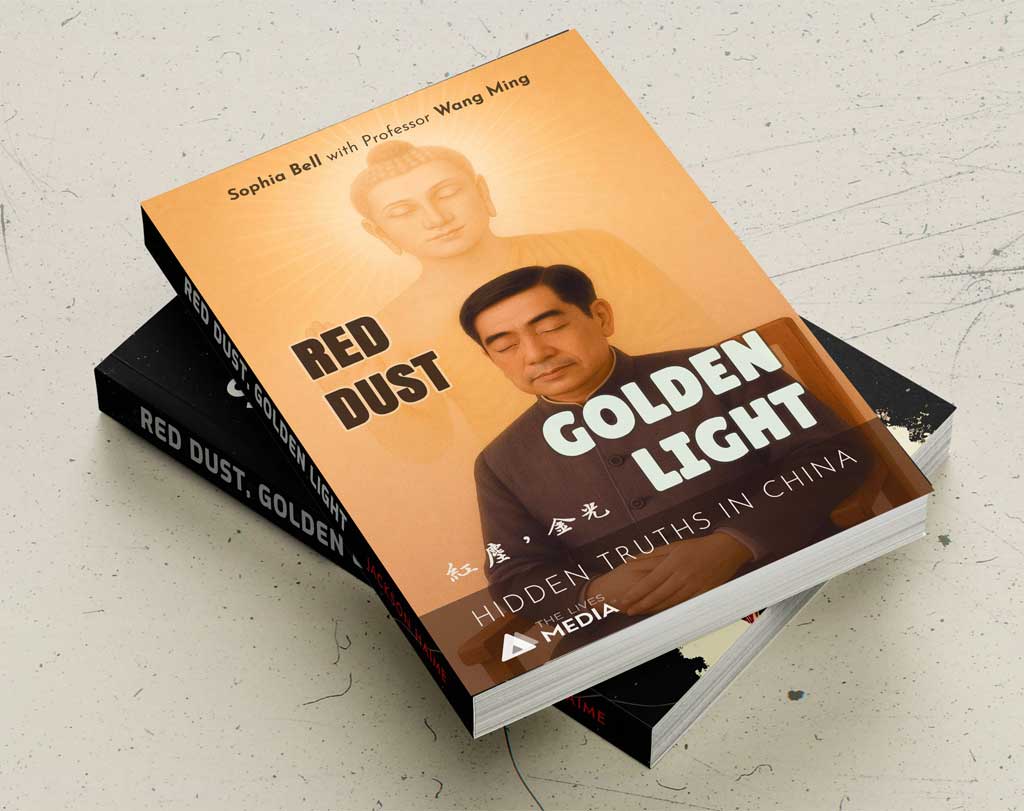
This article is an excerpt from the book “RED DUST, GOLDEN LIGHT” – which tells the story of Professor Wang Ming and his wife’s journey to uncover spiritual mysteries and many hidden truths in China.
If you wish to experience the full journey of thought and the unpublished insights of the work, please click the button below to own the complete book.
To explore more works from THE LIVES MEDIA, visit our book collection.