The Thirteen-Day Sleep in a Forgotten Land
After the haunting encounter with Master Mo and his shocking explanations of the soul and karmic force in Qingxi, both Qing Ling and I felt a strong urge to find a true moment of quiet. The rush of experiences, from the hermit on the mountaintop to the story of Old Man Wang’s “soul returning in another’s body,” had shaken the very foundations of our thinking. We needed time, we needed a truly quiet space to reassemble the shattered pieces of our beliefs, to face the countless immense questions that had just been unveiled before us.
During our final conversation with Master Mo, when we expressed our desire to find a secluded place to quiet our minds for a few days, he just gazed pensively out the window, then casually mentioned a rather unfamiliar place name: “Wangyou Town.” He didn’t say much about it, only smiled faintly and said that there, “time sometimes becomes strangely elastic for some people, and one can more easily forget the troubles of the secular world.” His half-joking, half-serious words, along with the evocative name “Wangyou” (Forgetting Sorrow), quietly planted an indescribable curiosity in our hearts.
Finding the way to Wangyou Town was no easy task. It didn’t appear on any standard tourist maps, and the people in neighboring towns we asked only had a vague knowledge of some remote valley. Our journey began with a train ride, then a transfer to a rickety local bus that crawled along winding mountain roads, finally stopping at a small, secluded town at the foot of a high mountain range. From here, to get to Wangyou, we had to hire a local young man and his self-made three-wheeled motorcycle to traverse a rough and treacherous dirt road.
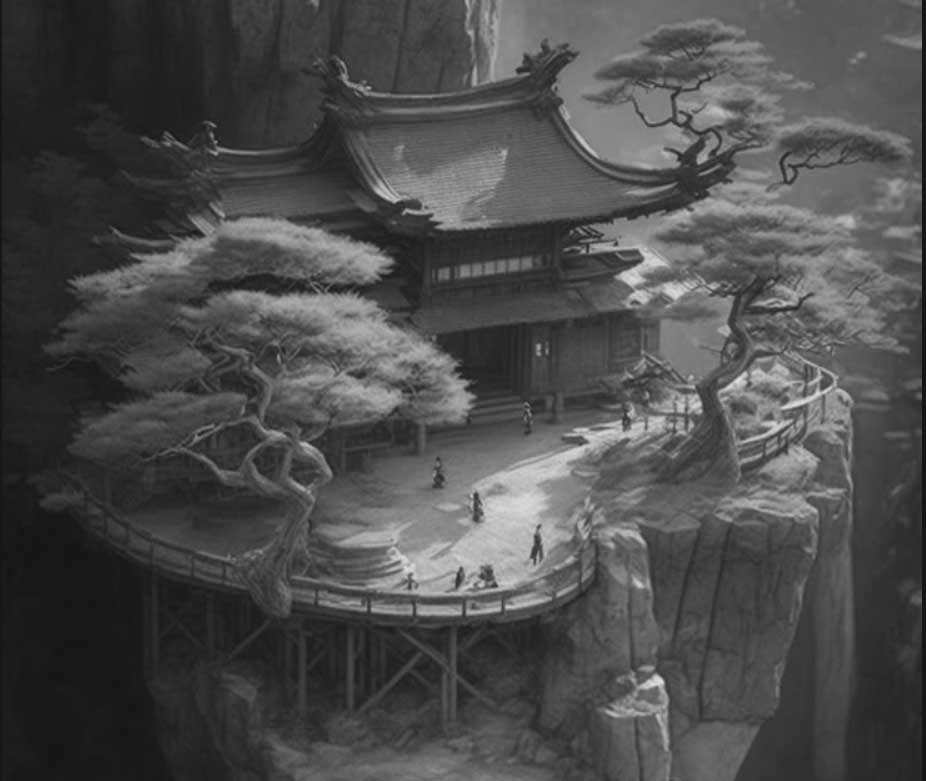
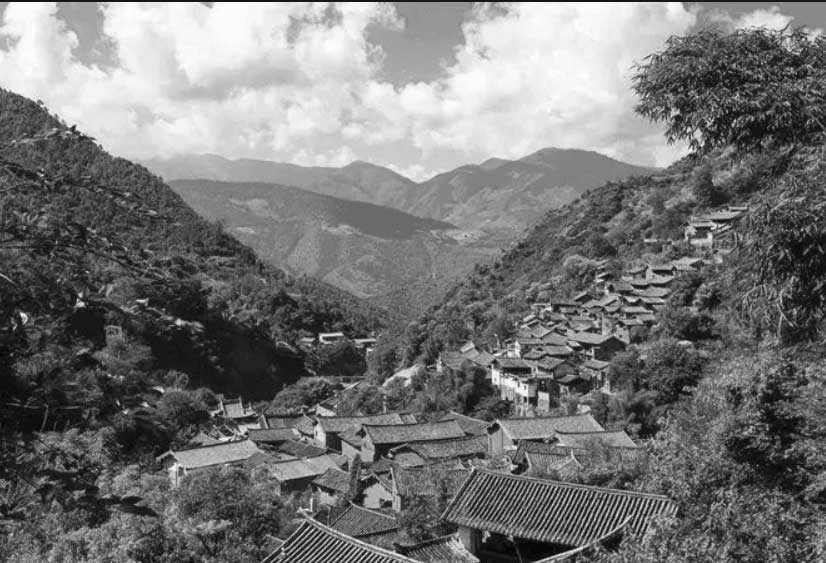
By the time we reached the edge of the Wangyou valley, it was already dusk. Both Qing Ling and I were exhausted after a full day of constant travel. The scenery of Wangyou Town appeared from a distance, with its dark brown tiled roofs emerging from the evening mist, looking ancient and somewhat isolated. Our guide introduced us to a hospitable local family at the entrance of the town, who had a small, simple room often reserved for stranded wayfarers.
The host family, a middle-aged couple and their young son, welcomed us warmly, albeit with the shyness of mountain folk unused to strangers. They quickly prepared a simple dinner for us with white rice, boiled wild vegetables, and some salted stream fish. Being so exhausted, neither Qing Ling nor I could eat much. Immediately after dinner, an overwhelming, unprecedented drowsiness suddenly hit both of us, so swift and powerful that it was impossible to resist. I vaguely remember my head spinning, my eyelids growing heavy, and then everything dissolving into a void. My last fleeting thought before completely losing consciousness was how quiet this place was, an unusual kind of quiet.
I awoke with a start, feeling incredibly light and refreshed, as if I had just experienced an extremely deep and restful sleep. My mind was completely clear, with no trace of fatigue, a stark contrast to the usual sluggish mornings after long trips. I stirred slightly, my eyes taking in the simple wooden room. Morning light was already seeping through the cracks in the door, casting pale yellow streaks on the floor.
Qing Ling had also just woken up beside me, looking around with a similar dazed expression, a look of unusual freshness and relief on her face.
“Did you sleep well?” I asked softly. “I feel strangely refreshed, my mind is so clear. It feels like I only dozed off for a moment, I can’t believe it!”
Qing Ling nodded, gently rubbing her eyes. “Me too. So incredibly light. It’s strange, I just had a very clear, vivid dream.”
“A dream?” I was surprised. I rarely remembered my dreams. “What did you dream about?”
“I dreamt we were lost in a valley filled with white mist,” Qing Ling recounted, her voice still a bit dreamy. “Then we found a trail leading up a very high mountain. At the top, there was an ancient temple, with elegantly curved roof tiles, looking very majestic. We went inside and saw many monks in yellow kasaya robes, sitting upright and chanting scriptures. The sound of the chanting was deep and resonant, the bells and wooden fish echoed… it felt so peaceful, so serene, and also strangely familiar, as if I had been there before…”
I listened to Qing Ling’s story, my heart stirring. In truth, I had just had a nearly identical dream, clear down to the details. But before I could share this with her, the door creaked open.
The hostess came in carrying a small tray with two bowls of steaming white congee and a simple dish of boiled vegetables. Seeing us awake, she smiled kindly.
“Ah, our esteemed guests are awake. Please have some congee to warm your stomachs. You must be very hungry.”
“Yes, thank you,” I said, a little surprised by her thoughtfulness. “We must have slept quite soundly, sorry to have troubled you.”
The hostess just waved it off with a laugh. “It’s no trouble at all. It’s good that you could sleep. Seeing you sleep so deeply, we didn’t dare to disturb you.”
“So, we probably slept until almost noon, right?” Qing Ling asked, looking out the window where the sun was already quite high.
The hostess looked at us, her eyes hesitant for a moment, then she said slowly:
“Well… I don’t know if you’ll believe me, but today is the fourteenth day since you arrived.”
“Four… fourteen days?!” Qing Ling and I exclaimed in unison, our voices filled with utter disbelief. I hastily looked at my wristwatch—it had stopped at some unknown time, the battery probably dead. Qing Ling also quickly took out her cell phone, but the screen was dark, without a flicker of life.
“Are… are you serious?” I stammered, my heart pounding in my chest as if it would leap out. “We… we slept for thirteen straight days and nights?”
The hostess nodded, her expression strangely calm. “Yes, that’s right. For the first few days, when you didn’t wake up, we were a bit worried. But my husband and the village elders said that, in the old days, there were one or two cases of strangers from afar coming here and also sleeping for a long time like this. Some said it was because they weren’t used to the mountain air, others said it was people with a predestined connection for cultivation, fated to be with the gods and Buddhas of this mountain. We saw that your breathing was steady and your complexions were rosy, so we didn’t dare to disturb you much, just checked on you from time to time, and moistened your lips with a little thin congee when they looked too dry.”
Thirteen days! Thirteen days and nights had passed without us knowing, feeling only like a short nap, a fleeting dream. Even more unbelievable was that after such a long period with almost no food or drink (that bit of thin congee was hardly enough to sustain a body), we felt neither famished nor exhausted. On the contrary, I felt an unusual vigor and mental clarity, as if my body had just been recharged with some new form of energy. I didn’t even feel the need to use the restroom.
I looked at Qing Ling and saw the same utter shock and disbelief on her face, mixed with something indescribable. The dream of the ancient temple, of the solemn chanting ceremony… what did it mean? And for the past thirteen days, where had we really been, what had we experienced in that state of deep, unconscious sleep?
The scientist in me screamed that this was completely irrational, impossible according to any biological law I had ever known. But the truth was right before my eyes, along with the hostess’s sincere, unembellished words, leaving me unable to deny it.
Wangyou Town. This land, it seemed, held many more secrets, many more wonders, far beyond what even Master Mo had hinted at.
Meeting People with Unusual Experiences or Concepts of Time and Aging
After a somewhat restless night, partly from being in a new place, but mostly because the feeling of Wangyou Town’s unusual rhythm of time from the previous afternoon still haunted my mind, Qing Ling and I awoke as the first rays of morning sun barely seeped through the cracks of the wooden window. The early morning air here was unusually fresh, carrying a bit of moisture from the nearby river and the distinct earthy scent of the mountains. In stark contrast to the usual hustle and bustle of other places at this hour, Wangyou Town was still submerged in an almost absolute stillness. Only the chirping of birds from afar and the gentle, gurgling sound of the river were the rare sounds breaking the vast silence.
We went downstairs, where the white-haired innkeeper—whom we now knew as Mrs. Lin—was leisurely sweeping the small earthen yard in front of the porch. Each sweep of her broom moved rhythmically, unhurriedly, even as the sun began to rise higher, as if she were drawing lines of tranquility onto the yard’s surface. Her hair was as white as snow, and though her face had many wrinkles, her eyes were remarkably clear and sharp. Her hands, though dotted with age spots, did not look as dry or wrinkled as those of other elderly people I had met. She moved with a light, graceful ease, showing no signs of the fatigue or heaviness of old age.
“Good morning, esteemed guests,” she smiled kindly upon seeing us, a smile that was also… as slow as everything else here. “Did you sleep well last night?”
“Good morning, ma’am. We slept well enough,” Qing Ling replied. I noticed her voice had also unconsciously become softer, more unhurried. “This Wangyou Town is truly peaceful, ma’am.”
“Of course, it is peaceful, my dears,” Mrs. Lin nodded slightly, her hands continuing the steady sweeps. “In this place, there is nothing to be rushed or hurried about.”
“Ma’am, have you been here for a very long time?” I blurted out, unable to hide my curiosity about this woman with such a special appearance and demeanor.
Mrs. Lin paused her sweeping and looked up at me, her clear eyes seeming to see right into my soul. She didn’t answer right away, but seemed to be searching for something in a distant memory. “A long time, my child,” she said softly, her voice seeming to echo from a faraway place. “So long that I can no longer remember exactly how many seasons of rain and sun have passed over this land. In this Wangyou Town, people don’t have the habit of counting the days and months. We just live, day after day, season after season.”
Her somewhat vague answer surprised me. Not remembering how long one has lived? Or simply not caring? That was so different from our common notions of time and life. She smiled again, a somewhat mysterious smile. “Time in this place is like that river. It flows along at its own pace—sometimes it seems very fast, other times it feels very slow—but it never truly stops, like an endless song. The important thing is whether one is quiet enough to feel that special flow.”
With that, she resumed her work, leaving us standing there with our minds racing. Her words, though seemingly simple, seemed to hold a profound philosophy of time that I could not yet fully grasp.
After a simple breakfast of soft-cooked congee and boiled wild vegetables with sesame salt, prepared by Mrs. Lin herself, we decided to take a walk around the town to observe the local life more closely. And indeed, the feeling that time was slowing down here became ever more palpable in my mind. Everyone we met on the road—from the old folks sunning themselves warmly on their porches, to the women carrying babies on their backs to the market, to the men diligently mending bamboo fences or re-thatching roofs—all shared a common demeanor: they were unhurried, deliberate, and seemed completely free from any of life’s pressures.
We stopped for a long time in front of a small pottery workshop modestly situated on the bank of a river tributary. Inside, a middle-aged man, perhaps around fifty, sat intently before an old potter’s wheel, his hands gently caressing and shaping a mass of reddish-brown clay. His movements were incredibly focused and meticulous, yet carried a rhythm of ease and contentment, as if each stroke on the clay was a slow, steady breath in harmony with the pulse of the earth. The pot gradually taking shape under his skillful hands had a very rustic, simple beauty, yet was also harmonious and well-proportioned. Around him were countless other ceramic pieces, finished or in progress, of all sizes and shapes, all with a very unique style, unlike any pottery we had ever seen before.
Seeing us lingering at the door, he looked up and gave a kind smile. “Are you two visitors from afar?”
“Yes, we’re from the US,” I replied. “Your pottery is beautiful. This craft must require a great deal of patience.”
He chuckled, a laugh that revealed deep wrinkles around his eyes, but his eyes were very bright. “Patience? I don’t really think so. It’s simply about following its nature. However the clay wants to take shape, my hands just follow. Whether a piece is finished quickly or slowly is not as important as whether the pot has its own ‘soul’.”
I pointed to a particularly beautiful jade-green glazed vase displayed prominently on a shelf. “This vase, you must have spent a lot of time making it, right?”
He followed my finger, his gaze as affectionate as if looking at his own creation. “The time to make it?” He laughed again, then shook his head. “To be honest, I don’t remember anymore. It might have been a few weeks, or it could have been several months. When you’re truly doing what you love, when you’re completely immersed in it, time seems to stop as well. You only know the beginning and the end. The process in between is like a continuous flow; there’s no need to measure or calculate it.”
Qing Ling, with the sensitivity of someone in culture and arts, was very interested in these unique ceramic products. She began asking him about the local pottery techniques, the source of the clay he was using, and the meaning of the decorative patterns on the vases. He cheerfully answered all her questions, but when we inadvertently mentioned time, the length of his career, or the rapid changes of the outside world, he seemed rather indifferent. “The world out there must be changing very fast now, right?” he asked us in return. “People there are always rushing somewhere, doing something quickly. But here in our Wangyou Town, things just happen slowly. The sun rises and sets, the trees sprout and change leaves with the seasons. There’s nothing to rush for.”
I observed the potter closely. He looked robust and healthy, his skin tanned by the elements, his hands calloused from labor. But something didn’t quite add up. If he was really only around fifty as he appeared, then who had made these ceramic pieces with their classic style and clear marks of age? Or was this man actually much older than his sturdy appearance suggested? I didn’t dare ask directly, afraid of offending him, but the question lingered in my mind.
Leaving the small workshop, we strolled along the riverbank. Under the shade of a giant banyan tree, whose lush canopy covered a large earthen yard, several old men were leisurely playing Go. The stone Go board was worn smooth over the years, and each black and white piece was polished to a sheen, as if holding countless quiet afternoons within them. The old men played very slowly, each move considered with great care; sometimes an entire afternoon would pass with only a few moves made. The atmosphere was incredibly tranquil, with only the dry ‘clack’ of a stone being placed on the board and the steady, gentle breathing of the old men.
We stood and watched silently for a long time. What I found strange was their conversation. They didn’t just discuss the current moves on the board; they sometimes talked about events from long ago with a natural tone, as if they had just happened yesterday. One mentioned a great flood that had devastated the region ages ago, while another recounted a bountiful harvest from his youth. Listening to them, I had the strange feeling that the past and present no longer had a clear boundary in their consciousness. Was time a completely different flow for them?
“Did you notice?” Qing Ling whispered in my ear. “They talk about things that happened decades ago as if it were yesterday. And look, although their hair is white and their skin is wrinkled, their minds are still very sharp, with none of the confusion or frailty of old age that we often see in other elderly people.”
I nodded. It was true. These old men, though surely very advanced in age, showed no signs of severe mental or physical decline. They were still sharp, still active in their own way, and participated in community life with great placidity. Aging here seemed to follow a very different course—slower, and seemingly not heavy with decay as I was used to seeing, but more like a mellowing, a settling of the spirit.
The more I interacted with the people of Wangyou Town, the more bewildered I felt. The way they perceived and experienced time, the way they faced the aging of their bodies, was completely different from anything I had ever known. It didn’t seem to be a denial or an attempt to resist the flow of time, but a harmony, an acceptance so complete that they had almost forgotten its existence. They did not live to race against time; they seemed to be truly living in a different stream of time, a much gentler and quieter one.
As a doctor, I knew very well that the biological aging of the body is inevitable. Cells grow old, organ functions decline, and diseases become more frequent. It is a very natural law of creation. But in this Wangyou Town, that law seemed to be bent, or at least significantly slowed down. Could the pure, isolated environment, the ever-quiet atmosphere, and an easygoing, contented state of mind truly affect that biological process? Or was there another factor, some secret still hidden deep in the heart of this valley, something closely related to the very nature of time and space?
I looked at Qing Ling and saw that her eyes were also filled with similar questions. It felt as if we had wandered into a land that time seemed to have deliberately forgotten, where the familiar laws of the outside world no longer held much meaning. And the people we met, with their extraordinary equanimity in the face of the years and their very different concepts of time, only deepened the mystery of this place in my mind.
Elastic Time and Other Dimensions?
The afternoons in Wangyou Town seemed to have a strange, prolonged quality. The golden sunlight still lingered gently, like delicate silk threads, on the moss-covered tiled roofs, draped languidly over the silently flowing river, and seemed to hesitate, reluctant to fade completely, even though, according to my watch, darkness should have been fast approaching. We sat on the wooden bench on the inn’s porch, silently gazing at the river, trying to sense the strange, elusive rhythm of this place. The stories of the townspeople who seemed unhurried by the years, of an aging process that also appeared to be slowing down, kept circling in my mind.
Mrs. Lin, the innkeeper, having finished her afternoon chores, brought a small stool and sat down beside us, fanning herself with an old bamboo-strip fan. She looked at both of us, her kind eyes holding a strange understanding.
“Esteemed guests, you seem to be pondering a great deal about this Wangyou Town of ours,” she said, her voice as even and slow as ever.
Qing Ling turned to her, smiling gently. “Ma’am, this place is truly special. We feel… that time here doesn’t seem to be quite the same as in other places. Everything happens more slowly, and the people here seem to live in great harmony with that rhythm.”
Mrs. Lin nodded slightly, her gaze distant as she looked towards the mountains fading into the mist at the end of the valley. “Time?” she repeated the word, as if it were a concept both deeply familiar and somewhat foreign. “You outsiders are used to measuring it with clocks, dividing it neatly into minutes and hours. But here in Wangyou Town, we often perceive it differently.”
She paused for a moment, her eyes on the languidly flowing river. “The ancients here often compared it to this river. There are stretches where the water rushes over rapids, and other stretches where the water just whispers along in quiet bends. There are places where the water is as deep as a mirror reflecting the whole sky, and other places where underground currents churn in ways our mortal eyes can never see. Time, perhaps, is just like that—a flow that is both tangible and intangible.”
I listened intently to her every word. Her expression was rich in imagery, yet somewhat vague, not adhering to any scientific logic. “Do you mean… that time can actually change its speed here?” I tried to ask more specifically, unable to hide the curiosity of a scientist.
Mrs. Lin smiled kindly, a smile that showed no mockery of my somewhat naive question, but was more like that of an adult trying to explain to a child something that was already self-evident to them. “Not exactly ‘change its speed’ in the way you might think,” she said slowly. “Rather, it is said that at times, in certain moments here, a day can feel as long as a week, but other times, a whole season can pass in the blink of an eye. They say this is especially easy to perceive when one is truly focused on something, or when their mind is completely tranquil, free from all attachments.”
She tilted her head slightly, looking at both of us with a somewhat probing gaze. “Have you two ever had strange dreams? Dreams in which you see things that have never happened, or meet relatives who have been gone for a long time?”
Qing Ling and I instinctively looked at each other. Who hasn’t had a few strange dreams in their life? But I sensed that her question was hinting at something much deeper.
“It is often recounted,” she continued, her voice lowered as if whispering a secret, “that in this place, people sometimes dream of fragments of a future that has not yet come, or get lost in ancient memories so clearly that it feels as if they happened just yesterday. Some even say that in such dreams, they have traveled to very strange places, meeting people who do not seem to belong to this world of ours.”
“Strange places? People who don’t belong to this world?” Qing Ling asked, clear curiosity in her eyes.
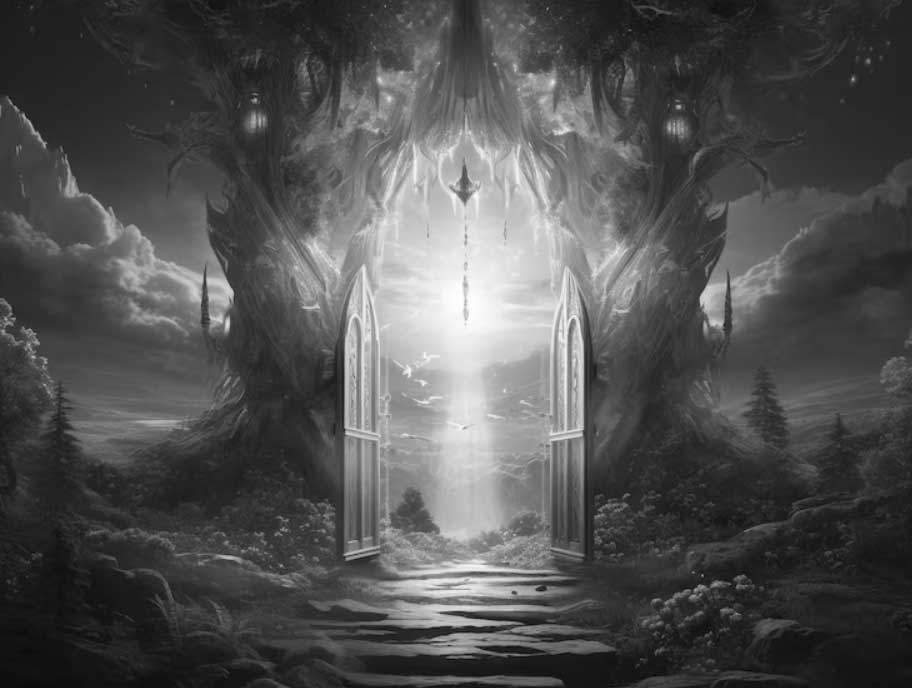
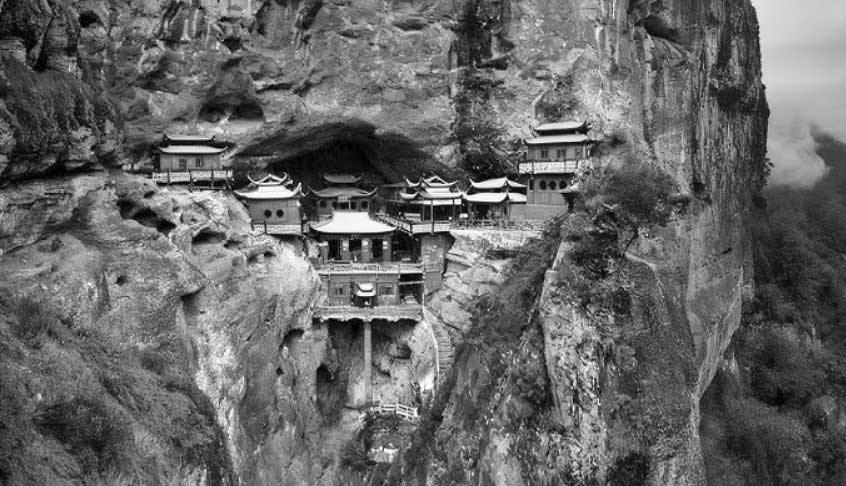
Mrs. Lin nodded, her gaze now seeming to look into some indefinite space. “The elders of Wangyou Town often pass down tales of ‘hidden doors’—places where it is believed the boundary between our world and other worlds becomes as thin as a morning mist. With just the right moment of convergence, a completely different reality can be revealed. It is said that, especially at the transitional times of day like dawn or dusk, or on bright, full-moon nights, in the deep parts of the forests on those mountains…” She gestured with her chin toward the distant, hazy mountains. “…someone has gotten lost, and just for a moment, found themselves in a completely unfamiliar place, where the trees, the houses, even the sunlight were different. Then, in the blink of an eye, they were back in the same spot, but the feeling of how much time had passed was very different.”
Listening to her words, I felt a cold chill run down my spine. Was she talking about other dimensions? About the concept of a multiverse? These were concepts that even our most advanced theoretical physics has only dared to speculate on and was still fiercely debating. Yet here, a simple-looking old woman was speaking of them as passed-down stories, as beliefs that had existed for generations.
“These ‘other worlds’ you mentioned… what are they really like?” I tried to keep my voice calm, though my mind was in turmoil.
Mrs. Lin shook her head slightly. “I’ve only heard the stories myself, my child; I’ve never seen it with my own eyes. People say some places are incredibly beautiful, always filled with light and wondrous, melodious sounds and music, but other places are very gloomy and frightening. But it seems they often exist in parallel with this world of ours, right here, it’s just that our mortal eyes cannot see them, just as we cannot see the air around us. It is said that only those with truly tranquil minds, or at very special times, when fated connections align, can catch a glimpse or be fortunate enough to see.”
Mrs. Lin’s words, though presented as folk tales and ancient beliefs, resonated strangely with what we had experienced and felt during our short time in Wangyou Town. The feeling of an “elastic” flow of time, the seemingly slower aging of some residents, the strange dream we both shared, and now the concept of parallel spaces, of “hidden doors”… All of it seemed to be gradually connecting, forming an incredibly complex and mysterious picture of the true nature of this place.
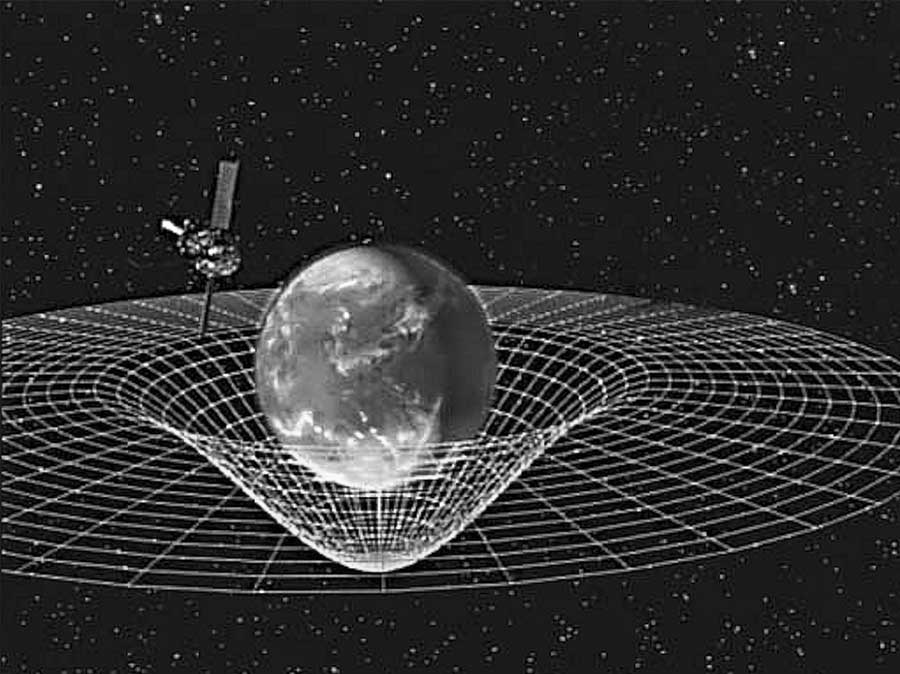
This wasn’t some advanced physics theory about the curvature of spacetime or the complexities of string theory. This seemed to be a form of experience, a direct perception of the universe’s workings from a completely different perspective—a perspective that my empirical science had perhaps not yet been able to touch. In this place, time did not seem to be an immutable straight line, and space was not just the familiar three tangible dimensions. They seemed more flexible, more malleable, and could exist in many more layers and levels than we ever imagined.
I looked at Qing Ling and saw that she, too, was silently pondering, her brows slightly furrowed. Perhaps these concepts, though strange and hard to believe, were not entirely foreign to the Eastern cultural foundation she had been exposed to since childhood, a culture where stories of celestial realms, the underworld, and cultivators with the ability to enter other dimensions have existed for thousands of years.
“So, ma’am, is it because they live in such a special place,” Qing Ling slowly asked Mrs. Lin, “that the people of Wangyou Town have such a sense of peace, less bound by time and age than people elsewhere?”
Mrs. Lin smiled faintly, a smile full of meaning. “That could very well be it, miss. When people know that this world is actually much larger than they thought, that time is not always the sole master governing everything, and that death is perhaps not a complete end, they will naturally let go of the trivial worries and struggles of daily life. They will learn to live more slowly, to listen more, and to feel more deeply. And when a person’s soul is truly at peace, perhaps the passing years will also be kinder to them, don’t you think?”
She stood up calmly, the bamboo fan still waving gently in her hand. “Well, I should probably go inside and prepare for dinner. You two feel free to sit here and enjoy the sunset.”
She went inside, leaving Qing Ling and me there with a jumble of emotions and countless unanswered questions. Her explanations were not scientific, nor was there any concrete evidence to verify them, but they touched a deeper level of consciousness within us, partially answering our questions about Wangyou Town in their own unique way. It did not dispel the mystery of this place; on the contrary, it made us feel more keenly the existence of wondrous things beyond ordinary human understanding.
We sat there, silently watching the mystical violet of the sunset gradually seep into every lingering cloud, every green treetop, as if the whole world were breathing in unison with the heavy thoughts in our hearts. My mind was in turmoil with unanswered questions. Could it be that what I had always known as “reality” was just an incredibly thin slice of a far more complex, multi-layered, multi-dimensional universe? Could it be that time and space were not always immutable constants, but could be “stretched” and “bent” by factors our science had yet to discover, such as a person’s state of mind, or the special energy field of a location?
I had no answers for any of it. But sitting there, watching the mystical violet sunset descend upon the Wangyou valley, I knew that the limits of my own thinking were being pushed back, bit by bit. This world, it seemed, held far too many wonders and mysteries, far beyond what my thick science books had ever described.
Expanding the Mind Before the Unknowable
Sunset in Wangyou Town was truly a different experience. It didn’t fade quickly as in other places, but seemed to linger like an old friend, slowly spreading layers of golden, then soft orange, then mystical violet light across the landscape, as if trying to hold everything back for a moment longer before sinking completely into darkness. Qing Ling and I sat almost motionless on the old wooden bench on the inn’s porch, our eyes silently following the magical transformation of colors in the sky and on the surface of the placid river. The air began to grow cooler, carrying the characteristic damp scent of the earth and the fragrance of mountain plants after a long day in the sun.
The stillness here was not a deathly silence, but a profound peace, punctuated only occasionally by the unique sounds of the valley: the steady, gentle flow of the Wangyou River, the nocturnal symphony of insects beginning from the dense thickets along the bank, the soft rustle of leaves with each passing breeze. In the distance, a few flickering oil lamps had begun to light up in the ancient stilt houses, casting the silhouettes of people moving unhurriedly on the wooden walls. There were no sounds of TVs or radios, no roar of engines, only the primordial, pure rhythm of a life that seemed completely intertwined with nature.
I instinctively glanced down at my watch again. The second hand ticked on steadily, as diligent as a solitary traveler, trying to count each moment in a world where time had seemingly become utterly vague, no longer willing to obey its old rules. But that very mechanical, precise rhythm now felt completely foreign, pathetically out of place in the space of Wangyou Town. I looked up at the crescent moon that had just risen from behind the high western mountain, a moon that looked faint and magical in the weak twilight. In theory, I could estimate the time based on its position in the sky, but a vague sense of fatigue held me back. It seemed that trying to impose concrete numbers, dry logical calculations, on this place was a completely meaningless, even somewhat crude, act. I shook my head slightly, chuckled to myself, and then stopped looking at my watch.
Qing Ling let out a soft sigh and gently rested her head on my shoulder. The prolonged silence between us was not at all suffocating, but more like a deep empathy that needed no words. We were both experiencing, together, the very special atmosphere of this place.
“Ming,” her voice was a sudden whisper, so soft it almost blended with the night wind. “I was just thinking of Master Mo’s words… Back in Qingxi, everything he said about the soul and karmic force felt so foreign and hard to believe. But now, sitting in this space, those things seem to have gently seeped into my heart, as naturally as my own breath. They no longer feel fantastical or irrational at all.”
I was silent for a long moment, my gaze still on the shadows deepening on the placid river. Qing Ling’s words seemed to have touched upon the very thoughts that were still vague in my own mind. The continuous experiences over the past weeks, from the first meeting with Mr. Zhang Feng, to the hermit on the mountaintop, Master Mo with his profound interpretations, and now this very special space of Wangyou Town—they were all like seemingly disparate puzzle pieces that were now coming together to point to a larger, more complex picture of this world. “I know how you feel,” I replied softly, my voice also low. “In places like this, there seem to be very different laws at work, laws we’ve probably never known.”
Mrs. Lin called us in for dinner. The flickering oil lamp in the house cast long shadows on the old wooden floor. Tonight’s meal was again very simple and rustic: a plate of lightly stewed small river fish, a dish of freshly picked wild vegetables boiled and served with sesame salt, and a pot of fragrant, newly cooked rice. We sat around the low wooden table, eating slowly, deliberately. Mrs. Lin didn’t say much, only occasionally and kindly placing more food into our bowls, her benevolent eyes always holding a quiet, warm smile. The atmosphere of the meal was so simple, so intimate, unlike any meal I had ever had in fine restaurants or at noisy social gatherings. It had a special authenticity, a very simple connection between people, and between people and the surrounding nature.
That night, lying on the slightly creaking bamboo bed in the attic room, I found I was no longer tossing and turning with racing thoughts as on previous nights. I stopped trying to analyze or explain everything with dry scientific knowledge, and instead just quietly opened all my senses, letting my soul drift freely with the slow, deep rhythm of the Wangyou night. I felt the near-absolute stillness of the darkness here, broken only by the incessant chirping of insects from the garden and the faint, distant sound of the flowing river. I felt the cool night breeze seeping through the cracks in the windows, carrying the fresh scent of the mountain forest. I even felt the presence of the simple houses around us, of the people who were probably also sinking into a very peaceful sleep. It was as if something invisible, a special kind of tranquility, was enveloping the entire valley, seeping into every thought, calming the restless currents in my mind. I fell asleep without knowing when, a deep and dreamless sleep.
The next morning, as the first rays of the new day pierced through the thick mist still blanketing the valley, we woke up feeling unusually light and refreshed. The air was so pure that a single deep breath felt as if it had completely cleansed my lungs. The rhythm of life in Wangyou Town went on as usual, slow and incredibly calm. A few townspeople had started their day with their familiar routines: lighting the fire to cook an early meal, going to the river to fetch water, or herding buffalo out to the lush green pastures in the distance. Everything proceeded sequentially, rhythmically, without any hint of haste or rush.
We packed our few belongings, a feeling of wistful reluctance in both our hearts. Though we had only stayed in Wangyou Town for a few short days, this place had left a profound impression on our souls. When we went downstairs, Mrs. Lin had already prepared some hot rice cakes and a pot of fragrant herbal tea for our breakfast. She didn’t ask where we were going or what we would do next.
When we said our goodbyes to leave, she walked us to the end of the alley, where the trail began to lead back up the mountain. She gently pressed a small cloth bag into Qing Ling’s hand. Inside were some dried wild herbs that gave off a very gentle aroma. “This is a little medicinal herb from this land of Wangyou,” she said, her voice as even and unchanged as ever. “It will help you calm your nerves and sleep better. Take care on your journey.”
Qing Ling took the bag of herbs, thanking her profusely, her eyes a little emotional. I also bowed to her once more, trying to find words to express my gratitude and appreciation, but in the end, I could only say a very simple sentence: “Thank you so much, ma’am. We will never forget this place.”
Mrs. Lin just smiled faintly, a smile as benevolent and mysterious as the valley itself. “Wangyou Town will always be here. Whenever you wish to forget the sorrows of the world, just feel free to return.”
We set off, following the trail covered in decaying leaves. After walking a fair distance, I instinctively glanced back. Wangyou Town was still there, nestled peacefully in a sea of white morning mist, with only a few dark brown tiled roofs and wisps of cooking smoke faintly visible. It was like a beautiful dream, a world seemingly completely separate from the noise and haste of modern life outside.
I don’t know if I had truly “understood” all the secrets of Wangyou Town. Probably not. But at that moment, it no longer seemed so important. I suddenly realized that perhaps not all questions need an immediate, clear answer, not all mysteries must be unraveled by reason. Some things, it seems, simply exist, and our task is to learn to perceive, to learn to accept their presence with a more open soul. Some truths simply exist, beyond our current understanding and ability to explain. And accepting the existence of the “unknowable,” accepting one’s own limitations, is sometimes the first step toward expanding one’s thinking, toward approaching deeper levels of consciousness.
I gently squeezed Qing Ling’s hand, feeling its familiar warmth. The journey of the past few days had many points that were difficult to explain from a scientific perspective. But strangely, that no longer brought a sense of confusion or fear as before. A curiosity, a vague sense of excitement, was quietly kindling in my chest, urging me to move forward, to unveil more layers of the mystery of this wondrous East.
This article is an excerpt from the book “RED DUST, GOLDEN LIGHT” – which tells the story of Professor Wang Ming and his wife’s journey to uncover spiritual mysteries and many hidden truths in China.
If you wish to experience the full journey of thought and the unpublished insights of the work, please click the button below to own the complete book.
To explore more works from THE LIVES MEDIA, visit our book collection.