The Strange Antique Shop and the Mysterious Owner
After leaving Huanglongxi, the old woman’s stories about fated connections and karmic force kept circling in my mind and Qing Ling’s. For a man of science like me, those concepts sounded strange at first, but the more I thought about them, the more I saw a certain logic. It seemed there were other, deeper laws governing this life that I didn’t fully know. This trip was truly opening up many new things for us.
We decided to continue south, to an ancient city called Zhenyuan, said to be situated by the Wuyang River. People said Zhenyuan wasn’t very large but had many old streets, stilt houses overlooking the river, and several old stone bridges. It sounded interesting, so we found a small room in an inn in the old town, planning to stay for a few days to see what it was like.
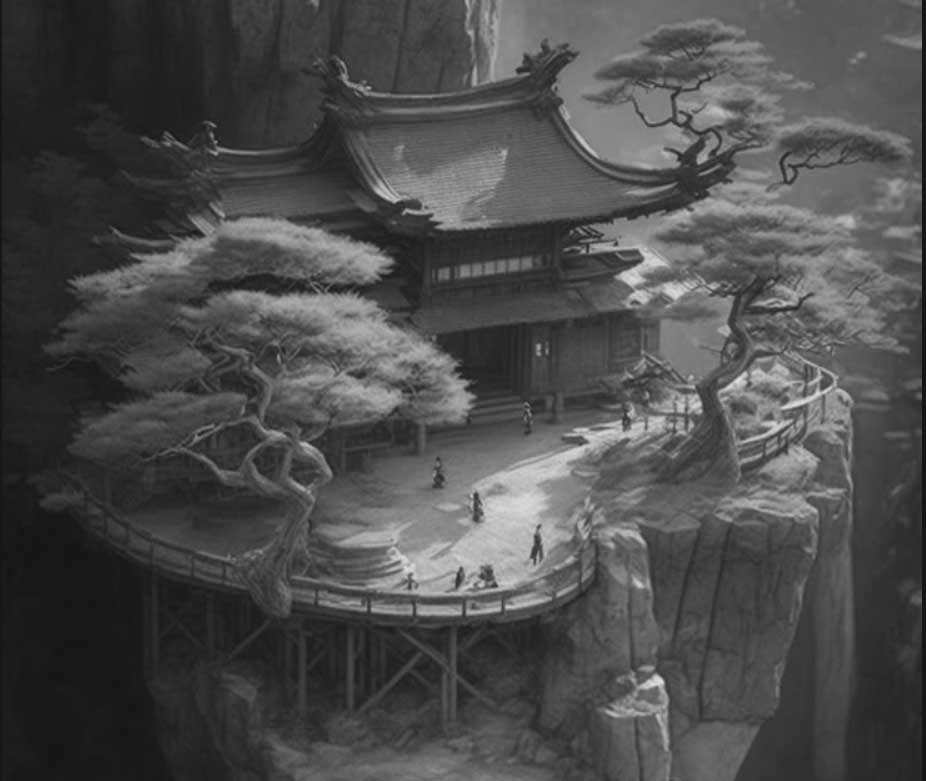
One afternoon, with the sun having softened, after visiting a few temples and taking a boat ride on the river, Qing Ling and I decided to take a walk through the small, stone-paved alleys of the old quarter. These alleys were less crowded than the main streets, flanked by old, moss-covered stone walls and wooden gates that were shut tight; only occasionally did we see a local pass by.
While wandering around, I happened to notice a wooden sign, looking very old, hanging hidden behind a bougainvillea trellis. On the sign were three Chinese characters, their paint faded, which read “Sui Yuan Ge” (Pavilion of Following Fate). Right below it was a low wooden door, only slightly ajar, looking no different from the surrounding houses. It probably wasn’t a bustling shop. If one didn’t look closely, one would walk right past it.
For some reason, I felt curious. “Ling, look,” I nudged my wife. “Sui Yuan Ge. The name sounds special, don’t you think?”
Qing Ling followed my gaze. She was fluent in Chinese and understood immediately. “Sui Yuan… Following Fate… It doesn’t sound like a normal shop,” my wife remarked, her eyes also curious. “Should we go in and have a look?”
I nodded. The name and its quiet exterior had something that drew me in. We gently pushed the wooden door.
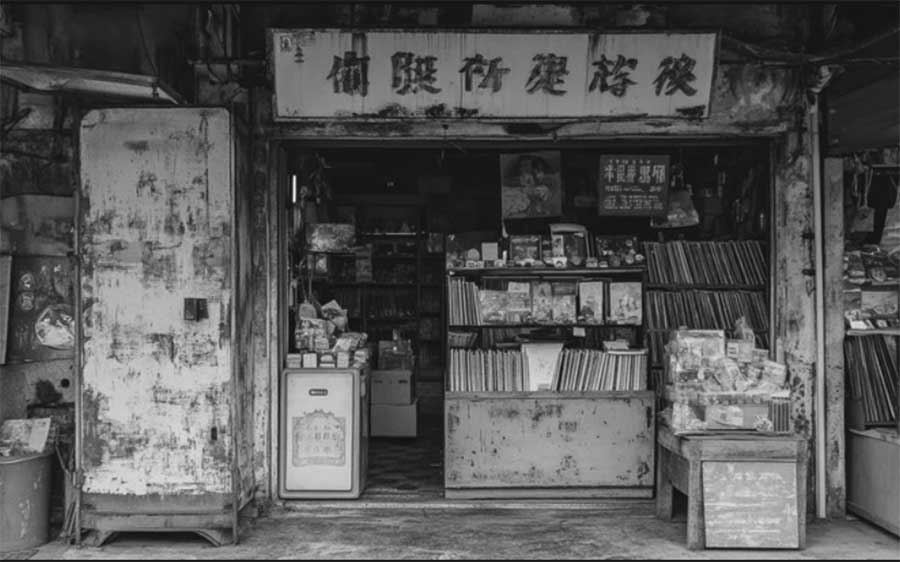
A small wind chime tinkled softly and then fell silent. Inside, the air was so still I could hear my own breathing. The light in the shop was dim, with only a few rays of afternoon sun filtering through paper-covered windowpanes, along with a small oil lamp in a corner. The air felt somewhat heavy, filled with the scent of old wood, dampness, and a faint, unidentifiable incense.
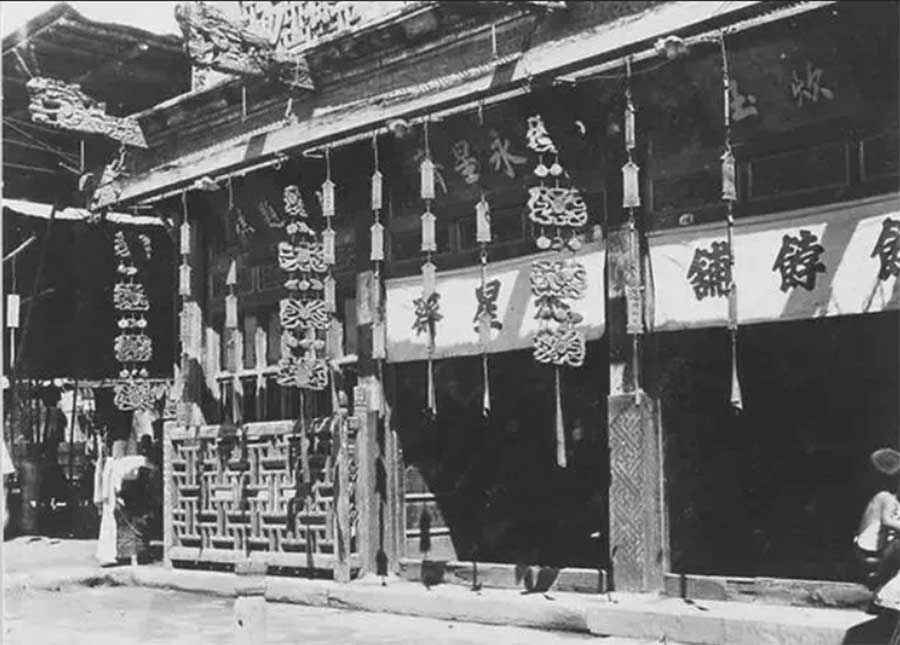
The room wasn’t very large, but it was cluttered with objects from floor to ceiling. On shelves, on tables, and even on the floor, there were old things everywhere: cracked ceramic vases, bronze Buddha statues that had turned green, old, yellowed painted scrolls, a few pieces of tarnished-looking jade and silver jewelry, an antique-style compass, a bronze mirror, an inkstone, and even strange items I couldn’t identify, looking like the tools of an ancient Taoist priest. Everything was arranged haphazardly, yet upon closer inspection, it seemed each item had its own place, having rested there for who knows how many years. A thin layer of dust covered almost everything—not the dust of filth, but the dust of time.
The atmosphere in this shop was very strange, quiet yet heavy, completely different from the places we had been to. It felt as if every old item here had its own story.
Then I saw the shop owner.
He sat motionless behind a high wooden counter in a corner, almost blending into the darkness with the pile of old objects around him. If not for the flickering oil lamp illuminating one side of his face, we might not have noticed he was there. He looked very old, his white hair sparse and tied neatly in a bun at the nape of his neck. He wore a long, old black silk robe with a high collar. He was small, his back slightly hunched, but his eyes were strange. They were not clear like Master Mo’s or the knitting woman’s, but deep and jet-black, staring at us without blinking. The gaze was not scrutinizing, not curious, not inviting; it was like the eyes of someone who had seen too much in this world, now just silently registering the arrival of two more strangers into his domain.
He said nothing when we entered, nor did he stand up to greet us. He just sat there, his hands on the counter, his eyes fixed on us. His silence, combined with the shop’s peculiar atmosphere, made Qing Ling and me feel a bit overwhelmed, forcing us to tread softly on the wooden floor.
“Ex… excuse me, sir,” I cleared my throat, speaking first to break the heavy air. “We were just passing by and found your shop interesting, so we thought we’d take a look.”
The shop owner just gave a slight, almost imperceptible nod, saying nothing. His eyes were still on us, a gaze that seemed to read every thought in my mind. Qing Ling moved closer to me; I knew she was feeling a bit tense too. There was something not normal about this place and its owner, something that was both intriguing and warranted caution.
Sui Yuan Ge. A mysterious owner. Old objects filled with the traces of time. A thought suddenly popped into my head: our coming here was no accident. Like the name of the shop, perhaps “fate” had brought us here, to some turning point that I was not yet aware of.
Each Object a Story of Choice and Fate
The shop owner remained silent, making the atmosphere in the shop even more peculiar. Qing Ling and I exchanged a glance, then began to look around more closely. The path was narrow; we had to squeeze past shelves of objects and things arranged on the floor. I scanned countless old items, each one looking mysterious, yet I felt as if something was silently guiding us.
Qing Ling stopped in front of a small, very old glass cabinet, inside which were a few pieces of jade and silver jewelry. Her eyes were fixed on a jadeite pendant, deep green in color, skillfully carved in the shape of a phoenix, but one of its wings had a small, barely visible crack. The jade, despite a thin layer of dust, still shone with a quiet, proud beauty.
“What beautiful jade,” Qing Ling said softly, almost to herself. She placed her index finger on the glass, as if wanting to touch it.
Just then, the shop owner’s deep, hoarse voice sounded from behind the counter, though he had not moved an inch. “A phoenix with a broken wing. It is beautiful, yes, but it is the beauty of regret.”
The sudden voice startled Qing Ling and me. We turned to look. He was still sitting there, his jet-black eyes fixed on the jade pendant in the cabinet.
“Regret?” Qing Ling asked, her voice curious.
The owner didn’t look at us, his eyes still on the jade. “Its former owner,” he said evenly, “was a woman of great talent and beauty, from a distinguished family. She stood at a crossroads: one path was to live a comfortable, wealthy life according to her family’s wishes; the other was to follow love, to be with a poor but compatible artist.” He paused for a moment. “She chose the first path. She lacked nothing in terms of glory and wealth, but her heart was never happy. She lived her whole life in luxury, but never had a single day of true ease. That crack on the phoenix’s wing… is the mark of that choice.”
He told the story concisely, his voice betraying no emotion, yet it felt heavy. It didn’t sound like a story fabricated to sell an item, but like a truth he had read from the object itself. Qing Ling stood silently staring at the pendant, her expression unreadable. The beauty of the jade was no longer simple; it seemed to be imbued with a certain sadness.
I felt a slight chill on the back of my neck. Could it be that every item here had its own story? A story of choice and its consequence? I moved deeper into the shop, my eyes drawn to a bronze compass resting on a low wooden table, covered in dust. It was unlike modern compasses; its needle was shaped like a small turtle, with strange ancient symbols carved on its shell. The bronze casing was tarnished, the glass face slightly clouded, but the turtle-shaped needle lay still, pointing in some direction in the darkness.
I instinctively reached out and lightly touched the cold glass face of the compass. A strange sensation passed through my fingertips, like a fleeting memory flashing and then disappearing: the image of a great merchant fleet caught in a sea storm, with high waves and strong winds, and a middle-aged man standing on the deck, clutching a compass identical to this one, his eyes both resolute and somewhat bewildered as he stared into the storm.
“The pathfinding compass,” the owner’s voice sounded again, cutting through the images in my head. I turned and saw he was looking at me, his black eyes seeming to have read what I had just seen. “It once helped a merchant find a sea trade route, bringing him immeasurable wealth.”
I waited silently for him to continue, sensing there was more to the story.
“But,” he went on, his voice still even, “on that path, to get things done, he had to make many choices. Sometimes against his conscience, sometimes abandoning friends, sometimes using tricks. This compass only helped him find the right direction of the wind, the water, the profit, but it did not show him the direction of morality, of human feeling.” He sighed very softly, almost inaudibly. “At the end of his life, he was very rich, but he was alone. He died on a pile of gold with no family by his side. The compass pointed to the right direction for wealth, but it lost the direction of the heart.”
The story of the compass was another example of choice and fate. Material success sometimes comes at the price of inner emptiness. Each old object in this shop seemed to be a witness to life’s turning points, to the decisions that had shaped a person’s destiny. They were like mirrors, not only reflecting the past of their former owners but also silently questioning those who looked at them, like Qing Ling and me now, about our own choices.
I looked around the room full of objects, each one lying dormant under the dust of time, but I felt they were not silent. They seemed to be whispering their own stories—stories of dreams, love, betrayal, courage, weakness, sacrifice… all revolving around choices made at crucial moments. This Sui Yuan shop was not just a place that sold antiques; it felt like a crossroads of destiny, where lives met in silence.
Between Arranged “Destiny” and “Free Will” in Cultivation
The stories of the phoenix with the broken wing and the misguided compass lingered in my mind and Qing Ling’s as we continued to browse the other old items in the Sui Yuan shop. It was as if every object here was a lesson on choice and its consequences, on the paths of fate that had been forged by past decisions.
I walked closer to the wooden counter where the shop owner sat. He was as still as before, his eyes fixed on the empty space in front of him, seemingly lost in thought. The flickering oil lamp cast shifting shadows on his aged face, making him appear all the more mysterious.
“Sir,” I began, trying to keep my voice normal despite the turmoil in my heart, “the stories you just told… about the former owners of these items… it sounds as if their fates were sealed by wrong choices. So, is everything in a person’s life already predetermined? Do we truly have the freedom to choose, to change our path?”
This was the question that had been troubling me ever since I heard the old knitting woman speak of fated connections and karmic force. If everything was the result of karma from past lives, if all connections were already woven, then what was the point of striving in the present?
The shop owner slowly turned to look at me. This time, his eyes no longer strayed but looked directly into mine, a gaze so deep it felt as if it could read my very thoughts. He was silent for a long moment; the shop sank back into a heavy stillness, with only the faint ticking of some old grandfather clock in a corner.
Then he spoke, his voice still deep and slow. “Destiny and free will… they are like two sides of the same coin, young man.”
He pointed a bony, slender finger at a scroll painting of a mountain landscape hanging on the wall behind him. The painting depicted overlapping mountain ranges shrouded in mist, with a tiny, winding path, sometimes visible, sometimes not, on a mountainside.
“Each person’s path in life,” he said, “is like that trail in the painting. The path itself is pre-formed by the layout of the mountains and rivers—which are like karmic force, like the circumstances of one’s birth, family, and society. That is the part of ‘destiny’ created by the karma one has generated before, by the family and society one is born into. That path can be difficult or easy, wide or narrow.”
He paused, looking at me as if gauging my understanding. “But,” he emphasized, “the person walking on that path has the complete right to choose how to walk. He can walk carefully, avoiding potholes and sharp rocks. He can choose to rest when tired, or try to go faster. He can choose to help others along the way, or selfishly push ahead. He can even choose to turn onto a different path, though it may be harder, if he feels the old one no longer suits him.”
“You mean…?” I asked, beginning to understand.
“I mean,” he replied, “the initial scenery, the initial path, may be arranged to some extent by past karma—that is ‘destiny.’ But how you walk, the choice you make at each fork, that is ‘free will’—no one can decide that for you. And it is these present choices that continue to create new karma, which can change the path ahead, and even change the final destination.”
He looked again towards the old items in the shop. “The former owners of these things, each had their own path. Some were born into favorable circumstances but chose to go backward. Some started with difficulties but strove forward and, by choosing the right path, ascended. The issue is not the starting point, but the choices made along the way.”
“Then what about cultivation?” Qing Ling asked unexpectedly. My wife had come to stand beside me at some point. “Does cultivation help a person see their path more clearly and make better choices?” Her question showed that what we had heard about cultivation from the hermit and Master Mo had truly made her think.
The shop owner turned to Qing Ling, a very faint, almost imperceptible smile touching his face. “You ask a very good question,” he said. “Cultivation, if on the right path, is precisely the way to purify one’s mind, to discard the desires and attachments that obscure the innate goodness and wisdom of a person.”
“When the mind is pure and tranquil, one can see things more correctly, not clouded by emotions or self-interest. They will know what is good and what is bad, what is right and what is wrong. From there, they can choose what is in line with principles, with their conscience.”
He paused, his voice becoming a bit more serious. “Furthermore, righteous cultivation also helps one to reduce the bad karma created in the past and accumulate more virtue and blessings. When karma changes, the path of ‘destiny’ can also change accordingly. A difficult path can become easier, a dark one can become brighter. That is the power to change one’s fate by cultivating one’s moral character.”
The shop owner’s explanations illuminated many things in our minds. They did not deny karma or destiny, but emphasized the free will and choice of each person, especially when that person walks on a righteous path of cultivation. Destiny was not something that bound you; it was more like a river, and you could learn to steer your boat along the favorable currents, avoid the dangerous spots, and even make the flow better.
I felt a sense of relief. I understood that I was not in complete control of my fate, but I had the right and the responsibility to influence it—with every choice, every day. And the path of cultivation, according to him, was the best way to gain the wisdom and strength to make those right choices.
The Crossroads Ahead and Future Possibilities
After the shop owner’s explanations about destiny, free will, and cultivation, the atmosphere in the shop felt different. It was no longer as heavy as before, but as if something had just been illuminated. My mind felt lighter, but at the same time, I understood more clearly the weight of each choice that lay ahead.
As we were about to thank the owner and leave, my eyes were suddenly drawn to an object tucked away in the darkest corner of the shop, on a low ebony shelf. It wasn’t a magnificent or strange antique like the others. It was just a small, square wooden box, dark brown in color, looking old yet strangely clean, as if it had just been carefully wiped down. What caught my attention was that its lid had no lock, no carved patterns, just a smooth wooden surface, faintly gleaming under the oil lamp. It sat there, silent and discreet, yet it gave me a strange feeling, as if it held something very important inside.
I instinctively walked closer to the box, and Qing Ling followed, curious. I suddenly felt the urge to open it and see, but I also hesitated, an unclear feeling, as if opening this box would lead to something from which there was no turning back.
I glanced at the shop owner. He was still sitting behind the counter, but his dark eyes were now looking at the wooden box, and then at us. An inscrutable smile flickered across his lips again.
“That box…” Qing Ling asked softly, her voice a little hesitant, “what’s inside it?”
The shop owner did not answer immediately. He just looked at us, then back at the box, his eyes very deep. “Inside?” he repeated, his voice hoarse. “It could be a map to a treasure. It could also be a curse from ancient times. Or perhaps… it’s just an empty box.”
He paused, looking directly into our eyes. “It depends on the one who opens it, on their fated connection and their choice.”
His words, though vague, carried great weight. The unadorned wooden box suddenly became a metaphor for the very crossroads we seemed to be standing at. To continue exploring this path, to go deeper into the spiritual mysteries that had just been revealed, or to return to the familiar life of science and reason? Either path had its gains and losses, just like what might be in the box.
I looked at Qing Ling. Her eyes were also full of indecision. She understood the shop owner’s meaning. It was as if we were standing before an invisible door, and whether to step through it or not was a decision only we could make. That choice would not only affect the coming days, but could also shape the long road ahead, perhaps even involving the matters of karmic force and reincarnation we had heard about.
We stood there for a long time, looking at the silent wooden box in the dark corner. Neither of us reached out to open it. Perhaps, now was not the time to decide. Or perhaps, the mere realization that we were at such a crossroads was already an important thing in itself.
Finally, I took a deep breath, turned, and bowed to the shop owner. “Thank you for your valuable advice.”
Qing Ling bowed as well. The shop owner just gave a slight nod, his eyes unchanged, still as mysterious and profound as before.
We turned and walked out of the Sui Yuan shop, leaving behind the solemn space filled with antiques and stories of fate. The wind chime on the door tinkled softly again and then fell silent. The afternoon sun outside had faded, signaling the end of the day.
Walking on the ancient stone-paved alley, my mind was in turmoil, yet there was also something clearer. The Sui Yuan shop and its mysterious owner had not given us a final answer, but they had helped us better understand the power and responsibility of choice. The road ahead was still misty, with countless possibilities and turns. But now, we understood that each step we took, each choice we made, was contributing to the very ‘destiny’ we would meet. The question of the unanswered wooden box and the future possibilities it evoked would surely stay with us. The next day, carrying these thoughts, we left Zhenyuan and continued our journey towards Leshan, where the famous Giant Buddha we had planned to visit awaited.
The Leshan Giant Buddha and a Mundane Tourist Destination
The next day, carrying with us the thoughts of the wooden box and the choices in life, we left Zhenyuan. The car took us south towards Leshan, home to the Giant Buddha I had heard so much about but never had the chance to see. Qing Ling also seemed to be looking forward to it, as this was one of China’s most famous Buddhist heritages.
The road to Leshan was not too long, and the scenery on both sides, with its terraced fields and interspersed villages, was quite beautiful. Upon arrival, the first thing that struck me was the scale of the area. Unlike the small temples or secluded hermitages we had visited, Leshan was a massive tourist complex, with a vast parking lot packed with all kinds of tour buses, and a dense stream of people.
We followed the crowd into the scenic area. To get a panoramic view of the Giant Buddha, the best way was by boat on the river. Our boat slowly approached the cliff face where the Buddha was carved. As the colossal statue gradually came into view, no words could truly describe the overwhelming feeling. It was a seated Maitreya Buddha, over seventy meters tall, carved directly into the red sandstone cliff, looking down at the confluence of the Min, Dadu, and Qingyi rivers. The scale of the work was astonishing, especially considering it was built over a thousand years ago. I tried to imagine how the ancients had managed to create such a magnificent masterpiece. The Buddha’s head was level with the mountaintop, his feet resting on the river, his posture at once majestic and compassionate. Seen from a distance, the entire statue seemed to fuse as one with the mountain, a marvelous fusion of human hands and nature.
Qing Ling also seemed very moved. She gazed in silence, occasionally raising her camera to take a few pictures. I knew that for a cultural researcher like my wife, witnessing such a heritage firsthand was a very special experience.
However, alongside the grandeur of the structure, I could not help but notice the surrounding atmosphere. Loudspeakers broadcasted introductions continuously in multiple languages, the chatter of people was noisy, and vendors hawked souvenirs along the riverbank and on the walkways. After the boat ride, we also tried climbing the steps carved into the cliffside to get closer to the statue. The higher we went, the more crowded it became, at times we had to jostle our way through. Around the Buddha area, numerous stalls sold everything from small Buddha statues, bracelets, and prayer beads to various snacks and drinks. Many people even rented period costumes for photos. The scene was somewhat chaotic and bustling, a far cry from the serenity and solemnity I had imagined for a sacred place.
Compared to the near-absolute stillness at the hermit’s mountain abode, the time-bending atmosphere of Wangyou Town, or even the rustic simplicity of Huanglongxi, Leshan had a completely different air. This was truly a world-famous tourist destination, with all the accompanying hustle and commercial elements. I had no intention of judging, as perhaps this was inevitable for places that attract large numbers of tourists. But in truth, amidst the bustling crowds and the noise, I did not feel any special “energy,” nor did I have any kind of spiritual encounter like in the previous places. This trip, for me, was mainly about admiring a great work of architecture and sculpture, a testament to the faith and creativity of the ancients.
We had planned to stay in Leshan for a few more days to visit some other old temples nearby that were said to be very sacred. But one evening, while we were having dinner at our inn, Qing Ling suddenly received a phone call from the US. On the phone, her voice was at first surprised, then turned to alarm and became choked up. I saw her eyes turn red. After hanging up, Qing Ling turned to me, her voice trembling: “My love… my maternal cousin in Shanghai… has just passed away suddenly. My mother just called to tell me.”
This was the cousin Qing Ling had been quite close to back in Shanghai, though they had had few opportunities to contact each other after she moved to the US. The news was so sudden that it stunned us both. Although we were in the midst of a journey full of wondrous discoveries, a family emergency was something we could not ignore.
“We have to go back to Shanghai immediately,” Qing Ling said. Though very sad, her voice was calmer now. “I want to go back to pay my respects and to support my aunts and uncles there.”
I understood my wife’s decision. Despite a twinge of regret at having to pause our unfinished journey, this was what needed to be done. “Alright, my dear,” I said, taking her hand. “We’ll arrange to go to Shanghai as soon as possible.”
And so, our plan to explore more of Sichuan had to change abruptly. The journey could not continue as planned; instead, there was sad news from home and a hasty decision to head for Shanghai.
This article is an excerpt from the book “RED DUST, GOLDEN LIGHT” – which tells the story of Professor Wang Ming and his wife’s journey to uncover spiritual mysteries and many hidden truths in China.
If you wish to experience the full journey of thought and the unpublished insights of the work, please click the button below to own the complete book.
To explore more works from THE LIVES MEDIA, visit our book collection.