Modern Shanghai and a Chance Introduction
Traveling from the mountainous region of Sichuan to Shanghai was like stepping from one world into another. In just a few hours on a comfortable high-speed train, we left behind the mossy ancient towns and misty mountains, only to find ourselves in the midst of a glamorous, bustling Shanghai that was overwhelming. Skyscrapers soared side by side, neon lights blazed through the night, and the flow of traffic was incessant. For me, this was a fairly familiar sight of a major metropolis, but for Qing Ling, the emotions were likely much more complex. This was the city where she was born, where her childhood memories were made before her family moved to the US.
We arrived in Shanghai with a mix of awe and sorrow, as the main purpose of this sudden trip was to attend the funeral of Qing Ling’s cousin. His passing was so abrupt that it had shocked and saddened the entire family here. As soon as we got off the train, we saw Qing Ling’s aunt and uncle waiting for us, their faces tinged with sadness. For the next several days, we spent most of our time at our relatives’ home, participating in the rituals and receiving guests according to custom. He was, after all, Qing Ling’s maternal relative, and being present at this time was the proper thing to do, showing respect and affection for the family, even though the years of distance had made the relationship less close than before. The atmosphere in the house was quite somber. Qing Ling was also a bit sad and wistful as she recalled her childhood memories with her cousin, but she mostly focused on sharing in the family’s grief and observing the proper etiquette.
During those times, I also took the opportunity to call home to the US to check on our children. Fortunately, they were grown up and understanding, so they weren’t too worried about their parents having to stay in China a little longer than planned for a family matter.
After the funeral for Qing Ling’s cousin was over, the atmosphere in the house became a little less tense. People began to have more time to sit and talk. One evening, while we were having a family dinner, a friend of Qing Ling’s uncle came to visit. His surname was Chen, and he was about her uncle’s age, looking like a kind, cheerful man. After inquiring about the family matters, the conversation gradually shifted to current events and health.
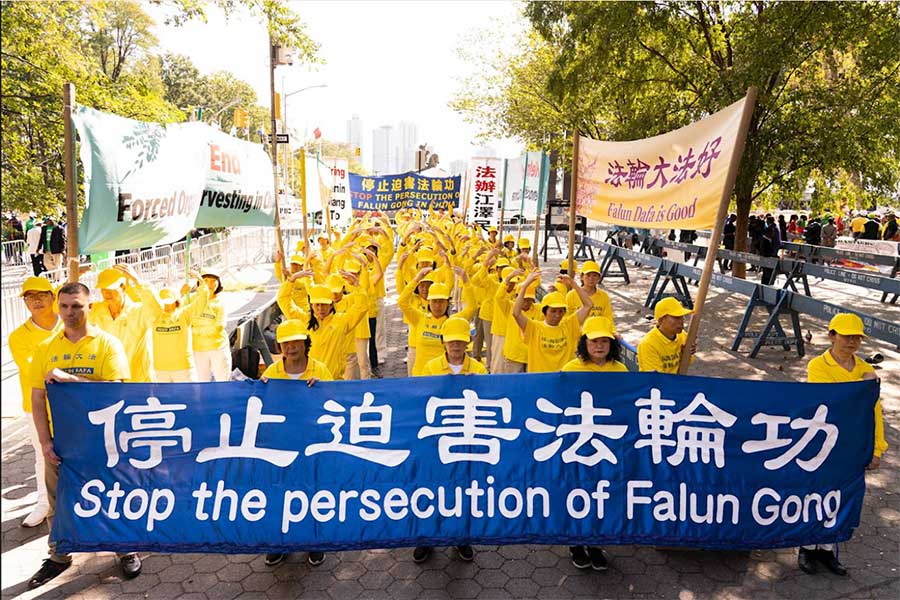
In the middle of the conversation, Mr. Chen suddenly mentioned a practice that many people in his neighborhood had taken up. “Lately, a lot of people in my area are practicing a qigong called Falun Gong,” he said, his tone very natural.
Qing Ling and I looked at each other upon hearing Mr. Chen’s words. The name Falun Gong sounded vaguely familiar. I seemed to recall having skimmed over some information about it online or in a few English-language newspapers in the US, something about this practice being suppressed in China. I hadn’t paid much attention at the time, only vaguely aware that something like that was happening.
“Falun Gong?” Qing Ling asked softly, her voice holding a hint of surprise and caution. “Mr. Chen, is that the qigong that… is being suppressed by the government here? I seem to remember reading some news about this in the US.”
Hearing Qing Ling’s question, Mr. Chen looked a little surprised, then he nodded, his voice also lowering a bit. “Ah… yes, you know about that too? That’s right, it is happening. I don’t understand why a practice that’s good for your health and teaches people to be good according to Truthfulness-Compassion-Forbearance would end up like this.” He sighed, then continued, trying to keep his voice normal. “But many people still believe in it, still practice secretly. The old folks in my neighborhood who practice all seem to be healthier and in better spirits. There’s an old lady who used to have constant back pain and difficulty walking, but after practicing for a few months, she now walks briskly and has a rosy complexion.”
He then lowered his voice even more, looking around with greater caution. “Well, this matter is complicated; we shouldn’t discuss it in depth here.” He quickly changed the subject, clearly not wanting to delve into this sensitive issue.
Mr. Chen’s words, though brief and somewhat evasive, sparked many thoughts in Qing Ling and me. So the information we had skimmed over was true. A seemingly good qigong practice, believed in by many people, was being suppressed by the government. What was really happening here? Our initial curiosity was now mixed with a sense of unease and an urge to find out more. “Falun Gong… Truthfulness-Compassion-Forbearance… Suppression…” Those words began to loom larger in our minds.
A Fateful Encounter in the City and a Precious Book
A few days after the conversation with Mr. Chen, my wife’s uncle’s friend, the words “Falun Gong,” “Truthfulness-Compassion-Forbearance,” and the “sensitive” atmosphere he had mentioned kept circling in my mind. My wife also seemed to be thinking a lot about it. Though it was only fleeting information, it had sparked an indescribable curiosity and a sense of unease.
One weekend morning in Shanghai, the weather was quite pleasant. After several days spent mostly with relatives for the family matter, we decided to go out for a walk to change the atmosphere. Qing Ling wanted to visit a park near her aunt and uncle’s home, a place she used to play in as a child. The park was right in the city center, quite large with many green trees, and crowded with people doing their morning exercises. The atmosphere here was bustling and modern, a stark contrast to the tranquility of the ancient towns we had visited.
We found a stone bench under a tree and silently watched the people. Some were practicing Tai Chi, some were dancing to music, others were power-walking. Qing Ling had brought her notebook and occasionally jotted something down. As for me, my familiar briefcase still slung over my shoulder, my mind was wandering over what we had been through, and what Mr. Chen had just said. Was that Falun Gong practice really as good as he said, and why was the government making things difficult for it?
Lost in thought, I was suddenly startled by an unusual commotion nearby. Not far from where we were sitting, towards the park entrance, I saw a scholarly-looking man of about forty, wearing glasses and a simple shirt, being stopped by two other men in plainclothes who looked rather aggressive. The conversation between them seemed tense; the scholarly man was trying to explain something, but the other two appeared not to be listening. One of them even shoved him hard on the shoulder.
A vague sense of unease arose. The behavior of those two men was not like that of ordinary people, but more like plainclothes police—something I was beginning to learn to recognize. The scholarly man looked a bit frightened but tried to remain calm, his eyes darting around as if looking for an escape or help.
Then, things happened very quickly. When the two plainclothes officers were not paying attention, the scholarly man suddenly took a step back, his hand moving like lightning to pull a small object from his jacket pocket and skillfully tuck it into a crevice between two large decorative rocks near the tree where we were sitting. The action was so discreet and swift that if I hadn’t been looking in that exact direction at that exact moment, I would surely have missed it. Immediately after, the two officers closed in, grabbed his arms, and began to search him.
Qing Ling and I stared at each other, stunned, our hearts pounding. It was clear the man was in big trouble, and the object he had just hidden was surely what those officers were looking for. What was it? Was it related to the Falun Gong that Mr. Chen had mentioned?
The two officers searched the scholarly man thoroughly but found nothing. Their faces showed frustration and suspicion. They began to look around, their sharp eyes scanning the nearby area, including where we were sitting. I tried to maintain a calm expression, turning to watch the passersby as if I wasn’t interested, but my heart was on fire. If they found that object, the scholarly man would certainly be in danger.
An idea flashed through my mind. I had to do something. I couldn’t let them find it. Out of an impulse to help the underdog, and perhaps also a bit of curiosity about the hidden object, especially after what I had heard, I turned to Qing Ling and gave her a look. She understood and nodded slightly, though her face clearly showed her worry.
I took a deep breath, trying to act as natural as possible. I stood up, pretended to take a stroll, and casually passed by the crevice where the object lay. As I walked past, taking advantage of the moment when the two officers had their backs turned to interrogate the scholarly man, I quickly bent down as if to pick up something I had dropped, and in an instant, my hand touched the hard, lumpy object in the crevice. A small, coverless book, cold and firm in my hand. I skillfully picked it up, quickly slipped it into the briefcase I was carrying, and then continued walking as if nothing had happened, my heart still racing.
I walked a few more steps and then returned to where Qing Ling was sitting, trying to keep my expression normal. Qing Ling looked at me, her eyes a mixture of worry and a hint of admiration for my audacity. The two plainclothes officers, after finding nothing suspicious in the surrounding area and perhaps not wanting to cause too much of a scene in a public place, reluctantly let the scholarly man go. However, before leaving, they said something in a threatening tone and their eyes never stopped watching him. It was clear he was still not free from their surveillance.
After the two officers had disappeared, the scholarly man stood silently for a moment, adjusting his clothes and glasses, his face still a bit shaken but calmer. He glanced towards the crevice, and then his gaze fell on us. He nodded slightly as if in recognition, then slowly walked towards us.
I stood up, feeling a bit nervous. The book was now safely in my briefcase.
“Thank you,” the man said softly as he approached, his voice gentle and polite, a complete contrast to the dangerous situation just moments before. He looked directly into my eyes. “I saw that you… helped me.”
“It’s nothing,” I replied, also lowering my voice. “I saw they weren’t treating you very fairly. Is this… yours?” I cautiously gestured towards my briefcase, preparing to take the book out.
The man quickly waved his hand, his eyes showing clear vigilance as he glanced around. “Wait,” he said quietly. “They might still be watching me from a distance. It’s very dangerous for both of us if I take it back now.”
I understood. “Then… what should I do with it?” I asked, feeling a bit bewildered at having become the unwitting keeper of what seemed to be a very sensitive item.
The man looked at me with sincere, deep gratitude. “Could I trouble you to keep it for me for a few days? When it’s safer, I will find a way to contact you.” He paused for a moment, then looked at me with a subtle, appraising gaze. “You’re a foreigner, aren’t you? Traveling in China?”
“Yes, we are Chinese-Americans,” I replied.
He nodded slightly, a thoughtful expression on his face. “Perhaps… it was no accident that you found this book,” he said, his voice full of meaning. He looked towards my briefcase, where the book lay. “This is a very precious book. It explains the profound principles of the universe and humanity, and the path of true cultivation to return to one’s original, kind nature.”
He looked directly into my eyes once more. “If you truly have a fated connection with it, please try reading it. Who knows, it might be able to answer the things that you and your wife have been pondering, have been searching for on this journey.”
With that, he gave us another slight bow. “I must go now. Thank you both very much. Take care!” He hurried away, quickly blending into the crowd on the street, occasionally glancing back cautiously.
Qing Ling and I stood there, watching his figure disappear. The coverless book now rested quietly in my briefcase. It was not physically heavy, but I felt its weight in my heart. A precious book? Explaining the principles of the universe and the path of true cultivation? “Fated connection” again? The words of the strange man, along with the difficult situation we had just witnessed, had sparked an intense curiosity in me, mixed with a sense of responsibility and a strange guidance of fate.
That evening, after returning to our aunt and uncle’s home, we discussed the matter. Although we were very grateful for our family’s help, in order to study this book in peace, and also to avoid any unnecessary trouble for our relatives if the book was indeed as “sensitive” as we thought, we decided to find a place of our own. A few days later, after thanking and saying goodbye to our aunt and uncle, we found a small, quiet-looking hotel in an area a bit far from the center of Shanghai.
First Encounter with Zhuan Falun—Shock and Fascination
After settling into the new hotel, with our own private and quiet space, my heart was still unsettled from the incident in the park a few days earlier. I carefully took the coverless book from my briefcase and placed it on the table.
Just as I had first sensed, this was not a professionally printed book. It had no cover at all, just a stack of ivory-white paper, bound along the edge with a few flimsy-looking staples. The first page listed no author or publisher, only a line of large, bold Chinese characters, “Lunyu,” as the title for the introduction. A closer look revealed that the print quality was slightly faded in places; it was clearly a document that people had printed themselves to pass around. Its simple appearance only strengthened my feeling that this was something precious, yet forbidden.
“Are you really going to read it?” Qing Ling asked, her voice tinged with worry as she saw me examining the book. “It looks… unusual. And it’s connected to what happened in the park. What if we get into trouble?”
“I know,” I replied, my eyes still fixed on the book. “But that man asked me to hold onto it, and he spoke with such sincerity. I think I should know what’s inside. Besides, I’m curious.” Moreover, I couldn’t shake the feeling that this encounter and obtaining this book were not coincidental, but perhaps some kind of arrangement in our journey.
I flipped through the pages. It was all in simplified Chinese characters. Qing Ling, being much more fluent in Chinese than I, sat down beside me and began to read the first few passages aloud, slowly.
The language in the book was indeed very direct and simple, without the flowery or obscure metaphors of many ancient scriptures Qing Ling had told me about. The author seemed to be speaking directly to the reader, using very plain language to express incredibly vast concepts about the universe, about a being’s life, about the true purpose of being human. The book spoke of “the Fa,” of “cultivation,” and of the importance of “xinxing” (mind-heart nature).
One thing we noticed was that, although the book had no cover or title page, in the content, the author occasionally mentioned the name of the book he was teaching—it was “Zhuan Falun.” For example, one passage read: “This book of mine, Zhuan Falun, is teaching the Fa at a very high level…” or “My true purpose in imparting Zhuan Falun is to save people to high levels…”. It was through these details that we learned the name of the book we were holding.
At first, understanding what was in the book was not easy at all. Many terms like “Truthfulness-Compassion-Forbearance,” “karmic force,” “virtue,” “levels,” and “Falun”… were used with very deep meanings, quite different from what we knew. There were passages that lectured on the multi-layered structure of the universe, the simultaneous existence of many different dimensions, ancient civilizations, and the root cause of illness being karmic force… these things seemed to completely contradict the modern scientific knowledge I had learned and always believed in. My scientific mind kept raising questions; many parts seemed hard to believe.
“It’s incredible, isn’t it?” Qing Ling said after reading a passage about different types of extraterrestrials and their interference in human society. “The writing is very direct, but the content… it’s truly beyond imagination.”
“It is,” I nodded. “If you just skim through it, it’s easy to think it’s not real. But…” I hesitated. “…for some reason, I don’t want to stop reading.”
There was a strange pull from these simple pages. Despite our initial skepticism, we were drawn in without realizing it. The deeper we read, the more astonished we were by the coherence, logic, and tight system of the principles presented in “Zhuan Falun.” The book didn’t just present concepts; it explained their origins, nature, and interconnections in great detail, from the smallest to the largest, in a way that was unexpectedly consistent and profound.
And strangely, these principles seemed to perfectly explain the questions and strange things we had experienced throughout our journey. When the book lectured on true qigong and spiritual cultivation disciplines, the images of Mr. Zhang Feng and the hermit on the mountain came back to me. When it lectured on the soul, karmic force, reincarnation, and the ability to change one’s destiny, the words of Master Mo, the old knitting woman, and the owner of the Sui Yuan shop seemed to be illuminated, seen from a higher perspective. When it lectured on other dimensions and the relativity of time, the experiences in Wangyou Town no longer seemed entirely irrational.
In particular, when “Zhuan Falun” explained that “Truthfulness-Compassion-Forbearance” is the supreme characteristic of the universe, the sole standard for measuring good and bad, and the foundation of all cultivation, I felt a powerful shock in my heart. It was simple, direct, yet all-encompassing. It was the root, the guiding compass I seemed to have always been searching for without knowing it.
I looked up at Qing Ling. Her eyes were wide, filled with an indescribable emotion and joy. “Ming,” she said, her voice trembling slightly. “This book… I feel… it’s real. It is the True Fa!”
I understood her feeling. I was undergoing a similar awakening myself. Like a person walking in darkness who suddenly sees the morning light. Like a thirsty person in the desert who finds a cool spring. All the scattered pieces from my previous spiritual experiences seemed to be arranged by “Zhuan Falun” into a complete, clear, and meaningful picture of the truth. Although my scientific mind still had a few points that needed more time to ponder, deep in my heart, I knew I had found something incredibly precious.
Profound Principles and Deep Inner Shock
For the next few days in Shanghai, our lives seemed to revolve around the coverless book called “Zhuan Falun.” Instead of visiting the famous tourist spots of this glamorous city, we spent most of our time in our hotel room, reading and reflecting together. The book had a strange pull, making it impossible for us to put it down. During the day, we took turns reading, sometimes aloud to each other, other times silently pondering on our own. At night, under the lamp, we often stayed up late, discussing what we had just read—sometimes things that resonated deeply with us, other times points we still found hard to understand. It felt as if we were embarking on the greatest exploration of our lives.
This book was truly special. The more I read, the more I perceived an unusual profundity in every word. It was unlike any religious or philosophical text I had ever known. The book spoke of very grand things, from the universe with its countless different dimensions to the most minuscule things within matter, even surpassing what my knowledge of modern science knew. It also spoke of the true origin of human beings—that we are not just this physical body, but have something more fundamental, called the Primordial Spirit, and that the purpose of coming to this world is not merely to enjoy material things, but to cultivate, to return to one’s original, good nature.
The concept of “Truthfulness-Compassion-Forbearance” as the fundamental characteristic of the universe was repeated time and again. The book explained that this was not just a moral standard, but the Law of the universe, the foundation of everything. True cultivation meant striving to live by these three words, to become a better person each day. The book also spoke at length about the law of cause and effect, about karmic force and virtue—the things that determine a person’s happiness and suffering, and that can be changed through one’s conduct and the cultivation of one’s mind-heart nature. These things reminded me of the words of Master Mo and the old knitting woman, but here, everything was explained much more systematically and deeply.
“Look at this passage, Ming,” Qing Ling said softly one evening, pointing to a page. “The book says that cultivating one’s mind-heart nature is the most important thing. Everything else, like supernatural abilities or physical changes, comes from whether one truly elevates one’s mind-heart nature. It’s not about how much you meditate or do the exercises. It’s about facing conflicts in daily life, at work, in the family, seeing where you are wrong, and getting rid of bad attachments like competitiveness, jealousy, showing off… only then can you improve.”
I read along attentively. It was true; the book emphasized that cultivation must be integrated with daily life, that one must encounter real-world situations and face tribulations for it to be true cultivation. This was completely different from my previous thinking, that to practice spirituality one had to go to a temple or a mountain, far from the secular world.
But what shocked me most, as a scientist, was what the book wrote about human history and the limitations of modern science. “Zhuan Falun” presented a completely different view of human origins, unlike Darwin’s theory of evolution, which I had always considered to be correct. The book stated that humanity on Earth has gone through many civilizations, some prehistoric ones having reached very high levels of science and technology, even surpassing today’s, but were all ultimately destroyed due to the moral decay of society.
To illustrate, the book mentioned several archaeological findings that modern science cannot explain, or deliberately ignores because they do not fit existing theories. For example, the nuclear reactor that was in operation two billion years ago in Oklo, Gabon; the footprints of giants found in many places; the cave paintings depicting strange creatures or unidentified flying objects; or the incredibly sophisticated artifacts found in geological strata where civilized humans supposedly could not have existed…
“Impossible!” I muttered when I read these parts. My entire knowledge of history and biology, which I had studied and taught for so many years, seemed to be shaken to its core. I tried to find inconsistencies, to recall the scientific explanations for these phenomena. But in truth, there were too many anomalous archaeological findings that mainstream science often explained away with very forced reasoning, or classified as “mysteries.” Could it be that the theory of evolution was just an incomplete, or even erroneous, hypothesis? Could the history of the Earth and humanity really be much more complex and ancient than we thought?
These questions swirled in my head, forcing me to think deeply. On the one hand, I did not want to easily abandon my faith in science, in the empirical methods I had followed my whole life. On the other hand, what was in “Zhuan Falun,” along with the evidence it presented, had a strange persuasive power, explaining even the things that science seemed to be at a loss to address. I began to realize the limitations of modern science: it is too focused on the physical world we can see, while ignoring the spiritual, the soul; it is constrained by its observational tools and experimental methods; and sometimes, it becomes rigid, unwilling to accept what lies beyond its existing knowledge.
Along with the change in my view of science, the way I saw everything in life also began to change. I thought back on my career successes, the money I had, my social relationships… in light of what the book said about karmic force and virtue, about the true purpose of life, they seemed to become less important. The ambitions, the calculations of gain and loss, the struggles in work and life that I had previously considered normal, even necessary, now appeared as bad things that needed to be discarded.
I also came to understand the significance of the strange encounters we had had. Mr. Zhang Feng and his unusual “pulse reading”; the hermit’s teachings; Master Mo’s explanation of the soul and karmic force; the experience of time in Wangyou Town; the old knitting woman’s story of reincarnation; the lessons on choice at the Sui Yuan shop… none of it was random. They were like preparatory steps, a skillful guidance from someone unseen, to gradually lessen my rigid, materialistic view, helping me to be able to accept the true Great Law when I had the fated connection.
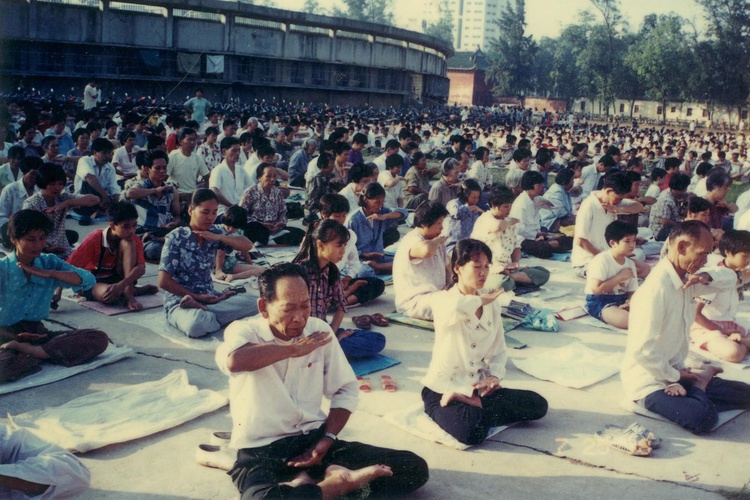
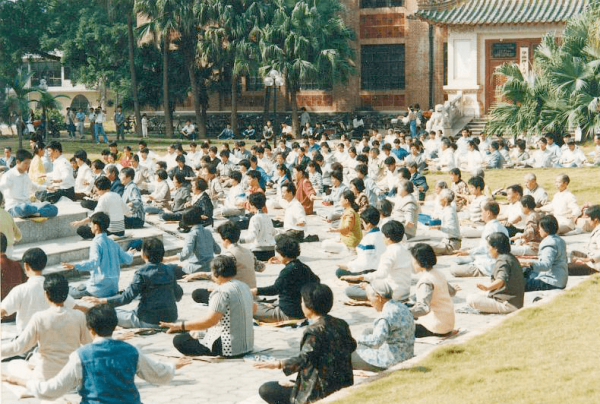
We also realized the vast difference between Falun Gong and other cultivation practices or religions we had known or heard of. This practice had no cumbersome religious rituals, no mandatory temples or places of worship, no collection of money or donations. It focused directly on cultivating the practitioner’s mind-heart nature in daily life, according to the standard of Truthfulness-Compassion-Forbearance, while combining it with five gentle exercises to purify the body. It was a Great Way of cultivation that was very simple yet very profound, aimed directly at a person’s heart. The systematic, comprehensive, and profound nature of the principles in “Zhuan Falun” was something we had never seen in any other doctrine or religion.
Although there were still many things in the book we could not yet fully understand, though we still had questions, a sense of peace and a great hope had begun to grow in both of us. It felt like finding a safe harbor after years of drifting, finding light after a long night. We looked at each other, and in our eyes was not just the love of husband and wife, but also the empathy and encouragement of fellow travelers who had just taken their first steps on a great path. Our relationship seemed to become even closer and deeper as we shared the changes in our hearts, the joy of discovering the profound principles of the universe.
After several days of being almost completely immersed in “Zhuan Falun,” we felt a strong urge to learn more. The book mentioned five exercises and also other lectures by the Master who wrote the book. We were eager to know what the movements were like and to read other scriptures.
Out of habit, the first thing I thought of was searching the internet. I opened my laptop and connected to the hotel’s network. Qing Ling sat beside me, also waiting eagerly. I tried typing the phrase “Falun Gong” in both English and Chinese into familiar search engines. But the results were disappointing. Most of the links were inaccessible, or the web pages showed errors, or worse, were filled with negative, crudely slanderous information that we knew for sure was not true after having read the book. I tried again and again, using different keywords, but the results were the same.
“Why is it so strange?” Qing Ling asked, surprised. “A practice that seems so good, with such a profound book, why is it so hard to find information about it online?”
I suddenly remembered what I had heard about internet censorship in China, about the so-called “Great Firewall.” This was probably the reason. All information related to Falun Gong seemed to have been systematically blocked. This made the “sensitive” nature that Mr. Chen had mentioned feel even more serious.
I considered using some firewall circumvention tools that people in the tech world sometimes use, but honestly, I wasn’t very familiar with them and wasn’t sure if it was safe to do so while in China. Asking friends in the US to search and send information was an option, but it would probably take time and wouldn’t be as direct.
We sat looking at each other, feeling a bit stuck. Then Qing Ling suddenly said, “Ming, what if… we try asking Mr. Chen again? He said many of his neighbors practice it. Maybe he knows someone, or at least knows where they practice.”
Qing Ling’s idea made sense to me. Mr. Chen seemed like a kind person; although he was cautious when talking about the “sensitive” matter, he had shared positive things about Falun Gong. He could be a lead.
Looking at the book on the table, then at Qing Ling, I knew that if we wanted to learn more, to learn the exercises, we couldn’t just rely on the internet here. Trying to contact the man who gave us the book was impossible, but perhaps, through Mr. Chen, we would have a chance to find the people who were truly practicing Falun Gong here in Shanghai.
The Decision to Try a New Path
After realizing the dead end in searching for information about Falun Gong online and with Qing Ling’s suggestion to seek out Mr. Chen, we sat down to talk more seriously about what we had just experienced and our next steps. The small hotel room was quiet, with only the yellow lamplight and the coverless book placed reverently on the table between us. Over the past three days, what “Zhuan Falun” had brought us had truly and completely changed our view of the world and of ourselves.
Qing Ling was the first to speak, her eyes sparkling with an indescribable emotion, both moved and somewhat solemn. “My dear,” she said, her voice soft but clear, “these past three days… I feel as if I’ve been on a long journey. This book…” She gently placed her hand on “Zhuan Falun.” “…it is completely different from anything I have ever known. Though there are parts I don’t yet fully understand, and things that sound hard to believe, deep in my heart, I feel it is incredibly true, incredibly righteous. It has answered all the questions that have troubled me throughout this journey, and the questions I’ve held in my heart for a very long time.”
She took a deep breath, looking directly into my eyes, her determination clear. “I feel as if… I have just found the way home, Ming. A strong urge from within tells me that this is the True Fa, the Great Way that my soul has perhaps been searching for for a very long time.”
I listened in silence, my heart resonating with her every word. I was also undergoing a revolution in my consciousness. My solid scientific worldview had been severely challenged by the principles in “Zhuan Falun.” The tight logic, the complete system, the ability to explain all aspects of the universe and human life, especially the discourses on history and prehistoric civilizations… all of it made me reconsider what I had always believed.
“I understand, Qing Ling,” I replied, my voice also full of emotion. “I feel the same way. Though my rational mind still has many questions, I cannot deny the profundity and power of these principles. They have a perfect internal logic. And most importantly, they touch upon one’s conscience, upon the benevolent nature of human beings. That standard of Truthfulness-Compassion-Forbearance… I feel that it is the universal truth, the most righteous path.”
I looked deeply into my wife’s eyes. “I think… perhaps we have truly found the path we were looking for, my dear.”
Silence returned, but this time it was a silence of consensus, of a great decision gradually taking shape. We knew that just reading was not enough. If this was the true path, we had to walk on it.
“So… shall we start by finding Mr. Chen again to ask for more information?” Qing Ling asked, after this idea had been discussed between us earlier. Her eyes were both eager and a little apprehensive. “He seems to know about it. Hopefully, he can help us find an instructor for the exercises, or at least tell us where the Falun Gong practitioners gather.”
That was what I was thinking, too. Cultivating one’s mind-heart nature according to Truthfulness-Compassion-Forbearance could be started right away, by trying to measure oneself against it in daily matters. But the five exercises really required specific guidance to be done correctly. “Alright,” I nodded, feeling a clear determination. “Tomorrow, or as soon as possible, we will find a way to visit your uncle and tactfully ask Mr. Chen. We must be very discreet and careful, as this matter doesn’t seem simple.”
A decision was made. We would not stop at just reading the book. We would begin to practice what we could immediately—striving to live by Truthfulness-Compassion-Forbearance in every thought and action, and proactively seeking the opportunity to learn the five exercises with Mr. Chen’s help, if fated connections allowed. The path of cultivating in Falun Dafa had opened before us, and though there were still many unknowns, we were determined to take the first steps together, with faith and hope in the truth we had just found.
The First Supernatural Experiences
After that candid conversation and momentous shared decision, a feeling of both excitement and a certain solemnity filled our hotel room. We were no longer mere curious explorers, but seemed to have willingly stepped onto a new threshold, a completely unfamiliar path that promised the very things our hearts had deeply longed for.
While waiting for the opportunity to meet Mr. Chen again and hopefully find an instructor for the exercises, we decided not to sit idly by. The book “Zhuan Falun” not only taught the Fa principles, but also briefly described the five exercises. Among them, the fifth exercise, the sitting meditation, was described quite clearly in terms of posture.
“What if… we try sitting?” Qing Ling suggested one evening, her eyes shining with a mixture of determination and curiosity. “While we wait, we can at least try to practice what we can.”
I nodded. “Yes, let’s try. The book says the sitting meditation relies mainly on a tranquil mind, so perhaps we can start by trying to sit still and empty our minds.”
And so, in the quiet of our hotel room, we made our first attempt to practice according to the book. I tried to imitate the full-lotus position described, but my stiff legs, accustomed to a lifetime of sitting on chairs, could only manage to place one foot on the opposite thigh in the half-lotus position. Pain and numbness quickly set in. I took a deep breath, trying to ignore the discomfort and focus on keeping my mind free from stray thoughts as the book instructed. But random thoughts kept coming, like uninvited waves. This was indeed much harder than I had imagined.
I glanced over at Qing Ling. She seemed to be doing better than I was, perhaps due to her natural flexibility or her familiarity with some traditional Asian sitting postures. She sat in the half-lotus position, her back straight, her hands forming the jieyin hand sign in front of her lower abdomen, her eyes closed. At first, I saw her brow furrow slightly; she was probably also enduring the pain in her legs or trying to quiet her mind.
But then, a moment later, I noticed something strange. Qing Ling’s body was completely still, her breathing even, but on her face, with her eyes still closed, two streams of tears were silently flowing down her cheeks.
“Ling?” I called softly, a little worried. “Are you… are you alright? Is the pain in your legs that bad?”
She didn’t answer right away, seemingly lost in a state I couldn’t comprehend. The tears continued to flow. I was bewildered, not knowing what to do, just sitting and watching, my mind full of questions. Was she just very moved thinking about the profound Fa principles we had just read? Or was it simply a physical reaction to meditating for the first time?
It was quite a while later when she slowly opened her eyes. They were still tear-filled but now shone with an expression of astonishment, emotion, and an indescribable, almost otherworldly quality. She turned to me, her voice still trembling:
“Ming… I… I just saw…”
“What did you see?” I asked immediately, sensing something unusual had happened.
Qing Ling took a deep breath, trying to speak clearly. “I’m not sure… As I was trying to quiet my mind according to the book… suddenly, what was before my eyes was no longer darkness. I saw… with another eye, right here,” she pointed to the area of her forehead between her eyebrows. “I saw light… brilliant, strange colors, unlike any color I have ever seen in this world.”
Her voice grew softer, as if recounting an unbelievable dream. “Then… then I saw another world. It was so beautiful, so magnificent. I saw… I saw myself there, not in this form… but in a different form, wearing resplendent robes… like… like a King, a Lord of that world…”
Tears welled up in my wife’s eyes again. “I also saw a scene… of myself and many others… bidding farewell to that world, descending… descending to this human realm… it seemed there was a vow, a mission… to await the Great Law at this time…”
I sat there, completely stunned by Qing Ling’s account. A magnificent world? A King or Lord? A vow to descend to the human world? These things were beyond my wildest imagination, but her strong emotion, the ceaseless tears, and the sincerity in her eyes made it impossible for me not to believe. I suddenly recalled the passages in “Zhuan Falun” about the celestial eye, the true origin of a being’s life, and the different levels of space. Could it be… could it be that Qing Ling had actually opened her celestial eye on her very first attempt at meditation?
While she was having such a strange and supernatural experience, I, sitting right beside her, saw nothing but the aching numbness in my legs and the jumble of thoughts in my head. A stark difference. But instead of feeling disappointed or skeptical, Qing Ling’s experience was like a powerful jolt to my consciousness. Even though I hadn’t seen it myself, my wife’s story, combined with what we had read and our previous encounters, strengthened my faith immensely. It showed me that what the book wrote was not empty theory, but truth, realms that could be reached through cultivation. I understood that each person’s path and state of cultivation are different; what matters is one’s perseverance and enlightenment quality.
“I believe you,” I said softly, placing a hand on her shoulder. “What the book says… it’s probably all true.”
Qing Ling nodded, her eyes still holding a deep emotion. That experience seemed to have been deeply etched in her heart, bringing her a root-level understanding of the meaning of this life.
In the following days, although I still had no special experiences like Qing Ling during meditation, we both began to feel other subtle changes. Our spirits felt more refreshed, our minds unusually clear and bright. The trivial vexations of life seemed to bother us less. Occasionally, I would have strange dreams, not clear, but they would bring a sense of peace or offer some kind of hint. At times, a sudden intuition about some small matter would turn out to be surprisingly accurate.
These things made us feel much more assured. This path seemed to be the right one we were looking for. But to continue, especially to learn the exercises correctly, we definitely needed to find an instructor. That was what we needed to do next.
This article is an excerpt from the book “RED DUST, GOLDEN LIGHT” – which tells the story of Professor Wang Ming and his wife’s journey to uncover spiritual mysteries and many hidden truths in China.
If you wish to experience the full journey of thought and the unpublished insights of the work, please click the button below to own the complete book.
To explore more works from THE LIVES MEDIA, visit our book collection.