DAY ONE
The room held only the two of us. The gentle afternoon light streamed through a large window, casting a layer of golden dust upon the old books that filled the shelves. No cameras, no microphones—only my small audio recorder resting on the table.
Julian Lee:
Good day, sir.
Thank you for agreeing to this meeting.
Out of respect for your privacy, I will refrain from using your name in our conversation.
(I took a deep breath before beginning.)
The first question… how have you felt since leaving office?
Are there any… successes, unfinished business, or regrets, sir?
(He leaned back slightly in his chair, his eyes gazing into the distance, as if looking back on a lifetime.)
The Former President:
Hello, young man.
And thank you for the delicacy of your question.
To be honest…
After leaving office, the first feeling was… relief.
When I was in office, every day was a relentless chain of pressure.
An emergency meeting in the middle of the night.
A phone call where a single wrong word… could send the stock market into a tailspin.
A military decision that could cost the lives of hundreds, thousands of people.
Stepping away from that chair… I felt like a human being again.
(He paused for a moment, letting the memories settle.)
As for the term…
I think there are a few things to be proud of.
Some of the reforms I pushed for did bring real results. Though slow. And imperfect.
But I don’t deceive myself.
Many goals were not achieved.
There were things I wanted to do… but couldn’t.
Because of the system.
Because of Congress.
Because of the media.
Because of the “unseen powers” you won’t read about in the papers.
Or… simply because I was wrong.
(His voice lowered. This was the hardest part to say, I could feel it.)
And regrets?
Of course, there are.
Many.
I once approved an airstrike… that was later reported to have civilian casualties.
There were meetings I should have refused.
There were people I trusted too much.
And above all…
I regret the times I had to choose “politics” over “truth.”
But that was the price of staying in the game.
(He looked directly at me, a look both piercing and weary.)
And that is also why, today, I can sit here and talk to you.
As a human being.
Not as a title.
Julian Lee:
Thank you for your candor, sir.
I have so much I want to ask…
First, let’s delve into the matter of institutions.
If a government like America’s, with the model of a true republic, still has so many operational problems… do you have any ideas for how to improve it?
And compared to a communist system, where do you see the republic’s… weaknesses?
The Former President:
(He raised an eyebrow, a flicker of amusement in his eyes.)
A direct and difficult question.
I like that.
We are often proud to call the United States ‘the greatest republic in the world.’
The ‘beacon of light for global democracy.’
Those slogans sound wonderful in speeches. They echo in great halls.
But when you have sat in the Oval Office and looked at the machinery of power from the inside, you see that reality is not so glorious.
Our ship of state is vast and sturdy.
But it is covered in barnacles called ‘special interests.’
Making it move incredibly slowly and heavily.
The biggest problem, in my view, is that the system is manipulated by money.
Capital and politics in America are intertwined like bone and marrow.
Corporations.
The financial elite.
Lobbying groups.
They don’t have to run for office, but their influence is greater than the president’s.
I once saw a clean energy bill, one that was very good for the country’s future, get gutted and turned into a meaningless document… all because one sentence, one word, was added by a lobbyist for an oil conglomerate.
True power isn’t in the hands of the voters.
It’s in the hands of those who write the checks.
(He paused, taking a sip of water, his gaze turning distant, as if recalling unseen battles in the corridors of power.)
And what about the communist model?
I won’t lie; I have never agreed with dictatorship, censorship, or the suppression of freedom.
Those things go against human dignity.
But there is one thing I must admit, an uncomfortable truth.
Their system, when it still has its ideals, can act like an arrow.
Fast. And decisive.
They don’t spend months negotiating with Congress.
They aren’t held back by the media.
They don’t fear a drop in ‘approval ratings’ every time they make a tough but necessary decision.
They are like a hammer, able to smash through obstacles instantly.
We are like a complex machine, designed for balance, but our gears are jammed because too many parts refuse to cooperate.
That is where our republic is weak.
The more democratic it is, the more power is dispersed, and in an age of crisis—speed is survival.
But it is that very dispersion of power that serves as a fortress protecting the people from an iron fist.
The problem is, when that fortress is bought by money and the media…
then that democratic shell is nothing but a mask.
A beautiful stage to hide the decay within.
(He fell silent for a moment, then looked at me.)
You ask about improvements?
Oh, I have lost countless nights of sleep over that question.
If I had a magic wand, there are three things I would do immediately.
(He held up three fingers, his gaze hardening, as if speaking of a battle he had long fought and understood.)
First, attack the biggest monster head-on: Implement extremely strict limits on campaign financing and lobbying.
Why?
Because it is the cancer eating away at our democracy.
Today, elections are no longer a contest of ideas, but a race for money.
Dark money, money from undisclosed super PACs, is drowning out the voices of ordinary citizens.
The soul of the republic is being sold to the highest bidder.
Second, impose term limits on both the Senate and the House.
Some people sit in those seats for forty years, or even longer.
They come to Washington with ideals, but they stay too long and become part of the “swamp.”
They no longer represent the people back home; they represent the interest groups, the defense contractors, the corporations that surround the Capitol.
Term limits would force them to return to the life of an ordinary citizen.
It would bring in new blood, new ideas, and break the toxic, symbiotic relationship between long-serving politicians and the lobbying world.
And third, and this is critically important…
We must radically reform the electoral system and end gerrymandering.
This is a form of legal cheating, where politicians draw their own electoral maps to choose their voters, instead of letting voters choose them.
It creates “safe seats” for both parties, where candidates no longer need to persuade moderates. They only need to please the most extreme voters in their own party to win.
That is why our politics has become so polarized and toxic.
(He lowered his hand, shaking his head with a look of weariness and helplessness.)
But it’s easier said than done… you know how it is.
When the interests of those in power are threatened, they will use that very power to protect their interests.
No matter what their original ideals were.
Julian Lee:
I’d like to return to those issues later, sir.
For now, I want to ask more about the institutions themselves.
A republic is clearly freer than communism.
But what about feudal politics? A reigning monarch… does that have any advantages?
The Former President:
(He nodded slowly, his eyes glinting with a contemplative look.)
A very good question.
And I must confess something. In the past, I used to consider feudalism an outdated relic.
But after many years at the center of power, after observing communist, republican, and modern authoritarian models… I am forced to see it in a more balanced light.
A monarchical model, especially with a king of sufficient talent and virtue—a true “enlightened ruler”… it has advantages that our modern republic is gradually losing.
(He raised his hand, slowly counting on his fingers.)
First, is vision.
An American president, I know this well, has four years. Eight, if he’s lucky enough to be reelected.
That is the blink of an eye in the river of history.
Too short to implement deep and sustainable reforms.
But a king doesn’t need to be reelected. He doesn’t need to court the media.
If he is truly for the people, he can pursue a strategy that spans decades.
Second, is speed and unity.
In our republic, just passing a single bill requires navigating a maze.
Committees, Congress, the media, the opposition, public opinion…
A wise king, if not manipulated by the nobility, can make decisions faster, more decisively. Sometimes even… more humanely, because he doesn’t need to play politics to be reelected.
And finally, is accountability.
When there is a king, all right and wrong can be traced back to one person.
He is the symbol, the soul of the nation.
But in a modern republic, power is so dispersed that… no one is truly responsible when everything collapses.
The president blames Congress. Congress blames the opposition.
And the people don’t know who is truly accountable.
(He lowered his hand, his tone growing more serious.)
But… never forget.
That is only the ideal, when there is an “enlightened ruler.”
What if the one in power is a foolish king?
What if the court is full of treacherous officials?
Then the country becomes a living hell.
Without the ballot, without a free press, the people have no mechanism to protect themselves.
To put it simply, it’s like this.
A feudal system places the nation’s destiny in the hands of one person.
A republic places it in a mechanism.
If that person is good, the country will flourish. If they are bad, the entire nation will suffer.
As for the republic, though slow, though flawed, it is designed to prevent disasters caused by a single individual.
The price we pay is efficiency, speed, and sometimes… the truth, distorted by political calculations.
(He looked me straight in the eye, his voice firm and somewhat shocking.)
If today, somewhere in this world, there existed a wise, virtuous king, unswayed by money, a person with true heart and vision…
I say this in all sincerity.
I would be more willing to support him than a republic that pretends to be democratic but has, in fact, been completely manipulated.
Julian Lee:
So, you’re not necessarily advocating for a feudal system.
The problem seems to be… how to select someone with enough talent and virtue?
The Former President:
Exactly. That is the core issue.
I don’t deny that a centralized model, if the leader is truly talented and virtuous, can achieve an efficiency that surpasses any modern democratic model.
But…
(He let out a long sigh, as if bearing the weight of a historical question.)
The dilemma is: how do you choose that person?
And more importantly, how do you ensure he maintains his virtue and wisdom… throughout his entire reign?
Choosing an enlightened ruler, I tell you, is harder than going to the moon.
Human history is filled with examples.
Emperor Minh Quang, Le Thanh Tong, or the founding kings of early dynasties… they were great men.
But right after them came generations of weak, cruel, or hedonistic rulers.
Why?
Because talent and virtue cannot be inherited.
A feudal society that stakes the nation’s fate on the lottery of bloodlines will, sooner or later, decline.
So where did our republic go wrong?
Not in its sharing of power.
But in choosing the wrong people.
The republic was created to avoid the mistakes of feudalism. No more hereditary succession. Instead, we have elections, separation of powers, checks and balances.
It sounds very idealistic.
But in reality, as I’ve said, elections today are manipulated by money, by the media, and by mob sentiment.
Virtuous people often lose, because they don’t say what the public wants to hear.
People with strong principles are often crushed, because they don’t serve the interests of factions.
(He paused, looking at me.)
So what is the way out?
I have thought long and hard about this. And I will tell you frankly.
The future does not lie in choosing between a “republic” or a “monarchy.”
It lies in building a true mechanism for selecting talent.
A mechanism that transcends politics, media, and special interests.
(His gaze grew distant, as if sketching out another world.)
I envision an ideal political future…
Where there are no noisy campaigns, no billion-dollar election drives.
Instead, candidates would be selected through a transparent and rigorous examination process: of their intellect, their virtue, their administrative skills, and most importantly, their ability to remain steadfast against temptation.
And who would choose them? Not the masses voting on emotion. But a council of the elite, composed of true sages and wise men, people who do not belong to politics.
And most importantly: the one chosen to rule must always be under scrutiny, and could even be replaced immediately if they lose their character.
(He chuckled softly.)
It sounds like a dream, doesn’t it?
Perhaps.
But if humanity cannot find a way to select true leaders, then whether it’s feudalism, a republic, or communism… all will eventually return to the cycle of collapse.
So now you see.
I don’t support feudalism.
Nor do I blindly believe in democracy.
I only believe in the heart and mind of man.
And in a mechanism wise enough to see it.
(…..)
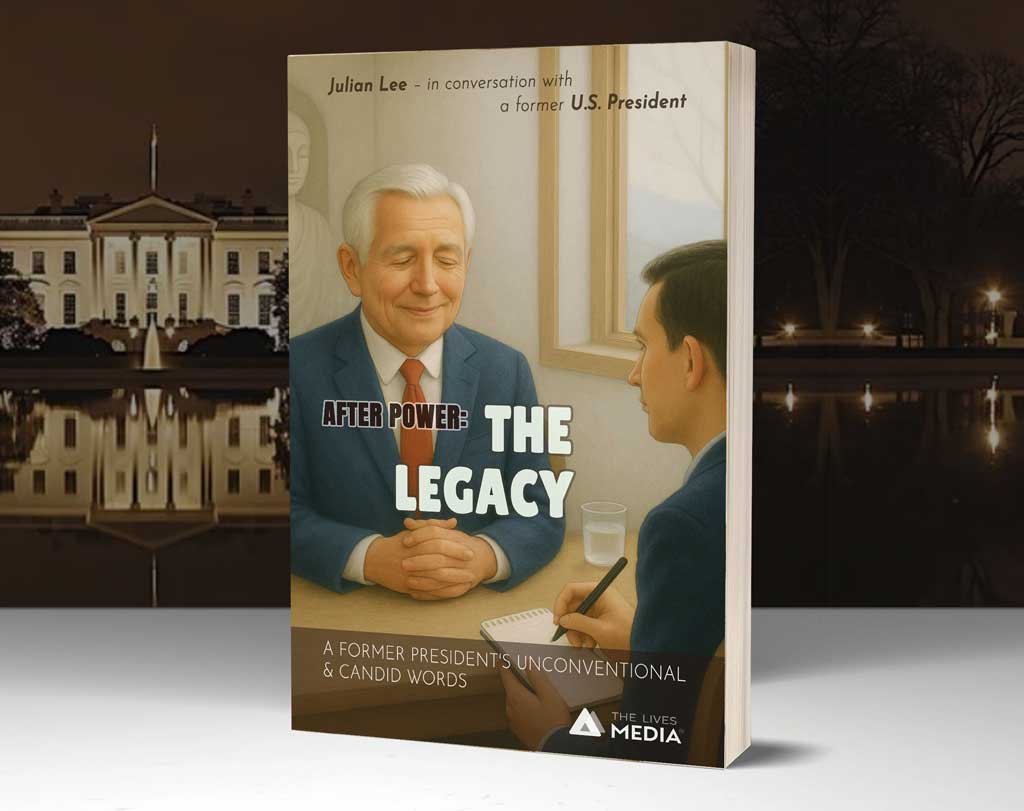
This article is an excerpt from the book “AFTER POWER: THE LEGACY” – which includes the complete exclusive interview by journalist Julian Lee with a former US President.
If you wish to experience the full journey of thought and the unpublished insights of the work, please click the button below to own the complete book.
To explore more works from THE LIVES MEDIA, visit our book collection.