(continue Part 2 of DAY THREE…)
Julian Lee:
Yes. Please speak more about Vietnam.
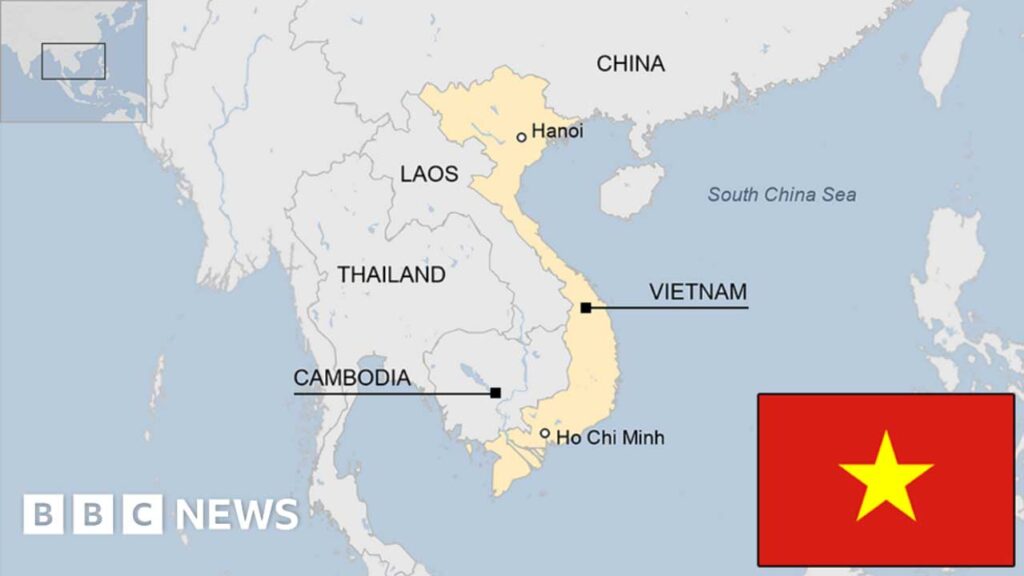
A country that has had a painful history with the U.S., but is now mentioned as a wonderful “model” for reconciliation and cooperation.
The Former President:
(He was silent for a long time, his eyes looking into the distance, and I could see a sincere emotion in them.)
This question… I have to be honest, it moves me.
Because perhaps, only those who have walked among the ruins of war, who have read the top-secret files on Vietnam, and who have heard the sighs never recorded in the minutes… can understand.
Vietnam is a country that has endured more than enough from the power games of the world.
But instead of becoming bitter, they chose… forgiveness.
(He paused, as if trying to find the words to describe an extraordinary journey.)
Vietnam’s journey, from a symbol of war to a model for reconciliation, is something no one could have predicted.
America once dropped more than seven million tons of bombs there, three times more than in all of World War II. The pain left behind was not just millions dead, but millions disoriented in their own historical memory. It was Agent Orange, children born with defects, mothers who would never see their children return.
All of that can never be erased.
But the strange thing is, Vietnam never held onto that hatred as a banner.
When we withdrew, many thought Vietnam would close its doors, isolate itself, and live forever with resentment.
But they did the opposite. They chose to open up.
In the years from 1986 to 1995, they began reforms, began negotiations, and proactively sought to heal relations with America itself.
We lifted the embargo and established diplomatic relations in 1995, just twenty years after the war ended.
And then, in 2016, the image of President Obama stepping barefoot into the Jade Emperor Pagoda, sitting down to eat bun cha¹ with ordinary people, and declaring that “Vietnam has moved beyond war to become a friend of America,” became a powerful symbol.
No one forced Vietnam to forgive.
They forgave on their own, so they could move on.
Why were they able to do that, while so many other nations in the world are still mired in the swamp of hatred?
Because Vietnam is a nation that understands one thing very well:
“True victory is not when the enemy kneels.
It is when both sides can stand up together, no longer holding knives in their hands.”
The Vietnamese do not worship America, but they do not resent America either.
They know how to clearly distinguish between politics and people.
And above all, they want their children to live in peace, rather than grow up with the lesson of “who the enemy is.”
(He looked at me, his eyes showing a deep respect.)
America’s view of Vietnam today is one of respect and expectation.
We see Vietnam as a “strategic partner with a memory.”
They are not easily manipulated, but they have a respectable depth.
In cabinet meetings, Vietnam is often mentioned as a nation that knows how to preserve its identity, not too close to China, not too close to the U.S., but understanding that both need each other.
We never expect Vietnam to become a second South Korea or Japan.
Instead, we admire the balance that Hanoi is maintaining.
So what future awaits Vietnam?
If they continue to hold onto their identity, avoid being dragged into extremist factions, and if the Vietnamese people never forget why they forgave, then Vietnam could become a kind of “intellectual balance” in a bipolar world.
They don’t need to be a superpower, nor a trade hub.
They will be a mirror, showing that the past can be painful, but the present can still be magnanimous.
(He concluded with a contemplative summary.)
What is the greatest lesson Vietnam has given the world?
It is that true reconciliation does not need declarations, nor does it need treaties.
It only needs a nation humble enough to understand that:
forgiveness is not because others deserve to be forgiven.
But because you yourself need to be free.
¹A traditional Vietnamese dish of grilled pork and noodle.
Julian Lee:
Do you have any personal experience that truly impressed you with this country?
Or do you have a special impression of any individual?
For example, communist leaders like Ho Chi Minh, Vo Nguyen Giap, or Nguyen Van Linh?
The Former President:
(He smiled, a nostalgic smile.)
This question… it really makes me pause.
Because Vietnam, in the eyes of many Western politicians, is just a geostrategic point, a lesson in warfare, or a “rising partner.”
But in my heart, this country is unlike any other place I have ever set foot in.
My most impressive experience with Vietnam was not an official event.
It was a night with no ceremony, no politicians, just the sound of cicadas in summer.
It was around the 2000s. I was not on an official tour, but just passing through Hanoi on a discreet regional survey.
That evening, I took a stroll around Hoan Kiem Lake, with no entourage, no formal attire.
The summer air was hot and humid, the scent of milk flowers, the sound of cicadas, and the voices of street vendors created a very… peaceful atmosphere.
I stopped next to an old man playing Chinese chess on the sidewalk.
I asked, without saying who I was:
“What do you think about the war?”
He smiled faintly.
“The Vietnamese only remember the war to learn how to live on, not to hold grudges.”
“So do you hate Americans?”
He looked at me, without a frown, just took a sip of tea.
“No. Americans are like the French, the Chinese, or the Japanese. They come, and they go.
But we still have to live, still have to learn to forgive… to keep ourselves human.”
I don’t remember that old man’s name.
Nor is there a single photograph.
But I took those words back to Washington. And I have never forgotten them.
A nation can win with guns and bullets, but it can only endure if it knows how to let go of the dagger.
(He paused, as if leafing through files in his mind.)
As for the Vietnamese leaders, who left the deepest impression on me?
Not because of their political views, but because of the way they carried a cultural spirit that transcended their party roles.
With Ho Chi Minh, it was a “man who knew how to make his enemies respect him.”
I don’t see him as a symbol of communism, but as a strategic symbol deeply imbued with East Asian cultural nuances. What impressed me was not that he won, but the way he “made his opponents learn to respect him.” A person can be praised, can be feared, but to be “respected” by even those who once opposed him, that is a rare depth.
With Vo Nguyen Giap, it was the image of a “general who knew the pain of his people.”
I once read internal U.S. documents about him, in which a colonel commented: “He doesn’t need us to understand him. But he makes it impossible for us not to see him as a man protecting the soul of his nation.” The greatness of Vo Nguyen Giap lies not only in his tactics, but also in the way he constantly emphasized that war is a last resort, not a glory.
(He looked at me, his gaze becoming particularly attentive.)
And Nguyen Van Linh.
He was not as prominent on the international stage as the other two, but for strategic analysts like us, his role was extremely important.
I call him “the man who opened the door but did not throw open the gate to the soul.”
In the context of Vietnam being surrounded, embargoed, and its economy nearly exhausted after the war, it would have been easy to choose one of two extreme paths: either to close the door completely and sink in isolation, or to throw open the gate, letting foreign powers flood in and lose one’s identity.
But Mr. Linh chose a third way.
His policy of Renewal (Đổi Mới) was not just an economic reform. It was a reform of mindset.
He had the courage to admit the mistakes of the old model, and the wisdom to open a new path without letting the country go astray.
It was a kind of “pragmatic wisdom full of morality,” something very rare. He became a bridge, an important bridge that led Vietnam into a period of integration without losing itself.
In summary, I am not impressed because they were communists or not.
But because they were people capable of standing in the midst of the currents of their time, and maintaining a vision that transcended it.
And perhaps, that is why Vietnam, a nation once divided, once crushed, was able to stand up without having to shout noisy slogans.
Julian Lee:
One final question for today, sir.
Could you predict a few countries that will rise in the next thirty years?
The Former President:
(He smiled, a delighted smile.)
A very worthy question to end the day.
You didn’t ask “which country will be the richest, or the strongest.”
You asked “which country will rise.”
That is an open question, encompassing soft power, spiritual values, global role, and the ability to lead a new order.
I will answer not in order of GDP, but by the level of deep and sustainable influence, in the next thirty years.
(He paused, as if looking at a world map of the future.)
The first country, unsurprisingly, is India.
They will become the “third democratic superpower.” With a young population, a fast-growing middle class, and a democratic system that, though challenged, has not collapsed, India will not replace China as the “world’s factory,” but they will become the “global center for services, data, and unique identity.” They will be the place where the West finds the youth of Asia, and where Asia finds a model not dominated by China.
The second country is Vietnam.
They will be the “middle way of Southeast Asia.” If they can maintain political stability, steady growth, and not be drawn into any extreme, Vietnam will be a middle-power with great influence on the structure of ASEAN and the order of Asia. Not through military strength, but through balance. The more chaos there is, the more the world will turn to places that are reasonable and not extremist. Vietnam does not need to be a superpower to be a spiritual anchor for the entire region.
The third country might surprise you: The Netherlands.
A “small country, but at the heart of the supreme value chain.” In the age of AI and semiconductor chips, the Dutch corporation ASML controls almost all advanced chip lithography technology. The Netherlands, though small in area, has the power to be a “technological bottleneck” that the U.S., China, and Europe all must negotiate with. There is a famous saying among our internal analysts: “Want to win the war of the future? Ask the Netherlands to borrow their technology.”
The fourth country is Brazil.
“The leader of the Southern Hemisphere.” With abundant resources, a favorable climate, and a large population not ravaged by war, Brazil has the opportunity to become the soft leader of the entire Latin American region. As the world shifts away from China, the major powers will need a “stable source of raw materials and agricultural products,” and Brazil will be at the top of that list. If they can effectively reform their institutions and fight corruption, Brazil could be the fourth pillar of the global order, alongside the U.S., China, and India.
And the fifth country is Senegal.
“The hidden gem of West Africa.” Senegal is one of the few African nations with a sustainable democracy, peaceful transfers of power, a free press, and a steadily growing economy. Located at the “Atlantic gateway to Africa,” Senegal could be a model for the world to see Africa in a new light. Once AI and online education break down infrastructural barriers, Africa will no longer need “help,” they will need to “hold onto themselves.” And Senegal is doing that.
(He paused, his gaze growing profound, as if looking at something invisible.)
And there is one more “invisible” nation.
A nation not on the map, but gradually coming into being.
It is the “Community of Awakened People.”
They do not distinguish by nationality, faith, or skin color.
They are the ones who are rebuilding the world with morality, not with weapons.
And they may be the force with the greatest influence on the future order, when all the old models have collapsed.
Julian Lee:
Yes, thank you, sir.
Let’s conclude today’s session here.
Tomorrow, which is also our final day, I would like to hear you share on the topic of spirituality.
The Former President:
(He nodded, a solemn nod.)
Very good.
Thank you for a day full of reflection, sharp questions, and also full of compassion for the fate of humanity.
Tomorrow’s session, our last, will no longer be about political analysis, nor about national strategies.
It will be a quiet journey into the inner self.
(His voice lowered, as if opening a door to another world.)
We will talk about the different planes of existence.
About the Celestial Eye.
About spiritual cultivation.
And about why, in a chaotic world, only when man returns to the Tao, will there be a tomorrow.
(…..)
This article is an excerpt from the book “AFTER POWER: THE LEGACY” – which includes the complete exclusive interview by journalist Julian Lee with a former US President.
If you wish to experience the full journey of thought and the unpublished insights of the work, please click the button below to own the complete book.
To explore more works from THE LIVES MEDIA, visit our book collection.