( ….. )
DAY THREE
Henry Lowell:
Good morning, Professor Solomon!
I’ve been eagerly awaiting today’s session, especially the “debts” you mentioned in the last two sessions, like more details about the Eye of the Sahara, or the purpose for which the Giza Pyramids were built…
Professor Solomon:
(Smiling warmly, he stands up from his chair and shakes Henry’s hand.)
Good morning, Henry. Your eagerness is a great encouragement to me. I have also been very much looking forward to this final conversation of ours, where we will string together the “echoes” we have heard, and perhaps, find some answers to the “debts” you have mentioned. Please, have a seat.
(The Professor gestures for Henry to sit, then sits down in his own familiar chair, pouring tea.)
Yes, the Eye of the Sahara and the true purpose of the Giza Pyramids, especially what relates to Laura’s “insights,” are topics I promised to share more about. They are important pieces of the puzzle that can help us see history and its operating laws from a completely different perspective.
So, shall we begin with the Eye of the Sahara? You seem very interested in this magnificent structure after we touched upon it in our last session. Do you have any specific thoughts or questions about it before I go into more detail?
Henry Lowell:
Then please, let’s start with the Eye of the Sahara… Looking at it on Google Maps, I see it doesn’t resemble any “natural” structure formed by volcanoes or simple geological formations…
Professor Solomon:
(Nodding, his eyes showing agreement.)
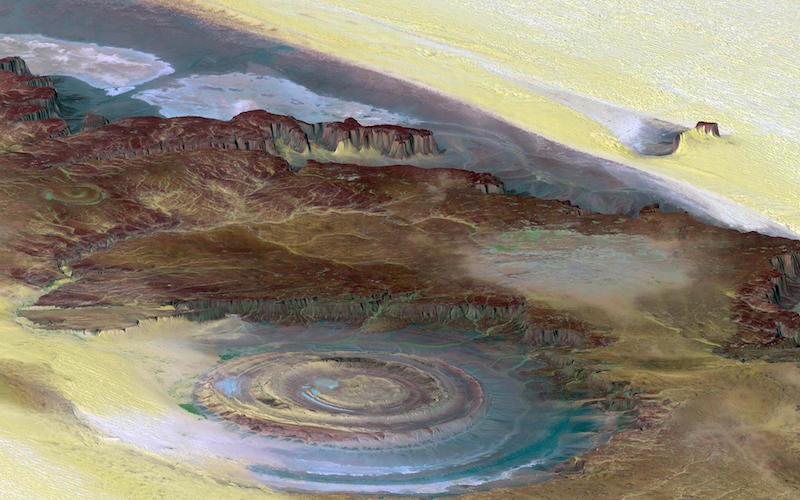
Your observation is very keen, Henry. And your intuition is entirely sound. When one looks at the Richat Structure from above, through satellite images like Google Maps, the first impression for many, including myself, is that it has a certain “arrangement,” an order that purely natural geological processes could hardly create with such a degree of perfection.
It’s true that mainstream science often explains the Richat Structure as a geological dome that has been eroded over millions of years, exposing concentric layers of sedimentary and volcanic rock. And certainly, natural geological factors have played a role in shaping it to some extent.
But,
(The Professor pauses, looking directly at Henry.)
…that explanation, in my opinion, still leaves too many questions unanswered, too many “illogical” points that we cannot easily dismiss.
First, there is the near-perfect roundness of the circles, especially the three main inner rings. Why would erosion create such smooth and concentric curves on such a vast scale, with the outermost ring’s diameter reaching over 40 kilometers? Natural processes tend to create more asymmetrical forms.
Second, there is the distance between the rings of land and the alternating low-lying “channels.” They seem to have a very regular distribution, suggesting an intentional design.
And when we place these features alongside Plato’s description of the Atlantean capital, the coincidences become incredibly astonishing.
Plato spoke of a city built with concentric circles of land and water canals. The Richat Structure, with its rings of high-standing rock alternating with low-lying valleys, fits this description perfectly.
In terms of size, Plato gave specific numbers for the diameters of the circles and the width of the canals. When compared to the actual dimensions of Richat, there are very noteworthy similarities, though there may be discrepancies due to time and interpretation.
Plato also described a hill in the center of the city, where the palace and temples were located. The central area of Richat, though quite flat now, still has a slightly elevated region with distinct geological features.
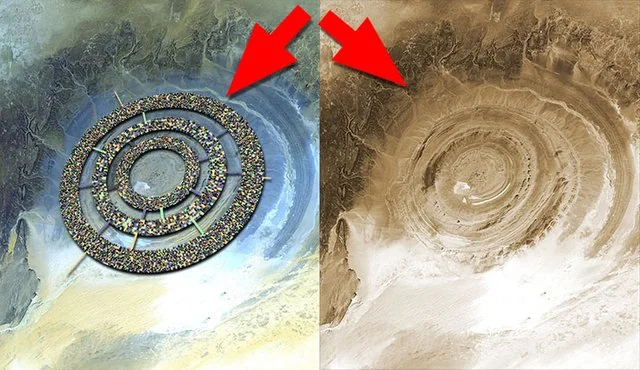
And another important detail: Plato said that Atlantis had a large canal leading out to the sea to the south. If we consider the ancient topography of the Sahara, when sea levels could have been much higher and the area was not a desert, it is entirely possible that a large river or canal once connected Richat to the ocean in the south. There are geological studies that indicate traces of vast ancient river systems in this region.
When I shared these things and showed Laura more detailed images, as well as topographical maps of Richat, she had some very strong “perceptions,” more detailed than last time. She still insisted that this was not a completely natural structure, but had the “intervention, creation of a form of intelligent being from a very, very long time ago.”
This time, Laura also described a “memory of a lost prosperity,” a place that was once very green, with plenty of water, teeming with life, completely contrary to the arid desert of today. She spoke of a very strong “swirling energy” at the center, as if the place had once been a major point of energy convergence or distribution. And occasionally, she “heard” very vague “reverberating sounds,” like the sound of large rocks breaking, the sound of giant structures collapsing in a chaos of water, along with a “sad memory of an event where water rose very quickly and submerged everything.”
When I asked about the “intelligent being” who created it, Laura wasn’t sure if it was just humans like us. She perceived a different “stature” or “ability,” but could not describe it more clearly. She also stressed that, despite her strong perceptions of its artificial nature and the water catastrophe, she could not definitively say whether it was Plato’s Atlantis or not.
Based on all of this—the similarity to Plato’s description, the unanswered questions from a purely geological perspective, and Laura’s special “perceptions”—I personally have a rather strong belief, perhaps up to 80-90%, that the Richat Structure is the remnant of the Atlantean capital, or at least an important part of that civilization. However, as a scientist, I must still emphasize that we need more direct archaeological evidence, large-scale excavations at the site itself, to be able to draw a final conclusion.
Henry Lowell:
So, considering the terrain there, its elevation and size… If we suppose you were the one choosing a location to build a great city for a mighty empire, would a position like the Eye of the Sahara be a good choice? Assuming the context that it was not surrounded by a vast desert at that time…
Professor Solomon:
(Smiling, nodding.)
A very practical and interesting question, Henry. Putting myself in the position of a creator, a planner of an ancient, mighty empire… would the Eye of the Sahara, in a non-desert context, be an optimal choice?
I think so, and for many reasons.
First, regarding its geographical location and natural defensive capabilities. If we imagine the Richat Structure as an island or a high coastal land, surrounded by natural or man-made canals as Plato described, it would create an incredibly effective defense system. The concentric rings of land and water would be natural barriers, making an attack from the outside extremely difficult. Any enemy wishing to invade would have to overcome multiple layers of defense.
Second, access to water and waterway transportation. If the area had abundant water, with canals connecting to the sea as Plato suggested, it would be very convenient for supplying fresh water to a large city, as well as for developing waterway trade, transporting goods, and maintaining a powerful naval fleet. The canals would not only be for defense but also economic and military lifelines.
Third, local resources. Plato described Atlantis as having many precious stones for construction, metals, wood, and fertile land. The Richat region, with its complex geological composition, could have once provided many types of minerals and building stones. If the climate was milder then, the surrounding land could have been very fertile for agriculture.
Fourth, strategic vision and spiritual factors. A slightly elevated position, like an island or a coastal plateau, not only provides an advantage in military visibility but can also have spiritual significance. Many ancient civilizations chose to build their centers of power and religion in “propitious” locations with good energy fields or near sacred resources. The “swirling energy” that Laura perceived at the center of Richat could be such a factor.
Fifth, if we consider the hypothesis that the Atlanteans had advanced technologies, then choosing a location with a special geological structure like Richat might not have been coincidental. Who knows, its natural dome structure, or its specific types of minerals, might have been suitable for building their energy works or high-tech devices.
Of course, we are speculating based on the assumption that Richat was once a place with favorable natural conditions. But if the evidence of a green Sahara in the past is accurate, then it is entirely plausible that a mighty civilization chose this place as its center. It combines all the elements from defense, economy, and resources to even symbolic and spiritual values.
And then, a harsh climate change, or a terrible geological catastrophe, turned a “paradise” into a “deathly desert,” burying a glorious civilization under the sands of time, leaving only a giant “eye” as a silent relic.
Henry Lowell:
So, to date, have there been any serious surveys by archaeologists and scientists of this Eye of the Sahara? And have they found any noteworthy traces, Professor?
Professor Solomon:
That’s a very pertinent question, Henry. A structure as strange and suggestive as the Eye of the Sahara has certainly attracted the attention of the scientific community, especially geologists.
And it is true that many serious geological surveys have been conducted at the Richat Structure. Geologists have studied its rock layers, mineral composition, and formation process in great detail. As I’ve mentioned, the current mainstream scientific explanation is that it is a geological dome that was uplifted and then eroded over millions of years, exposing rock layers of varying hardness, which created the concentric rings. They have also found evidence of past volcanic activity in this area.
However, when it comes to large-scale archaeological expeditions with the goal of finding traces of an advanced civilization like Atlantis, the situation is different.
First, the fact that the mainstream scientific community already has a geological explanation (albeit with some less-than-satisfactory points as we have discussed) makes it more difficult to propose and fund major archaeological excavations based on the “Atlantis” hypothesis.
Second, the Richat Structure is an incredibly vast area located in one of the world’s harshest deserts. Conducting detailed archaeological surveys over its entire area requires enormous resources, both financial and human, and faces countless logistical challenges.
Third, at times, political stability in the region can also affect the ability to carry out long-term research projects.
Despite this, it’s not that there have been no archaeological finds at all. In and around the Richat Structure, prehistoric stone tools belonging to the Paleolithic and Neolithic periods have been found. This indicates that the area was inhabited by humans for a very long time, when the Sahara was greener. Some pottery shards and other signs of habitation have also been found, but these findings are generally attributed to simpler cultures, groups of early hunter-gatherers or pastoralists, not the traces of a complex metropolis, a high-tech civilization as described for Atlantis.
The issue is, if an advanced civilization once existed there and was then buried or destroyed by a terrible catastrophe, what remains might lie very deep under layers of sediment, or have been severely altered. The simple stone tools of later inhabitants might just be what is easily found on the surface, or in the shallow layers.
I personally believe that to truly unravel the mystery of the Eye of the Sahara, we need more clearly directed archaeological surveys, possibly combined with advanced remote sensing technologies (like ground-penetrating radar) to search for structures hidden deep below, and most importantly, an open mind, willing to consider possibilities beyond existing explanations.
To date, “noteworthy traces” in the sense of irrefutable proof of an Atlantean city at Richat have not been widely published by the mainstream scientific community. But that doesn’t mean there’s nothing there. Perhaps the most important discoveries are still waiting for us, hidden beneath the sands of time and skepticism.
Henry Lowell:
If that was the central city of Atlantis, and as Plato mentioned, it was submerged under the sea, and now it has been pushed up onto dry land in the middle of a vast desert, then it must have undergone a powerful geological transformation and a very long period of time… Thus, naturally, it would have been eroded and covered by layers of sediment…
Professor Solomon:
(Nodding, his expression in deep agreement.)
You are absolutely right, Henry. That is precisely what we must imagine if the Richat Structure is indeed the relic of an ancient center of civilization that has undergone such horrific geological events.
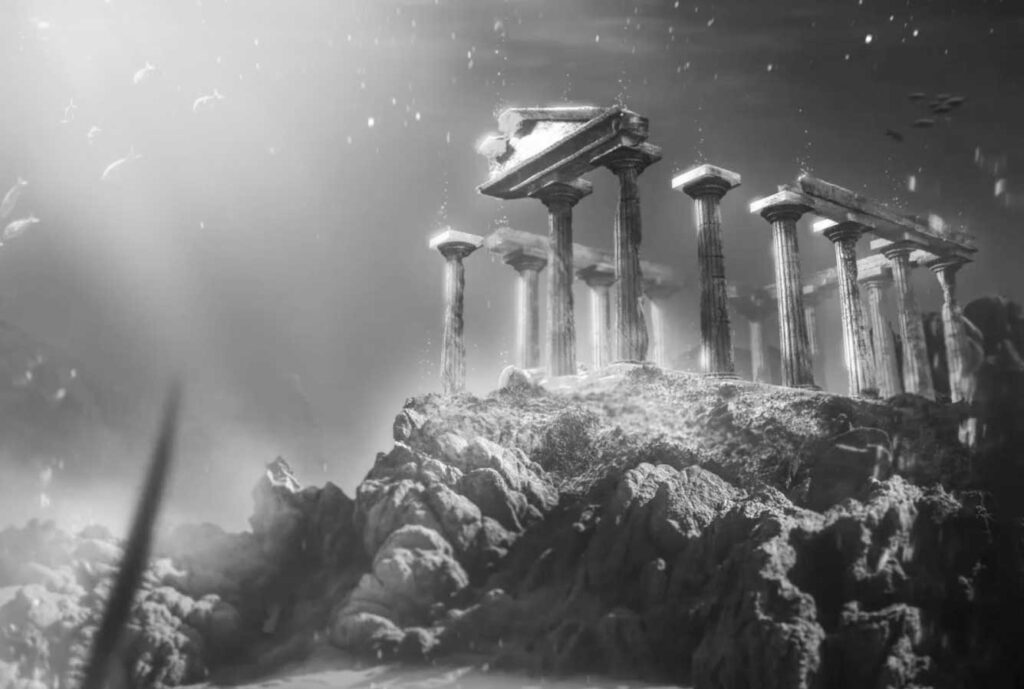
If it was once submerged under the sea—an event that in itself was destructive enough to wipe out most structures—and then, through an extremely powerful geological uplift process lasting thousands, even tens of thousands of years, only to be exposed to the elements in one of the harshest deserts, then the search for clear traces would be an immense challenge.
Imagine:
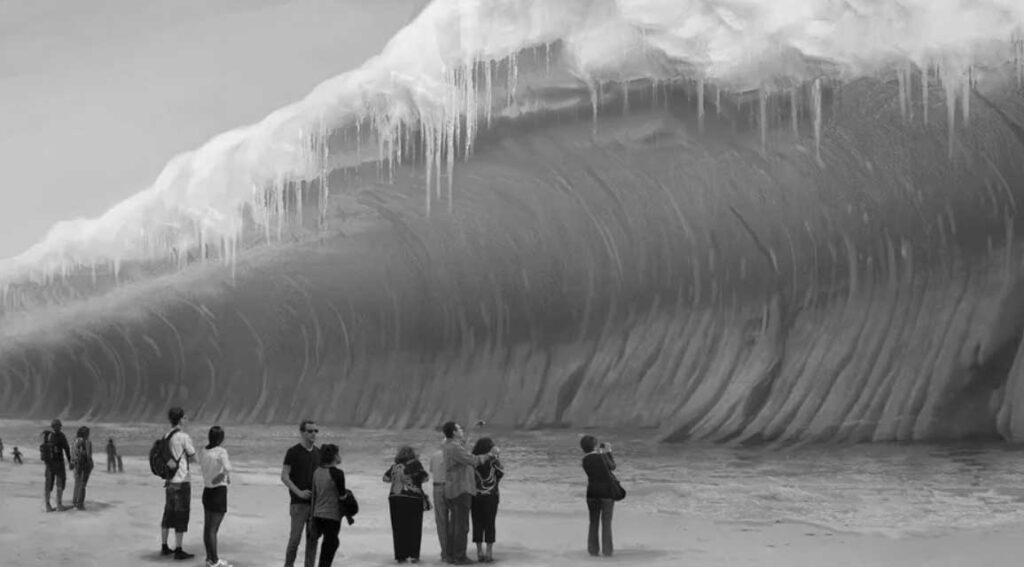
First, there is the destruction by water. Tsunamis, changes in pressure, saltwater corrosion… all would erode, wash away, and cause the collapse of architectural structures, no matter how sturdy they were.
Then, upon being uplifted, it would face erosion by the elements on land: the relentless sandstorms of the desert, the extreme temperature differences between day and night causing rocks to fracture, and perhaps even the rare but intense rainstorms would also contribute to erosion.
And as you said, layers of sediment, sand, and dust would slowly accumulate, covering and burying what was left. Thousands of years of desertification would create thick layers of cover, making the detection of anything beneath extremely difficult based on surface observation alone.
What we might find, if we are lucky, are perhaps only the deepest foundations, heavily damaged structures made of particularly durable stone, or scattered fragments. Easily perishable materials like wood and metal (except for gold or special alloys) would have almost no chance of surviving.
This explains why simple stone tools of prehistoric people can be found relatively easily on the surface or in shallow layers, as they belong to later periods of habitation, after most of the geological events had occurred and the landscape had become more stable. But to touch the “heart” of a civilization that has been buried and eroded through so many geological strata and so much time, we need methods that go far beyond traditional archaeology.
It requires patience, advanced technologies capable of “seeing through” layers of rock and soil, and most importantly, a willingness to accept that the “traces” may no longer be intact, may not be easily recognizable, and require a trained eye and an open mind to decipher them.
So, the fact that no “golden cities” or intact “crystal machines” have been found at Richat does not necessarily negate the possibility that it was once a great center of civilization. It only further illustrates the scale of the destruction and the vastness of time that have obscured its glorious remnants.
Henry Lowell:
Professor, a big question just popped into my head…
If we observe it from above, using Google Maps, we can see the vast sea of sand surrounding it… So why isn’t that “eye” completely covered by sand? Could this be the intention of the Creator?
And then a second question: Where does all that sand come from?… A continuous belt stretching from the westernmost part of Africa to Egypt, then across West Asia to Central Asia, and even to the Xinjiang and Inner Mongolia regions of China… Such a huge amount of sand is far different from the amount of sand on coastlines or created by rivers and streams… So where did that sand originate? Was it from some omnipotent being who used sand to destroy civilizations?
And a third question arises: in that case, how many civilizations have been buried under that layer of sand?
Professor Solomon:
(Pausing for a moment, his gaze distant, then a faint smile touches his lips.)
Henry, you have just asked a series of incredibly profound and bold questions. They touch upon the greatest mysteries of our planet, and also the things I have pondered for many years. This is no longer merely archaeology; it has entered the realm of cosmic laws and possibly even great “arrangements.”
Let me try to share my thoughts on each of your questions, knowing that we are perhaps only scratching the surface of truths that lie much deeper.
Regarding your first question: Why isn’t the “Eye of the Sahara” completely covered by sand? Could this be the intention of the Creator?
This is a very keen observation. It is true that in the midst of a vast sea of sand, the fact that the Richat Structure still retains its clear outlines, though eroded, is something to ponder.
There may be natural factors contributing to this. For example, the rock structure of the rings might be harder than the surrounding area, making them more resistant to erosion and sand cover. Or the wind currents in the region might have a special pattern, causing sand to be blown away from these elevated structures.
However, the idea of an “intention” of the Creator, or some kind of arrangement, is not without basis if we look at it from a spiritual perspective. Perhaps, such a “sign” was left, not so clear as to become irrefutable “proof” in the purely scientific sense, but not so faint as to disappear completely. It is like a reminder, an “echo” for those with sufficient karmic destiny and the spirit of inquiry to recognize and reflect upon. It was left there, like a “riddle” for humanity, waiting for an opportune time to be deciphered. This “just enough” exposure could be the very way to arouse curiosity and seeking, without interfering too directly with humanity’s free will and perception.
Regarding your second question: Where does all that sand come from? Was it from an Omnipotent Being who used sand to destroy civilizations?
This is an extremely important question and one that challenges our conventional understanding. The huge amount of sand stretching across a vast region from West Africa through the Middle East to Central Asia is truly an “anomaly.”
Mainstream science explains that desert sand is primarily formed from the mechanical and chemical weathering of various types of rocks over millions of years, due to the effects of temperature, wind, and water (in the past). Ancient rivers also transported sand from mountainous regions.
However, the scale and uniformity of these sand seas, as well as some geological features, sometimes make those explanations not entirely satisfactory.
The hypothesis that the sand was “created” or “brought” by an intervention beyond the natural, as a form of “purification” or “burial” of sinful or terminal civilizations, is an idea that has appeared in many legends and even in the “insights” of some people with special abilities.
Laura, when I asked her about the origin of this enormous amount of sand, she didn’t give a clear answer, but she “perceived” an “energy of large-scale destruction,” and a “sudden transformation of the landscape.” She used the words “crushed” and “covered over.”
In some ancient scriptures or spiritual texts, there are mentions of “weapons” or “magic” capable of turning rock into sand, or of “divine sandstorms” used for punishment. Although we cannot verify them, they open up the possibility that not all desert sand was formed slowly over millions of years. There may have been special “events” that created or moved a large amount of material, turning fertile lands into deserts in a relatively short period of time.
This is a very bold hypothesis, and it needs to be considered with caution. But it also explains the “anomaly” of the great deserts.
And your third question: In that case, how many civilizations have been buried under that sand?
If the above hypothesis has any basis, even in part, then the answer to this question could be: “Many, more than we can imagine.”
Those great deserts could indeed be giant “tombs,” concealing not just one but countless cities, cultures, and civilizational cycles that have existed and vanished. Every time we find an oasis, an ancient ruin in the middle of a desert, it may only be a tiny “pinnacle” of a lost world.
The history we know, with its few thousand years of records, may only be a brief moment compared to the true length of the existence of civilizations on Earth. The majority of that history has perhaps been “erased” or “hidden,” either intentionally or by the harsh operating laws of nature and the universe.
Henry, your questions have truly taken us to the very edge of our contemplations on the history and destiny of humanity. They have no easy answers, but the very act of asking them is an important step in the journey of “awakening” our consciousness.
Henry Lowell:
For me personally, the hypothesis that an “invisible” hand of the Creator has intervened to alter the rise and fall of civilizations is much more believable than the simple explanations from science and archaeology… But perhaps for the readers of THE LIVES MEDIA, it will take more time, along with clearer evidence…
So, has archaeology currently discovered any cities or sites under the layer of sand stretching from West Africa to West Asia, and then to Inner Mongolia of China?
Professor Solomon:
(Nodding, his eyes full of understanding.)
I completely understand your feeling, Henry. When we face such great mysteries, “anomalies” that current science cannot fully explain, turning to an “explanation” beyond the material framework, towards an “invisible hand” or “spiritual laws,” is a very natural thing for those with keen intuition and an open soul. And as you say, perhaps that is a path closer to the truth in many cases.
It is true that to convince the general public, especially those accustomed to empirical scientific thinking, more concrete, “see-it-with-your-own-eyes” evidence is needed. But sometimes, that “evidence” lies in the very “irrationality” of existing explanations, and in the repetition of motifs in myths, in the collective memory of humanity.
Regarding your question, whether archaeology has discovered any significant cities or sites under that vast layer of sand? The answer is yes, and increasingly so.
Although they are not always glorious “Atlantises,” these discoveries are gradually painting a different picture of the past of lands we once thought were eternally desolate.
Let’s talk about the Sahara Desert (West Africa to Egypt):
Besides the famous rock paintings in Tassili n’Ajjer (Algeria) or Ennedi (Chad) that show a green Sahara with wildlife and human inhabitants, archaeologists have also found traces of ancient settlements, stone structures, burial sites, and even complex irrigation systems buried by sand.
For example, in Egypt, west of the Nile Valley, there are oases like Siwa or Kharga, where there are ancient temple ruins, showing they were once important centers. It is believed that many other settlements lie deeper in the desert.
In Sudan, the Meroë Pyramids, though not as large as Giza’s, are also proof of a thriving Nubian civilization on the edge of the desert.
Recently, remote sensing technologies like satellite imagery and ground-penetrating radar have helped to discover “lost cities” or man-made structures buried under the sand in many places, such as in Libya or Egypt. Some of them date back thousands of years.
And in West Asia (Arabian Desert, Mesopotamia):
Legendary cities like Ubar (“Atlantis of the Sands”) in Oman, said to have been swallowed by the desert, have been found thanks to satellite imagery.
Many sites of ancient Mesopotamian civilizations (Sumer, Akkad, Babylon) also lie within or on the edge of desertified areas.
In Central Asia (Karakum, Kyzylkum) and on to Xinjiang, Inner Mongolia (Gobi, Taklamakan):
The ancient Silk Road passed through these regions, and along it, many once-bustling cities and oases were swallowed by the desert sand. The ancient city of Loulan in Xinjiang, China, is a classic example.
Explorers and archaeologists have found many ruins of cities, Buddhist monasteries, and other structures buried under the sand in the Taklamakan Desert, showing that a flourishing civilization once existed there. The Tarim mummies with their European features are also a great mystery of this region.
These discoveries, while they may not be the “high-tech” civilizations we imagine for Atlantis, all show one thing: the deserts were not always deserts. They were once lands of life, of culture, and very possibly, they hold secrets much greater than what we have found.
Each new discovery is like wiping away a thin layer of sand from a huge, covered canvas. What is initially revealed may only be small details, but they suggest the existence of a much grander whole waiting to be uncovered. And who knows, one day, one of these “lost cities” might reveal things far beyond what we dare to imagine
.
Henry Lowell:
You just mentioned the ancient city of Loulan in Xinjiang, China…
I vaguely recall reading about the ancient city of Loulan on the internet somewhere… Could you tell me more about it? About its scale or its age?
Professor Solomon:
(Nodding and smiling.)
I’m glad you’re interested in Loulan, Henry. It is truly a place that holds a haunting story about the rise and fall of a civilization.
Regarding its age, the Kingdom of Loulan, or Krorän as the locals called it, is best known from Chinese historical records of the Han Dynasty, which is from about the 2nd century BC. It continued to exist and thrive as an important center on the Silk Road for several centuries thereafter, perhaps until the 4th or 5th century AD, when it began to decline and disappeared completely from historical records.
As for its scale, we should not imagine Loulan as a huge metropolis like Rome or Chang’an of the time. It was an oasis kingdom, with a central city (often called the ancient city of Loulan) serving as its capital and an important trade hub. During excavations, archaeologists found ruins of wooden and rammed-earth structures, including houses, public buildings, a rather large Buddhist stupa, and traces of city walls. This indicates that it was an organized settlement with a considerable population and vibrant economic and cultural activities. The excavated area of the main ancient city is not very large, perhaps a few square kilometers, but the influence of the Loulan kingdom extended to the surrounding oases.
What makes Loulan so special and mysterious is its almost sudden disappearance. From a bustling center, a crossroads of Eastern and Western cultures, it suddenly became a ghost town, swallowed by the yellow sands of the Taklamakan Desert. It wasn’t until the early 20th century, when Western explorers like Sven Hedin arrived, that the secrets of Loulan were gradually revealed again.
The cause of this decline, as I said, was likely a combination of many factors. The changing course of the Tarim River, the lifeblood of the oasis, was a key factor. When the river dried up or changed its course, the land became arid, agriculture could not be sustained, and the people were forced to leave. The increasing desertification also contributed to the destruction. Besides, changes in the trade routes of the Silk Road, or political instability and conflicts in the region, could also have weakened the kingdom.
Loulan is a vivid example of how a civilization, despite having a glorious past, can still be wiped out by environmental changes and historical upheavals. It reminds us of the fragility of life and human existence in the face of the power of nature, and also of our own decisions.
Henry Lowell:
I just took a quick look at the location of the ancient city of Loulan on Google Maps. It’s on the eastern edge of the Taklamakan Desert.
With such a location, it’s understandable that it could be buried by just a few major sandstorms… But if you look at the area surrounding this desert, the north, west, and south are surrounded by high mountain ranges, especially the Himalayas to the southwest, forming a natural wall that would naturally prevent sand from the west from encroaching… If so, where does the sand in the Taklamakan Desert come from… Is it too simplistic to say it’s from natural weathering or washed down from the mountains?
Professor Solomon:
(His eyes light up, and he nods in appreciation.)
A very sharp observation and a very profound question, Henry! You are not just looking at the location of Loulan but analyzing the entire vast geographical context surrounding the Taklamakan Desert. And you have touched upon one of the greatest mysteries of the great deserts: the true origin of that enormous amount of sand.
You are absolutely right. The Taklamakan Desert lies in a basin—the Tarim Basin—enclosed on three sides by majestic high mountain ranges: the Tian Shan to the north, the Kunlun Mountains to the south, and the Pamirs to the west. The eastern side is a bit more open. The Himalayas you mentioned are further to the southwest, but the Kunlun Mountains themselves are an incredibly solid natural wall.
So, if there are such natural “walls,” where did the enormous amount of sand that makes up the Taklamakan—one of the world’s largest shifting sand deserts—actually come from?
The conventional explanation from geologists is that the sand in the Taklamakan was primarily formed from the long-term weathering of rocks on the surrounding mountain ranges, then transported by wind and ancient rivers (like the Tarim River and its tributaries, when they had more water) into the basin and accumulated over millions of years. The wind continued to sift, blowing away fine dust particles, leaving behind the heavier sand grains.
However, as you have keenly observed, when you look at the scale of those “mountain walls” and the huge volume of sand in the basin, as well as some characteristics of the sand, the question of whether it is “too simplistic to say it’s from natural weathering or washed down from the mountains” is entirely justified.
Is the process of natural weathering and transport sufficient to create such a vast and deep sea of sand? Or were there other factors, some special “events” that contributed to its formation?
This is precisely the point where we can expand our thinking beyond purely geological explanations.
When I discussed the origin of this enormous amount of sand with Laura, she had a rather special and somewhat shocking “vision.” She described that, for a moment, she seemed to be “seeing” a scene from a very high vantage point, overlooking a vast land. And from “above,” seemingly from another “space” or a “heavenly gate” of some kind, it wasn’t clouds, but huge streams of sand, like sandfalls, pouring down onto the planet’s surface for many days and nights continuously.
Laura said the scene was both majestic and terrifying. The amount of sand did not seem to be blown by the wind from one place to another, but rather “poured down” or “materialized” from an unknown source, covering everything below. She could not determine the specific location of this scene on Earth, or the exact time it occurred, but the feeling of a “large-scale intervention” from another “world” or a “superior power” was very clear.
If we try to interpret this, from a hypothetical scientific perspective, one might think of matter being transferred from another multidimensional space into our three-dimensional space. Or perhaps it was large meteorite impacts carrying material, or extreme geophysical phenomena that we have never known.
From a spiritual perspective, as you suggested, it could be an “arrangement” of the Creator, a form of “purification” or “recreation” of the Earth’s surface by means that exceed human understanding. “Sand” in this case is not just a product of weathering, but a “tool” of a greater will.
Of course, what Laura “saw” is just one perspective, a personal “echo” that needs to be received with an open but also cautious mind. But it also provides another possibility, a potential explanation for the “anomaly” of the great deserts, beyond conventional geological models. It suggests that the history of our planet may have witnessed events of a scale and nature that modern science has not yet dared to imagine.
(…..)
This article is an excerpt from the book “ECHOES BEFORE TIME,” recording a profound dialogue between journalist Henry and Professor Solomon, an archaeologist.
If you wish to experience the full journey of thought and the unpublished insights of the work, please click the button below to own the complete book.
To explore more works from THE LIVES MEDIA, visit our book collection.