( ….. )
Henry Lowell:
Yes, yesterday we also mentioned a drawing on a 30,000-year-old stone in Peru, which depicted a person observing the heavens… I think there must be many similar signs in the vast region of South America…
And you mentioned “Atlantis.” This is a very famous topic in Western countries, but it seems we still don’t have any conclusive evidence to prove its existence?
Professor Solomon:
(Nodding.)
That’s right, Henry. The drawing of the astronomer on the 30,000-year-old stone we talked about in our last session is just one typical example. I believe there are countless similar “signs,” evidence of an unexpected level of development, scattered throughout the Americas, from megalithic structures to ancient legends, waiting to be discovered and properly recognized. Each new discovery further strengthens the hypothesis of prehistoric civilizational cycles.
(The Professor pauses for a moment, his gaze turning more pensive as Henry mentions Atlantis.)
And you’ve mentioned a truly legendary name: Atlantis. It is true that in the West, this is a topic that has attracted interest, debate, and relentless searches for centuries. You are right, if we are looking for “conclusive evidence” by the standards of modern empirical science—that is, an ancient city fully excavated from the seabed with inscriptions saying “This is Atlantis”—then indeed, we do not yet have it.
However, the absence of such “irrefutable proof” does not mean that Atlantis is merely a product of imagination.
For me, the existence of Atlantis is built on several pillars, not just one.
First and foremost are the detailed accounts of the ancient Greek philosopher Plato, in his two dialogues “Timaeus” and “Critias.” Plato did not present Atlantis as a pure allegory; he asserted that it was a true story, passed down through many generations, originating from Solon, a wise lawmaker of Athens, who heard the story from ancient Egyptian priests. These priests said that their ancient records preserved the history of very distant ages, events that even the Greeks had forgotten. Plato’s descriptions of the location, size, social structure, and downfall of Atlantis are incredibly specific.
Second, there are studies in marine geology and oceanography. There is evidence of major geological upheavals, of submerged lands in the Atlantic Ocean in the past. While it cannot be definitively confirmed that this was Atlantis, it shows the possibility of large continents or islands that have disappeared beneath the waves.
And third, which is also a special source of reference for me, are Laura’s “insights.” Although what she “sees” of Atlantis is often more vague than her “visions” of the Giza Pyramids, it brings very strong “perceptions” of a glorious civilization, with cities of brilliant light and a technology based on highly advanced crystals. She also perceives a “great tragedy,” a “swift and painful collapse.”
So, although there is no specific artifact labeled “Atlantis,” synthesizing from ancient records, geological signs, and even intuitive “insights,” I personally believe that Atlantis was a historical entity, a civilization that reached a peak and then fell into oblivion. The lack of absolute proof is perhaps due to the scale of the cataclysm that wiped it out, or because it lies at depths we have not yet been able to explore.
Henry Lowell:
Speaking of ancient “philosophers” like Plato or Socrates, many people would probably associate them with modern Western philosophers… But personally, I feel they shouldn’t be called “philosophers” but rather by other names like “sages” or something similar, because I feel that what they said was not based on mere logical reasoning, but was more like enlightened beings who could see the past and future clearly… To some extent, it’s similar to your daughter, Laura…
Professor Solomon:
(Smiling, a warm and understanding smile.)
Henry, you’ve touched upon a very subtle and profound point. I completely empathize with your sentiment. The way we use the word “philosopher” today, especially in the modern Western context, is often associated with systems of thought based on logic, analysis, and pure rational critique.
But when we look at the ancient masters like Plato, Socrates, or Pythagoras, Heraclitus, and many others, the title “philosopher” perhaps does not fully encompass their stature and essence. Calling them “sages,” as you suggest, or perhaps “the wise” or “seers,” seems closer to their true selves and what they left behind.
I also have the feeling that what they said, the knowledge they imparted, was not merely the result of sharp logical reasoning, although they certainly possessed it. It seems that within it, there was also a direct “knowing,” a “connection” to deeper levels of consciousness, beyond the scope of the five ordinary senses. Perhaps through methods of inner cultivation, deep contemplation, or even being “enlightened” in some way, they were able to perceive the laws of the universe, the nature of life, and perhaps even glimpses of the past and future.
In the ancient world, the boundaries between “philosophy,” “religion,” “science,” and “art” were not as clearly drawn as they are today. They often blended together. A great thinker could also be a spiritual practitioner, a scientist, an artist, and a person with special spiritual abilities. Their goal was not just to build theoretical systems, but to seek truth, wisdom, and a path to live a meaningful life in harmony with the universe.
And when you connect this to Laura’s ability, I see a certain similarity in the nature of “accessing information” in non-traditional ways. Of course, each case is different, and the path of the ancient sages was likely a more active and comprehensive process of cultivation and enlightenment. But the common point is that they all had the ability to “see” or “perceive” things that ordinary people could not.
That is why, when Plato tells the story of Atlantis, I do not consider it merely a philosophical fiction. For a person of his stature and wisdom, it is very possible that it was a historical truth he came to know through special channels of information, perhaps from preserved ancient teachings, or from the very “insights” of the teachers and sages he studied under.
Henry Lowell:
I lean towards that view. Because, if people like Plato were merely “philosophers,” then his words certainly wouldn’t have carried the weight to capture the attention of people of that era… Therefore, his contemporaries must have recognized in him some special ability that an ordinary philosopher did not possess…
Professor Solomon:
(Nodding vigorously, his eyes clearly showing agreement.)
You’ve made a very rational point, Henry. That is an incredibly sharp and weighty observation. If Plato, Socrates, or similar figures were merely “philosophers” in the narrow sense, people who were only skilled in logical speculation, would their words have had the power to move, to shape an entire civilization, and to endure for thousands of years? I think not.
Their extraordinary influence, the respect their contemporaries had for them, surely did not come from the sharpness of their arguments alone. It must be, as you said, that people recognized something superior in them—a deep wisdom, an insight that perhaps originated from an ability to “see” or “know” that ordinary people did not possess. They may have been seen as people who had touched a certain level of Truth, not just with their minds, but with their whole being, with their very cultivation.
This has great significance when we consider what they left behind, such as Plato’s story of Atlantis. If Plato was seen by his contemporaries not just as a logical thinker, but as a sage with special “insights,” or as someone with access to esoteric sources of knowledge, then the story he told about Atlantis would carry a completely different weight. It would not be considered a pure product of imagination, but could be seen as a historical truth, an ancient memory he respectfully passed down.
People would believe that a man like Plato would not casually tell a baseless story, especially when he emphasized its origin from Solon and the Egyptian priests—sources already respected for their erudition and preservation of ancient knowledge. The “extraordinary” character and wisdom of the storyteller would add to the authenticity of the story being told.
Therefore, your observation about contemporaries recognizing a “special ability” in these sages not only helps us understand their status better, but also opens up a new, more open approach to the seemingly “unbelievable” legacies they left behind, such as the story of Atlantis. It is no longer a matter of blindly “believing or not believing,” but of considering the possibility that they knew things that we today, with our own limitations, cannot yet fully comprehend.
Henry Lowell:
Yes, let’s return to the story of Atlantis, listening with the mindset of the citizens in the ancient times when sages like Plato lived, to see what they shared…
So, Professor, could you recount Plato’s words about Atlantis, and what is your perspective?
Professor Solomon:
(Smiling, his eyes shining with appreciation.)
A wonderful mindset, Henry. “Listening with the mindset of the citizens in the ancient times”… that is precisely the way we can touch the deeper layers of meaning, the “echoes” that the sages wished to convey.
So, let us “listen” to Plato together.
(The Professor closes his eyes for a moment, as if to focus his thoughts, then begins to speak slowly.)
According to what Plato recorded, mainly in his two dialogues “Timaeus” and “Critias,” the story of Atlantis was not his own invention. He asserted that it was a true story, told to the lawmaker Solon, a sage of Athens, by ancient Egyptian priests in the city of Sais. These priests said that in their ancient records, they preserved the history of very distant ages, events that even the Greeks had forgotten.
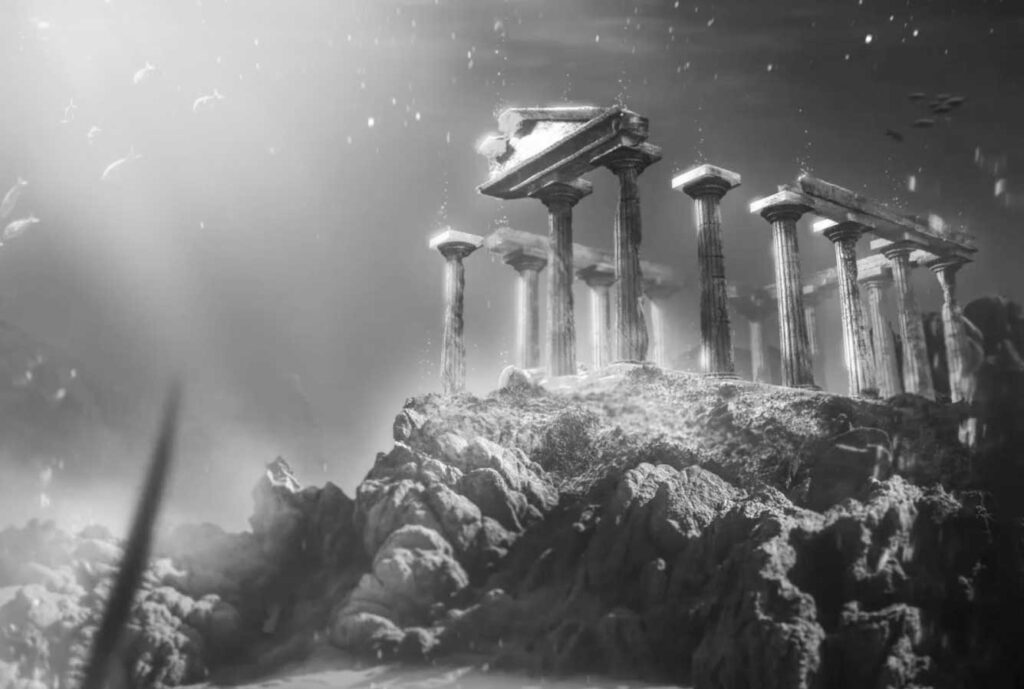
They told that, about 9,000 years before Solon’s time (which would mean about 11,500 to 11,600 years before our time), there existed an island, a great continent named Atlantis. It was situated beyond the “Pillars of Hercules”—today’s Strait of Gibraltar—in the Atlantic Ocean. This island, according to Plato, was larger than Libya (North Africa) and Asia Minor (modern-day Turkey) combined.
From Atlantis, one could travel to other islands, and from there to a “continent on the opposite side” that encompassed the true ocean (perhaps the Americas?). Atlantis was a powerful kingdom, ruling not only its own island but also many other islands and a part of that opposite continent.
The capital of Atlantis was described in great detail: a city built in concentric circles of land and water canals, connected by bridges. In the center was a sacred hill, where there were magnificent temples, adorned with gold, silver, and especially a mysterious, precious metal called “orichalcum”—a metal that gleamed like fire. They had bustling harbors, complex aqueducts, and public baths with both hot and cold water. The land was fertile, providing all kinds of produce, metals, precious woods, and even strange animals; Plato even mentioned elephants.
They had a powerful military, with chariots and a navy. And then, with that power, the Atlanteans became arrogant. They sought to conquer Athens and the entire Mediterranean region. The ancient Athenians, though smaller, bravely stood up against them and eventually defeated the Atlantean invaders, liberating many peoples.
But the tragedy did not end there. After the military defeat, and perhaps more importantly, due to their moral decay, “when the divine portion in them grew faint” as Plato wrote, the Atlanteans angered the Gods. And then, in “one dreadful day and night,” terrible earthquakes and floods occurred. The entire island of Atlantis was submerged and “disappeared into the depths of the sea.” That place, according to Plato, became an impassable barrier of mud, hindering ships from passing through.
(The Professor pauses, opens his eyes, and looks at Henry.)
Those are the main points of Plato’s story of Atlantis. As for my personal perspective…
First, I believe this is not a pure allegory. The detail in the description, Plato’s emphasis on its origin from Solon and the Egyptian priests, shows that he regarded it as a historical truth.
Second, Laura’s “insights,” though somewhat more vague than when she “saw” the Giza Pyramids, also resonate strongly with what Plato described. She “sees” cities of light, where people used energy from giant, finely cut crystal blocks. Initially, this energy was used for good purposes: lighting, healing, communication, and even helping people move with ease. What Plato called “orichalcum,” who knows, might not have been just a metal, but a form of energy-matter, or a special alloy capable of conducting or amplifying that crystal energy.
Third, the fall of Atlantis, in my view, was not merely due to a natural disaster. Plato emphasized the moral factor: arrogance, greed, and the “fading of the divine portion.” This is very important. Laura also “perceived” a deep division in later Atlantean society. On one side were those who wanted to continue pushing technological development, exploiting crystal energy to its limits. On the other side were those who felt uneasy, wanting to return to spiritual values. Gradually, the extremist technology faction gained dominance. She “saw” them begin to abuse the crystal energy, turning it into weapons of terrible destruction. Laura once described a weapon capable of disintegrating matter at a molecular level. Moral decay, the abuse of power, that was the seed of destruction, and the natural disaster was perhaps just the final “judgment” of the universe, or of the Divine.
Atlantis, for me, is an incredibly costly lesson on the intimate link between technological advancement and moral responsibility. A civilization, no matter how glorious, if it loses its moral foundation, its reverence for sacred laws, will sooner or later lead itself to the brink of ruin.
Henry Lowell:
On the topic of Atlantis, I am reminded of an American prophet named Edgar Cayce. I’ve heard he was able to obtain a lot of information about Atlantis through hypnosis. I vaguely recall reading a short article that mentioned him… Do you have any specific information he shared that is related to Atlantis?
Professor Solomon:
(Nodding, a spark of interest in his eyes.)
Edgar Cayce! You’ve mentioned a very noteworthy figure, Henry. Yes, Edgar Cayce, often called the “Sleeping Prophet” of America, left behind a vast treasury of “readings” given in a hypnotic state, and a significant portion of them speak in great detail about Atlantis. What he described is truly fascinating and, at many points, bears a striking resemblance to what Plato wrote, as well as to Laura’s “perceptions.”
From what I have studied of Cayce’s readings, he not only confirmed the existence of Atlantis but also provided a much more detailed picture of its history, technology, and downfall.
One of the prominent points Cayce frequently mentioned was the crystal technology of the Atlanteans. He spoke of them using large crystals, especially a type of “Tuaoi Stone” or “Great Firestone,” not only to generate energy for daily activities like lighting, heating, or transportation, but also for more advanced purposes like long-distance communication, physical rejuvenation, and even weather modification. This aligns very well with what Laura “saw” about cities of light and the use of energy from finely cut crystal blocks.
Cayce also spoke of the social division and moral decay, similar to Plato and what Laura “perceived.” He described two main factions: the “Sons of the Law of One,” who maintained spiritual values, lived in harmony, and used technology responsibly; and the “Sons of Belial,” who pursued material power, carnal desires, and abused technology for selfish, domineering purposes. It was the conflict between these two factions, and the increasing dominance of the Sons of Belial, who abused crystal energy and even created weapons of destruction, that led to the fall of Atlantis. This again resonates strongly with Plato’s description of the “fading of the divine portion” and what Laura “saw” about a weapon that could disintegrate matter.
Another interesting detail from Cayce is that Atlantis was not destroyed in a single event, but went through three major periods of destruction, separated by thousands of years. The final one, around 10,000 BC, was the complete destruction, corresponding to the timeframe Plato gave. This suggests that Atlantis may have been a very long-lasting civilization, experiencing many ups and downs before its final disappearance.
Cayce also spoke of survivors from Atlantis migrating to many parts of the world, carrying with them portions of their knowledge, and may have contributed to the development of other civilizations like those in Egypt, the Mayan region, or the cultures of the Pyrenees. This could partly explain the mysterious similarities between ancient civilizations that were geographically distant.
When I shared some details from Cayce’s readings with Laura, she neither confirmed nor denied them, as what she “sees” are usually direct images and emotions, not a narrative with a beginning and end. But she did say that some descriptions of the use of crystal energy, and the feeling of a “decay from within” of that civilization, “sounded familiar” to what she “perceived.”
So, Edgar Cayce, with his very special method of accessing information, provided another “echo,” a rich and detailed perspective on Atlantis. Although we cannot fully verify what he said with current scientific methods, their consistency with other sources, and the internal logic of the story he told, make them an invaluable reference for anyone who wants to delve deeper into this legendary civilization.
Henry Lowell:
If Atlantis truly existed, where exactly was it located? From your daughter Laura and other sources, do you have any promising clues to find its location?
Professor Solomon:
(Smiling, a somewhat pensive smile.)
That’s the million-dollar question, Henry, and one of the greatest mysteries that researchers, explorers, and dreamers have tried to solve for centuries. “Where exactly was Atlantis located?”
If we stick closely to what Plato wrote, the main clue is “beyond the Pillars of Hercules,” which is the Strait of Gibraltar, and situated in the Atlantic Ocean. He also described it as a very large island. This is the traditional starting point for most searches.
Edgar Cayce, in his readings, also offered some hints. He said that a part of Atlantis, specifically the region called Poseidia, is in the area of today’s Bermuda Triangle, and that some of its ruins can still be found on the seabed around the Bimini and Bahamas area. In fact, the “Bimini Road”—a seemingly man-made underwater stone structure—has sparked much controversy and the hypothesis that it could be part of Atlantis. However, mainstream science has not yet recognized this.
As for Laura, well, her ability is not like a GPS device, Henry. She doesn’t “see” a specific coordinate on a map. But when I ask her about her feeling of Atlantis’s location, she often describes a “feeling of vast emptiness and sadness” when directing her mind towards a large region of the Atlantic. There is a strange “pull,” a “longing for something lost forever beneath the deep waters.” This, in a way, is reminiscent of Plato’s description that after Atlantis sank, the place became an “impassable barrier of mud.” Perhaps it is a vast sea, with complex and difficult-to-explore underwater terrain.
From my personal perspective, based on a synthesis of sources, I believe Atlantis was a continent or a large archipelago located in the Atlantic Ocean. However, its destruction was likely so horrific that it not only submerged it but may have also significantly altered the seabed’s topography, making the search extremely difficult. What remains might only be fragments, remote outposts, or energy imprints that sensitive people like Laura can perceive.
But,
(The Professor pauses for a moment, a different speculative glint in his eye.)
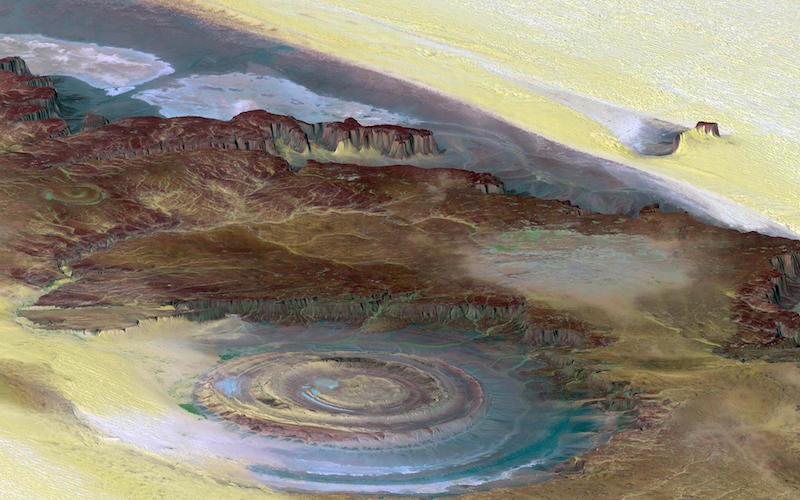
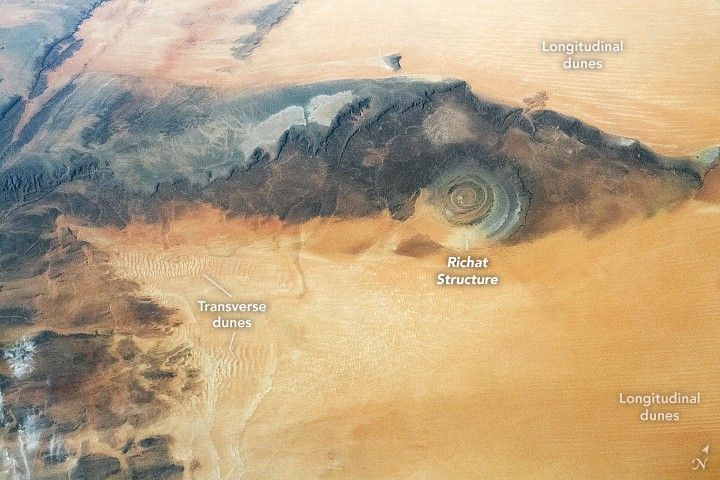
…there is an interesting thing: Plato’s description of the Atlantean capital, with its structure of concentric rings of land and water canals, bears a striking resemblance to certain geological structures on land today. One of them is the Eye of the Sahara. That is a very compelling hypothesis, suggesting that perhaps Atlantis was not entirely in the middle of the ocean, or that its capital was in a location that later, due to geological shifts, became part of the mainland.
So, to answer your question, we do not have a specific “address” for Atlantis. The most promising clue still points towards the Atlantic Ocean, following Plato’s directions. But we should not ignore other possibilities, the “echoes” from strange structures on land that may hold the key. The search for Atlantis, perhaps, is not just a search for a physical location, but also a search for a lost part of human history.
Henry Lowell:
I’ve also been curious enough to use Google Maps to see if there are any clues…
If you look at the Atlantic Ocean on Google Maps, you can clearly see the continental drift, and the trace of the Americas separating from Africa is very clear. This could be an event that happened a very long time ago… Thus, if Atlantis were near the Bahamas, meaning close to Florida, it would be too far from Europe. Therefore, I think it might be the region of the Azores archipelago, about 1,500km from Portugal and Morocco…
You also just mentioned the Eye of the Sahara, which is also one of the locations that I have a big question mark about!… It’s possible that place was once submerged, then rose up again… In that case, it would be a strong “candidate” for Atlantis..
Professor Solomon:
(Smiling, with an expression of delight.)
Excellent, Henry! The fact that you actively use modern tools like Google Maps to explore and ask questions on your own shows a very admirable spirit of inquiry. And your deductions about the location of Atlantis are all very well-founded, based on what we know about geology and ancient descriptions.
You are right, continental drift is an important factor to consider. If Atlantis were too close to the Americas, it would be harder to explain its extensive influence and trade with Europe and the Mediterranean as Plato described, though not impossible.

The Azores region you mentioned, located in the mid-Atlantic, about 1,500km from Portugal and Morocco, is indeed one of the locations seriously considered by many researchers. This location fits better with the description “beyond the Pillars of Hercules” and could be part of a larger mountain range or plateau that has been submerged. The strong volcanic and seismic activity in this region also suggests that major geological upheavals may have occurred in the past.
And you have mentioned an incredibly potential “candidate,” a place that makes me, as well as many others, raise a big question mark: the Eye of the Sahara, also known as the Richat Structure in Mauritania. That is truly a strange and enchanting place.
When viewed from above, its structure of concentric rings is astonishingly reminiscent of Plato’s description of the Atlantean capital. Its size is also relatively consistent. And there is geological evidence to suggest that the Sahara region was not always an arid desert as it is today. In the past, it went through much wetter periods, with rivers and lakes.
The possibility that the Eye of the Sahara was once an island or a coastal land, then was submerged and later rose up due to geological upheavals or major sea-level changes, is a hypothesis that cannot be ignored. If this is true, it would open up a completely new direction in the search for Atlantis—not just under the sea, but also on land.
Laura, when I showed her images of the Eye of the Sahara, had a rather special reaction. She didn’t say it was Atlantis, but she “perceived very clearly that this is not a completely natural structure.” She said there was “intervention, creation by humans or some form of intelligent beings from a very, very long time ago,” along with a “swirling energy” and a “sad memory” of an event where “water rose very quickly.” This perception, though vague, confirms its artificial nature and its connection to a major water catastrophe.
Personally, based on a synthesis of the evidence and perceptions, I have a rather strong belief, perhaps around 80-90%, that the Eye of the Sahara has a close connection to Atlantis, if not being its capital itself. However, as a scientist, I must still maintain caution and wait for more concrete archaeological evidence. We will have the opportunity to discuss the Eye of the Sahara in more depth in our next session, when we examine other large-scale traces of ancient civilizations.
The fact that you are asking these questions shows that we are on a journey of discovery together, Henry. Each hypothesis, each clue, is a step closer to unraveling the mysteries of the past.
Henry Lowell:
Yes, if you wish to “save” a deeper discussion about the Eye of the Sahara for our next session, then you must have your own hidden meaning and are not yet ready to share it today…
But personally, if I were to look from another, invisible perspective, if the existence of an ancient civilization was preserved for some sacred and great purpose of the Creator, then surely there must be a clearer trace than just stories…
Professor Solomon:
(Smiling, a smile of deep understanding.)
You are right, and that is a very natural concern, Henry. If the existence of a civilization, a heritage, truly carries a sacred purpose, an arrangement of the Creator, then why do the traces seem so faint, limited to just stories, myths, or structures whose origins and meanings we endlessly debate?
This is a question I have also pondered a great deal. And I think, perhaps we need to look at the concept of a “clear trace” in a different way.
Perhaps, those “traces” are already very clear, but not in the way that our modern empirical science often demands—that is, physical evidence that can be weighed, measured, and analyzed in a laboratory. The “trace” of a divine arrangement may be more subtle, more profound, and require a “perception,” an “enlightenment” from within each person.
Think about it: if the Creator wanted to convey a message, an important truth, would He necessarily have to leave inscriptions carved in stone, or structures that no one could deny? Or would He choose to sow “seeds” of knowledge, “echoes” into the subconscious of humanity, into legends, symbols, and even into the very fabric of the universe and nature, so that at an opportune time, those with sufficient karmic destiny, enough spirit of inquiry, and enough openness of heart, would discover it for themselves?
Perhaps the “vagueness” of these traces is itself a part of the arrangement. It creates a space for choice, for faith, for sincere seeking. If everything were too clear, too obvious, then perhaps there would be no opportunity for us to “awaken” ourselves, to contemplate and realize profound values. The truth is sometimes hidden subtly, not to challenge, but to invite a journey of discovery from within.
The “echoes” from Atlantis, from the Maya, from the Giza Pyramids that we are trying to listen to, are perhaps precisely those “traces.” They do not shout the truth; they whisper, they suggest, they wait for us to use both our minds and our hearts to decipher them.
And when we talk about more universal “traces,” there is one event whose memory seems to be preserved more “clearly” in the collective subconscious of all humanity, though it has been obscured by time and different interpretations through various cultures. That event is the Great Flood. Cataclysms of such a scale may have erased much physical evidence, but they left indelible marks on the collective memory, in the myths of almost every people on Earth. This can be considered a form of global “trace,” a common “echo” of a purification and a new beginning.
Henry Lowell:
Regarding the term “Great Flood,” it is perhaps more famous than Atlantis but has also not been widely recognized by scientists…
Mentioning this term, I feel it is one of the ways the “Creator” often uses to end a civilization… And the most recent great flood described in the Bible, with the story of Noah’s Ark, according to many estimates, occurred about 5,000-6,000 years ago. It seems to still have repercussions in the legends or fairy tales of many countries..
Professor Solomon:
(Nodding, his expression becoming more serious.)
You are very accurate, Henry. “The Great Flood”—a term that carries immense historical and spiritual weight. It is true that it’s more famous than Atlantis, and like Atlantis, this event, though recorded in countless legends, has yet to receive widespread recognition from mainstream science as a global historical event.
And your feeling, that this might be a “method” used by the Creator or the laws of the universe to end a civilizational cycle, is also a very profound thought. It suggests a deliberate “intervention” or a “purification” process when a civilization has reached its end, perhaps because it has strayed too far from fundamental principles.
The story of Noah’s Ark in the Bible, which you mentioned, is the most famous version in the West, and the estimated date of around 5,000 to 7,000 years ago for that Great Flood also coincides surprisingly with the time when many great civilizations seemed to “suddenly” appear or undergo significant transformations.
But what makes me believe that the Great Flood is not just an isolated myth, but the memory of a real historical event, is its universality. There is hardly a major culture on Earth that does not have its own version of this story. From the Epic of Gilgamesh of Mesopotamia, where Utnapishtim is warned in a dream by the god Ea to build a great ship to save his family and all creatures; to the story of Manu in India, who is saved from a great flood by the fish god Matsya (an incarnation of Vishnu); or Deucalion and Pyrrha of Greece; and even legends in distant lands like China with the story of Yu the Great controlling the flood… The similarity in the core plot, despite different details, is too great to be a mere coincidence. This is undoubtedly a common “echo” of humanity about a terrifying memory and a salvation.
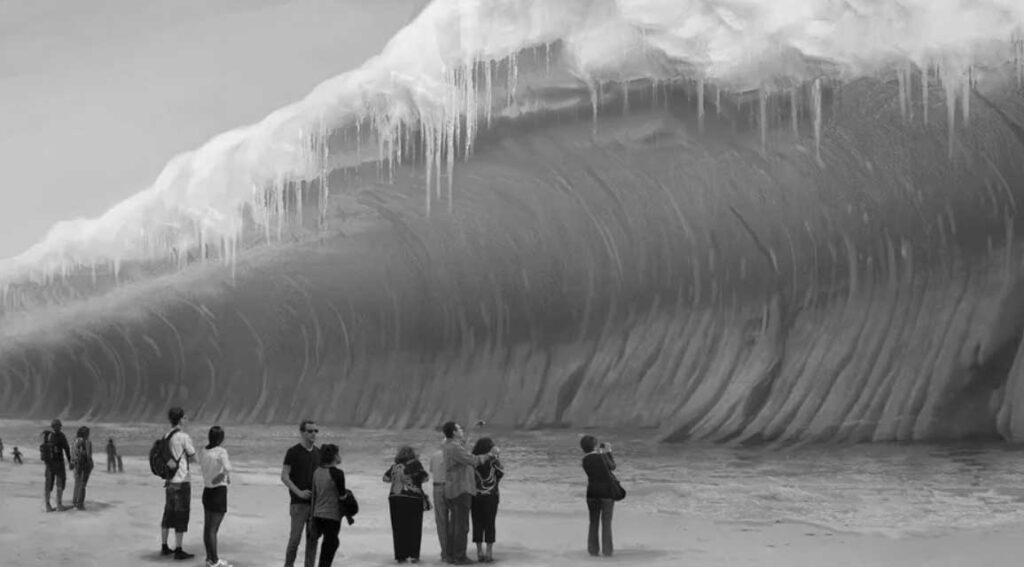
Regarding the scale of the disaster, it is difficult for us to fully imagine. But there are details in the legends, and also special “perceptions,” that suggest a widespread destruction. I once read a sharing on the internet, from a person who claimed to have the Celestial Eye and to be a cultivator of the Buddha Law. This person described that, during a state of deep meditation, they “saw” the tsunami of that Great Flood reaching a height of about 2,000 meters, submerging almost all continents. Only very high mountain peaks, like the Kunlun Mountains in Asia for example, had a few lucky survivors. Although the authenticity of that information needs to be verified, it gives us an idea of the horror of the catastrophe. Laura, when thinking about the Great Flood, also “perceives” an overwhelming despair and destruction, a sense of immense loss, and a “screaming of water.”
As for Noah’s Ark and the “traces” in Turkey, that is a topic that has always attracted interest. Many explorers and researchers have tried to find traces of the ark on the Ararat mountain range, where the Bible records the ark landed. There have been some reports, satellite images, and even some studies of unusual geological structures shaped like a giant boat, or ancient wood fragments believed to be fossilized from the ark. However, this remains a highly controversial issue in the scientific and archaeological communities, requiring more irrefutable physical evidence. I present this cautiously, as we need to maintain scientific objectivity.
But beyond the specific details, the profound meaning of the Great Flood story is what is most worth our contemplation. Why were certain people chosen to survive, like Noah or similar figures in other legends? It couldn’t have been random. Perhaps they were chosen based on their moral qualities, their kindness, their reverence for the Divine. That ark, like a “seed,” carried not only the lives of humans and animals, but also the knowledge, culture, and perhaps the important spiritual principles from the previous civilizational cycle, to sow for a new era.
The Great Flood, from any perspective, was a large-scale purification, a “reset” of the Earth. It shows the existence of greater laws, perhaps the intervention of the Divine as many religious beliefs hold, or the natural operation of the universe according to the cycle of Formation-Stasis-Degeneration-Destruction, to ensure that life and civilization always have the opportunity to be renewed, to continue on a more righteous path.
Henry Lowell:
Yes, listening to you share for these two sessions, I realize that the history of the earth and mankind is not as simple as Darwin’s theory of evolution says… History is truly complex, multi-layered, and more mystical than it appears on the surface… And so, should we not consider Darwin’s theory a joke of the millennium?!…
Perhaps this question should be left for the readers of THE LIVES MEDIA to contemplate for themselves…
We have been talking for a long time today, it’s almost 12 noon. Perhaps we should pause and return tomorrow?
I still remember that you “owe” me and the readers the answer to the question about the “purpose of the construction of the Giza Pyramids,” and also about the “Eye of the Sahara” you mentioned earlier…
Professor Solomon:
(The Professor glances at the clock.)
Oh, time really flies! It’s almost noon. You are right, perhaps we should pause today’s conversation here.
(Smiling, a warm and somewhat satisfied smile.)
Henry, you have summarized wonderfully. Yes, after what we have explored together over these two sessions, the historical picture of the Earth and humanity no longer appears as simple and one-dimensional as many still imagine. It is truly more complex, more multi-layered, and holds many wonders, many “echoes” from the depths of time that Darwin’s theory of evolution, with its limitations, can hardly encompass.
As for considering Darwin’s theory a “joke of the millennium”…
(The Professor leans back in his chair, his voice slowing, his gaze distant.)
That is a strong statement, and I understand why you would think that after being exposed to this information. Perhaps, instead of making a final judgment, let’s just let the evidence, the “echoes” we have discussed, speak for themselves. As you said, let’s leave it for each reader of THE LIVES MEDIA, after reading these things, to contemplate for themselves, to cross-reference, and to find their own answers.
And rest assured,
(The Professor smiles, a hint of humor in his eyes.)
…I have not forgotten my “debt.” The story of the true purpose, the spiritual origin of the Giza Pyramids, especially Laura’s “insights” about the dialogue between the young King, the Princess, and the High Priest, along with a deeper analysis of the Eye of the Sahara and its possible connection to Atlantis, will certainly be key highlights of our next session. They will be the final pieces of the puzzle, helping us to complete the picture of the great “arrangements” and the “echoes” for the present.
Thank you, Henry, for a morning of incredibly interesting and insightful exchange. I very much look forward to our meeting tomorrow.
Henry Lowell:
Yes, goodbye Professor. See you tomorrow morning!
Professor Solomon:
(Standing up, he smiles and extends his hand to shake Henry’s.)
Yes, goodbye, Henry. I’ll see you tomorrow morning. I believe our final session will have many more interesting things for us to discover together. I wish you a good afternoon and profound reflections.
(…..)
This article is an excerpt from the book “ECHOES BEFORE TIME,” recording a profound dialogue between journalist Henry and Professor Solomon, an archaeologist.
If you wish to experience the full journey of thought and the unpublished insights of the work, please click the button below to own the complete book.
To explore more works from THE LIVES MEDIA, visit our book collection.