( ….. )
Avery Lin:
While you were in prison, did you witness other practitioners being beaten, or even—
did you hear or see anything about organ harvesting?
Ma Changsheng:
(His face grows very solemn. A deep pain and restrained fury flicker in his eyes. He remains silent for a while, as if searching for the right words to express something unspeakable.)
Avery Lin, what you’re asking about… these are crimes that go far beyond what any kind-hearted person could imagine.
When I was inside—whether in detention centers or forced labor camps—torture of fellow practitioners was almost a daily occurrence.
I witnessed many heartbreaking scenes firsthand.
Terrible screams coming from the interrogation rooms.
Practitioners dragged back, bloodied, or returning to the cell covered in bruises and wounds, barely able to walk.
Some were handcuffed and hung up for days.
Some were shocked with electric batons, especially on sensitive areas.
Some were force-fed with thick plastic tubes that tore their throats and made them bleed.
Some had cold water dumped on them during the freezing winter.
The purpose was to inflict unbearable physical pain in order to break our spirits and force us to renounce our belief.
Many fellow practitioners remained unshakable.
Even after being tortured within an inch of death, they would still firmly declare “Falun Dafa is good” without a word of complaint—only silent endurance.
Sometimes, that very steadfastness made their persecutors even more vicious.
As for… organ harvesting…
(Uncle Ma takes a deep breath. His voice turns raspy.)
When I was inside, Avery Lin, I never personally saw anyone being cut open.
Such monstrous things are usually done in secret, leaving no trace for ordinary people to witness.
However, I did witness things that made your blood run cold—things that forced us to ask terrifying questions.
Some practitioners—especially younger, healthier ones who refused to “transform”—suddenly disappeared without a trace.
Before that, they were often taken for “medical exams,” very thorough ones—blood tests, scans—much more comprehensive than any regular prisoner would receive.
Then… they were gone.
When their families asked, the detention centers would casually say they’d been “released,” “transferred,” or had “died from illness.”
But no one ever saw the body.
And if they did, it had often already been cremated.
There were whispers too—rumors passed around the prison:
“Falun Gong organs are very good,” “they sell for high prices…”
At the time, we were filled with fear and disbelief.
We couldn’t bring ourselves to think it was true.
It was only later, after I was released and gained access to outside information—from international investigative reports, from witness testimonies—
that I began connecting the dots: the missing practitioners, the strange medical exams…
And then, Avery Lin, I realized the truth was even more horrifying than we had imagined.
This wasn’t random.
It showed signs of being a state-sponsored system—targeting detained Falun Gong practitioners, who were no longer even treated as human,
and harvesting their organs to feed a lucrative transplant industry.
Thinking back on those healthy practitioners who vanished…
those unusual “health checkups”…
I can’t help but connect them to this monstrous crime.
It’s a pain—a scar that will never heal in the hearts of those who survived and know the truth.
This… this is a crime against humanity, Avery Lin.
Avery Lin:
Yes, those scenes are truly heartbreaking…
So how long were you imprisoned?
Ma Changsheng:
(Uncle Ma gently nods, his eyes reflecting a thoughtful look that gradually becomes clearer.)
Let me recall it accurately… The time I was arrested at that temple—after the interrogations, detention, and their attempts to “transform” me—I was actually imprisoned for about three or four months, Avery Lin.
Indeed, compared to many fellow practitioners who were imprisoned for years, even decades, that period wasn’t particularly long.
I believe part of it was because I always tried to maintain righteous thoughts and unwavering faith in Master and the Fa.
Even under pressure and interrogation, I did my best to speak the truth to them with a compassionate heart—no fear, no hatred. I told them that Falun Dafa teaches people to be good, that Truthfulness-Compassion-Forbearance is right, and that this persecution was unjust.
There were times I truly felt Master’s reinforcement, helping me get through the most difficult moments.
When your mind is pure and righteous, without fear, the evil has no place to enter. I believe that a cultivator’s strong righteous thoughts can transform the environment around them, even dissolve tribulations.
During those three or four months, although short compared to others, I still witnessed and endured all kinds of their tactics—from coaxing and threats to psychological and physical pressure, as I’ve shared.
When they saw they couldn’t shake my faith, couldn’t force me to sign the “three statements,” and perhaps felt that holding onto an “old monk” like me without being able to “transform” him wasn’t of any use, they eventually released me.
Even if it was just three or four months, it was still an incredibly harsh cultivation ground, Avery Lin.
It helped me see more clearly the nature of the persecution and further solidified my resolve on the path I had chosen.
And after being released, even though I was still monitored and restricted, I continued to do what a Dafa disciple should do.
Avery Lin:
After you were released, did you continue your path of “spreading the Fa and clarifying the truth”? Could you share some of the events you still remember clearly?
Ma Changsheng:
(Smiling gently, his kind expression reveals a firm inner resolve.)
Of course, Avery Lin. How could I possibly stop?
After being released, although I knew I was still “under surveillance,” the responsibility of a Dafa disciple—the deep pain of seeing Master and Dafa being slandered, of seeing so many people still deceived—urged me to press on.
My time in detention only made me understand even more how important it is to clarify the truth.
So my journey of “spreading the Fa and clarifying the truth” resumed—perhaps more cautiously, but with even stronger conviction.
There were so many memorable moments, Avery Lin.
Every encounter, every person I had the opportunity to speak with, was a story in itself.
I remember one time I went to a very remote rural area.
There, information was heavily censored, and people only knew about Falun Gong through the negative propaganda on TV.
I approached a farming family whose son was seriously ill. They had tried everything without success and were struggling financially.
They seemed kind and simple.
At first, when I gently mentioned Falun Gong, they were frightened. They waved their hands urgently, saying it was an “evil cult” banned by the government.
I didn’t rush. I simply asked them for a little time so I could tell my story—the benefits I and many others had experienced through cultivation, and the truth about the persecution.
I talked about the principles of Truthfulness-Compassion-Forbearance, about being a good person.
I stayed at their home for a few days, helped out with little chores, and treated them with sincerity.
Gradually, they saw that I was nothing like what the TV described. They began to listen, then started asking questions.
I gave them a few truth-clarifying materials I had carefully brought along.
By the third day, their bedridden son suddenly felt better and wanted to sit up.
The whole family was astonished and overjoyed.
I told them it might be because their hearts had begun to turn toward kindness and that the Buddha Fa is boundless—when people hold true belief, divine beings will see it.
I also taught them to quietly recite, “Falun Dafa is good, Truthfulness-Compassion-Forbearance is good.”
When I left, the whole family walked me to the edge of the village.
Their eyes were filled with gratitude and respect.
The mother held my hand with tears in her eyes and said they would never again believe the lies on TV.
I don’t know whether they eventually began cultivation themselves, but I believe that a seed of goodness had been planted in their hearts.
For me, that was a tremendous joy—a source of encouragement on this difficult path.
There were other times too—when I handed out truth-clarifying materials at markets, or posted small flyers in public places—some people reacted with hostility, even threatening to report me to the police.
In such situations, I always tried to stay calm, explain kindly, and if they wouldn’t listen, I would quietly walk away.
The important thing was that I had done what I needed to do.
On those journeys, I also met many people from temples and Taoist monasteries.
Not everyone was like that abbot who reported me.
Some were genuinely seeking the Dao, though they might not yet understand Falun Dafa or the persecution.
And through those encounters, I had many dialogues that made me reflect deeply on the times we live in and the path of cultivation…
Avery Lin:
So, was your journey to spread the Fa smooth? Did you encounter many people who were truly predestined with Dafa? I’ve heard that many monks in temples, after reading numerous scriptures and cultivating for years, believe they’ve already enlightened to many Fa principles… That kind of mindset often puts them on a high pedestal, making it hard to dialogue or share understandings with them.
Ma Changsheng:
(Smiling gently, a kind expression tinged with a trace of reflection.)
“Smooth” may not be the right word to describe that journey, Avery Lin. Every step carried potential dangers, and every word spoken had to be weighed carefully. But if you’re asking whether I met people truly predestined with the Fa—then yes, I met quite a few.
“Predestined connection” comes in many forms. There were people who, from the moment I shared something, could feel the sincerity and goodness of Dafa and were willing to listen and learn more. Those were people with good inborn quality—perhaps they’d been waiting for this moment all their lives. Like that farming family I mentioned before—that was one such example.
But there were also others who were initially suspicious, even resistant. Yet after I persistently clarified the truth with a kind heart, they gradually changed their attitudes. Some didn’t believe immediately, but at least they started to think for themselves and stopped blindly accepting the propaganda. To me, planting even one seed of righteous thought in their hearts was already a success.
As for the monks you mentioned… indeed, that’s a very particular situation, and not always easy to navigate.
(Uncle Ma pauses, letting out a soft sigh, his gaze drifting into the distance.)
You’re absolutely right, Avery Lin. Many monks have devoted their lives to studying scriptures, strictly following the precepts of their school. In their minds, the Fa principles they’ve understood, the cultivation experiences they’ve accumulated, have become inseparable from their identities. When they feel they’ve “awakened” to many truths and have a certain standing in the spiritual community, accepting a new Fa or a new understanding can become a major challenge.
The mindset of “being above others” that you mentioned—it can come from many sources. It might stem from their attachment to their own knowledge, thinking that what they know is already the highest. It might come from being long accustomed to receiving respect from others, making it hard for them to humble themselves and listen to something “new” from someone they don’t know. Or perhaps, in this Dharma-ending age, many who appear outwardly as monks—wearing robes and reading scriptures—are no longer cultivating genuinely. Their heart of true spiritual seeking has been diluted by worldly concerns. They might speak eloquently about principles, but lack the humility and open heart to embrace something that goes beyond their current understanding.
When I encountered people like that, Avery Lin, I never tried to argue over right or wrong, or prove that “my Fa is higher.” I simply shared from a place of sincerity and respect.
I would speak about my own experiences of gaining Dafa, of how both my body and mind were elevated.
I would talk about the principles of Truthfulness-Compassion-Forbearance as universal values that any true cultivator should strive for.
If the moment allowed, I’d gently mention the signs of the Dharma-ending age, and the decline of purity in the spiritual world—things that many of them could already feel.
Some of them just listened silently, without showing much reaction.
Some expressed disagreement or even rejection.
But I understood—every person has different predestined relationships and enlightenment quality.
All I could do was sow the seed; whether or not they would accept it was their choice.
That said, not all were like that. I also met a few monks who genuinely sought the Way. They weren’t bound by rigid notions. Among them, there was one encounter that left a deep impression on me—a profound conversation with the abbot of an old mountain temple.
We talked at length about the Dharma-ending era, the challenges of cultivation today, and the true meaning of “no second cultivation way” (Bu Er Fa Men) as each of us understood it. That meeting gave me a lot to ponder.
Avery Lin:
Yes, could you share about that meeting with the abbot, if you still remember it clearly?
Ma Changsheng:
(Smiling, his eyes gazing toward a distant but vivid memory.)
Certainly, Avery Lin. I still remember that encounter very clearly.
It was one afternoon when I stopped at a secluded ancient temple nestled against a hillside.
The abbot there appeared to be in his seventies—dignified, with a compassionate face.
After I requested and received permission to stay the night, we sat down for tea.
His room, Avery Lin, was filled wall to wall with scriptures—so many types. There were orthodox Buddhist canons, Taoist texts, even scriptures from other religions and some folk religious writings—like the Scripture of Queen Mother of the West.
He seemed quite proud of his breadth of study, telling me he had explored many schools and teachings.
He lamented the chaos of the world, the moral decline, and how difficult cultivation had become.
He said that his extensive study was his way of seeking a path that could truly help sentient beings.
But as he spoke, I sensed a kind of confusion, a lack of certainty—something he tried to mask.
After listening quietly, I shared my own insights about this Dharma-ending age.
I told him that the moral decline wasn’t just superficial. More fundamentally, many orthodox scriptures had been lost or were difficult to comprehend.
In contrast, many texts written later by ordinary people based on personal interpretations—though seemingly easier to read—lacked the original depth and true meaning.
People easily get caught up in surface-level understandings, thinking they’ve “attained the Way” when they’ve only grasped fragments.
I also told him something crucial:
In the past, the Divine beings—Buddhas, Daos, and Gods—descended to impart the Fa, but their teachings could only be preserved for a certain period.
Now, in the Dharma-ending era, many of those cultivation paths have lost their spiritual efficacy.
The enlightened beings who once upheld them have “completed their term,” so to speak—like a president whose term has ended and no longer has governing power.
This is a time when sentient beings await a new, true Fa—a future Buddha, such as Maitreya, who is prophesied in scriptures to descend to save the world.
Seeing his room filled with all sorts of scriptures, I gently shared my understanding of the principle of “No Second Cultivation Way.”
I told him it’s not wrong to study and learn, but in true cultivation—especially when aiming for liberation—single-mindedness is essential.
I said: A cultivator not only cultivates their character and enlightenment to the Fa principles, but also needs virtue to be transformed into gong (energy).
Each orthodox school has its own mechanism through which the Master helps disciples transform virtue into gong.
If someone has a limited amount of virtue, but divides it across many cultivation paths—like trying to build several houses with enough money for just one—none of them will ever be completed.
By reading too many different texts, especially those outside the orthodox canon, one’s mind becomes scattered. Energy becomes unfocused.
And the Master of whatever path they’ve chosen will find it difficult to truly help them elevate.
Unknowingly, they’ve violated the principle of “No Second Cultivation Way.”
The abbot was silent for a long time, Avery Lin.
I saw surprise on his face, followed by deep contemplation.
Perhaps my words touched upon the confusion and impasses he had long felt in his own cultivation but couldn’t articulate.
He didn’t refute anything—he only nodded slightly, his expression no longer so confident, but instead deeply pensive.
Before I left, I gave him a copy of Zhuan Falun.
I told him, “These are the teachings of our Master about the universe, human life, and the path of cultivation in this Dharma-ending age. If you’re predestined, please read it and reflect for yourself.”
I saw him accept the book—his hands trembling slightly—and his eyes looked at me with a quiet sense of gratitude.
I don’t know if that abbot ever truly stepped into Dafa cultivation, Avery Lin.
That depends on his predestined relationship and his choice.
But I believe that conversation, and the Dafa book, planted a seed in his heart.
At the very least, it made him reconsider his path and what true cultivation means in this extraordinary era.
Avery Lin:
Those efforts, at the very least, meant you were able to plant a seed of goodness…
I get the sense that your journey of spreading the Fa and clarifying the truth must have been full of hardship—but certainly carried a completely different mindset compared to your earlier 30-year journey of seeking the Fa…
Ma Changsheng:
(Smiling, a gentle smile filled with deep understanding.)
You’re absolutely right, Avery Lin. Those two journeys—though both involved walking a path, both about seeking and sharing—were worlds apart in terms of mindset.
That 30-year journey of seeking the Fa was one of a person groping through darkness, longing for the light.
I walked it with the heart of a disciple looking for a Master, burdened with questions and yearning to understand the meaning of life and the path to liberation.
Every time I met someone regarded as a high monk or a Daoist adept, my heart would stir with hope—only to sometimes feel disappointment when I realized it wasn’t what I was truly seeking.
It was a journey of seeking, often of confusion and solitude, and at its core, it was for myself—for my own liberation.
I still remember the times I was turned away—back then, I felt disheartened.
But later, upon enlightenment, I realized those were actually the best arrangements—unseen protection, preserving my purity so I could one day receive the True Fa.
(Uncle Ma pauses briefly, eyes brightening as he speaks about the later years.)
But the 16-year journey of spreading the Fa and clarifying the truth—that was after I had found the light, after I had obtained the True Fa, and had a Master guiding me.
The mindset was no longer that of one seeking, but of one giving, one offering.
I walked not for myself, but for sentient beings—for those still being deceived, for those in need of hope and truth.
First, the purpose was different:
Before, it was “seeking for myself.” Afterwards, it became “giving to others.”
Second, the state of mind was different:
Before, I had uncertainty, anxiety, and restlessness.
Later, even in the face of danger, arrest, or torture, my heart remained calm and steadfast—because I knew I was doing the most righteous thing, with the Fa as my support.
No longer wandering in fear, but walking with certainty, guided by the beacon of the Fa.
Third, the source of strength changed:
Before, my strength came mostly from personal will and longing.
Later, it came from Dafa, from the empowerment of the Master, and from unwavering belief in Truthfulness-Compassion-Forbearance.
It was a boundless strength, far beyond anything I could’ve imagined.
And fourth, the people I approached were different:
Before, I sought out “masters.”
Later, I went to ordinary people—the general public—and to other spiritual practitioners, to share the truth.
It’s true, this later journey was far more difficult externally, filled with danger.
But Avery Lin, when one carries the Fa in their heart and has compassion for sentient beings, then these hardships become tests that help elevate one’s character and fulfill the role of a Dafa disciple during the Fa-rectification period.
Each time I overcame a tribulation, each time I helped someone awaken to the truth, a profound peace and joy would rise in my heart.
It was no longer the loneliness of a seeker, but the happiness of one who had found and was sharing a treasure.
Though the physical body may suffer, the spirit was always full and purposeful.
That is the greatest difference, Avery Lin.
Avery Lin:
And how long did that journey last?
I heard there was even a time you traveled to both Hong Kong and Taiwan?
Ma Changsheng:
(Smiling gently, his gaze distant, as if embracing a long stretch of life.)
Yes, Avery Lin.
This journey of spreading the Fa and clarifying the truth, from the start of the persecution until the time I recently left mainland China, lasted about sixteen years.
Those sixteen years weren’t spent constantly on the move—there were times when I stayed in relatively secluded places to hide, to study the Fa quietly and recharge, before continuing on again.
And you heard right.
During those sixteen years, I also went to Hong Kong and Taiwan for a period.
(Uncle Ma pauses briefly, as if recollecting a special chapter.)
You know, Avery, at that time, Hong Kong—though returned to China—still retained a certain degree of freedom under the principle of “One country, two systems.”
It was an important window, a place where the truth about the persecution in the mainland could be revealed to the world, and also a rare opportunity for mainland Chinese visitors to come into contact with information they could never access back home.
I went to Hong Kong hoping to do my small part in clarifying the truth—especially to mainland tourists and business travelers passing through.
Taiwan, on the other hand, was an entirely different land.
There, Falun Dafa was openly practiced and respected by society.
The Taiwanese people had preserved much of China’s traditional moral and cultural values—values that had been nearly destroyed in the mainland after so many political campaigns.
When I arrived in Taiwan, it was partly to personally witness how Dafa had flourished in a free environment, to learn from fellow practitioners there, and also to find a temporary place of peace for quiet cultivation, to strengthen myself again after the years of danger on the mainland.
My time in Hong Kong and Taiwan left many memorable impressions, Avery Lin.
Each place brought its own experiences, its own encounters—giving me new perspectives on the path of cultivation and the mission of a Dafa disciple during this extraordinary time.
Avery Lin:
So when you left China, did you face any difficulties?
I’ve heard that for many Falun Gong practitioners, leaving China is incredibly difficult—sometimes requiring diplomatic intervention from the U.S. or other countries just to get out…
Ma Changsheng:
(Nods, a trace of concern flickering in his eyes as he reflects on the struggles many fellow practitioners have faced.)
You’re absolutely right, Avery Lin. For most Falun Gong practitioners, leaving mainland China is extremely difficult—almost impossible. Their control system is very tight.
Most practitioners who are identified by the authorities are on a blacklist, banned from leaving the country. Many have had their passports confiscated, or were denied renewal or issuance.
What you heard about diplomatic intervention by other countries to help some people leave—yes, that’s true. Those are rare cases, often involving people with special circumstances or international attention.
As for my case… perhaps it was somewhat special too.
There are things that, even now when I think back on them, feel like they were divinely arranged.
(Uncle Ma pauses briefly, then continues with calm composure.)
As I mentioned before, I had spent a long time “moving around” within China, never staying in one place for too long.
Perhaps that made it harder for them to keep close tabs on my whereabouts compared to someone who lived at a fixed address.
Regarding leaving the country, I still had my passport from earlier—which was a stroke of luck.
When I decided that I needed to go abroad—partly to find a freer environment to continue my cultivation, and partly to do more in clarifying the truth to the world and exposing this persecution—I went through the process like any ordinary person.
At the border checkpoint, when the officer scanned my fingerprint and checked my passport, I knew full well that their system must contain information about me.
My heart beat a little faster at that moment, but I did my best to stay calm and hold firm righteous thoughts.
I thought: everything is arranged by Master. I will walk this path righteously and upright.
And then something miraculous happened, Avery Lin.
After my file popped up on the screen, the officer looked up at me.
I looked straight into his eyes—without fear, without evasion—only calmness, compassion, and the dignified presence of a practitioner.
He stared at me for quite a while. I could sense his surprise, a kind of hesitation, and then a subtle change in his expression.
He said nothing. He didn’t question me. He simply stamped my passport and handed it back.
He showed no signs of trying to block me or give me trouble.
I truly believe that in that moment, the righteous field of a true practitioner—the compassionate and upright energy—touched his conscience, or at least awakened a bit of his kindness, making him unwilling to obstruct me.
Of course, on a deeper level, I knew this was Master’s arrangement, opening the way for me.
And so, I was able to leave China in a relatively “normal” way—though I knew this was almost impossible for many other fellow practitioners.
That made me cherish the opportunity even more—and made me feel a greater sense of responsibility.
Avery Lin:
That customs experience really exemplifies the mindset of a true cultivator—and the power of Dafa…
So during your time in Hong Kong and Taiwan, did you participate in any group activities with other practitioners? Were there any events that especially stood out to you?
Ma Changsheng:
(Smiling, his eyes lighting up with joy and gratitude as he recalls those days.)
Oh yes, Avery Lin.
Though my time in Hong Kong and Taiwan wasn’t as long as my years on the mainland, it was incredibly meaningful.
There, I could truly immerse myself in activities with fellow practitioners in a free environment—something we could only dream of in China.
In Hong Kong:
You know, Hong Kong is a very special place.
It served as a gateway, a point of contact. Practitioners in Hong Kong did an excellent job of clarifying the truth to tourists from the mainland.
I often joined them at tourist sites, where many visitors from China passed through.
At first, these people were cautious, even afraid—but then they were drawn in by the banners, by the powerful images depicting the persecution, and most of all by the practitioners’ calmness and patience.
Many eventually stopped to listen, accepted flyers, and some even quietly made the “three withdrawals” (withdrawing from the Party, Youth League, and Young Pioneers) on the spot.
To be able to speak directly with them, to help them break through the lies—that felt incredibly meaningful.
Now, around 2016–2017, when I was there, the political climate in Hong Kong had already begun tightening.
The large-scale parades and rallies from the early years of the persecution had become much harder to organize.
Still, the practitioners in Hong Kong remained courageous and creative.
They continued holding public events to speak out—even if on a smaller scale or in altered formats to fit the environment.
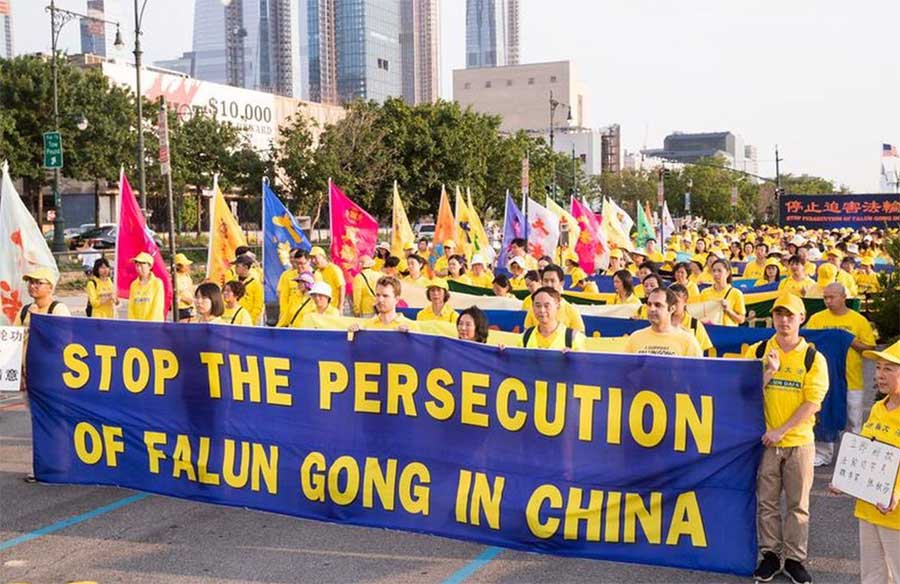
There were candlelight vigils, modest-scale parades through central areas, peaceful gatherings—all conducted with dignity and grace to raise awareness.
The Tian Guo Marching Band still appeared, though with fewer members.
To me, even if these events didn’t involve tens of thousands like before, being able to witness and participate in any public activity in that increasingly tense environment was deeply precious and unforgettable.
It showed extraordinary bravery—a steadfast resolve to stand firm before tyranny.
I took part in several peaceful appeals and moderate-scale parades.
Although the crowds weren’t massive, the orderliness, the peaceful presence, and the powerful messages about Truthfulness-Compassion-Forbearance and ending the persecution were clearly conveyed.
And most importantly, they still left a deep impression—awakening many minds, especially those of first-time mainland visitors who saw such scenes with their own eyes.
In Taiwan:
Now, Taiwan had a completely different feel.
There, Falun Dafa was openly practiced, respected by society and supported by the government.
The number of practitioners was very large.
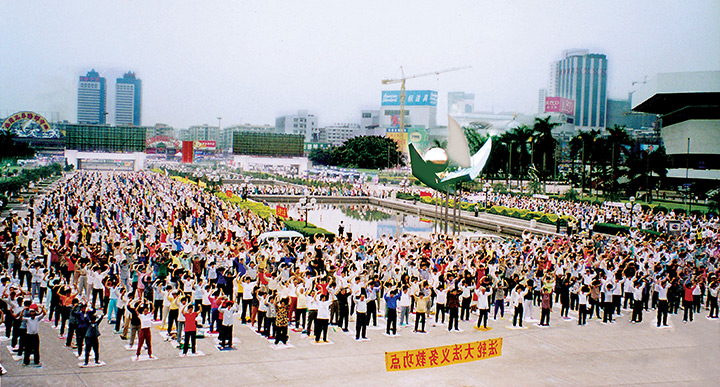
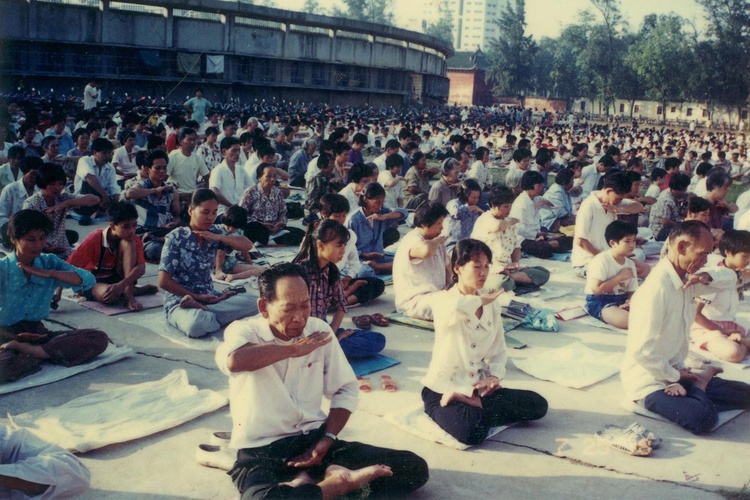
I had the chance to attend major Fa study sessions—sometimes with hundreds of people—sharing cultivation experiences openly and sincerely.
What touched me most were the large-scale Fa Conferences and character formation events.
You might have seen those photos, Avery Lin.
Thousands of practitioners, dressed in neat exercise clothes, sitting in peaceful meditation—forming huge sacred characters like “Truthfulness-Compassion-Forbearance,” or images of Master or the Falun emblem.
To be part of that sea of people, to feel the harmonious, compassionate energy that enveloped everything, to see the unity and sincerity of fellow practitioners—it moved me deeply.
It truly reflected the beauty and greatness of Dafa.
It was a living image of Dafa’s wide spread, a complete contrast to the persecution on the mainland.
I also joined some truth-clarification efforts at tourist sites in Taiwan, where many mainland tourists visited.
The warmth and support of the Taiwanese public toward Falun Gong was another thing that deeply moved me.
Those experiences in Hong Kong and Taiwan, Avery Lin, not only opened my eyes and allowed me to learn from overseas practitioners, but more importantly, they strengthened my confidence and inner strength.
I saw that no matter how brutal the persecution was in China, outside of it, Truthfulness-Compassion-Forbearance was still spreading.
The light of Dafa still shines.
And in this battle between good and evil—goodness will ultimately triumph.
Avery Lin:
I haven’t witnessed the atmosphere in Taiwan firsthand, but I can feel that it’s probably quite similar to the grand activities organized by practitioners here in New York…
It’s already getting late—later than yesterday…
Could you share a bit about your journey to the U.S., and perhaps offer a few words for sentient beings, especially young people?
Ma Changsheng:
(Smiling gently, his eyes filled with warmth as he looks at Avery Lin.)
That’s right, Avery Lin. The activities in Taiwan, with their freedom and large scale, do indeed have a similar atmosphere to what our fellow practitioners have created here in New York.
They are all vivid demonstrations of the widespread transmission of Dafa around the world—a stark contrast to what’s happening in our homeland.
You’re right, it’s getting late. We’ve been talking for quite a while.
(He pauses for a moment, his gaze drifting into the distance before turning back to Avery Lin with a calm, reflective air.)
As for my coming to the U.S.… after the years in Hong Kong and Taiwan, I felt that my mission needed to continue in a place where I could raise my voice even more, a place where the truth could reach more people around the globe.
New York—as you know—is often called the “capital of the world.” And our fellow practitioners here are doing many great things to clarify the truth and expose the persecution.
Being able to come here—I also consider it a part of Master’s arrangement.
Just like my departure from China, everything went surprisingly smoothly, beyond what I could have imagined.
I simply held one thought in my heart: that I needed to go where I was meant to go, and do what I was meant to do. And the path naturally opened up.
(He smiles softly, then his voice takes on a more heartfelt tone.)
If I could share a few words—especially for sentient beings in this special time, and especially for young people like you…
First of all, I hope everyone, no matter where you are or what ethnicity you belong to, will make an effort to learn the truth about Falun Dafa and the brutal persecution by the Chinese Communist Party.
Don’t blindly believe the one-sided propaganda or distorted information.
Truthfulness–Compassion–Forbearance are universal values, the moral foundation of humanity.
A spiritual practice that teaches people to live by Truthfulness–Compassion–Forbearance and brings health and peace to millions cannot possibly be an “evil cult.”
Use your conscience to judge.
Especially for the younger generation—you are the future of the world.
In this era, you face countless material temptations and overwhelming chaos of information.
It’s easy to get swept up in surface-level trends and forget core spiritual values, forget the true meaning of life.
I hope you will cherish kindness and uphold morality.
Don’t be afraid to go against the crowd if it means doing what is right.
Be brave in seeking the truth—don’t let lies blind you.
Within each person is a lamp of conscience; let it light your path.
The world is going through a time of great upheaval.
Many speak of the “End of Dharma,” of the trials humanity must face.
But in every crisis, there is also hope.
I believe that as long as people hold onto kindness and choose to stand with righteousness, a bright future awaits.
Falun Dafa has given me—and millions of others—the answers to life’s biggest questions, bringing inner peace and a genuine path of cultivation.
If you are fated, I hope you will look into it. It could be a tremendous blessing.
Remember, human life is incredibly precious.
Don’t waste it on meaningless things.
Live with purpose, live in a way that honors your existence—and leave behind something good for future generations.
(Uncle Ma looks at Avery Lin with tenderness and hope in his eyes.)
Let’s wrap up here for today, Avery Lin.
Thank you for your patience in listening to the stories of an old man like me.
Avery Lin:
Thank you for sharing, sir…
When you just mentioned “human life is incredibly precious,” it reminded me once again of the phrase:
“To be born as a human is rare; to be born in China is rarer; to encounter the True Law is even rarer; and to meet a True Master is the rarest of all…”
Once again, thank you so much—and I wish you all the best!
Ma Changsheng:
(Smiling, his eyes glinting with deep empathy and appreciation upon hearing Avery Lin recall that line.)
Avery Lin, what you said is truly meaningful and profound.
“To be born as a human is rare; to be born in China is rarer; to encounter the True Law is even rarer; and to meet a True Master is the rarest of all.”
Every part of that saying speaks to a great truth—a reminder of the precious and rare opportunities in this human life.
(He nods gently, looking at Avery with satisfaction and admiration.)
For myself, after so many years of seeking, through all the ups and downs, I’ve come to understand these words more deeply.
Precisely because “human life is rare,” we must treasure it.
And because “encountering the True Law and meeting a True Master” are so rare, once we have the chance, we must cherish it, remain steadfast, and cultivate diligently.
The fact that you can reflect on this, Avery Lin, brings me great joy.
Once again, thank you for taking the time to listen.
I hope you always hold onto kindness and wisdom—and that many good things come your way.
All the best to you.
(…..)
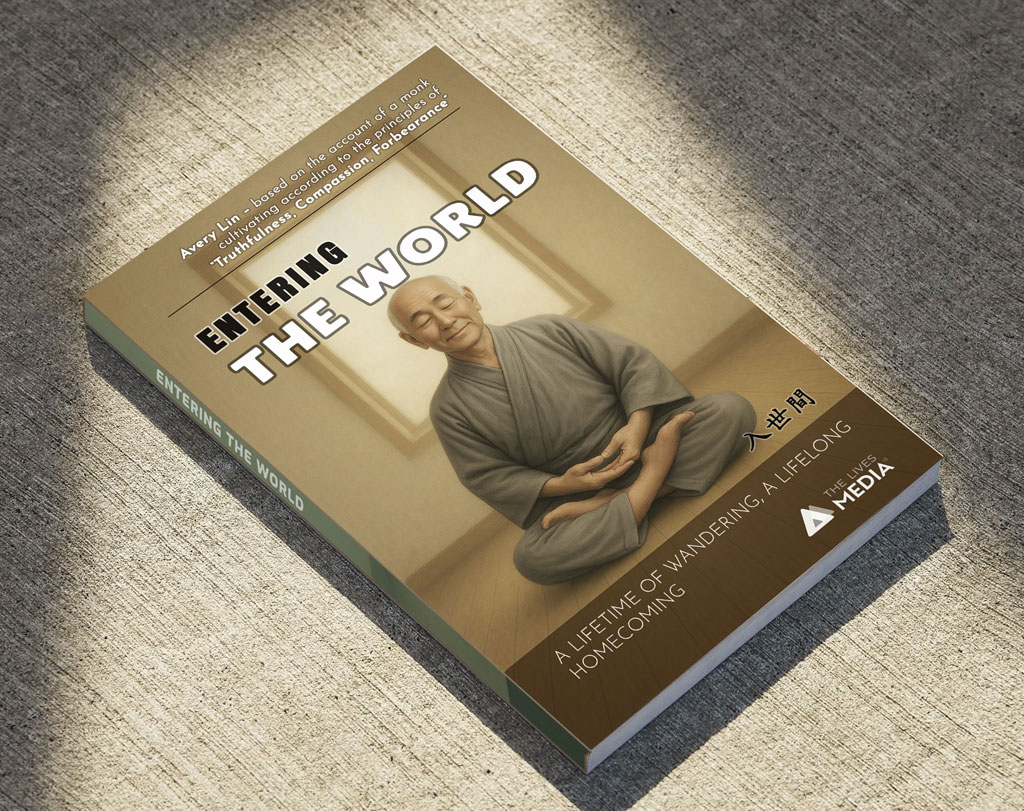
This article is an excerpt from the book “ENTERING THE WORLD“, which tells the story of a Chinese monk’s more than 60-year journey of seeking and practicing the Dharma.
If you wish to experience the full journey of thought and the unpublished insights of the work, please click the button below to own the complete book.
To explore more works from THE LIVES MEDIA, visit our book collection.