( ….. )
Avery Lin:
Hearing your story makes me reflect on my own journey. I obtained the Great Law so easily—without trials, without tribulations. Maybe it was just destiny and a bit of inborn insight that let me gain it so effortlessly…
When I imagine wandering alone, seeking the Law across mountains and lands—I honestly can’t see myself doing it. So much hardship, so many trials… and all of it done in solitude.
During all those years, did you ever encounter solitary cultivators deep in the mountains?
Ma Changsheng:
(Uncle Ma smiled gently, understanding Avery’s reflection.)
There’s truth in what you’re saying. Every person walks a different path, with different destinies. Some must endure countless hardships to find the Way; others obtain it with ease when the time is ripe.
What matters isn’t whether one’s path is hard or easy—but whether, after gaining the Law, one truly treasures it, truly applies oneself to cultivation. Perhaps your destiny was sown over many lifetimes, so that in this life, things unfolded smoothly for you.
As for solitary cultivators in deep mountains—yes, Avery, during my thirty years wandering, I did encounter them. Sometimes directly, sometimes through stories, and sometimes by sensing their presence.
(Uncle Ma nodded slightly, his gaze drifting toward the distance as if recalling a long-lost scene.)
I remember once, trekking through a treacherous mountain region in southwest China—remote, wild, untouched by travelers. Locals whispered of reclusive cultivators deep in the forest—beings with profound skills who rarely showed themselves. Moved by curiosity and hope, I ventured in alone.
After days navigating rivers and thick forests, I found a large cave hidden behind thick vines. The air inside was cool and damp, yet eerily still. As my eyes adjusted, I saw something that made my heart stop.
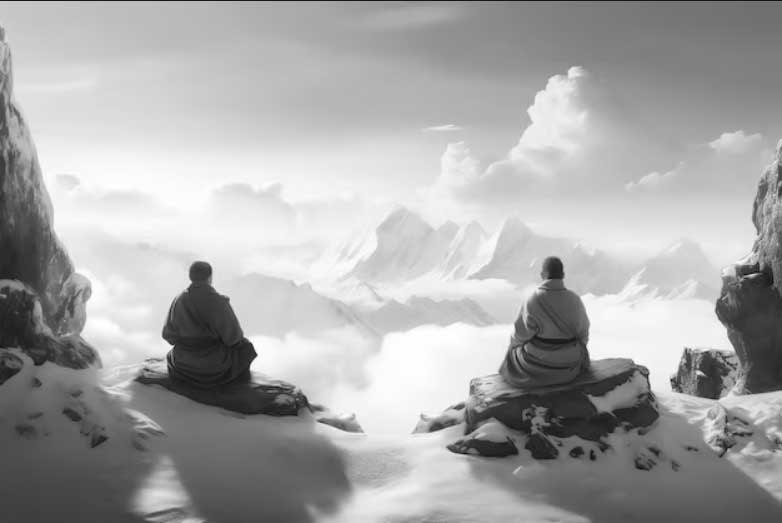
In the center of the cave, on a flat stone slab, sat a man in deep meditation. I couldn’t tell how long he had been there. His robes were tattered and coated in dust, as if untouched by time. His hair and beard were long and silver, making him seem ancient—perhaps in his seventies. But his skin was smooth and glowing, like that of a man in his thirties. Strangest of all—he didn’t seem to breathe. His chest didn’t rise or fall. No air passed through his nose. He looked more like a statue—or a mummified monk.
I stood there, heart pounding, stunned and unsure. I didn’t dare move closer—just observed from afar. One day passed. Then two. Then three. He remained absolutely still—no sound, no movement. I began to wonder: Was he alive? Or had he passed away while meditating? What kind of cultivation could bring someone to such a profound state?
On the fourth day, curiosity overwhelmed me. I thought to myself—maybe I should check for a pulse. But just as that thought formed in my mind, before I could take a step, a deep, steady voice rang clearly inside my head:
“Do not disturb me.”
I froze in place, stunned. His mouth hadn’t moved. His eyes remained closed. Yet the voice had echoed clearly within my mind, as if spoken soul-to-soul. A surge of awe and guilt rushed through me—I had let my thoughts disturb his meditation.
I immediately pressed my palms together and bowed several times, silently apologizing. Then I quietly turned and left, never once looking back.
As I descended the mountain, my heart was filled with wonder. There are indeed beings in this world whose cultivation surpasses anything we can imagine. There are Laws and paths that reach depths beyond words. That experience convinced me further—this path I was on, though filled with hardship, was not in vain. Somewhere out there, true cultivators and the True Law awaited me. I just hadn’t reached the right timing, or the right level.
(Uncle Ma paused, then continued.)
Besides those rare encounters, there were also times I saw signs of other recluses—tiny thatched huts nestled along mountainsides. Nothing inside but a straw mat and a few simple tools. The owner often absent—perhaps deep in the forest, or in long meditation.
Yet the austerity of those huts spoke volumes—the quiet resolve of someone committed to inner transformation.
Such cultivators choose a very different path. They don’t seek recognition. They don’t need to be known. They simply face themselves, nature, and the tests of the heart—in absolute silence.
That road demands unshakable resolve, deep endurance, and a powerful faith in their method.
I’ve come to believe: everyone walks their own way. Some cultivate amid the bustle of worldly life, some in remote solitude. No path is easy. What matters is whether the cultivator’s heart truly longs for liberation.
Seeing such people only deepened my respect for the vastness of the cultivation world—and made me even more grateful for the day I finally encountered the True Law.
A path that allows people to achieve true perfection, even while still living in the secular world.
(Uncle Ma paused and took a sip of tea. His tale of solitary cultivators opened up a different realm—a hidden world that seemed to float quietly amid the mountains surrounding that little cottage.)
Avery Lin:
Perhaps those reclusive practitioners were cultivating through some form of “grain abstention” or a solitary esoteric method…
But returning to your path—though you were never formally accepted by a true master—surely, through scriptures and real-life experience, you must have come to realize many meaningful insights.
And regarding the Dao De Jing your grandfather gave you—the one you always kept by your side—did your understanding of it deepen over the years?
Ma Changsheng:
(Uncle Ma nodded slowly, his eyes lighting up with reverence at the mention of the Dao De Jing.)
Yes, just as you said. Though I was never formally accepted by a true master or given step-by-step instruction, those thirty years—filled with hardship, rare encounters, and brushes with error—became my great teachers. And the scriptures that walked with me, especially the Dao De Jing, became my closest companions.
That book wasn’t just an heirloom—it truly became a lifelong friend, a lantern illuminating my long road ahead. In the beginning, as I mentioned, I read it like a duck listening to thunder—clueless. But over time, through trials and tribulations, every time I opened it again, the words seemed to come alive. New meanings would emerge—layer upon layer—each time I read.
(Uncle Ma paused, as if tracing his memories through the haze of time.)
I remember once, while traveling through the Kunlun Mountains. I’d been wandering for nearly two years along perilous ridgelines, and hadn’t encountered anything noteworthy.
One day, exhausted beyond measure, I came upon a tiny, weathered Daoist temple perched precariously near the summit. I asked to rest there and, completely drained, I fell into a deep, dreamless sleep for more than a full day.
But during that slumber, I had a dream that changed everything. I saw myself standing amidst vast clouds—soft and billowy—and then Laozi appeared. His beard and hair were long and white, and he stood with a bamboo staff, calm and serene.
He looked at me kindly and said in a gentle, resonant voice that carved itself into my mind:
“Good. But if you want to truly understand my book, you must first place yourself in the context of 2,500 years ago—understand the original meanings of the words as they were used then.”
Then, like mist, he slowly faded away.
When I awoke, the sun was already high. But the words from the dream lingered vividly.
That was when I realized: all this time, I had been reading the Dao De Jing through the lens of modern language, interpreting it as someone from today would. But language changes. Over millennia, words shift, meanings distort. If I didn’t grasp the original meanings, how could I ever understand what Laozi truly meant to convey?
That dream—I now see it as a profound moment of enlightenment. From then on, whenever I read the Dao De Jing, I didn’t just read passively. I started to actively research classical annotations, delve into historical and cultural contexts from the Spring and Autumn period, and try to understand how ancient people used those words in their time and place.
That shift became a turning point in my relationship with the text. Gradually, I felt like I was tapping into the living current that flows beneath its words. Passages that once seemed cryptic or abstract now became clearer—almost luminous.
Take the opening verse, for example:
“Dao ke dao, fei chang dao; Ming ke ming, fei chang ming.” (道可道,非常道。名可名,非常名。)
At first—like many modern readers—I misunderstood “fei chang” (非常) to mean “extraordinary,” “magnificent,” or “sublime.” That led to interpretations like: “The Dao that can be spoken is the great Dao; the name that can be named is a remarkable name.”
It sounds lofty, even poetic—but it completely misses the point.
Once I studied the etymology, I realized that “fei” (非) simply means “not,” and “chang” (常) means “constant” or “eternal.”
So “fei chang dao” means: “not the Eternal Dao.”
In other words: The Dao that can be expressed in words is not the true, unchanging Dao. The very act of trying to “dao” it—verbalize it—limits it. It becomes a concept, a philosophy. But the Chang Dao—the Eternal Dao—is beyond description, beyond form, beyond capture by language.
Likewise, “Ming ke ming, fei chang ming” means: The name that can be named is not the eternal name. Names are just conventions, labels. The true nature of things transcends names.
That realization helped me loosen my attachments to names, appearances, and ornate interpretations.
I began to see that truth isn’t found in how many sutras you memorize or how many grand phrases you recite—but in whether you can actually feel the Dao in each breath, in every ripple of life around you.
It also made me more cautious when listening to teachings—less quick to be dazzled by “magnificent” interpretations that veer too far from original intent.
Take the line, “The highest good is like water”—Shang shan ruo shui.
Water nourishes all things but never contends. It settles in low places that people avoid.
That taught me about humility, endurance, and silent giving—doing good without seeking credit. During the years I was scorned and rejected by society, these words helped me maintain equanimity, without bitterness or resentment.
So, piece by piece, each chapter and line of the Dao De Jing, illuminated through my lived experiences, unlocked deeper meanings for me. It became more than a book—it became a mirror, a teacher, a guide I could consult again and again.
(Uncle Ma gazed out the window, where the evening light had begun to fade. His face carried the peace of someone who had found wisdom in hardship.)
Avery Lin:
Oh! Hearing your explanation of “Dao ke dao, fei chang dao; ming ke ming, fei chang ming,” I finally understand what Laozi meant… And now I feel I can also grasp the next line:
“Wu ming, tian di zhi shi; you ming, wan wu zhi mu.”
Ma Changsheng:
Exactly, Avery.
Once you truly understand what “fei chang Dao” and “fei chang Ming” mean in the first line, the next one becomes much clearer:
“Wu ming, tian di zhi shi; you ming, wan wu zhi mu.”
When the Chang Dao—the Eternal Dao—had not yet been named, not yet limited by “ming” (names), that was the state of “wu ming” (namelessness). That was the origin of Heaven and Earth—tian di zhi shi.
At that point, all things were still undivided, undefined—without form, without name. It was pure essence. Primordial.
Then, as human perception emerged—distinctions arose, names were given: this mountain, that river, this tree, that animal… That was when “you ming” (having names) appeared.
And “you ming” became the “mother of ten thousand things” (wan wu zhi mu).
Because only through naming, through distinguishing, could things take shape in the human mind. Diversity emerged. Everything we see—its shape, form, and meaning—came alive through this act of naming.
Understanding this made me marvel at the brilliance of Laozi’s language.
“Wu” (non-being) and “You” (being) are not opposing forces—they are two aspects of the same reality.
From the nameless Dao arises the world of names.
“Wu” is essence. “You” is function.
It also helped me realize the importance of keeping the mind “void of desires”—wu yu.
Only when our minds are not clouded by attachments, by imposed meanings, by the “names” we’ve given things—only then can we observe the mystery (guan qi miao).
But when the mind is full of cravings, judgments, and distinctions, we only observe the manifestations (guan qi jiao)—the surface, the shell.
(Uncle Ma pauses briefly, then continues with a more reflective tone.)
These realizations from the Dao De Jing didn’t just deepen my understanding of philosophy—they changed how I viewed life, and how I faced suffering along the path.
I learned to let go of the “names” the world gave me—beggar, failure, superstitious fool…
Instead, I tried to look deeper—at the essence of things—not just their outward form.
And you know, Avery, this understanding of wu ming and you ming—later on, when I encountered Buddhist texts, I found surprising similarities to the concepts of emptiness (śūnyatā) and non-self (anattā).
Though the language is different, the aim is the same: to transcend all dualities, all conceptual forms—to glimpse a higher, unconditioned reality.
That realization made me believe even more deeply: Truth may be one, even if it wears many robes.
(Uncle Ma smiles gently—the kind of smile that comes from seeing the hidden connections among great streams of thought.)
Avery Lin:
Hearing your insights makes me understand how important it is to stand in the author’s time and context… only then can we uncover the original meaning and touch the deeper truths hidden in those words.
But history spins forward—words that seem unchanged on the surface may have meanings that have shifted 180 degrees.
That must make reading ancient texts incredibly difficult…
Did you find that to be true in your own experience?
Were there many words you discovered had lost their original meaning?
Ma Changsheng:
(Uncle Ma nodded, a contemplative look settling over his face.)
You’re absolutely right.
That’s one of the greatest challenges we modern readers face when trying to understand the ancient scriptures—the teachings of sages long past.
As time flows, cultures shift, societies evolve—and the meanings of words shift with them.
Some meanings become distorted. Some are lost entirely.
The characters on the page may look the same…
But the spirit, the essence within those words—has often changed.
If we aren’t careful—if we don’t research and reflect deeply on the original context—we risk misunderstanding the ancients, even misrepresenting their message entirely.
My experience with the Dao De Jing is a perfect example.
Had it not been for that moment of clarity in my dream, I might have remained stuck in modern interpretations—trendy, polished, but divorced from what Laozi actually meant.
And it’s not just the Dao De Jing, Avery.
As I delved into Buddhist scriptures, and also the Confucian classics, I saw this same pattern again and again.
There are terms we use today with negative or shallow meanings—yet in ancient times, those same words carried profound, even sacred significance.
(Uncle Ma pauses, eyes lighting up as if recalling something.)
Ah—take the word “jianghu” (江湖), for instance.
Today, when people hear jianghu, they think of gangsters, outlaws, shady dealings—a dark and chaotic world.
But if we look back to older texts, we find something far more elegant.
I once discovered an origin story that few people today seem to remember.
Long ago, in the regions of Jiangsu and Hubei, there were two highly respected Daoist teachers—renowned for their cultivation and virtue.
People from across the land, seekers of wisdom, would journey great distances hoping to learn from them.
Over time, those who walked this path were referred to as “people of jianghu”—pilgrims heading toward Jiang and Hu to pursue the Dao.
So originally, jianghu referred to a fellowship of seekers—those united by a longing for truth.
There’s another layer of meaning, too—rooted in nature.
Jiang means river. Hu means lake.
Together, jianghu conjured the vast, open lands beyond the reach of officialdom—beyond rules and rituals.
It symbolized freedom.
A place for people of spirit, unshackled by power or wealth, to live in harmony with the natural order.
In Zhuangzi, there’s a beautiful passage about two fish.
When their stream dries up, they stay alive by moistening each other with their own spit—desperately clinging to life.
But Zhuangzi laments this, saying:
“Wouldn’t it be better to forget each other entirely—lost in the great rivers and lakes?” (bu ru xiang wang yu jianghu)
Here, jianghu becomes a symbol of total freedom—of returning to one’s natural self—without dependence, without struggle.
So back then, jianghu meant something noble:
A realm for those on the Way, for sages wandering the land, for heroes living by justice.
It was where seekers lived out their ideals.
And yet, over time, all of that was forgotten.
Once people lost touch with the spirit of dao-seeking, with that yearning for freedom and integrity—the term jianghu took on a new, darker form.
Today, it’s often synonymous with lawlessness, danger, corruption.
That’s just one example, Avery, but it shows how deeply language can shift.
There are many other terms in the ancient texts that have suffered similar distortions.
If we fail to trace their original meanings—if we don’t “seek the root”—we risk misunderstanding, even misrepresenting the wisdom of the ancients.
This doesn’t just hinder our learning.
Sometimes it leads to false beliefs, even misguided actions—both in life and in spiritual practice.
That’s why serious study, thoughtful comparison, and consultation of older commentaries are so important.
Only by sifting carefully—by “clarifying the muddy and drawing from the pure”—can we rediscover the true resonance of these sacred teachings.
(Uncle Ma lets out a gentle sigh—not of fatigue, but of deep reflection on how language drifts over time, and how difficult it is to return to the wellspring of original meaning.)
Avery Lin:
Oh! Now I finally understand the original meaning of the word “jianghu”—it’s much more beautiful than I thought.
I realize now that without understanding the historical context, not only would ancient scriptures be lost on us, but even literary classics like Journey to the West would be like “playing music to a cow”—it’d be nearly impossible to grasp the deeper intentions of the author, wouldn’t it, Uncle?
Ma Changsheng:
(Uncle Ma nodded, his eyes reflecting deep agreement.)
You’re absolutely right.
This isn’t just true for spiritual texts—it’s also the case with classical literature, ancient poetry, fables, and timeless novels.
If we don’t understand the historical and cultural setting in which they were written—if we can’t decipher the “cultural code,” the metaphors hidden in every line, every image—we end up just scratching the surface.
We see the shell but miss the soul.
The great works of the ancients weren’t written merely for entertainment.
They often contain layered meanings—life lessons, moral teachings, and sometimes even hints of divine mysteries.
But to “decode” those meanings, the reader needs a certain level of familiarity with traditional culture, history, and the classical references the author drew upon.
(Uncle Ma pauses briefly, preparing to give an example.)
Take Journey to the West, for instance—a story nearly everyone knows and loves.
On the surface, it’s an epic adventure about a monk and his three disciples journeying to India to retrieve sacred scriptures, facing 81 trials along the way.
But if we stop there, we’re only seeing the tip of the iceberg.
Do you remember the part where Sun Wukong is trapped under the Five Elements Mountain?
To a casual reader, that might just seem like a punishment for a mischievous monkey who wreaked havoc in Heaven.
But when we reflect more deeply, we realize it’s a profound allegory.
The Five Elements—metal, wood, water, fire, and earth—are the foundational materials that make up everything in the Three Realms, including the human body and all sentient beings.
So, Sun Wukong being trapped under the Wuxing Shan isn’t just about a rock.
It symbolizes how all beings in the Three Realms are bound and suppressed by these material laws—by the very structure of the world.
We are imprisoned by the Five Elements, subjected to the cycle of birth, aging, sickness, and death, endlessly spinning in the wheel of reincarnation.
Sun Wukong, with his unmatched powers—his 72 transformations, his somersault cloud that spans thousands of miles—represents the soul’s yearning for freedom and transcendence.
But no matter how powerful, as long as he remains within the Three Realms, as long as he’s bound by the laws of matter, he still “can’t escape the Buddha’s palm.”
Meaning: no one can truly break free from the cosmic order without the guidance of True Law, without genuine spiritual cultivation that transforms one’s very essence and allows one to transcend.
Those 500 years under the mountain symbolize countless lifetimes of suffering and wandering—enduring hardship within the bounds of this world, gradually shedding karma and dark tendencies, until one is ready for salvation and the true path of cultivation.
Then there’s the dynamic between the four pilgrims.
Each has a distinct personality, a unique role, but together they form a complete whole, overcoming challenges as a team.
Tang Sanzang may be naive and easily deceived, but he possesses unwavering devotion and compassion—that’s the root of cultivation.
Sun Wukong is powerful but impulsive—he needs the golden circlet (symbolizing discipline and the Law) to rein him in.
Zhu Bajie is lazy and gluttonous, full of base desires—he represents our inner cravings and selfishness.
Sha Wujing is diligent and humble, always carrying the burden—he symbolizes perseverance and endurance.
In truth, the four travelers are symbolic aspects of one person’s inner world.
Their pilgrimage is our spiritual journey—our quest to purify the mind and elevate the heart.
Every trial they face is not random, but a test—a mirror revealing their weaknesses, so they may grow and ascend.
Without understanding these layers, Journey to the West becomes just a fantastical tale of magic and demons, and we miss the timeless teachings on cultivation and the nature of existence that Wu Cheng’en carefully wove into it.
(Uncle Ma spoke with passion, as if reliving the story himself, eyes glowing with the excitement of someone rediscovering hidden wisdom.)
Avery Lin:
Wow!.. Hearing you explain Journey to the West like that gave me a whole new layer of understanding.
When I was a kid, I loved watching the TV adaptation, fascinated by the magical battles and transformations—but I never grasped the profound messages that Wu Cheng’en intended…
Oh—but look! I didn’t even realize how late it’s gotten… I’m so sorry, Uncle. I didn’t mean to keep you this long and disturb your evening rest.
Ma Changsheng:
(Uncle Ma smiled warmly and glanced out the window.
Indeed, night had fully fallen, with only faint streaks of twilight left in the western sky.
The quiet hum of mountain insects had begun.)
No need to apologize, Avery.
When a conversation flows with such resonance, time passes quickly.
And sharing these reflections with someone who listens so intently—it brings me joy.
Seeing the spark of realization in your eyes… That, to me, is a reward.
(Uncle Ma stood and stretched gently.)
Yes, the night is here.
These stories, these realizations—there are many more.
They can’t all be told in one sitting.
Today, we’ve covered quite a bit: from the journey’s trials and cryptic refusals, to the danger of straying into false paths, and even the hidden meanings within ancient texts.
Perhaps we should pause here, give ourselves time to rest and reflect.
Tomorrow, if you still wish to hear, I’ll share the final chapters of my thirty-year search—and how I finally encountered the true Great Law I had been seeking all along.
(Uncle Ma looked at Avery with warmth and encouragement.)
Take your time to contemplate what we’ve discussed today.
Young people like you have access to a flood of information—but what matters is knowing how to sift through it, to find the essence beneath the surface.
Sometimes, the oldest things contain the most timeless wisdom.
Now, go on—best not to linger too long.
Even familiar mountain paths deserve caution in the dark.
(Uncle Ma walked Avery to the doorstep.
The crisp mountain air flowed in, laced with the scent of wild grass and the stillness of night.)
Avery Lin:
Yes, thank you, Uncle.
I truly enjoyed our conversation…
I’ll see you again tomorrow!
(…..)
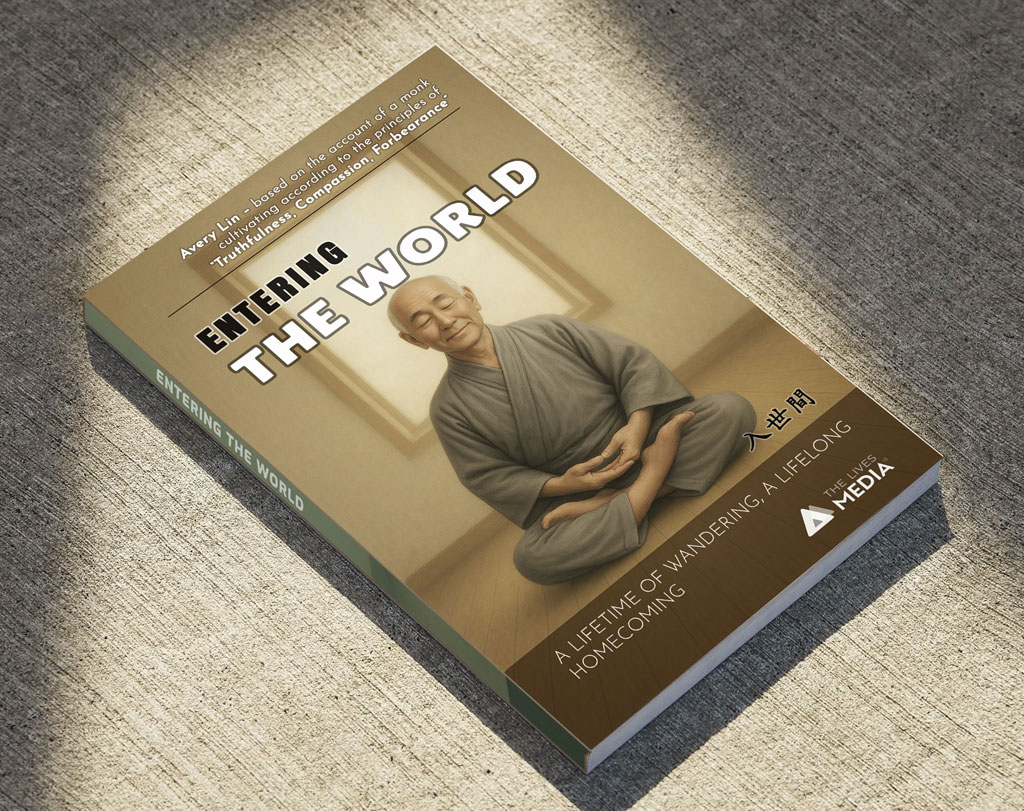
This article is an excerpt from the book “ENTERING THE WORLD“, which tells the story of a Chinese monk’s more than 60-year journey of seeking and practicing the Dharma.
If you wish to experience the full journey of thought and the unpublished insights of the work, please click the button below to own the complete book.
To explore more works from THE LIVES MEDIA, visit our book collection.