( ….. )
After a long journey with you, the reader, exploring the diverse origins of prophetic messages, confronting the allure and challenges of interpreting “fulfillment,” and especially listening to the timeless themes of upheaval, purification, and the aspiration for rebirth along with the hope in a Savior, I feel it is time for us to bring these contemplations back to our own present context.
We are living in a special time. A time of rapid, complex changes in every aspect—from politics, economics, and society to the environment and even the profound shifts in human consciousness. A time when information explodes, where truth and falsehood are mixed, sometimes leaving us feeling lost and disoriented. But it is also in this very era that many people feel that the ancient prophecies seem to be coming true more clearly than ever, and the warning “bells” seem to be ringing with ever-increasing urgency.
The central question I want to explore with you in this Chapter 7 is: In this age of information and unceasing upheaval, what role does prophecy still hold? Do the “bells” we may be hearing, both from the thousand-year-old prophecies and from contemporary premonitions and messages, carry any special meaning for our time and, more importantly, for the choice of each one of us? What is the invitation that the “bell of the present” wishes to convey?
We will look squarely at the characteristics of prophecy in this new era, its impacts and challenges, and from there, seek a deeper meaning, a core message that the river of prophecy perhaps intends for each of us, who are standing at the junction of eras.
1. Prophecy in the Information Age: Characteristics, Impacts, and Challenges
It is undeniable that the way we access and interact with prophetic information today is entirely different from previous generations. The digital age has brought both opportunities and new challenges to the existence and dissemination of these “voices” believed to be from the future.
The Explosion and Spread of Prophetic Information:
- The Internet and Social Media – A Double-Edged Sword: Whereas prophecies were once transmitted through books, word-of-mouth, or official religious channels at a slow and somewhat controlled pace, today, the internet and social media platforms have become a “superhighway” for prophetic information. With a single click, a prophecy (whether ancient or new, credible or entirely fabricated) can spread to millions of people worldwide in just a few hours, or even minutes. On one hand, this helps valuable information and warnings reach a wider audience, bypassing traditional censorship barriers.
- The Diversity (and Chaos) of Sources: Another consequence of the information age is the “democratization” (or sometimes, “chaotization”) of delivering and interpreting prophecy. Anyone with a bit of writing skill, a strange dream, a special intuition, or simply a desire to attract attention can claim to be a “prophet,” offering their own predictions or reinterpreting ancient prophecies in their own way. This creates an incredibly diverse and rich “market” of prophetic information, but one that is also rife with “counterfeits and imitations,” leaving the public inevitably bewildered.
Real-World Impact and Global Spread – A Case Study of Ryo Tatsuki’s Prediction:
To better visualize the impact of prophecy in the information age, we can look at a specific case that has garnered significant global attention: Ms. Ryo Tatsuki’s prediction of a “great catastrophe” that could occur on July 5, 2025.
Not confined to spiritual forums, this prophecy crossed borders and was reported by many international news agencies as a noteworthy social phenomenon. Its impact was by no means limited to cyberspace. There were concrete reports of many people around the world who, out of concern, canceled pre-booked tours to Japan during that period.
Anxiety was further heightened when geological data recorded a series of unusual activities: over 1,000 minor earthquakes occurred in the predicted region between June 23 and July 5. Although experts suggested these could be normal seismic activities, this coincidence further solidified the belief of those who trusted the prophecy. In the days leading up to July 5, social media truly erupted with fervent discussions, theories, and prayers.
And then, the moment arrived.
The “Silence” of the Prophecy and the Waves of Contemplation:
As I write these lines, it is 11:49 AM on July 5, 2025 (Japan Standard Time). Ms. Ryo Tatsuki’s prophecy of a “great catastrophe” involving an earthquake and tsunami in Japan and the Philippines at 5:00 AM did not occur as predicted. The “silence” of nature at the foretold moment, paradoxically, created a wave of contemplation even stronger than the preceding anxiety. The tide of social media discussion will surely continue, but instead of fear, it will now diverge in two directions: on one side, skeptics will likely laugh triumphantly, seeing this as proof of prophecy’s absurdity; on the other, people will seek a deeper explanation.
This event has become a direct and vivid case study of how we confront the “uncertainty” of prophecy, opening up various lines of interpretation:
- First Possibility: The prophecy was inaccurate in its timing, but the event could still occur. Like many ancient prophecies, the details of time may be merely symbolic or subject to certain inaccuracies in the prophet’s process of “receiving” the message. Those who lean this way believe that Ms. Tatsuki’s dream captured the “energy” of a major impending event, but the specific timing could have been shifted. Therefore, the fact that the event did not happen at exactly 5:00 AM does not mean the danger has completely passed. The warning still holds value, and preparation and vigilance remain necessary.
- Second Possibility: The prophecy was entirely incorrect. This is the perspective of skeptics, who see this as a classic example of how premonitions and dreams, however vivid they may seem, can still be mistaken. They argue that public attention amplified a personal dream into an event of global proportions, and its failure to occur is the clearest evidence that we should not place too much faith in unverified predictions. For them, this is an important lesson in clear-headedness and critical thinking in an age of chaotic information.
- Third Possibility: The prophecy was originally accurate but was proactively changed by a higher power. This is a deeply spiritual interpretation contemplated by many with profound faith. They believe that prophesied apocalyptic events, such as the Mayan 2012 event or this catastrophe, were part of a “script” arranged by the gods of the old universe. However, these people also believe that the Creator—who is also the Savior of the final LIVES—has already come to the mortal world. He did not come to execute that script of destruction but, on the contrary, to spread a Great Way (Dafa) to save sentient beings, awaken benevolent thoughts, and break the old arrangements. The postponement of great tribulations, accordingly, is a great act of compassion on His part. He does this not because enough people have become good, but precisely because He sees that the number of people who need to be saved is still not enough, that there are still far too many people lost in delusion, who have not yet had time to awaken and receive salvation. If the old “script” were allowed to play out, countless lives would be tragically eliminated according to the arrangements of the old cosmic powers. Therefore, with immeasurable compassion to save more sentient beings, the Creator decided to “extend” the time, postponing the calamity to give humanity another chance to awaken, to recognize what is righteous and what is evil, and to make a choice for their own future. From this perspective, the fact that the disaster did not happen does not mean the prophecy was wrong or that the danger has passed. It is a miracle of delay, a grace period of time, and an even more urgent warning: there is not much time left, and each of us must awaken quickly before the final opportunity is gone.
The Challenge of Discerning Truth from Falsehood in a “Sea” of Information:
The very explosion of information and diversity of sources mentioned above poses an immense challenge to the public: how can one distinguish a valuable, thought-provoking prophecy from mere fake news, misinformation, or the words of self-proclaimed “prophets” with less-than-pure motives (e.g., to profit, to create panic, or to serve a political agenda)?
- The Danger of Opportunistic “Prophets”: In a society where many feel insecure and anxious about the future, the need to seek guidance from “mystical” sources can be high. This is fertile ground for opportunists. They may rely on ancient prophecies, interpreting them arbitrarily, or create new “prophecies” that sound appealing and sensational to attract followers, sell books, or even commit fraud.
- The Complexity of Verification: Verifying ancient prophecies is already difficult. For “contemporary prophecies” spreading online, it is exponentially harder. Information often lacks a clear source and is easily edited or taken out of context. Determining who first made the prophecy, what their motives were, and whether the prophecy was truly “fulfilled” requires a clear mind, information analysis skills, and sometimes even specific expertise.
The Fluctuation of Official Information and the Role of Non-Traditional “Voices”:
Another factor that contributes to the “fertile ground” for prophecy and non-traditional information sources in the current era is the fluctuation, and sometimes the decline, of public trust in official channels of information in certain contexts.
- When people feel that official sources (from the government, state media, or large organizations) are not providing complete information, or that the information is biased and unreliable, they naturally tend to seek alternative sources. These can be independent news sites, freelance analysts, and, of course, those who deliver prophetic messages.
- During periods of social instability and crisis (economic, political, epidemiological), when the future becomes obscure and unpredictable, people’s desire to find an explanation, a guide, and a glimmer of hope intensifies. Prophecy, with its ability to sketch a picture (however vague) of the future and often carry messages about the deeper meaning of events, can partially fulfill that psychological need.
* * *
I believe this phenomenon reflects a fundamental human need: the need to search for truth and meaning, especially when facing chaos and uncertainty. It also raises a question about the responsibility of official information channels in building and maintaining public trust. When the “mainstream light” is not bright enough, people will turn to other “sources of light,” even if those sources have not been verified.
Recognizing the characteristics, impacts, and challenges of prophecy in the information age is the first step toward approaching them more proactively and consciously. It is not so that we may fear or reject them, but so that we can become wiser “consumers of information,” knowing how to filter and seek out true value.
2. Beyond Predicting Events: The Deeper Purpose of Prophecy from a Spiritual Perspective
After having examined together the characteristics, impacts, and challenges of approaching prophetic information in the present age, I feel the need to dig deeper, to go beyond the debates about the rightness or wrongness of each specific event prediction, to find the deeper purpose and meaning that prophecy can bring, especially from the perspective of a spiritual practitioner and contemplative.
Is the greatest value of prophecy merely in letting us know what will happen? Or are there more important messages, more important invitations, hidden within those prophetic words, those revelations, those dreams?
From My Own Understanding (Taylor Reed’s):
Through my own personal journey, both as a researcher seeking out data and as a person listening to the subtle vibrations of my inner self, I have gradually come to feel that the purpose of many great prophecies does not seem to stop at merely providing a “map of the future.” They also carry deeper meanings, aimed at the transformation of human consciousness.
- Awakening Consciousness – The “Bells” that Arouse the Conscience: Many prophecies, especially the warnings about great calamities and the decline of the Dharma-Ending Age, in my perception, are not primarily intended to sow fear or despair. On the contrary, they are like powerful, urgent “bells,” trying to awaken people from delusion, from being engrossed in chasing after temporary material values and worldly pleasures while forgetting core moral and spiritual values.
They are like a reminder that life is not just about food and clothing, fame, fortune, and sentiment. There are greater laws governing our destiny, and there are responsibilities that we need to be aware of. The warnings about the consequences of moral decay are meant for people to awaken in time, to look back at themselves, and to find their way back to their conscience, back to what is good and virtuous.
- Emphasizing the Law of Karma – The Future Is Not Entirely Random: An important message that frequently appears, whether hidden or apparent, in prophecies is the affirmation of the law of Karma. Descriptions of disasters, wars, or the decline of dynasties and civilizations are often linked to the wrongdoings and moral decay of people in the past or present.
This implicitly affirms that the future is not a completely random and uncontrollable chain of events. On the contrary, what we have to face in the future is, to a large extent, the consequence of what we have sown in the past and are sowing in the present. “Good is rewarded with good, and evil meets with evil” (善有善報, 惡有惡報, Shàn yǒu shàn bào, è yǒu è bào) is not just a moral teaching, but a universal law understood and passed down by the prophets. Realizing this helps us to be more conscious of our every thought, word, and deed.
- Affirming the Role of Free Will and Choice – Opportunity in “Delusion”: If the future were rigidly arranged and unchangeable, what would be the meaning of life, of effort and cultivation? I believe that even if there are predictions, “scripts” about the future revealed by prophets, it does not mean that human beings have completely lost their free will and their right to choose.
The purpose of prophecy, in many cases, may be precisely to show people the “crossroads,” to let them see the possibilities that may occur, so that they can make better choices to change the destiny of individuals and the entire community. History is not a single path that has been completely laid out. It may have “nodes,” important “junctions,” where the choices of human beings, especially the choice between Good and Evil, between righteous and deviant, will decide the future course.
The fact that Gods and Buddhas do not reveal themselves too clearly in the human world, that heavenly secrets are not fully disclosed, in my perception, is also to preserve a necessary “delusion.” It is precisely in this state of “delusion” that a person’s choice has real value, that it truly comes from their own heart and their own enlightenment, not from fear of punishment or a desire for the benefit of grace. Only when one recognizes the Truth for oneself and chooses to follow it amidst countless temptations and confusing information does that choice become truly precious.
- Purification and the Opportunity for a New Beginning – The Meaning of “The End”: As we discussed in Chapter 6, prophecies about “the end” of a cycle, an era, though they carry sorrowful images, often also imply a necessary purification and an opportunity for rebirth, a better new beginning.
From a spiritual perspective, great upheavals and trials may be the very process of the universe “eliminating” what is no longer suitable, what is negative, to make way for new values, for new beings with higher moral character. It is an opportunity for those who hold fast to virtuous thoughts, who maintain their faith in the Righteous Law, to pass through and enter a new era. “The end” is not a final stop, but a transformation to move toward a more perfect state.
* * *
I feel that when we look at prophecy through this lens, its value no longer lies merely in correctly or incorrectly predicting an event. More importantly, prophecies are reminders, lessons, and opportunities for us to awaken, to question ourselves, and to choose the path we want to take.
3. “The Last Bells”: A Call for Personal Choice in a Special Era
After having contemplated together the deeper purpose of prophecy from a spiritual perspective—the calls to awaken consciousness, to affirm the law of Karma, and the role of free will—I feel as if all the streams of information, all the “bells” from the past to the present, are converging on a core message, an urgent invitation for each of us, especially in an era that many believe we are living in: a decisive “junction of times.”
Is Our Era a Special “Junction of Times”?
When we connect the dots of what we have explored—the repetition of major themes of upheaval, purification, and rebirth in prophecies from many cultures (CHAPTER 6); the described signs of the Dharma-Ending Age and the Kali Yuga; the prophecies of the Savior’s appearance with specific characteristics and missions; the appearance of sacred natural phenomena like the Udumbara flower; and even the premonitions and “contemporary prophetic voices” about great upheavals to come (CHAPTER 4, 7)—it all seems to point to one conclusion: the era we are living in is not a normal time.
Many prophecy researchers, many people with deep spiritual practice, and even ordinary people with a sensitivity to the current of the times, all feel that we are standing at an important “crossroads” in human history, a “junction of times” between two eras, where the old is fading away and the new is preparing to be born. This could very well be the “end times,” the “final period” that the prophecies have warned of, but it is also a moment that opens up the opportunity for a great transformation.
I do not wish to make a firm assertion that “this is that time,” because heavenly secrets are uncertain and each person’s enlightenment is different. But I want to invite you, the reader, to contemplate these signs, to listen to the “bells” echoing from many directions, and to feel for yourself whether there is an urgency, a special quality to the era in which we now exist.
What are “The Last Bells”?
When I speak of “The Last Bells,” I do not mean to imply that a specific prophecy is the final one that ends all others. Rather, in my perception, “The Last Bells” here is the synthesis of all the messages of warning, of awakening the conscience, and of calling for virtuous change that we have explored together throughout this book.
It is the bell from the moral teachings in ancient scriptures.
It is the bell from the prophetic warnings about the consequences of decline.
It is the bell from the descriptions of the law of Karma and the cycles of the universe.
It is the bell from the promises of the Savior’s appearance and a new era.
And it could also be the bell from our own conscience, urging us to recognize what is right, what is wrong, and what is truly important in this life.
“The Last Bells” are not meant to sow fear, but to signal the urgency of choice, the preciousness of the opportunity we have in our hands to decide our own destiny and to contribute to the future of the world.
A Call for Personal Choice:
If we are truly living in a special era, an important “junction of times,” then what are “The Last Bells” inviting each of us to do? From what I have perceived and contemplated from the river of prophecy, that invitation focuses on foundational choices:
- Choosing to be virtuous, upholding one’s conscience: In a world full of upheaval, where moral values can be inverted, where truth and falsehood are hard to distinguish, the act of holding fast to the goodness in one’s heart, acting according to the call of one’s conscience, not colluding with evil, and not chasing after trivial material temptations, becomes more important than ever. This is the most fundamental choice.
- Choosing to elevate morality, to cultivate one’s heart and mind: Not just stopping at not doing evil, but also proactively turning inward, recognizing and correcting one’s own shortcomings, attachments, and deviant notions. Practicing universal moral principles like Truthfulness-Compassion-Forbearance (which we have seen revealed in prophecies as a path) can be a concrete way to cultivate and elevate one’s moral character.
- Choosing to seek true spiritual values: Rising above the worries and clamor of material life, let us take the time to learn about and reflect on the deeper meaning of life, on the relationship between humans and the universe, and with Divine Beings. Seeking and connecting with pure spiritual energy and righteous teachings can help us find inner peace and direction for our lives.
- Choosing to spread kindness and hope: Every small, virtuous act, every sincere word, every selfless act of help, can be like a candle lit in the darkness, helping to dispel negativity and spread positive energy to those around us. Do not underestimate the power of individual choices, because it is those very choices, when multiplied, that will create great change for the entire community.
I believe that, no matter what the world situation may be, no matter how the prophecies may be fulfilled, the power of an individual’s good choices is undeniable. It is these choices that will shape not only their own futures but can also influence the very stream of history, deciding whether we can overcome the trials of this era and step into a better future.
4. Taylor’s Insights
As the “bells of the present” gradually quiet down, after we have looked back together at the characteristics of prophecy in the information age, its deeper purposes from a spiritual perspective, and especially the urgent call for personal choice, I feel that the journey of exploring the river of prophecy ultimately leads each of us back to the most core, the most simple things of human existence.
It is the ceaseless choice between Good and Evil, between light and shadow, in our every thought, word, and deed each day. It is a profound awareness of the responsibility of each individual not only for their own life but also for the community, for the world we share. And above all, it is the unextinguishable hope, a belief that no matter how great the trial, human beings always have the ability to rise up, to perfect themselves, and to strive for better values.
Prophecy, in whatever form, whether ancient or modern, is perhaps not for us to know the future down to the finest detail, only to then wait passively or in fear and anxiety. Instead, I believe the higher purpose of these “bells” is for us to live better in the present. To live more consciously, more aware of what we are doing, what we are thinking. To live more responsibly with our choices. And most importantly, it is for us to prepare for the future—whatever that future may be—with a proactive mindset, an open heart, and a clear conscience.
The prophecies may be ancient maps, pointing out the paths that can be taken, the dangers to be avoided. But the one who decides the voyage, the one who steers their own ship, is always each of us.
And perhaps, the final bell, the most important bell, does not come from the outside, but is the bell that echoes from the depths of each person’s soul, inviting us to return to our own innate, virtuous nature.
(…..)
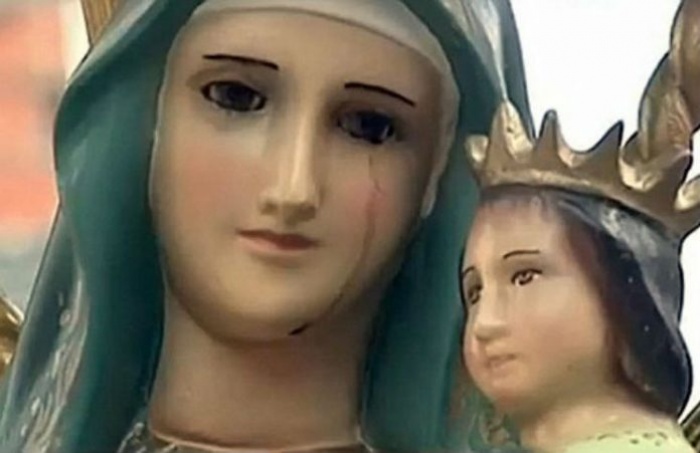
This article is an excerpt from the book “THE LAST BELLS“, which contains insightful notes and analyses by author Taylor Reed on the phenomenon of weeping statues of the Virgin Mary in many places around the world, as well as pointing out the mysterious coincidences of ancient and modern prophecies about the present day.
If you wish to experience the full journey of thought and the unpublished insights of the work, please click the button below to own the complete book.
To explore more works from THE LIVES MEDIA, visit our book collection.