1. Beyond the Playground
We have explored two great maps. The map of the Periodic Table of Elements helps us understand the structure of matter. The map of the Five Elements helps us understand the flow of energy. Both are invaluable tools for describing and operating within the “playground” of this world. They help us build, analyze, diagnose, and heal.
But there is a third worldview, a map not aimed at playing better within that playground. Its goal is far more audacious: to find a way to step out of the playground altogether.
In ancient systems of spiritual cultivation wisdom, there is a saying that serves as a guiding principle, encapsulating the ultimate goal of the practitioner: “Not within the Five Elements, beyond the Three Realms.”
To understand this saying, we must temporarily define the terms. The term “Three Realms” appears in many East Asian cultures with different categorizations. In Buddhism, they are the Desire Realm, the Form Realm, and the Formless Realm. In Taoism, it sometimes refers to Heaven, Earth, and Water. In folk culture, it is often understood as the three realms of Heaven, the human world, and the underworld.
However, regardless of the classification, all these interpretations share a core commonality: they all describe a finite scope of space-time, the entire worldview of the cycle of birth, death, and reincarnation to which beings are bound. From a cosmological perspective, this scope may correspond to an extremely large region, perhaps our entire Milky Way galaxy. And “the Five Elements,” as discussed, represent the very laws of energy flow, the operating rules of that “playground.”
Therefore, “Not within the Five Elements, beyond the Three Realms” is not an abstract philosophy. It is a statement of purpose: to transcend the known laws of matter, to escape the cycle of life and death within this finite scope, and to reach a completely different state of existence, a realm of greater freedom and vastness.
This map no longer asks “What is this thing made of?” or “What is the energetic dynamic at play?” It poses an entirely new question: “How can the very being of a life be transformed from coarse, heavy matter into something more subtle and transcendent?”
This is the map of transformation, of inner alchemy. And to read it, we must accept a fundamental axiom, an axiom that may be the greatest challenge to the modern mindset.
2. The Matter of Morality: Virtue and Karma
In the modern worldview, moral concepts like “virtue” or “sin” are considered social conventions, psychological states, or abstract ideas. They belong to the world of the spirit, completely separate from the world of matter.
But on the map of transformation, this boundary is erased. Its core axiom is: morality is material.
Accordingly, “Virtue” (De) and “Karma” (Ye) are not abstract concepts. They are described as real substances that exist in other dimensions but simultaneously surround the human body.
- Virtue (德) is described as a white, pure, and subtle substance. It is accumulated when a person does good deeds, endures hardship without resentment, or treats others with compassion.
- Karma (業) is described as a black, coarse, and heavy substance. It is generated when a person does bad things, harms others, or harbors jealousy and hatred.
In this system, all our moral actions and thoughts are not invisible. They are constantly producing one of these two substances and storing them around our bodies. A person with much Virtue will feel light, fortunate, and clear-minded. A person carrying much Karma will feel heavy, encounter much misfortune, illness, and suffering. The Law of Cause and Effect is no longer a religious belief, but a clear material mechanism: whatever action you sow, you will receive the corresponding substance.
This “materialization” of morality is the key to understanding the mechanism of transformation. Because if Virtue is a type of matter, then it can be used as a kind of “raw material.”
3. Inner Alchemy and Its Material Traces
Why is the accumulation of the substance of Virtue so important in the worldview of spiritual cultivation? Because according to this system, it does not merely bring blessings in the human realm. It is considered the raw material and foundation for an extraordinary process of inner “alchemy,” a process that transforms the very root of a being’s existence.
This worldview describes the human body in this realm as being composed of coarse and heavy matter, completely subject to the laws of the Five Elements. To transcend those laws, this material being must be replaced by another, more subtle and high-energy type of matter. That high-energy matter is called “Gong” (功).
Gong, as described, is not a skill or a physical exercise. It is considered a subtle substance, existing in higher dimensions, formed right within the body of the cultivator. The process of creating this Gong is said to be a collaboration between the disciple’s efforts and the master’s evolution of it.
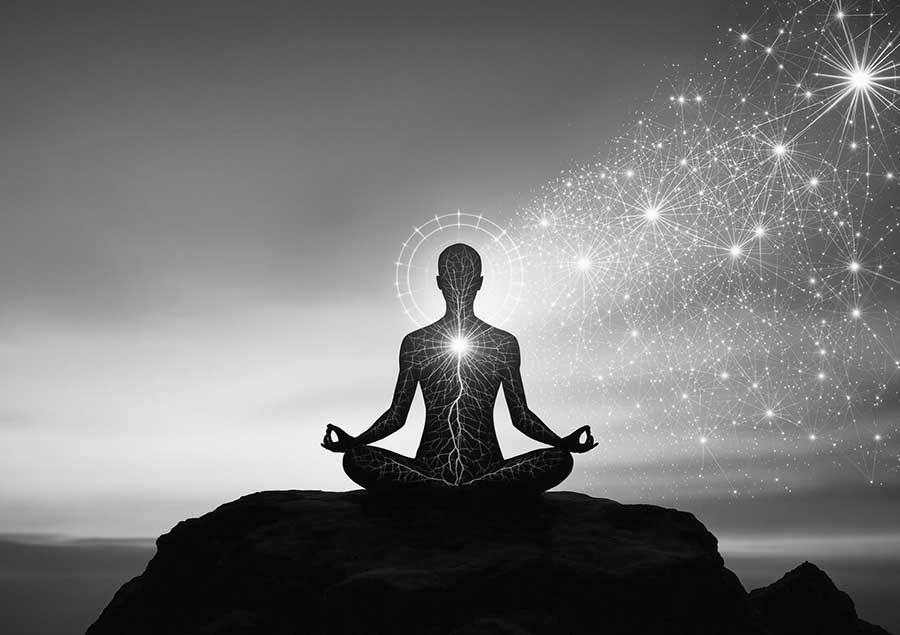
In this mechanism, the disciple’s role is defined as continuously cultivating their mind and character, that is, raising their ideological realm. Every time they do a good deed, endure hardship, or relinquish a bad attachment, they are said to be accumulating more of the “raw material” of Virtue. Simultaneously, they practice certain movements (like meditation or gongfa exercises) to open up energy channels, purify the physical body, and create the best conditions for the transformation to occur.
Then, according to this model, a true master is said to perform a process of “evolution,” taking the Virtue that the disciple has accumulated and transforming it into Gong. This is not a random process. It is said in cultivation circles that every true practice is a complete and consistent system, like a master architectural blueprint for building a new being. This evolutionary process must be carried out precisely from beginning to end according to that “blueprint,” without mixing or changing it midway.
As one can see, in the logic of this system, the role of the master is crucial and irreplaceable. If the disciple does not cultivate their character, they will have no “raw material.” And without a master “architect” with a complete blueprint, no amount of “raw material” can become a transcendent structure on its own.
Once there is Gong, this high-energy substance is believed to begin transforming the cultivator’s body from the inside out, replacing coarse matter with subtle matter. This is the process of “shedding one’s mortal body” at the most microscopic level, the essence of inner alchemy.
If such a profound physical transformation were to truly occur, would it leave any observable traces in our material world? This worldview says yes. Two of the phenomena presented as the clearest material evidence are Sarira (relics) and incorruptible bodies.
- Sarira: After cremation, the remains of many high-level monks and lamas leave behind gem-like beads of brilliant colors and extraordinary hardness, which can sometimes even grow or multiply. Modern science has yet to adequately explain their formation, as the temperature of a crematorium is high enough to destroy all common biological structures. From the perspective of cultivation, Sarira are considered the material traces of the transformation process—they are accumulations of high-energy matter refined from Virtue, something that cannot be destroyed by worldly fire.
- Incorruptible Bodies: The phenomenon where the bodies of some accomplished practitioners do not decompose naturally after death, but remain soft, with hair and nails even continuing to grow. This is seen as evidence that their physical bodies have been largely replaced by a subtle matter that no longer follows the normal laws of biological decay.
These phenomena, from the perspective of the map of structure, are anomalies, unexplainable. But from the perspective of the map of transformation, they are the inevitable results, the tangible “fossils” of a journey of inner alchemy.
4. The Perceptual Tool of the Inner World: The Celestial Eye
A reasonable question arises: How could the ancient sages know about invisible things like Virtue, Karma, or other dimensions? Was it all just deduction and imagination?
The cultivation worldview answers no. They speak of another perceptual tool, a “sense” that can be opened through the process of cultivation, transcending the five ordinary senses. This is the Celestial Eye (Tian Mu), also known as the “Third Eye.”
According to descriptions, the Celestial Eye does not see by receiving reflected light (photons) like the physical eye. It is an ability to directly perceive the nature of things at different dimensional levels. Depending on the realm and state of the cultivator, this tool allows them to see scenes far beyond the range of the naked eye, such as the subtle energy structure of the body or beings in parallel dimensions.
With this perceptual tool, depending on each person’s realm, they can see different scenes in various higher and lower dimensions and with varying clarity, including abilities such as:
- Directly observing substances like Virtue (white) and Karma (black) surrounding a person.
- Seeing beings and scenes in parallel dimensions.
- Perceiving the subtle energy structure of the body (meridians, dantian).
In this system, the Celestial Eye is not a mystical supernatural power. It is considered an innate ability of a person (of their Primordial Spirit) that has degenerated and closed. Cultivation is simply the process of purifying the body and mind to reopen this inherent ability.
It is like modern science inventing the microscope to see bacteria, or the telescope to see distant galaxies. The Celestial Eye is a kind of “inner microscope,” a tool that allows a person to become a scientist of the invisible realms. It is the answer to how the map of transformation could have been drawn with such detail and consistency.
This article is an excerpt from the book “The Universe Beyond the Big Bang” – a journey to explore the origin and profound meaning of the cosmos.
- Continue reading other chapters from the same work:
- Chapter 1: THE GREAT QUESTION ON THE FRINGES OF SCIENCE – THE NET AND THE SILENCE OF THE OCEAN
- Chapter 2: CONSCIOUSNESS AND MATTER – A TWO-WAY RELATIONSHIP
- Chapter 3: THE IMPLICATE ORDER AND THE QUANTUM UNIVERSE
- Chapter 4: THE MAP OF STRUCTURE – THE PERIODIC TABLE OF ELEMENTS
- Chapter 5: THE MAP OF FLOW – THE FIVE ELEMENTS AND ENERGY
- Chapter 6: THE MAP OF TRANSFORMATION – THE WORLDVIEW OF SPIRITUAL CULTIVATION
- Chapter 7: THE MULTIDIMENSIONAL MAP – FROM STRING THEORY TO THE BERMUDA TRIANGLE
- Chapter 8: THE REALMS OF EXISTENCE
- Chapter 9: DREAMS – GATEWAYS TO OTHER REALITIES
- Chapter 10: INSPIRATION – ECHOES FROM OTHER REALITIES
- Chapter 11: SPIRIT POSSESSION – WHEN CONSCIOUSNESSES FIGHT FOR THE SAME BODY
- Chapter 12: SUPERNORMAL ABILITIES – WHEN CONSCIOUSNESS BENDS THE LAWS OF PHYSICS
- Chapter 13: EXTRATERRESTRIAL LIFE: A MULTIDIMENSIONAL PERSPECTIVE
- Chapter 14: THE BIG BANG – A BUBBLE BURSTING ON THE OCEAN?!
- Chapter 15: THE GALAXY – A LIVING CIRCUIT OF THE UNIVERSE
- Chapter 16: BLACK HOLES, DARK MATTER, AND DARK ENERGY – A REINTERPRETATION
- Chapter 17: FRACTAL ARCHITECTURE – FROM THE MICROCOSM TO THE MACROCOSM
- Chapter 18: TRANSCENDING THE BOUNDARY OF OBSERVATION
- Chapter 19: THE UNIVERSE IS A MIRROR – WHAT IS YOUR MEANING?
If you wish to experience the full journey of thought and the unpublished insights of the work, please click the button below to own the complete book.
To explore more works from THE LIVES MEDIA, visit our book collection.