( ….. )
After journeying together through the diverse paths by which prophetic messages are said to have reached humankind—from sacred revelations to the silent voice of the heart or the omens of heaven and earth—a great question inevitably arises, compelling the inquiry of anyone who touches this field: Are these prophecies “real”? The allure, the mystery, and even the awe that prophecy has inspired in the human consciousness for thousands of years perhaps lies largely in its miraculous ability—the ability of “fulfillment.” This is when ancient writings, words of prophecy from the distant past, seem to describe with astonishing accuracy what has happened, is happening, or will happen in the stream of history.
Deep down, each of us seems to carry an instinctual curiosity about the future, about what lies beyond our sight and our control. Is destiny truly predetermined? Are there individuals who, somehow, have “seen” the pages of time before they were turned for everyone else? The phenomenon of prophetic “fulfillment” is the most fertile ground for nurturing these questions. It at once challenges our conventional understanding of causality and free will, while also cracking open a door to a glimpse of the infinite possibilities of consciousness and the cosmos.
For this reason, in this chapter, I wish to invite you, the reader, to join me in a closer examination of “the mark of time” on the words of prophecy. We will review a few notable cases of “fulfillment” recorded by history, attempting to approach them with an objective attitude. Then, we will take a step back to analyze the challenges and pitfalls in the art of interpretation, and attempt to compare the prophetic approach to the future with the lens of modern science. This is not a journey to seek absolute confirmation or denial, but to understand more deeply a phenomenon that has continued to shape human perception.
1. Timeless Prophecies: Notable Cases of “Fulfillment”
Entering the world of prophecies that are said to have been fulfilled, we are like wanderers in an ancient library, where every page, every line holds its own mysteries and allure. There are names that have become legends, works of prophecy whose very existence seems to defy all conventional logic. Although interpretation is always a challenging art and skepticism a necessary companion, it cannot be denied that the strange “coincidences” between prophecy and historical events always make us pause, reflect, and ask questions. In this section, I want to review a few representative cases with you, not to pass a final judgment on their validity, but to “witness” together the vibrant life of these timeless messages, and to build a foundation for deeper analysis in the sections to follow.
1.1. Nostradamus (France, 16th Century): The Enigmatic Verses That Transcend Time
When speaking of the most influential Western prophets, perhaps none can surpass Michel de Nostredame, or Nostradamus (1503-1566). He was a French physician and astrologer who lived in a turbulent period of European history. His magnum opus, “Les Propheties” (The Prophecies), first published in 1555, consists of nearly a thousand four-line poems (called quatrains), arranged into “Centuries” (each Century containing 100 quatrains). What creates the mystery and appeal of these verses is their language: a complex mixture of Old French, Latin, Greek, and Occitan, along with countless self-invented words, metaphors, anagrams, and cryptic abbreviations. Many believe Nostradamus intentionally used such a style to avoid persecution by the Church of his time, or so that his messages could only be decoded by those with sufficient predestined connection and wisdom at the right moment.
One of the quatrains most often cited when discussing Nostradamus’s prophetic ability is Century II, Quatrain 51, which is believed to have described the Great Fire of London in 1666:
“Le sang du juste à Londres fera faute,
Bruslez par foudres de vingt trois les six,
La dame antique cherra de place haute,
De mesme secte plusieurs seront occis.”
(Translation:
“The blood of the just will be wanting in London,
Burnt by fire of three times twenty plus six,
The ancient lady will fall from her high place,
Many of the same sect will be killed.”)
Many researchers and enthusiasts of Nostradamus have pointed out remarkable “matches.” The phrase “three times twenty plus six” (vingt trois les six) is often interpreted as 20 x 3 + 6 = 66, alluding to the year 1666. The Great Fire of London occurred in that exact year, incinerating a large part of the city. “The ancient lady will fall from her high place” is believed to be the image of the old St. Paul’s Cathedral, a symbolic architectural work of London, which was heavily damaged by the flames and later had to be rebuilt. “The blood of the just will be wanting” and “Many of the same sect will be killed” could relate to the loss of life (though the official number was not exceedingly large, the destruction of property and livelihoods was severe) or could be a metaphor for spiritual loss and chaos. Of course, there are still opinions that this is merely retrofitting, and that Nostradamus’s language is vague enough to be applied to many events. However, when reading these lines and comparing them with the historical event, it is hard not to feel a chill at the strange similarities.
Another example, often linked to the rise of Adolf Hitler, is Century II, Quatrain 24:
“Bêtes farouches de faim fleuves tranner;
Plus part du champ encontre Hister sera,
En caige de fer le grand fera treisner,
Quand rien enfant de Germain observera.”
(Translation:
“Wild beasts of hunger will swim across rivers;
The greater part of the battlefield will be against Hister,
The great one will be dragged in an iron cage,
When the child of Germany observes nothing.”)
The most striking point here is the word “Hister,” which many believe is a variant spelling of “Hitler,” or even an ancient name for the lower region of the Danube River, near where Hitler was born (Braunau am Inn, Austria, near the Inn River, a tributary of the Danube). “The child of Germany” (enfant de Germain—”Germain” could be German) and the context of war (“the greater part of the battlefield”) further strengthen the association. The imagery of “wild beasts of hunger” and “dragged in an iron cage” is also seen as descriptive of the brutal nature of the Nazi regime and the tragic end of some of its key figures. Nevertheless, skeptics still point out that “Hister” is a real geographical name, and the link to Hitler is merely a coincidence amplified in hindsight.
Even more notably, in the context of the upheavals of the modern world, some of Nostradamus’s quatrains have been interpreted by researchers and interested parties as relating to recent global events. One of these is Century X, Quatrain 72, often associated with the persecution of Falun Gong in China that began in 1999:
“L’an mil neuf cens nonante neuf sept mois,
Du ciel viendra un grand Roy d’effrayeur:
Ressusciter le grand Roy d’Angolmois,
Avant que Mars regner par bonheur.”
(Translation:
“The year one thousand nine hundred ninety-nine, seventh month,
From the sky will come a great King of Terror:
To resurrect the great King of Angolmois,
Before and after Mars reigns by good fortune.”)
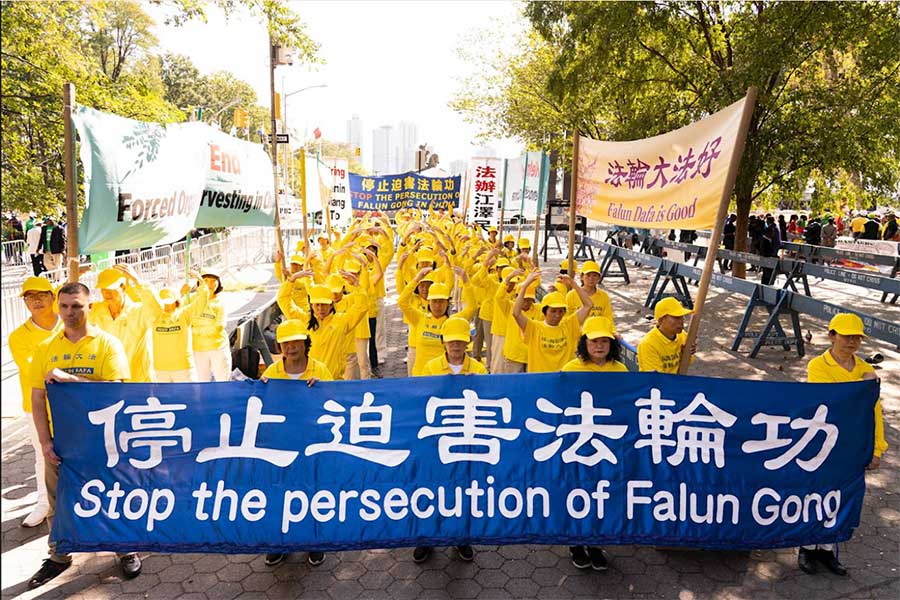
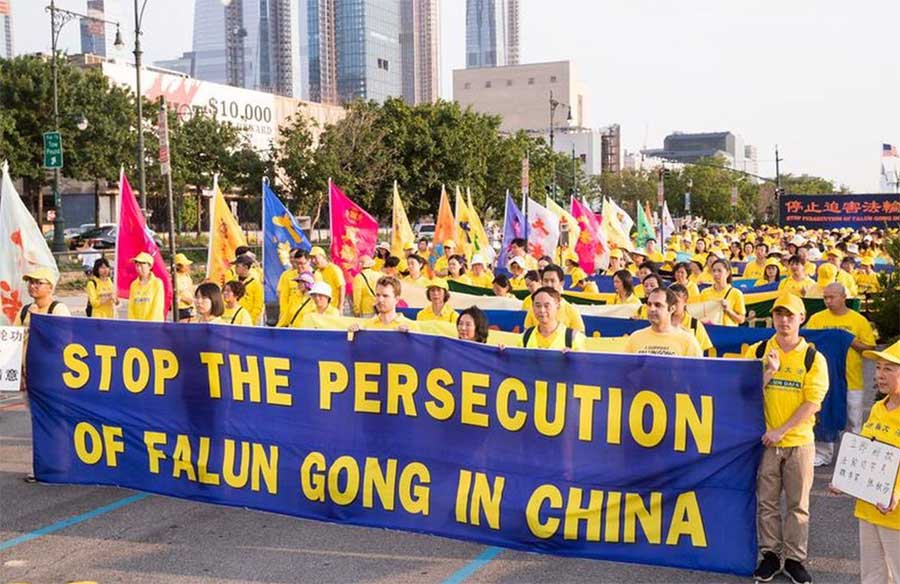
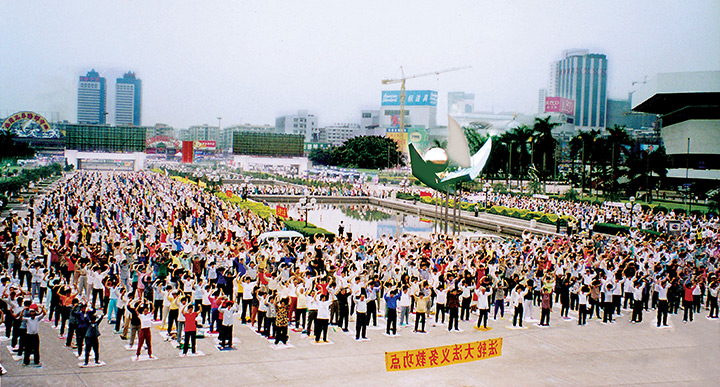
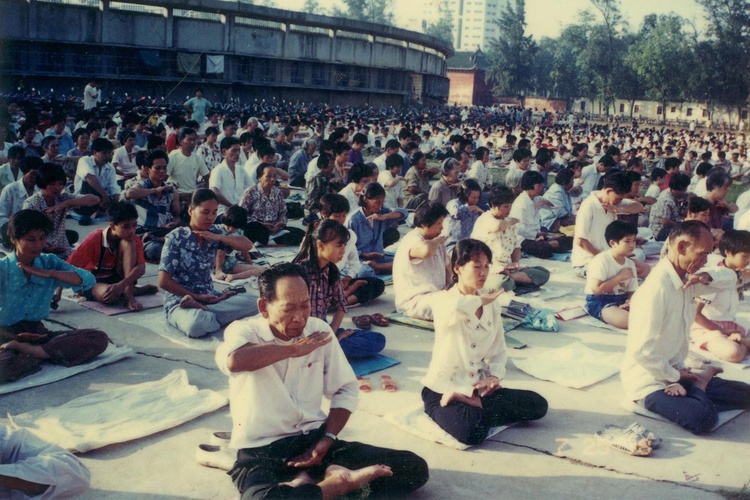
Those who interpret this in connection with the persecution of Falun Gong in China point to the astonishing temporal coincidence: “The year one thousand nine hundred ninety-nine, seventh month” (July 1999) is the exact time when the Chinese Communist Party (CCP), under the leadership of Jiang Zemin, officially launched the brutal persecution of Falun Gong, a peaceful meditation practice based on the principles of Truthfulness-Compassion-Forbearance. “A great King of Terror from the sky” is believed to allude to the nature of the persecution: a top-down terror campaign, state-directed, destructive, and widespread throughout the country. It is noteworthy that, looking back at world events in July 1999, there seems to be no other act of terrorism or political upheaval of a comparable scale and global impact to the beginning of the persecution targeting tens of millions of peaceful citizens in China.
The phrase “to resurrect the great King of Angolmois” is one of the most mysterious parts. The most common interpretation suggests that “Angolmois” is an anagram or a variant of “Mongolois” (the Mongols). Following this line, “resurrecting the King of the Mongols” could imply that the nature of the “King of Terror” (the persecuting power) is as brutal, warlike, and destructive to cultural and spiritual values as what one imagines of the Mongol conquests of the past. Alternatively, it could suggest that this power is repeating oppressive, foreign-like forms of rule over its own people, a kind of spiritual or methodological “Mongolization.”
However, some recent analysts, especially when viewing this prophecy through a deeper understanding of the nature of communist regimes, have proposed a different decoding of the word ‘Angolmois’—one that could make the entire quatrain even clearer. They hypothesize that ‘Angolmois’ could be Nostradamus’s phonetic alteration or encoding of a Chinese phrase, such as ‘Angongmen’ (暗共门 – Àn Gòng Mén).
If we try to read ‘Angolmois’ in this way, with ‘Àn’ (暗) meaning dark or hidden; ‘Gòng’ (共) relating to ‘Communist’; and ‘Mén’ (门) meaning gate, school, or way; then ‘Àn Gòng Mén’ could be understood as ‘the hidden gate/school of Communism’ or ‘the dark communist power.’ In that case, the ‘King of Terror’ (believed to be Jiang Zemin and the CCP) ‘resurrecting the King of Àn Gòng Mén’ could signify that to carry out the brutal persecution in July 1999, the regime had to mobilize and fully awaken the darkest natures, the covert control mechanisms, and the deceitful and evil tactics inherent to the communist system. It is not just the revival of an individual, but the exposure and consolidation of power of the evil ‘communist school’ itself.
Placed in the context of the last line, ‘Before and after Mars (Marx/Marxism) reigns by good fortune/happiness,’ the entire prophecy seems to paint a picture with strong internal logic. Thus, it can be understood that in July 1999, a tyrannical, brutal ruling power (‘King of Terror from the sky’) would take action. The profound purpose of this action would be to consolidate and fully awaken the inherent nature and covert mechanisms of the communist system (‘to resurrect Àn Gòng Mén’). All of this would take place in a context where Marxism is still present and dominant, and every action (including the persecution) is cloaked in the name of ‘the people’s happiness.’
A concise interpretation of the entire quatrain from this perspective could be:
“In the year 1999, seventh month,
A great King of Terror will come from the sky:
For the purpose of resurrecting the Àn Gòng Mén (the inherent/covert nature of communism),
While Marxism still reigns and in the name of the people’s happiness (to carry out the persecution).”
Of course, this remains a speculative interpretation, and we cannot know for certain what Nostradamus was thinking when he wrote these lines. But it shows that ancient prophecies, when contemplated deeply and connected with momentous historical events, can open up layers of meaning that perhaps the author himself did not foresee, or had intentionally hidden for later generations to discover.
I have noticed that this interpretation, though potentially controversial, has attracted particular attention from those concerned with the human rights situation in China and those who study the persecution of Falun Gong. It shows that the ancient verses of Nostradamus continue to be “read” and “decoded” in new contexts, reflecting the anxieties and aspirations of the era. It also reminds us that sometimes, the most important messages are hidden subtly in seemingly familiar words.
When first encountering such “coincidences” in the quatrains of Nostradamus, not only in this example but in many others, I could not help but feel a great curiosity, an astonishment at the possibility that lines from the 16th century could “touch” upon specific events and profound issues many centuries later. Although reason always advises caution with post-hoc interpretations, the haunting power and evocative nature of these verses are undeniable.
Of course, when approaching the prophecies of Nostradamus, we must be extremely cautious. His language, as mentioned, is very vague and highly symbolic. On one hand, this creates a mysterious appeal; on the other, it opens up countless possibilities for interpretation, and not all of those interpretations have a solid basis. However, it is undeniable that, through the centuries, the verses of Nostradamus have always been present in the consciousness of many as warnings, as revelations of a turbulent future. To me, as a researcher, they are not just “predictions,” but also a unique cultural heritage, a mirror reflecting the fears, hopes, and aspirations of humankind to understand its own destiny.
1.2. 20th-Century Western Psychics: Voices from the Invisible Realm
Besides classical prophets with enigmatic works of prophecy like Nostradamus, the 20th century also witnessed the emergence of individuals possessing special psychic abilities, attracting great attention from the public and the research community. They did not leave behind coded verses, but often delivered more direct messages and “readings,” though the origin of that information has always remained a miraculous and hard-to-explain matter. Two of the most prominent names are perhaps Edgar Cayce and Jeane Dixon.
Edgar Cayce (“The Sleeping Prophet” – USA, 1877-1945)
Edgar Cayce is often called “the sleeping prophet” or “the father of holistic medicine.” His life and abilities are one of the most carefully documented and studied psychic phenomena of the 20th century. Born into a farming family in Kentucky, Cayce did not have a high level of education but showed unusual signs from a young age. His special ability was only truly discovered when, in an effort to cure his own aphonia, he put himself into a state resembling hypnosis or deep sleep. In that state, he could accurately diagnose illnesses and prescribe effective treatment methods, which were often natural therapies, sometimes very unique and ahead of their time.
The miracle was that, when “asleep,” Cayce seemed able to access an endless source of knowledge. He called that source “The Information” or the “Akashic Records”—a concept from theosophy and Hinduism, believed to be a kind of “cosmic library” that stores every thought, action, and emotion of every sentient being throughout all lifetimes. When asked a question (by a conductor, usually his wife or secretary), the “sleeping Cayce” would answer coherently and in detail, even using complex medical terminology that the “waking Cayce” knew nothing about or did not understand.
Over 14,000 of Edgar Cayce’s “readings” have been transcribed and are stored at the Association for Research and Enlightenment (A.R.E.), which he founded in Virginia Beach. The majority of these readings relate to health and healing, but a significant portion also addresses spiritual matters, philosophy, past lives, and predictions about the future of both individuals and the world.
When examining Cayce’s readings, many cases believed to be fulfilled have left a powerful impression. In the field of medicine, there are countless records of Cayce accurately diagnosing diseases for people he had never met, sometimes thousands of miles away, based only on their name and address. He not only named the disease but also described in detail the condition of the internal organs and the root cause of the illness (sometimes related to psychological factors or karmic consequences from past lives). More importantly, he often provided specific treatment regimens, including diet, gentle exercises, herbal therapies, castor oil packs, or spinal adjustment methods. Many patients, after losing hope with the conventional medicine of the time, regained their health by following these instructions. It is noteworthy that many therapies he proposed, such as the importance of a balanced diet, alkalizing the body, or the mind-body connection, are very similar to the views of modern holistic and functional medicine, decades ahead of his time.
Regarding world events, one of Cayce’s most outstanding predictions was his warnings about the Wall Street stock market crash. In early 1929, as the U.S. economy was experiencing the “Roaring Twenties” with extreme optimism, Cayce in several readings advised people to be cautious and withdraw money from the market because a major crisis was imminent. That October, the “Black Tuesday” event triggered the Great Depression, which lasted throughout the 1930s, proving his warning to be correct. Similarly, in the 1930s, as the specter of war began to loom over Europe, Cayce was also said to have foreseen the main developments of World War II. He spoke of the rise of dictatorial powers, the alliances between nations, and a global conflict that would engulf the world—things that later unfolded with unimaginable brutality.
In the field of geology, Cayce also made many notable predictions, although their degree of fulfillment and verifiability are more complex. He frequently spoke of major changes to the Earth’s surface in the future, including a shift in the planet’s axis, earthquakes, volcanic eruptions, the submersion of many coastal lands (like California and New York), and the rising of new lands from the ocean floor, including the lost continent of Atlantis—a subject he described in great detail in many readings on history and ancient civilizations. Many people who follow climate change, rising sea levels, and increasing seismic activity today believe that these prophecies of Cayce are gradually being fulfilled. However, it must also be objectively acknowledged that some of his predictions about the specific time and place of these geological events did not happen as he described, or they still belong to a distant future that is difficult to confirm at present. Caution is necessary when approaching such macroscopic and long-term predictions.
What makes Edgar Cayce special is not just his predictions, but also the man himself and his life. He was a devout man who lived simply and always used his ability to help others, often refusing payment for his health readings. The consistency, detail, and vast amount of information he left behind, along with the recorded cases of miraculous healing, have made Edgar Cayce a unique spiritual phenomenon that continues to attract interest and research to this day. To me, his story is a powerful testament that there are sources of knowledge and latent abilities in human beings that modern science has perhaps not yet been able to fully touch.
Jeane Dixon (USA, 1904-1997)
Another very famous name in the world of psychics and prophets in 20th-century America is Jeane Dixon. She was widely known as an astrologer and a self-proclaimed psychic with the ability to see the future, frequently making predictions about famous figures and national and international political events. Unlike Edgar Cayce with his “readings” in a hypnotic state, Jeane Dixon often received “visions” or “premonitions” while awake, sometimes through dreams or while looking into a crystal ball—a tool she often used.
Jeane Dixon’s fame peaked after one of her most famous predictions seemed to come true in a tragic way: the assassination of U.S. President John F. Kennedy. According to records, in a 1952 interview with Parade magazine, she predicted that the 1960 presidential election would be won by a Democrat, who would later be assassinated or die while in office, though not necessarily in his first term. When John F. Kennedy, a Democrat, was elected in 1960 and subsequently assassinated in November 1963, Jeane Dixon’s prophecy was recalled and widely circulated, bringing her resounding fame.
Besides the prediction about Kennedy, Jeane Dixon was also said to have made several other predictions that were considered fulfilled, or at least had remarkable similarities. For example, she was said to have foreseen the death of Mahatma Gandhi, the partition of India, the launch of the Soviet satellite Sputnik, and the deaths of several other famous figures. She also regularly made predictions about elections, political upheavals, and sometimes natural disasters.
However, like many other prophets, not all of Jeane Dixon’s predictions came true. In fact, many analysts have pointed out that she also had a significant number of incorrect predictions. For example, she once predicted that World War III would begin in 1958, that the Soviet Union would be the first nation to put a man on the moon, and made several inaccurate election forecasts. This phenomenon is sometimes called the “Jeane Dixon effect,” a term used to describe the tendency for people to focus on and remember the fulfilled predictions (hits) while ignoring or forgetting the large number of failed ones (misses).
Nevertheless, Jeane Dixon’s influence on the American public for a long time is undeniable. She served as an informal advisor to several powerful figures, including First Lady Nancy Reagan (wife of President Ronald Reagan), who reportedly consulted her in arranging the president’s schedule. Books about her life and prophecies became bestsellers, and she frequently appeared in the media.
Looking back at the case of Jeane Dixon, I see a mixture of “bright spots”—predictions that seemed to be fulfilled in a strange way—and “murky areas” of unfulfilled prophecies. This raises questions about the nature of prophetic ability: is it a stable, absolutely accurate power, or is it more like a “channel” of information that sometimes picks up clear signals but at other times suffers from static or is misinterpreted? And does a prophet’s fame depend more on a few spectacular “hits” than on their overall accuracy rate? These are questions we will continue to discuss in later sections.
The story of Jeane Dixon, as well as Edgar Cayce, shows that in the 20th century, belief in the ability to see the future and the existence of people with psychic powers remained very strong, even in a society increasingly oriented by science and technology. They are “voices from the invisible realm,” challenging the limits of our understanding and hinting at other dimensions of reality.
1.3. Eastern Wisdom: Prophecies That Shaped History
As we have explored together in the previous section, prophecies from the West—whether through the enigmatic verses of Nostradamus or the messages from the special states of Edgar Cayce and Jeane Dixon—have all left profound marks on the stream of human consciousness about the future. Now, I invite you to turn with me to the East, where ancient wisdom often does not stop at predicting isolated events, but also sketches panoramic pictures of national destiny, the cycles of history’s rise and fall, and contains within it profound lessons on social ethics.
Eastern prophecies often carry a different flavor, a perhaps more macroscopic vision, tied to the concept of “Heaven and Man are one,” where the fate of individuals, society, and the nation are intimately intertwined with the laws of Heaven and Earth. We will examine a few representative cases to feel this more clearly.
- Maqian Ke (馬前課) (Attributed to Zhuge Liang – China, Three Kingdoms Period):
“Maqian Ke” (literally, “Divinations Before the Horse”) is a concise yet extremely famous work of prophecy in Chinese culture, attributed to Zhuge Liang (181-234), the brilliant military strategist of the Three Kingdoms period. The work consists of 14 “lessons” or divinatory poems, each a four-line verse, predicting a dynasty or a major historical period of China, from the Shu Han era to the distant future. The conciseness and high symbolism of “Maqian Ke” have made it a subject of study and interpretation for many generations.
Let’s examine a few lessons that are considered to have been clearly fulfilled:
Lesson One (預言蜀漢):
The verse (無力回天,鞠躬盡瘁,陰居陽拂,八千女鬼) is interpreted as follows: The first line, “Powerless to turn back heaven, I bow and exhaust myself in service,” is believed to describe the career of Zhuge Liang; despite his utmost efforts, he could not restore the Han dynasty. “Bending my back to the task… until death” (鞠躬盡瘁,死而後已) is his famous saying. The second line’s “Yin resides, yang fades” refers to the decline of the Shu Han dynasty. “Eight thousand female ghosts” (八千女鬼) is a way of deconstructing the character for “Wei” (魏), implying that the Shu Han dynasty was ultimately destroyed by the state of Wei.
Lesson Five (預言唐朝):
The verse (十八男兒,起於太原,動則得解,日月麗天) is interpreted as follows: “Eighteen sons” (十八男兒) combines to form the character “Lǐ” (李), the surname of the Tang dynasty. Li Yuan began his uprising in Taiyuan. “The sun and moon splendid in the sky” (日月麗天) could describe the prosperity of the Tang dynasty, or it could also allude to Empress Wu Zetian (武曌), whose self-created character 曌 is composed of “sun” (日), “moon” (月), and “sky” (空).
Lesson Six (預言宋朝):
The verse (二十九換,春夏秋冬,神州出現,盡在其中) is interpreted as follows: The Song dynasty lasted 319 years with 18 emperors. “Twenty-nine changes” (二十九換) has many interpretations, with some suggesting it relates to the number of years or emperors. “Divine Land” (神州) is another name for China. Researchers still debate the exact meaning, but this lesson is widely accepted as referring to the Song dynasty.
Taylor’s preliminary comment:
“Maqian Ke” displays a different style of prophecy: concise, condensed, using very suggestive words and images to encapsulate the fate of an entire dynasty. Its interpretation requires a deep understanding of culture, history, and the art of character deconstruction.
- The Prophecies of Trạng Trình (Nguyễn Bỉnh Khiêm – Vietnam, 16th Century):
In the flow of Vietnamese history and culture, Trạng Trình Nguyễn Bỉnh Khiêm (1491-1585) is an outstanding cultural figure, a poet, an educator, and also a prophet whose prophetic words have deeply penetrated the folk consciousness. His works, especially the orally transmitted prophetic verses, contain extraordinary predictions about the country’s future, many of which are believed to have been astonishingly fulfilled.
The prophecies of Trạng Trình are often general in nature, using metaphorical images and folk language, but contain great messages, guiding political forces and even ordinary people through turbulent historical periods.
“Hoành sơn nhất đái, vạn đại dung thân”: This is perhaps one of the most famous prophecies, linked to a crucial historical decision. Legend has it that when Nguyễn Hoàng feared being harmed by his brother-in-law Trịnh Kiểm, he sought Trạng Trình’s advice. The Trạng said casually: “A strip of the Hoành Sơn range can provide shelter for ten thousand generations” (“Hoành sơn nhất đái, vạn đại dung thân”). Nguyễn Hoàng understood the hint and requested to be the governor of Thuận Hóa (south of the Ngang Pass – Hoành Sơn), from which he built the foundation for the Nguyễn lords in the South. This prophecy was not just situational advice but a direction for an entire lineage, opening a new chapter in Vietnamese history.
Predictions about the French colonial period and the division of the country: Some prophecies have been interpreted as having foreseen the French colonial period. For instance, the line “Cửu cửu càn khôn dĩ định/ Thanh niên cổ nguyệt tự nhiên” is often interpreted through number puzzles (9×9=81 years) and character composition (“Thanh niên” – 青年 -> “Chủ” – 主; “cổ nguyệt” – 古月 -> “Hồ” – 胡), suggesting the role of a leader with the surname Hồ in regaining sovereignty. Other lines, such as “Mã đề dương cước anh hùng tận/ Thân Dậu niên lai kiến thái bình” (When the horse’s hooves and goat’s feet are gone, heroes end / In the years of the Monkey and Rooster, peace is seen), are linked by many to wars and their end dates.
Prediction about Nguyễn Công Trứ: Another famous anecdote is Trạng Trình’s prediction about Nguyễn Công Trứ, a historical figure who lived more than 200 years after him. A prophecy carved on a temple stele, “Minh Mạng thập tứ… Kì nhân danh Trứ, tự Công/ Phá tự chi hậu, công danh thủy thành” (In the 14th year of Minh Mạng’s reign… That person’s name is Trứ, courtesy name Công / After demolishing the temple, his fame and career will be made), is said to have correctly foretold not only Nguyễn Công Trứ’s name and time but also the specific act that would lead to his success, making later generations admire the Trạng’s prophetic talent even more.
Taylor’s preliminary comment:
The prophecies of Trạng Trình show an important characteristic of Eastern prophecy: practicality, a close connection to national destiny, and an action-oriented nature. The Trạng’s profundity lies not only in his ability to “see” but also in the way he conveyed his messages—subtle yet clear enough for the predestined to comprehend.
- Plum Blossom Poem (梅花詩) (Shao Yong – China, Song Dynasty):
The “Plum Blossom Poem” (Plum Blossom Poem) by Shao Yong (邵雍, 1011-1077) is another famous work of prophecy said to predict historical events in China for centuries. The work consists of 10 seven-character quatrains, each corresponding to a historical period, and is famous for its refined language and rich symbolism.
Let’s look at a few examples:
- Poem One (Prediction about the Northern Song Dynasty):
The verse (蕩蕩天門萬古開,幾人歸去幾人來。山河歷歷觀天地,一旦浮雲暗帝臺。) describes the beginning of the Song dynasty. The last line, “One day floating clouds obscure the imperial throne,” is believed to allude to the Jingkang Incident (靖康之變) of 1127, when two emperors were captured by the Jin army, ending the Northern Song dynasty. “Floating clouds” is often used to refer to foreign invading forces.
- Poem Six (Prediction about the Qing Dynasty and the return of Han rule):
The verse (漢水茫茫,不復流,徒將忍氣吞江侯。諸侯亂世紛紛擾,幾見牛郎又見牽。) is interpreted as follows: “The Han River flows vast, no longer to return” (漢水茫茫,不復流) is understood as the decline of the Han people’s fortune. The final lines, describing the Cowherd meeting the Weaver Girl again, are seen as a metaphor for the restoration of Han rule during the 1911 Xinhai Revolution.
- Poem Ten (Prediction about a special period in the 20th-21st centuries):
This verse (火龍提爪日月傷, 擾亂中原百鍊剛。 一圭雞三點血, 桃花笑逐浪濤濤。) is interpreted by many researchers as corresponding to events in China from the mid-20th century to the present, including the persecution of Falun Gong. “The Fire Dragon’s claws tear the Sun and Moon” (火龍提爪日月床): “Fire Dragon” (火龍) is associated with the red symbol of communism, while “Sun and Moon” (日月) can form the character “Míng” (明), signifying righteousness. This line could allude to the persecution of righteous spiritual values. “Around the Central Plains, steel is tempered a hundred times” (繞洛中原百煉剛) describes the chaos and struggles in China. “One Rooster, three drops of blood” (一圭雞三點血) is interpreted through complex character deconstruction, with some linking it to the map of China (shaped like a rooster) and the brutal persecution of belief groups, particularly those who uphold “Truthfulness-Compassion-Forbearance” (真善忍). “Peach blossoms laugh, chasing the rolling waves” (桃花笑逐浪滔滔) suggests overcoming difficulties to reach a brighter future and may allude to people with the surname Lý (Li).
The “Plum Blossom Poem” by Shao Yong uses refined poetic language and rich imagery, creating many layers of meaning. Interpreting these poems often requires a combination of historical and cultural knowledge, and intuition. The prophecies in “Plum Blossom Poem” not only describe events but also faintly suggest moral judgments and the principles of rise and fall.
- The Prophecies of Liu Bowen (劉伯溫) (China, Ming Dynasty):
Liu Bowen (1311-1375), real name Liu Ji, was one of the most famous founding fathers of the Ming dynasty, a military strategist, statesman, writer, and also considered a great prophet. The prophetic works attributed to him, such as “Shaobing Ge” (燒餅歌 – Baked Cake Song), “Jinling Tabei Wen” (金陵塔碑文 – Jinling Tower Stele Inscription), and “Tuibei Tu” (推碑圖 – Pushing the Stele Diagram), have been widely circulated and have profoundly influenced the Chinese perception of historical events from the Ming era to the future.
We will focus on a few representative excerpts from these works, especially those believed to be fulfilled by major events and which carry a warning message.
- Shaobing Ge (燒餅歌 – Baked Cake Song): This work is presented as a dialogue between the Hongwu Emperor (Zhu Yuanzhang) and Liu Bowen.
Regarding the fall of the Ming and the rise of the Qing: In “Shaobing Ge,” there are passages interpreted as describing the suicide of the Chongzhen Emperor and the Manchu conquest of the Central Plains. For example, lines such as “At this time the temples belong to brothers, What way is there when they slaughter each other…” (此時廟堂在目中,諸侯暫走氣運終) or “When all the tens of thousands of sons and grandsons are gone, Only when sixteen men are masters will there be peace.”
Predictions of the final period and its calamities: “Shaobing Ge” also describes a period of chaos, moral decay, and endless natural and man-made disasters in the final stage, before a new order is established. For instance, lines like: “The world laughs at the fool among fools, The believer starves while the doubter grows fat” (世事街談巷語,信者死,疑者活) or descriptions of the people’s misery, where “seven out of ten will die” (十份死七份).
- Jinling Tabei Wen (金陵塔碑文 – Jinling Tower Stele Inscription): This stele inscription, attributed to Liu Bowen, predicts events after the Ming dynasty.
On the great upheavals in 20th-century China: Many parts of the “Jinling Tower Stele Inscription” have been interpreted by later researchers as corresponding to events such as the Xinhai Revolution, the Sino-Japanese War, and the Nationalist-Communist Civil War. For example: “The population has eleven, Of three able-bodied men, only one remains” (人口有十分,死掉九成人), alluding to massive loss of life, or wordplay alluding to the names Chiang Kai-shek and Mao Zedong.
Warning of a great calamity and the path to survival: The “Jinling Tower Stele Inscription” also has very noteworthy passages about a terrible calamity in the end times, and it reveals a hope. “People rejoice, while ghosts grieve. Fog locks the mountain tops, a single strip of water connects” (人人歡樂,鬼鬼愁悲。霧鎖山頭,一堤水). This line describes a clear division between good and evil, where the good are saved and the evil are eliminated. “Light qi floats up to heaven, turbid qi sinks to hell” (輕氣浮上天,濁氣下地獄). “If you ask when the plague will appear, just look to the ninth and tenth months of winter” (若問瘟疫何時現,但看九冬十月間). “Heaven has eyes, Earth has eyes, everyone has a pair of eyes, Heaven turns, Earth turns, the carefree and happy are like free immortals” (天有眼,地有眼,人人皆有一雙眼。天也翻,地也翻,逍遙自在樂無邊). This passage emphasizes the fairness of Heaven and Earth, that all deeds are witnessed, and after the great upheaval, those who survive will live a life of peace and joy.
Notably, some lines are believed to point to the path of hope: “One who can resolve the Qi of Quiet Poetry, Can escape from gold, white, and jade” (能解靜詩氣,逃出金白玉). “Qi of Quiet Poetry” (靜詩氣 – Jìng Shī Qì) can be understood as tranquility, reading and understanding poems and prophecies, and finding inner peace. “Gold, white, and jade” (金白玉 – Jīn Bái Yù) symbolize materialism, fame, and fortune in the secular world. Only by letting go of attachments to materialism and returning to spiritual values can one escape the calamity.
Some interpretations also relate this to seeking a “Great Way” or universal principles that can help people overcome the tribulation, for example, the message of cultivating one’s heart and mind.
- Tuibei Tu (推碑圖 – Pushing the Stele Diagram): This work is often mentioned for its very detailed prophecies about the Dharma-ending age, a great calamity, and the appearance of Maitreya Buddha (or a Savior).
Description of the great calamity: “Tuibei Tu” describes the terrible disasters in great detail: “The tenth sorrow is the chaos that fills the world” (十愁天下亂紛紛), “The ninth sorrow is that dry bones and corpses are left unburied” (九愁屍體無人撿), “The eighth sorrow is that the roads are difficult and no one travels them” (八愁人民難過日).
Prophecy of Maitreya Buddha and the three words Truthfulness-Compassion-Forbearance: This is one of the most prominent points of interest in “Tuibei Tu.” Liu Bowen wrote: “Maitreya Buddha sits on a mountain of treasure, lecturing on the True Law to save the original people” (彌勒佛坐寶山,講說真法度原人).
And specifically, he mentioned the three core words: “The highest Heavenly Buddha is the three-word Buddha of Truthfulness, Compassion, Forbearance. The people of the middle and lower levels all seek the three-word Buddha. He who can pass the border before the three-word Buddha will find endless joy in the Buddha’s kingdom and the immortal’s paradise” (上上天堂佛,真善忍三字佛…得在三字佛前過邊境,佛國仙境樂無邊).
This passage clearly indicates that “Truthfulness-Compassion-Forbearance” (真善忍 – Zhēn-Shàn-Rěn) are the core principles, the path to be saved and to enter a beautiful future.
* * *
Liu Bowen’s prophecies, whether in “Shaobing Ge,” “Jinling Tabei Wen,” or “Tuibei Tu,” all display a far-reaching vision that spans centuries. They not only predict historical events but also contain profound warnings about morality, the law of cause and effect, and reveal hope and a path for humanity in pivotal moments. The mention of principles like “Truthfulness-Compassion-Forbearance” as a path to salvation is a point worthy of deep contemplation.
* * *
When looking back at the prophecies from Trạng Trình Nguyễn Bỉnh Khiêm, Zhuge Liang (through “Maqian Ke”), Shao Yong (through the “Plum Blossom Poem”), or Liu Bowen, I notice several prominent common characteristics and the profound messages of Eastern prophetic wisdom:
First, they often have a macroscopic scope, focusing on the destiny of an entire nation, a people, or the rise and fall of dynasties. It seems these prophets had the ability to see through the great currents of history, the laws governing the movements of societies.
Second, these prophecies often emphasize historical cycles—the circulation of formation, stasis, degeneration, and destruction; of prosperity and decline. This suggests that history is not a chain of random events but follows certain laws, and the end of one cycle often opens a new beginning.
Third, the element of social ethics and the law of Karma is a consistent theme, whether hidden or apparent. Moral decay and the corruption of people’s hearts are often considered the cause of chaos, natural disasters, and decline. Conversely, maintaining moral values and living virtuously are seen as the foundation for stability and development, as well as the path to overcome calamities. This is not just a prophecy but also a profound teaching.
Fourth, a point of immense significance is that many Eastern prophecies, especially when speaking of the final period or the end times, often reveal a great hope, the appearance of a Savior or a Great Law that can save people. The fact that prophets like Liu Bowen mention Maitreya Buddha and principles like “Truthfulness-Compassion-Forbearance” as a “key” to overcome disaster and enter a new era is a universal message, transcending predictions of specific events. It touches upon the deepest aspirations of humankind for salvation and a better future.
The style of expression is also very characteristic: using metaphorical language, symbolic imagery, suggestive poetry, and the art of character deconstruction. This not only adds a layer of mystery to the prophecies but also requires later generations to contemplate, reflect, and have a pure heart to be able to comprehend the deep, hidden layers of meaning.
The comparison between Eastern and Western prophecy (which we glanced at in the previous section) shows the diversity in how people from different cultures approach and express messages from the invisible realm. However, despite differences in form, the aspiration for knowledge of the future, the anxiety before upheavals, and the hope for salvation or a better renewal seem to be profound commonalities of humanity.
* * *
The great names from the past have left behind immense prophetic legacies, not only predicting events but also carrying messages of warning and hope. But the stream of prophecy does not stop there. Right in our own time, with the explosion of information and the unceasing changes in the world, there are still individuals who claim to receive messages, premonitory dreams about the future. How should we view these “contemporary prophetic voices,” and do they continue the tradition or bring a new shade compared to the ancient prophecies? That is what we will explore in the next section.
* * *
1.4. Contemporary Prophetic Voices: Dreams and Premonitions of Our Time
As mentioned at the end of the previous section, after contemplating the immense prophetic legacies from the past with their timeless messages, I cannot help but wonder: does the stream of prophecy stop there? Or does it continue to seep into modern life, in new forms, through new people? In the age of explosive information, where every individual can become a “transmitter,” how do we listen to and discern the “voices” that are said to carry messages from the future?
The stream of prophecy is not limited to ancient texts or the words of sages from the past. Right in our own time, with the rapid and complex changes of the world, individuals still emerge who claim to have the ability to foresee events, or to receive warning messages through dreams and intuition. They may not be “official” prophets in the classical sense, but what they share sometimes resonates greatly within the community, reflecting the anxieties and hopes of the era.
- Ryo Tatsuki (Japan): The Prophet of “Fulfilled” Dreams
One of the names that has been mentioned frequently in recent years, especially in the community of those interested in spiritual and prophetic phenomena, is Ms. Ryo Tatsuki, a Japanese manga artist. What is special about Ms. Tatsuki is that her method of prophecy is based entirely on dreams. She says she has the ability to remember and record in detail her prophetic dreams, and these dreams often come true after a certain period of time.
- Past Predictions on Record: According to widely shared information (and recorded in her previously published works), Ryo Tatsuki has made several predictions that are considered to have been fulfilled quite accurately, making her name known. For example, many believe she predicted the COVID-19 Pandemic. In a work published in 1999 titled “The Future I Saw” (Watashi ga Mita Mirai), she drew a cover that read “Great Catastrophe in 2020,” and the story contained images and messages interpreted as relating to a mysterious virus that would appear, cause illness, and spread widely. The detail that a virus would appear 10-15 years after a previous disaster (believed to be the 2011 earthquake and tsunami in Japan, with the prediction of a “great catastrophe in July 2025” also appearing on that cover) also attracted much attention. In addition, she is also said to have correctly predicted several other events such as the deaths of some famous figures (e.g., singer Freddie Mercury of the band Queen, Princess Diana) and specific natural disasters in Japan.
- Method and Prophetic Characteristics: A special point is that Ms. Tatsuki often records specific dates for her predictions in her dream diary, and only publishes them later. According to her supporters, this increases the objectivity of the “fulfillments.” The language in her predictions is often direct and less metaphorical than ancient prophecies, describing specific events or images she sees in her dreams.
- Necessary Caution: Of course, as I approach cases like Ms. Ryo Tatsuki’s, I always maintain the cautious attitude of a researcher. Independently and absolutely verifying contemporary prophecies, especially when they spread rapidly through the internet and media, is a challenge. There may be factors such as random coincidence, or the reinterpretation of details after the event has occurred to make them “match.” However, it is undeniable that the recorded “fulfillments” have attracted great public interest, making many curious and eager to learn more.
- Connection to the Present: At the time I am writing these lines (late June 2025), the name Ryo Tatsuki is once again being mentioned frequently, linked to her prediction of a “great catastrophe” that could occur on July 5, 2025, involving Japan and the Philippines. We will not delve into analyzing the impact of this prediction here (that will be covered in CHAPTER 7, when discussing prophecy in the current context). In this section, I just want to present Ms. Ryo Tatsuki as an example of how a “prophetic voice” can appear and have influence in the modern age, through a very personal channel: dreams.
- Personal Premonitions and Intuition Before Major Events:
Besides those with systematic prophetic abilities or through dreams like Ms. Ryo Tatsuki, perhaps many of us have also experienced moments of unusual “premonition” or “intuition” before some event, though we cannot explain it clearly with logic.
It could be a vague sense of unease before a trip, a nameless anxiety for a loved one, or even fleeting images in the mind of something about to happen. Many people recount having such feelings before natural disasters, accidents, or important personal events.
These “voices” are not usually clearly “prophetic,” lacking specific dates or details, but they show that humans seem to have some latent ability to sense the “vibrations” of the future, or changes in the surrounding energy field. This could be a manifestation of intuition, an aspect of consciousness that modern science is still exploring.
In the context of this book, listening to personal “premonitions,” though not prophecy in the traditional sense, can also be a way for us to connect more deeply with ourselves and with the invisible currents of life.
* * *
The appearance of “contemporary prophets” like Ryo Tatsuki, or personal experiences of premonition, raises many interesting questions. Are these new manifestations of the same latent ability that ancient prophets possessed? Or do they reflect a special sensitivity of some individuals to the upheavals of the era?
In a world where true and false information are mixed, approaching “contemporary prophetic voices” requires sobriety and critical thinking. However, dismissing them entirely could also cause us to miss out on valuable messages, or at least other perspectives on reality.
More importantly, these “voices,” whether right or wrong, verified or not, often touch upon the deep anxieties and aspirations of people in an uncertain world: the desire to know in advance, the desire for safety, and the desire to find meaning in what is happening.
* * *
As we skim through a few representative examples together—from the enigmatic verses of Nostradamus, the “readings” from Edgar Cayce’s special state, to the history-shaping prophecies of Trạng Trình, Zhuge Liang, Shao Yong, and Liu Bowen, and even the prophetic dreams of a contemporary manga artist like Ryo Tatsuki—I believe that you, like me, can feel the strange allure of these messages that seem to transcend the barriers of time.
We have “witnessed” cases that are said to have been “fulfilled” in an astonishing way, words from the past that seem to accurately describe what happens in the present or future. The diversity in the forms of expression, from multi-layered verses and concise prophecies to more direct descriptions in “readings” or dreams, shows that the ability to access and transmit prophetic information is incredibly rich.
These names and works have become legendary, an indispensable part of the cultural and spiritual heritage of many peoples. Their enduring vitality, through centuries and even millennia, shows that they touch upon something very fundamental in the human psyche—curiosity about the future, the aspiration to find laws and patterns, and perhaps, a belief that there are levels of consciousness that transcend our ordinary senses.
However, as an inquirer and a contemplative, I cannot help but ask further questions. Although these “coincidences” or “fulfillments” are impressive, are there other factors we need to consider when evaluating them? Is interpreting a prophecy simply a matter of “reading and understanding” it literally? Or behind the seemingly clear “match,” are there hidden challenges, pitfalls of the mind and language that we need to recognize?
The allure of prophecy is undeniable, but to truly understand its value and meaning, perhaps we need to take a step back and look at the phenomenon of “fulfillment” from more angles, with a mindset that is both open and cautious. That is precisely what I want to invite you to explore in the next section, as we delve into “The Art of Interpretation and the Pitfalls of Fulfillment.”
* * *
2. “Fulfillment” from Multiple Perspectives: The Challenges and Pitfalls of Interpretation
After reviewing the notable cases of “fulfilled” prophecies together, from East to West, from ancient to modern times, different emotions have likely stirred within each of us: admiration, curiosity, and perhaps even a bit of skepticism. The allure of a statement from the past accurately describing the future is undeniable. However, in my role as an inquirer, I feel it is necessary to take a step back and, with you, the reader, analyze the nature of this “fulfillment” more objectively and from multiple dimensions. Is everything as clear as it seems on the surface?
- The Ambiguity and Polysemy of Prophetic Language:
One of the most prominent characteristics we can easily observe in many prophecies, especially ancient prophetic books like the “Plum Blossom Poem” or “Maqian Ke,” and the verses of Nostradamus, is their frequent use of highly symbolic, metaphorical, and polysemous language.
Ancient prophets rarely seemed to describe future events directly and clearly like a news report. Instead, they used images and words that could evoke many associations and multiple layers of meaning. For example, a “fire dragon” could be interpreted as a war, a revolution, a destructive authority figure, or even a special natural phenomenon. A “river running dry” could allude to the fall of a dynasty, a prolonged drought, or a loss of spirit and culture.
On one hand, this very ambiguity creates a mystical beauty and depth for the prophecies, allowing them to withstand the test of time and retain their value for contemplation across generations. But on the other hand, it also opens up a vast space for interpretation. The same prophetic verse or poem can be “applied” by readers from different eras, with different experiences and background knowledge, to various historical events and still feel “plausible.”
I ask myself: Could it be that this very polysemy has helped prophecies to “live forever” and be “fulfilled” in many different situations, because they are flexible enough to be adapted accordingly? This is not a denial of the value of prophecy, but a necessary question for us to better understand the mechanism of their operation in the human psyche.
- “Matching” After the Fact (Postdiction / Retrofitting):
This is an important psychological factor we need to recognize when considering the “fulfillment” of prophecy. “Postdiction” or “retrofitting” is the phenomenon where people tend to reinterpret or search for details in an ancient prophecy to make it fit an event that has already happened, rather than the prophecy having truly described that event accurately and in detail before it occurred.
Imagine this: after a major historical event, such as a war or a natural disaster, people often tend to dig up ancient prophetic texts, trying to find sentences or words that seem “similar” or can be associated with the recent event. When they find a few “matches,” however vague, they easily exclaim, “It’s true! Prophet X predicted this!”
In my own research process, I too have had moments of being swept up in the excitement of finding such “connections.” However, if we look at it objectively, we might see that these “connections” are sometimes created more by our effort to “assign” meaning than by the clarity of the prophecy itself.
Nostradamus is a typical example. His quatrains, with their archaic language, mix of multiple tongues, and abundance of symbols, have become “fertile ground” for countless later interpreters. The same quatrain can be “applied” to different events across the centuries, from French kings, the French Revolution, Napoleon, Hitler, to more modern events. Did Nostradamus really “see” all these things in detail, or was it the interpreters who were “creative” in finding the matches?
This does not mean that all “matches” are the result of imposition. But being aware of this tendency for “postdiction” helps us to have a more cautious view and avoid rushing to conclusions about a prophecy’s ability to predict with great detail based solely on “after-the-fact” interpretations.
- Confirmation Bias:
Another psychological “pitfall” that often appears when we approach prophecies (and indeed, many other types of information in life) is “confirmation bias.” This is a very natural human tendency: we often seek, remember, prioritize, and interpret information that confirms our existing beliefs or hypotheses, while tending to ignore, downplay, or rationalize information that contradicts them.
In the field of prophecy, this can manifest as follows: if a person believes in the ability of a certain prophet, they will tend to focus only on that prophet’s “fulfilled” prophecies, and these “fulfillments” will further strengthen their belief. Conversely, inaccurate prophecies or incorrect predictions might be ignored, dismissed as “misinterpreted,” “not yet time,” or simply forgotten.
Imagine a prophet who makes hundreds of predictions. If only a few of them are “fulfilled” in an impressive way, people will easily remember those “fulfillments” and overlook the majority of the unfulfilled predictions. At this point, confirmation bias has taken effect, making us feel that the prophet is “very skilled” or “very accurate,” while their actual success rate may not be as high as we think.
In starting my journey to understand prophecy, I also had to remind myself of this bias. The allure of “fulfillment” stories sometimes makes us forget to ask the comprehensive questions: “What other prophecies did this person make? Were they fulfilled? What is the ratio of right to wrong?” Being aware of confirmation bias helps us to have a more balanced and objective view, not easily persuaded by “evidence” that is merely selective.
- The Barnum/Forer Effect:
The Barnum effect (also known as the Forer effect) describes a psychological phenomenon where people tend to rate descriptions of their personality or future as highly accurate, even though those descriptions are in fact very general, vague, and could apply to a great many people. The effect is named after P.T. Barnum, a famous circus showman known for the line, “We’ve got something for everyone.”
In the context of prophecy, especially personal prophecies or general descriptions of “the times,” the Barnum effect can play a certain role. Some prophecies are written in a very general style, for example: “There will be great upheavals in society,” “People will face moral challenges,” “There will be unexpected changes in your life.” These descriptions, because of their generality, can easily “match” the experiences of many people at different times.
When reading such prophecies, people might feel, “So true! This is happening to me/to society!” without realizing that the statements are broad enough to apply to almost any situation or individual. This does not mean that all prophecies take advantage of the Barnum effect, but it is a factor to consider, especially with predictions that lack specific details or a clear timeline.
Recognizing this effect helps us distinguish between a prediction that is truly informative and specific, and general statements that anyone might feel “apply” to them.
- The Role of the Interpreter:
One factor that cannot be ignored when discussing the “fulfillment” of prophecy is the decisive role of the interpreter. As we have seen, prophetic language is often ambiguous and polysemous. Therefore, the meaning of a prophecy does not lie entirely in the text itself, but also depends heavily on how the reader, researcher, or “experts” interpret it.
The same quatrain by Nostradamus, the same prophetic verse from Trạng Trình, or the same poem from “Mai Hoa Thi” can be given completely different interpretations by different interpreters at different historical moments, with different cultural, political, and religious frames of reference. Even the same interpreter, at different stages of their life, may have changes in their perspective.
This raises an important question: To whom does the “authority” of interpretation belong? And on what basis? Is there a single “correct” interpretation for a prophecy? Or is every interpretation subjective and dependent on the interpreter’s point of view?
When a prophecy is said to be “fulfilled,” we need to ask ourselves: is that fulfillment due to the prophecy itself being very clear, or is it due to the talent (or cleverness) of the interpreter in connecting the details of the prophecy with actual events? This is sometimes a very fine line.
I believe that acknowledging the active and creative (sometimes excessively so) role of the interpreter helps us approach translations and analyses of prophecy more cautiously. We need to consider not only the content of the prophecy, but also the context, motives, and methodology of the interpreter.
- Self-Fulfilling Prophecy:
Finally, there is another interesting phenomenon to consider, which is the “self-fulfilling prophecy.” This is a case where a prophecy, which may initially be a false or baseless prediction, becomes true precisely because it is believed and spread, thereby influencing people’s thoughts, emotions, and behaviors in a way that indirectly leads to its fulfillment.
The classic example often given is the prophecy of the collapse of a bank or a stock market. If there is a rumor (or a “prophecy”) that Bank X is about to fail, depositors who believe it may rush to withdraw their money. This mass withdrawal, even if the bank was initially sound, ultimately becomes the very cause of the bank’s crisis and bankruptcy. The initial prophecy “fulfilled itself” through the behavior of those who believed in it.
In some cases, a prophecy of war or conflict, if believed by the parties involved, can increase suspicion, hostility, and preparations for war, ultimately leading to the actual outbreak of war. Conversely, a positive prophecy of reconciliation can create an atmosphere of optimism, promote efforts for dialogue, and ultimately lead to peace.
Although not all prophecies have the potential to be “self-fulfilling” (for example, it is hard to say a prophecy about an earthquake could “self-fulfill” in this way), this is a factor to consider, especially for prophecies related to social psychology and behavior. It shows the power of belief and how our perception of the future can influence the very creation of that future.
* * *
When we walk together through the analyses of the ambiguity of prophetic language, the tendency of “matching after the fact,” confirmation bias, the Barnum effect, the role of the interpreter, and even the “self-fulfilling” potential of some prophecies, a question may arise: So, should we completely dismiss the value of prophecy? Is it all just coincidence, subjective imposition, or psychological “pitfalls”?
I, after many years of searching and contemplation, do not think the answer is that simple.
The psychological and cognitive factors we have just discussed are real, and they play an important role in how we receive and interpret prophetic messages. Recognizing them is not meant to completely deny the phenomenon of prophecy, but for us to have a more sober perspective, the necessary caution of a researcher, a seeker of truth.
Facing these factors, I feel a certain inner turmoil. A turmoil about the fine line between faith and credulity, between the suggestiveness of symbols and the imposition of interpretation, between true clairvoyance and the subjective human desire to see what one wants to see.
However, this caution does not mean completely closing our minds to the mysterious, to phenomena that modern science may not yet fully explain. If we only cling to rational analysis to reject everything beyond our common understanding, are we not limiting our own ability to perceive and explore the deeper levels of reality?
I believe what is important is that we approach prophecy with a mindset that is both healthily critical and sincerely open. Critical, so as not to fall into superstition, not to be led astray by false information or baseless interpretations. Open, so that we can listen, feel, and reflect on messages that may contain values transcending the rightness or wrongness of a specific prediction—they could be lessons on morality, warnings about human responsibility, or rays of hope for a better future.
Recognizing the “challenges and pitfalls of interpretation” does not diminish the allure or the potential value of the river of prophecy. On the contrary, it helps us become more sober “ferrymen” on this journey of discovery, knowing how to navigate our boats through winding turns and undercurrents, so that we can perceive the true beauty and depth of that river.
And perhaps, the ultimate purpose of studying prophecy is not just to determine whether it is “fulfilled” in a literal sense. More importantly, it is how those messages impact our consciousness, sparking reflections on life, the universe, and the position of humanity in that vast picture.
So, if we temporarily set aside the debates about the accuracy of individual prophecies to look at the bigger picture, can prophecy, with all that it represents, be compared or contrasted with modern forecasting methods, especially scientific forecasting? What are the similarities and differences between these two approaches to the future? That is what we will explore in the next section.
3. Prophecy and Scientific Forecasting: Two Approaches to the Future
After considering together the fascinating “fulfillments” of prophecies and the challenges and pitfalls in their interpretation, a question naturally arises in my mind, and perhaps in yours as well: So, where does prophecy, with all its characteristics, stand when compared to the methods of future forecasting that modern humans have been developing, especially scientific forecasting? Are they two completely separate worlds, or are there points of contact, differences, and similarities between them that are worthy of our contemplation?
- Scientific Forecasting: The Effort to Grasp the Future with Reason and Data
When we speak of scientific forecasting, we often envision a systematic process built on solid foundations.
- Foundation: Scientific forecasting typically originates from observing the material world and collecting measurable, verifiable data. It is based on discovered natural laws, mathematical and statistical models, and logical analysis. Scientists build hypotheses, test them through experiments or against historical data, and from there, derive laws or trends that can be used to extrapolate into the future.
- Method: This process involves building models (e.g., meteorological models to forecast weather, economic models to forecast growth, epidemiological models to forecast the spread of disease). These models are continuously tested, calibrated, and improved as new data or new understanding becomes available. The result is usually not an absolute certainty, but rather possible scenarios with certain probabilities.
- Purpose: The main goal of scientific forecasting is often very practical: to provide early warnings (e.g., storms, floods, earthquakes), support decision-making in many fields (economics, healthcare, agriculture, urban planning), manage risks, and help people be more proactive in dealing with changes in the natural and social environments.
- Nature: An important characteristic of scientific forecasting is that it is verifiable (though not always 100% accurate). Failed forecasts can be analyzed to find the cause, thereby improving models and methods. Science accepts error margins and considers them part of the process of progress. It does not claim to hold the absolute truth about the future.
Clearly, scientific forecasting is a powerful tool, an achievement of human intellect in the effort to understand and master the world around us. It has been and continues to be of great benefit to society.
- Prophecy (in the traditional sense explored in this book): A Different Approach from Deeper Levels of Consciousness?
When placed alongside scientific forecasting, prophecy (in the way we are exploring it in this book—that is, messages from prophets, prophetic books, revelations, dreams…) presents a completely different picture.
- Foundation: As we discussed in CHAPTER 4, the origin of prophetic information is very diverse and often not based on conventional logic or measurable data in the traditional scientific sense. It could be revelations from Divine Beings, the “seeing” ability of those with special powers (the celestial eye), altered states of consciousness, prophetic dreams, or the interpretation of omens from Heaven and Earth. Many believe that prophets, especially cultivators, can access other dimensions, cosmic laws that modern empirical science has not yet touched. It may be that history has been arranged like a “script” at higher levels, and prophecy is the act of “seeing” a part of that script in advance.
- Method: If scientific forecasting relies on analysis and modeling, prophecy is often intuitive, sensory, or through “supernatural” channels. It is not the result of a logical calculation process but a direct “seeing,” “hearing,” or “knowing,” sometimes without the medium of ordinary senses.
- Purpose: The purpose of prophecy also seems to extend beyond just predicting specific events. Besides giving warnings, many prophecies carry profound moral and spiritual messages. They may aim to awaken human conscience, remind us of the law of Karma, encourage virtuous behavior, or reveal the greater laws of the universe and destiny. Sometimes, knowing a part of the future is not for people to wait passively, but to have the opportunity to recognize “heaven’s will” and make better choices in the present, especially at crucial transitional moments.
- Nature: “Verifying” a prophecy is often much more complex than with scientific forecasting. It depends heavily on the art of interpretation, on faith, and on historical and cultural context. A prophecy may be true for some people and some cultures, but be incomprehensible or meaningless to others. It is not easily refuted just for being “wrong” on a few details, because its deeper meaning may lie on a metaphorical or spiritual level.
- Core Differences:
From the comparisons above, I see some very fundamental differences between prophecy and scientific forecasting, not only in method but also in worldview and ultimate purpose.
- On the source of information and approach to reality: Modern science primarily relies on the senses and measuring instruments to explore the tangible, physical world, in the dimension where we exist. It seeks laws from what can be “seen, touched, and counted.” Meanwhile, prophecy seems to touch upon sources of information from other realms, dimensions that ordinary senses cannot perceive. It suggests a multi-dimensional reality, where past, present, and future may coexist, or have been arranged according to laws that transcend our current understanding of matter and time.
- On methodology and tools: Science uses logic, analysis, mathematical models, and experiments. Prophecy relies on intuition, spiritual enlightenment, special states of consciousness, or a sensory connection to subtle messages. The tools of a scientist are machines and laboratories; the tool of a prophet (especially a cultivator) may be their own purified and elevated consciousness.
- On ultimate purpose and meaning: Scientific forecasting often aims for specific, practical goals in material life: improving living standards, preventing natural disasters, developing the economy. Meanwhile, many prophecies, especially the great ones, carry a larger mission: to awaken conscience, warn against moral decay, affirm the existence of Gods and Buddhas and the law of Karma, and point out the path to salvation or a spiritual transformation for humanity. It is concerned not only with “what will happen” but also “why it happens” and “what we should do.”
- On assessing reliability and “fulfillment”: As mentioned, scientific forecasting can be verified with data, and error is part of the process. Prophecy is more complex. Its “fulfillment” is often tied to belief, to the ability to interpret, and sometimes, an event is only recognized as a “fulfillment” long after it has occurred. A prophecy may not be fulfilled in its event details, but its warning message may still hold its value.
- Is There a Meeting Point or Room for Complementation?
Placing these two methods side by side, a big question appears in my mind: Are they completely opposite, mutually exclusive? Or is there some space between them for a meeting, or even for complementing each other in humanity’s journey to understand the universe and the future?
Modern empirical science, with its brilliant achievements, seems to be gradually touching its own limits when facing the great mysteries of the universe, of consciousness, and of life. There are questions that the current methodology of science cannot yet answer. Are there some “laws” of the universe, some energy flows, or some levels of reality that modern science has not yet reached, but that prophets have somehow sensed or “seen”?
I think of cases where the intuition of a brilliant scientist sometimes leads them to discoveries that pure logic could not have imagined. Is that intuition in any way similar to the “sensory connection” of prophets?
Conversely, can science help us better understand the mechanisms of some phenomena considered “prophetic”? For example, could studies of the brain in deep meditative states, of the subconscious, of special dreams, or even new discoveries in quantum physics about the nature of time and space, partially open the doors that prophets seem to have walked through?
From the perspective of a contemplative, I feel that prophecy is not meant to replace science, or vice versa. Each method has its own value and role in helping people perceive the world. Science helps us understand and transform the material world. Prophecy, especially prophecies with spiritual messages, can help us return to core values, turn towards virtue, and recognize our place in a universe that is vaster and more meaningful than what we usually see.
Perhaps a truly scientific attitude is not to reject what one does not yet understand, but to constantly ask questions, to explore, and to be open to new possibilities. Who knows, in the future, when humanity’s consciousness has evolved, the boundary between “science” and “spirituality,” between “forecasting” and “prophecy,” will no longer be as distinct as it is today. There may be a “new science,” a more comprehensive understanding that encompasses the laws of matter as well as the laws of the spirit, of destiny.
The prophecies, the foretold words, may be the very hints, the “traces” left by the wise ones of the past, inviting us to reflect on a broader picture of reality, a “science” at a higher level that we are gradually discovering.
* * *
4. Taylor Reed’s Insights:
When I look back at everything we have explored together in this chapter—from the allure of “fulfilled” prophecies, the challenges and pitfalls in the art of interpretation, to the comparison between prophecy and scientific forecasting—I sense the complexity and multi-dimensional nature of this topic. Clearly, “fulfillment” in prophecy is not a simple concept that can be framed in absolute terms of “right” or “wrong.”
The journey of a researcher, and also of a spiritual contemplative like myself, is always full of questions. I realize that trying to “prove” or “disprove” the accuracy of each specific prophecy can sometimes distract us from the deeper values they may offer.
I believe that “fulfillment” is not always the sole or most important measure for evaluating the worth of a prophecy. More than whether a prediction comes true, it is the cautionary significance, the ability to inspire reflection, and the encouragement for people to turn towards virtue and live more consciously that are the immensely important values that many great prophecies have transmitted through the generations. They are like bells, not only signaling what may come, but also awakening our conscience, reminding us of our responsibility to ourselves, our community, and the world.
In approaching prophecies, the roles of faith and healthy skepticism are essential. I do not advocate for blind superstition, believing in everything labeled as “prophecy” without discernment. But at the same time, I do not support the complete denial of things that our current reason cannot fully explain. To maintain an open mind, ready to listen, but also to never stop thinking, analyzing, and perceiving with both heart and mind—that is perhaps the most suitable path.
Despite the significant challenges in determining “fulfillment” by current “scientific” standards, we cannot deny the fact that a great many prophecies continue to attract attention, to be cherished, and to profoundly influence the consciousness and culture of people across many eras. This shows that they touch upon something very fundamental, an aspiration or a deep-seated anxiety in the human psyche—the aspiration to understand the laws of the universe, the aspiration to overcome current limitations, and the aspiration to find meaning in the infinite flow of time.
And it is from these reflections that a larger question arises in my mind, leading us to a new aspect of our journey:
“So, if we temporarily set aside the debate on the accuracy or degree of ‘fulfillment’ of each specific prophecy, are there common patterns, major themes, and universal messages that frequently appear in prophecies throughout the world and across the ages? Why do those themes—such as great upheavals, purifications, and the aspiration for a rebirth, a new golden age—stir and awaken us so powerfully, like bells echoing unceasingly from the past to the present? And amidst the warnings of darkness, where are the rays of hope, the lights that are kindled?”
* * * * *
(…..)
This article is an excerpt from the book “THE LAST BELLS“, which contains insightful notes and analyses by author Taylor Reed on the phenomenon of weeping statues of the Virgin Mary in many places around the world, as well as pointing out the mysterious coincidences of ancient and modern prophecies about the present day.
If you wish to experience the full journey of thought and the unpublished insights of the work, please click the button below to own the complete book.
To explore more works from THE LIVES MEDIA, visit our book collection.