( ….. )
The First Perspective: The Decay of the Creative Soul (Culture & Art)
I opened my laptop to complete an unfinished analysis.
In an old folder, my previous draft was titled: “When music is no longer art.”
Right at the beginning, I had written:
“Art once was a torch illuminating the soul. Now, it is merely a convex mirror, reflecting illusions and guided instincts.”
I still remember the feeling when I first typed these lines. It wasn’t indignation. It was regret.
I opened YouTube, not waiting for the algorithm to suggest anything.
I actively typed the keyword: “Top trending music video 2020s” — as a way to check where today’s visual culture stood.
The first MV that appeared was by a young band currently “taking the world by storm.” But I didn’t need to know who they were.
Just a few seconds after pressing play, the analytical system in my mind was already operating — like a professional mechanism that needed no name:
- The melody was programmed to stimulate nerves, creating feelings of euphoria and explosiveness after each hook (an instant attention-grabbing technique in digital content).
- The choreography was synchronized, bland, jerky, dehumanized to the point of resembling a dance of demons.
- Lyrics were structured in 4-6 word cycles, repeated in an advertising pattern.
- Images flashed, scenes were jumpy, lights were cold, special effects were excessive.
- The singers and dance troupe had hair of various colors—blue, red, purple, yellow—covered in diverse tattoos, and costumes that looked exactly like cinematic demon outfits.
The people on screen were no longer artists. They were tools of demons…
There were no real expressions. No moments of silence. No narrative thread.
Everything was just encrypted code — designed to addict, not to inspire.
I used to ignore this phenomenon. Not because I didn’t see it.
But because I thought I understood the mechanism behind it too well.
But this time, I had to confront it. Because it was no longer just a musical phenomenon — but a global psychological ecosystem, shaping the personalities and emotions of an entire generation.
I recalled my early days in college, more than twenty years ago.
Back then, I had never heard the term “K-Pop.” But what was called “global music culture” had already begun to surge.
I vividly remember the Michael Jackson craze sweeping through the dorm like a flood.
My friends were obsessed with his every move, every spin, every gaze on stage. One friend told me:
“Don’t you see? This is iconic. This is greatness.”
I asked: “Greatness where? In the message, or the technique?”
She answered without thinking: “No need to understand. Just feel it.”
That sentence etched itself into my mind like a silent blow.
I was born into a Christian family.
I grew up with church music, where every hymn was a prayer.
When I started to explore Eastern culture, I found another depth in ancient zither music, in quiet folk melodies echoing from the Asian countryside.
That music wasn’t flashy. It wasn’t sensational.
It wouldn’t make you say “wow” in the first 5 seconds.
But if you listened quietly, it touched something very deep—like healing water for the inner self.
Compared to it, today’s music is a paradox:
The more glamorous – the emptier.
The more tumultuous – the more voiceless.
The more it incites lust – the more it loses true emotion.
I don’t deny that art should create more good things. But what’s happening isn’t development — it’s an ever-increasing degenerate decay.
I flipped back to my notes in my notebook. A heavily underlined line:
“The most sophisticated decay is decay within a perfect facade.”
Young idols are screaming about “self-liberation” on stage.
But they are precisely the most meticulously vetted products: from their height, voice, pronunciation, to even the emotions they are allowed to display on television.
I looked at the chorus line produced like packaged goods.
I recalled a concerto by Vivaldi (18th-century Italian Baroque composer), where every rise and fall of the rhythm felt like the heartbeat of the universe.
I compared. And I shuddered.
We have lost the ability to hear silence in art.
Music, once a means to connect with the divine — now merely a tool for entertainment.
No one writes music to enlighten others anymore. There’s only music to “retain viewers for 15 seconds on a platform.”
I typed the final lines:
“True music elevates humanity. Today’s music paralyzes them.
And in that state, they will no longer have the will to think, to resist, or… to remember who they are.”
I stopped typing. Stood up. Silently poured a glass of water.
Images from the MV still flickered wildly on the screen behind — as if signaling from a world I no longer belonged to.
I returned to my desk, opened my notebook. A line heavily underlined from the previous year:
“When art no longer transmits light, it becomes a dark shadow in the human mind.”
Yet, a sad truth is that these modern bands, typically K-Pop groups from South Korea, are globally adored by young people. They win numerous prestigious music awards, and some groups are even invited to the United Nations headquarters for global recognition!
My memory shifted to another domain: painting.
In New York, I once stepped into a modern art gallery, where “masterpieces” valued at hundreds of millions of dollars were displayed.
A colossal canvas with a few smeared colors and strokes as if left by a child playing with crayons.
I stood silent. No emotion. No depth. Not a single tremor reached my soul.
And then I read the description:
“This work reflects the artist’s internal instability amidst the collapse of modern order.”
I gave a faint smile. Perhaps the description was more refined than the painting itself.
I was once moved by Raphael’s “The School of Athens” – where philosophy, mathematics, and art converged in a divine geometric symphony.
I once stood for hours before a Tang dynasty Buddha statue, just to feel the serenity flowing from the benevolent gaze carved more than a thousand years ago.
Compared to that, what is called “peak art” today makes me… shudder.
I’m not speaking lightly. These are real numbers:
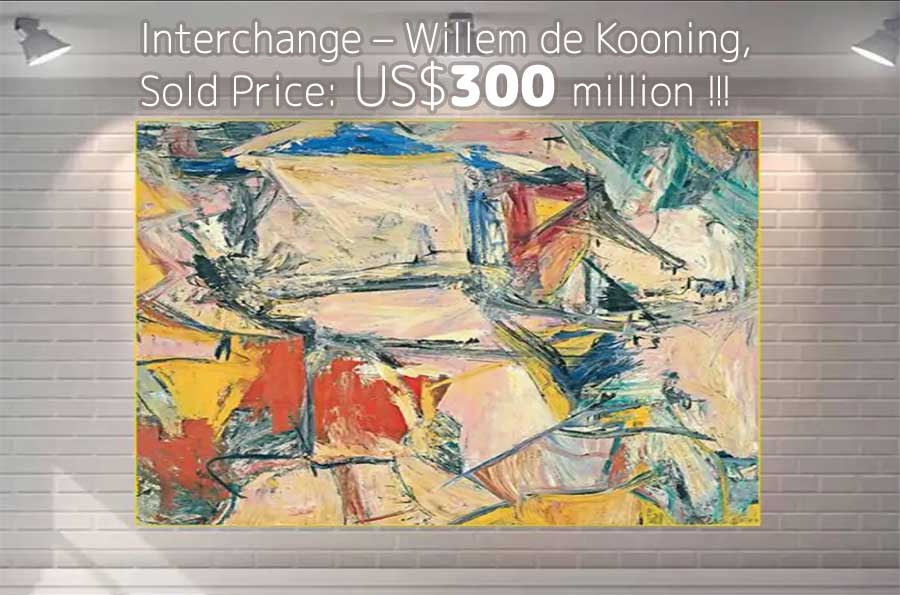
Willem de Kooning’s “Interchanged” — a jumble of abstract swirls — sold for $300 million.
“Woman III” by the same artist — a twisted face, distorted body — changed hands for $137.5 million.
Mark Rothko’s “No. 1 (Red and Blue)” — just two overlapping color blocks — priced at $75.1 million.
Christopher Wool’s “Riot” — simply the four letters RIOT printed in black on a white background — cost $29.9 million.
If art is meant to inspire and purify the soul, these paintings are doing the opposite.
In fact, I once wrote in a blog post — and I still hold this view:
“When people look at a painting and find it beautiful, perhaps it’s because their mental landscape aligns with the chaotic, twisted, and distorted state within the painting itself.
As for those who still retain the purity of their souls, they will feel dizzy, nauseous, even literally sick.”
I sighed…
I also heard that in Thailand or somewhere, people train an elephant to randomly smear paint on a canvas, then call it “unique art” and auction it off.
And honestly, compared to some “master artists” today, that elephant’s painting is even… more visually appealing!
I typed a bitter line into the draft:
“With the ‘leapfrog’ evolution of contemporary art, it’s highly possible that in the not-too-distant future, a painting of… a pile of feces will be labeled ‘anti-flat-earth thesis’ and fetch a price of 1 billion USD.”
Exaggerating? Not at all.
Just a few years ago, a “contemporary artist” taped a ripe banana to a wall with duct tape, named it “Comedian,” and sold it for $120,000.
The only thing I found amusing — was that people called it the “pinnacle of postmodern thought.” And me? I called it the ultimate mockery of humanity’s conscience by the demonic nature.
I sat in silence. Remembering an old saying from my father:
“When art falls into the hands of those without morals, it will no longer be art — but a tool for legally corrupting the soul.”
I switched to cinema — a form of “synthetic art” once considered the pinnacle.
But increasingly, films are driven by algorithms rather than by virtue.
Blockbuster movies relentlessly cram in meaningless action scenes, dazzling special effects, absurd violence, and gratuitous sexuality… as if audiences are no longer capable of thought.
I’ve read hundreds of comments like:
“No plot needed, just beautiful explosions.”
“Plot holes galore, but the male lead’s visuals and abs save the entire film.”
“Don’t demand depth — people watch to escape, not for philosophy.”
So art has stripped itself bare, transforming from a bridge to spirituality into… an addictive entertainment tool.
I remembered “Joy to the World” — the familiar Christmas carol, written by Isaac Watts.
Not grand. No sound filters. Just simple lyrics sung from the mouths of people who believed in goodness.
When that music resounded in the night, I felt: my soul being uplifted.
But today, in the movie theater, I only feel overwhelmed, tired, and empty.
I returned to the screen, typing the final lines:
“The most sophisticated decay of art is when it no longer directs people towards light, but drags them into darkness in the name of ‘creativity.’
And in that vortex of chaos, the human soul is eroded — little by little — without even knowing it.”
I closed my laptop. Sat still in my office.
In my heart, an old question lingered — one that never ceased to ache:
“What have we exchanged… to call this creative freedom?”
* * *
The Second Perspective: The Compromise of Intellect and the Decline of Wisdom (Media & Social Networks)
I reopened an old news report on my computer — an article I had worked on about a year ago.
The original title was: “Inside a School Full of Shadows.”
But the title after being edited and publicly published was:
“Teacher beats student to hospitalization: Who is in charge?”
I still remember the feeling back then. Anger. Confusion.
My investigative article had delved into the school’s mechanism of silence, systemic cover-ups, and how victims were marginalized. But that entire section — over 2,000 words — had been edited out. They kept a few shocking details, added some public outrage, and pushed it to the front page.
I wasn’t the only one.
I used to admire many veteran journalists — those who reported from war zones, who uncovered hidden cases. But year after year, I witnessed them change.
Not because they lost their ideals, but because ideals no longer paid the bills.
Journalism, once called the “fourth estate,” now stands behind even social media algorithms and mob sentiment.
In the past, to become a journalist, one needed ethics, courage, and extensive social knowledge.
Today, a writer might only need to know how to catch TikTok trends and craft “artistic” clickbait headlines on Facebook.
I looked at myself.
I once told some of my interns:
“Journalism is about protecting the truth.”
But I myself had to write to order: “Increase female readership, 18–25 years old, add emotional and controversial elements.”
Once, the editor-in-chief suggested a headline to me: “Singer X’s ex-lover unexpectedly speaks out about that breakup year.”
I asked: “What does that have to do with education?”
They replied curtly: “Who reads political news? Add this line to get views first, content later.”
I opened my phone. Swiped the screen.
TikTok. YouTube Shorts. Instagram Reels.
Each platform is like an endless conveyor belt of short videos — 15 seconds, 30 seconds, 60 seconds — where everything is designed to grab attention.
A neurologist once said at a conference I attended:
“The structure of short-form content stimulates the mind like a mild addiction — but prolonged over many years, it can rewire the human brain.”
Explicit images are not the most dangerous.
What’s more dangerous is the fragmentation of attention.
People can no longer read a 1000-word article.
Cannot follow an argument that extends beyond three paragraphs.
In fact, today’s articles have to “break sentences” after every line, because otherwise… “users will scroll past.”
I scribbled a line in my notebook:
“Truth takes ten minutes to understand.
A lie takes only five seconds to infuriate.
In today’s media world — which will win?”
I once thought: if there was anywhere that could keep the flame of independent thought alive, it would be social media, where individuals had the most agency and freedom of speech…
But then, one morning, millions of people around the world woke up to something unusual: the social media accounts of the sitting President of the United States had been blocked.
Not just one, but all of them: Twitter, Facebook, Instagram, YouTube… almost simultaneously silenced the man holding the most powerful position on the planet.
Regardless of whether you loved or hated him, it was a cold, hard fact: an individual could be completely erased from public space with just a few clicks by anonymous “councils.”
And if that could happen to a president, it could happen to anyone.
But what made me shudder wasn’t the fact that he was “banned.”
It was that it was considered normal.
Social media is now monitored and controlled by governments, not just in totalitarian states, but also in Western countries.
And social media has now become a chaotic mess dominated by cheap “entertainment” content…
That so-called “open space” is, in reality, a series of echo chambers, where each person only sees what they already believe and hears what they want to hear.
It’s ironic:
We have over 4 billion people connected globally, yet we increasingly lack the ability to truly converse.
We have an unprecedented store of knowledge, yet we are losing the capacity for independent thought.
People no longer read books.
They watch “1-minute book summaries.”
They don’t listen to an entire debate.
They just pick out a quote from the middle, add background music, and create a sensational headline.
Once I asked a recent college graduate:
“Do you like to read?”
She replied:
“I like listening to 5-minute podcasts every morning. Anything longer and I feel lazy.”
A “lazy-reading” society is not necessarily an ignorant society.
But a society that shies away from critical thinking, fears debate, and prefers to be led by emotion rather than reason, is certainly moving backward in intellectual evolution.
I typed the final line again:
“Once truth takes 10 minutes to understand, and a lie takes only 5 seconds to infuriate — it’s not the lie that will win, but rather… intelligence will self-extinguish.”
I turned off the screen. And asked myself:
“If I submitted this draft today, would it be rejected… for lacking ‘market appeal’?”
* * *
The Third Perspective: The Chaos of Foundations (Morality & Society)
That night, I read a news report:
A group of junior high students at a secondary school locked their classroom door, threw slippers at their music teacher, then recorded a video and posted it on social media with a defiant caption: “Teacher sings badly, so she deserves it.”
The incident went viral like a virus. No one condemned it; people only created memes and remixed it with music.
I sat in silence. Not for the teacher. But for this society — where moral chaos is no longer recognized as wrong.
I remembered a line written in an old catechism book:
“The family is the first foundation God gave to humanity to learn how to be human.”
But today, what was once a foundation is now considered an obstacle.
People no longer believe that a child needs both a father and a mother.
Instead, they promote “modern family” models, where gender, roles, and obligations are all optional like phone apps.
I am not writing this to attack anyone.
I am merely observing a reality:
When every concept can be redefined, there is nothing left to serve as a standard.
I once witnessed a student talk back to their parents, saying:
“I don’t need to listen to you. People on TikTok teach differently!”
At a seminar, a teacher recounted:
“My 7th-grade student confided in me that they only dared to speak truthfully to… YouTube Shorts. Because their parents were ‘old-fashioned,’ and their friends were ‘judgmental.'”
TikTok, YouTube, Facebook… have now become the spiritual parents, virtual teachers, and simulated confidants of a generation.
Meanwhile, real relationships — between children and parents, students and teachers — have become strained, distant, even antagonistic.
When morality is detached from the structure of family and school, where do children learn how to be human?
Social ills have long ceased to be a “distant” problem.
— From school drug abuse to underage prostitution. — From financial fraud to rampant pornography.
I’m not saying these things only exist in modern times.
But there’s one key difference:
In the past, they were called vices.
Today, they are disguised as “diverse lifestyles” or “sexual liberation.”
I once read an internal survey:
In Japan and the U.S., over 80% of children had been exposed to pornography before the age of 12.
Some even couldn’t imagine the concept of “love” without accompanying explicit and violent imagery.
Online, there are sites that publicly share pornographic comics — and no one gets arrested.
In addition, fraud and theft — both offline and online — are increasing exponentially.
People steal because they are poor, and sometimes they steal because… they want to be famous.
The more shocking, the more shares.
The more brazen, the more attention.
Society has turned wrong into a tool for survival.
Perhaps what troubles me most is a wave being called by a euphemism:
“Gender freedom.”
In reality, more and more countries are legalizing same-sex marriage (male with male, female with female), even recognizing non-binary identities.
Things once considered abnormal — are now labeled “modern human rights.”
I’m not against anyone. I just wonder:
If a child is born and no longer knows if they are a boy or a girl, how will they learn how to be human?
If gender is just a “feeling” — then what is permanent?
I believe that:
Heaven’s principles do not change.
Gender is not an opinion.
Morality cannot be rewritten by the majority.
Things contrary to nature, contrary to conscience, contrary to traditional culture — even if written into law — can never become a healthy foundation for society.
I concluded with a line in my journal:
“We cannot cure a body if both the doctor and the patient call its condition… normal.”
* * *
The Fourth Perspective: The Hollowing of Power and Trust (Politics & Religion)
POWER: A GHOST BEHIND THE VEIL OF DEMOCRACY
One evening, I sat in my office, flipping through news channels. A live debate between two presidential candidates was airing. They attacked each other relentlessly.
— “You once cut education budgets so much that thousands of teachers lost their jobs!”
— “What about you? You raised corporate taxes, causing the economy to falter!”
No one mentioned actual policies. No one offered a clear solution. I quietly jotted down a few familiar slogans:
“For justice,” “Rebuilding trust,” “Systemic innovation”…
But they were all hollow. No one dared to define what “justice” was, or how the “system” needed to be innovated.
I’ve been a political and social journalist for over 20 years. I used to believe that power could create positive change. But the more I interacted, the more I realized:
Modern politics is not the art of governing a nation, but the art of maintaining image and power.
In Western democracies, power is stretched between three dominant influences:
— Mass media, playing the role of shaping public opinion. — Economic corporations, with behind-the-scenes interests. — And the tastes of the electorate, which are increasingly shallow and easy to manipulate.
A politician who doesn’t cooperate with the media will be slandered. If they don’t meet corporate interests, funding will be withdrawn. If they don’t cater to public taste, they will be discarded in the next election.
They no longer have time to think about long-term values, because power only lasts for a term.
I once asked a friend who worked as an election consultant:
— “Why don’t you propose policies on educational moral reform?”
He smirked:
— “That doesn’t sell votes. But a clip of a candidate shaking a baby’s hand does.”
In one-party states, however, the problem lies elsewhere:
The government does not represent the people, but rather the ruling party itself.
There, power is concentrated at a single apex. Every policy boils down to one goal: protecting the Party, maintaining stability for the system. The people are not subjects to be served, but objects to be controlled.
And because there’s no need for elections or campaigns, decisions become arbitrary and inhumane. When there’s no free press to scrutinize, no opposition to challenge, no true public will — then power becomes absolute, and absolutely corrupt.
I concluded in my notebook:
“Whether democratic or totalitarian, if power is not based on morality – it is merely a game of shadows.
The people, whether they vote or not, are then just pawns in a predetermined game.”
* * *
RELIGION: THE BELLS NO LONGER ECHO
One afternoon, I passed an old church in the city center.
The bells rang – steadily as always. But inside, only three elderly people were quietly counting rosary beads.
The long pews were empty. There was no light in their eyes, no whispered prayers.
The bells rang, but no one listened with their heart anymore.
I once attended a wedding in a grand cathedral. Everything was spectacular: a choir, LED screens, a livestream on Facebook.
But when the pastor began reading from the Bible, no one listened. They were busy adjusting their cameras, busy pressing likes.
Faith, now, was just background decor for a party.
Many pagodas and churches now resemble event centers.
— Some collect offerings like selling tickets. — Some open stalls selling lucky charms, feng shui items, bottled holy water. — Some livestream ancestral worship ceremonies with hundreds of thousands of views.
Some individuals exploit the guise of “monk” or “pastor” to seek personal gain, defraud, and even abuse followers.
Worse still, in many parts of the world, religion is turned into a tool for war.
— In the name of holy war, people open fire on children. — In the name of doctrine, people discriminate against and murder those of different genders or beliefs. — In the name of “God’s will,” people attack entire cities.
No war is bloodier than one waged in the name of God.
I suddenly recalled a story from the Bible:
Jesus once entered the Temple in Jerusalem, angered that the sacred place had been turned into a marketplace.
He overturned the tables of money changers, drove out the merchants, and said:
“My Father’s house is a house of prayer, but you have made it a den of robbers!”
(For general readers: This is a significant event in the New Testament, illustrating Jesus’ purification of religious defilement, and is symbolic of the restoration of faith’s divine dignity.)
I whispered inwardly:
“Lord, if Your house today has truly become a marketplace… please cleanse it one more time – as You once did.”
And I understood:
When faith is no longer a compass, humanity will drift aimlessly in a chaotic sea.
A society may have no gold, no oil, but it cannot be without morality.
When power rots and faith is distorted – that is when the ship of civilization begins to sink.
I put down my pen. The computer screen was still lit, with a series of flashing notes and quotes.
Every topic I had just covered – music, art, social media, politics, religion – was like a disconnected piece of a puzzle. But now, they all suddenly connected.
As if every blood vessel was leading to a failing heart.
Though the forms differed, though the manifestations spanned various fields, I realized:
All these symptoms point to a single root cause – the disconnection from the Divine, and the rejection of universal moral standards.
We have abandoned the moral foundations once established by sages.
We mock scriptures, scoff at beliefs, and replace divine teachings with political slogans and ethical marketing campaigns.
We build skyscrapers, glittering financial centers, but the light within each human being grows dimmer.
We can livestream across the world in an instant, but cannot listen to our own conscience.
We have everything – but we lack peace.
I wrote down the last line in my notebook:
“We have built a civilization glorious in material wealth,
But its soul is dying.
This Tower of Babel is crumbling from its very foundation.
And perhaps…
the tears of God are for that.”
I looked out the window. It was late. The city was still brightly lit, but inside me was a silence.
The diagnosis was complete. But a doctor, if they have a conscience, doesn’t just diagnose the illness – they must also trace its root cause, both within and outside the patient’s body.
Humans are like this.
So what about Heaven and Earth?
Is this planet, this universe, revealing its own vital signs?
Are there other symptoms, not created by humans, quietly reminding us:
We have gone astray?
(…..)
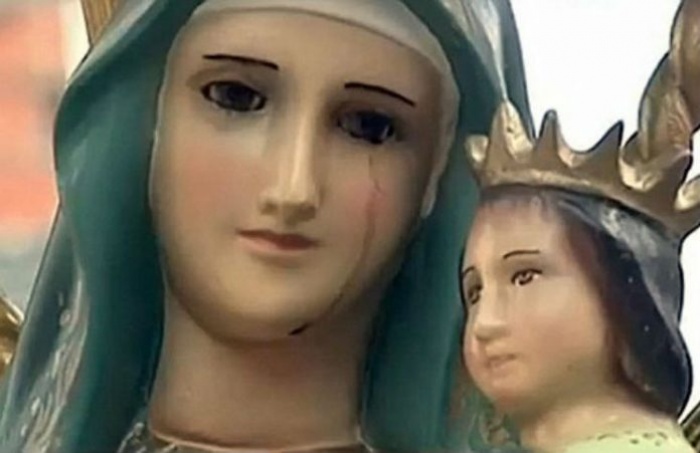
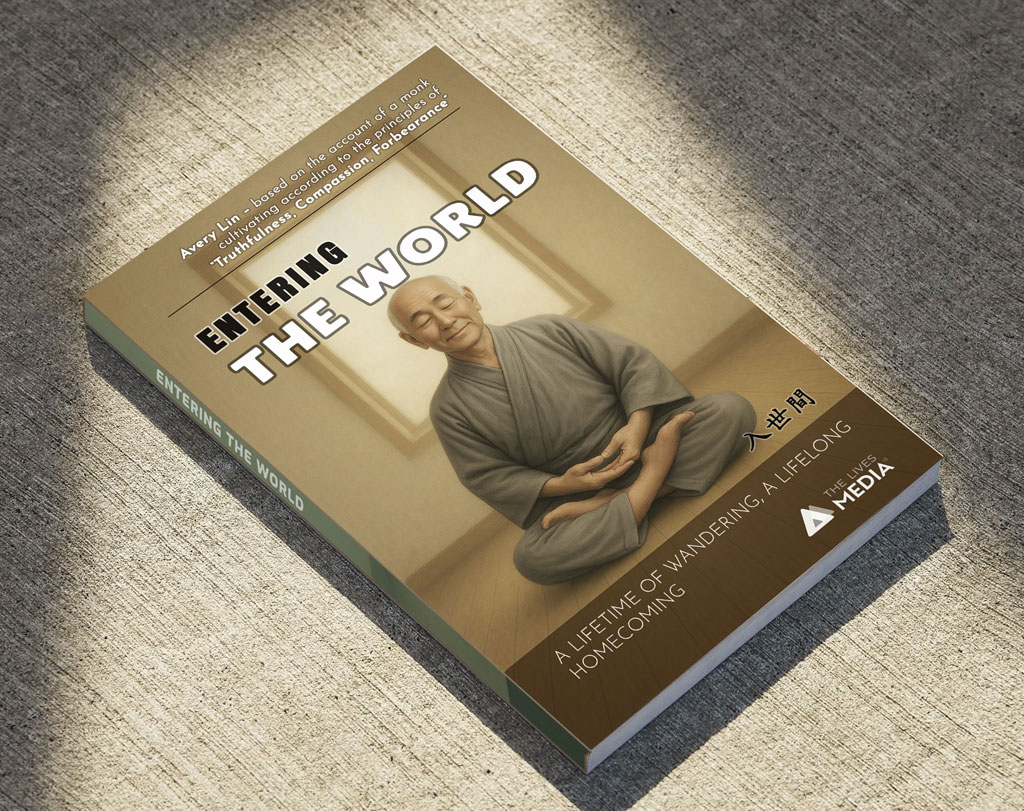
This article is an excerpt from the book “THE LAST BELLS“, which contains insightful notes and analyses by author Taylor Reed on the phenomenon of weeping statues of the Virgin Mary in many places around the world, as well as pointing out the mysterious coincidences of ancient and modern prophecies about the present day.
If you wish to experience the full journey of thought and the unpublished insights of the work, please click the button below to own the complete book.
To explore more works from THE LIVES MEDIA, visit our book collection.