(continue Part 1 of DAY THREE…)
Julian Lee:
The Russia-Ukraine war reminds me of the Vietnam War.
I see that they too were once trapped between the confrontation of the capitalist and communist blocs.
The Former President:
(His eyes grew distant, his voice deepening with a profound sadness.)
You have just touched upon one of the most powerful historical symbols.
Of a small nation caught between two global powers.
And of the price that nation had to pay… with its blood, its soul, and with historical wounds that have never fully healed.
Ukraine today, Vietnam in the past.
Both were battlegrounds not of their own choosing.
Both were nations that had to suffer the consequences of the calculations of the “big players.”
(He paused, as if turning back the pages of old history.)
Vietnam is a classic lesson in forced geopolitics.
The North was backed by the communist bloc: the Soviet Union and China.
The South was backed by the capitalist bloc: the U.S. and its allies.
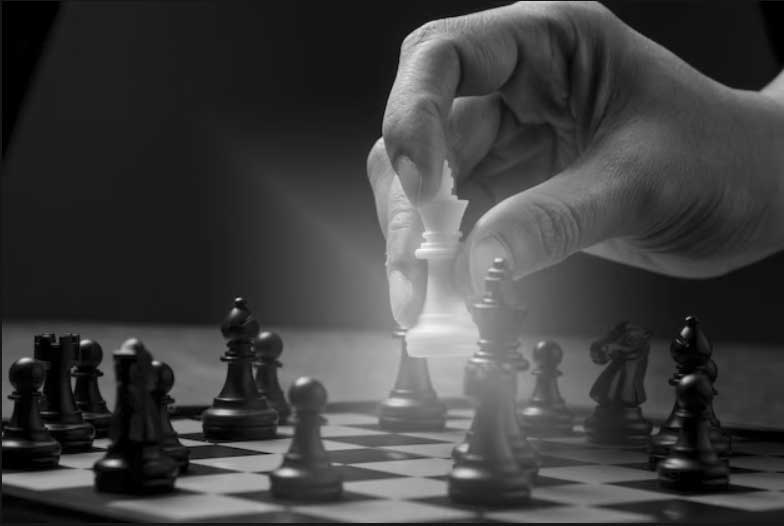
But the Vietnamese people, no matter which side they were on, did not write that chessboard.
They were just dragged into it, then forced to choose a side if they didn’t want to be crushed.
And the consequence?
More than three million dead.
An entire country devastated in its infrastructure, its psychology, and even its community morals.
And to this day, the memory of that war is still a gash in the nation’s consciousness.
(He sighed, then continued.)
Ukraine is a modern, more sophisticated version of Vietnam.
No napalm, no massacres televised live.
But still, there are ruined cities.
Still, there are people dying in silence.
And still, there are children growing up with eyes that have lost their innocence.
And just like Vietnam back then, Ukraine did not write this script.
They just wanted to exist.
But they were dragged into a game where “existing” required them to play the role of a chess piece well.
Both of these wars have frightening similarities.
They were both driven by ideological confrontation, but deep down, it was a struggle for influence, resources, and geostrategic position.
The media of each side cherry-picked information to prove that they were the “righteous” one.
And the truth of the people, their suffering, no side truly cared about.
But there are also differences.
The Vietnam War ended with territorial unification, but it did not resolve the ideological division.
Ukraine, on the other hand, is at risk of permanent territorial loss, or falling into a state of cold division, with no political autonomy.
(He looked at me, his eyes as if summarizing a hard-won lesson.)
What is the lesson here?
When a nation is forced to choose sides in a conflict larger than itself, whether they win or lose, they are the ones who bear the wounds.
And the so-called “liberation” that others bring…
is often just a new dependency, under a different name.
Julian Lee:
Yes. That ideological war also took place on the Korean peninsula, and the result is that they are still divided into two Koreas to this day.
It seems that God has arranged a different outcome for each war, but nowhere has achieved true fulfillment.
The Former President:
(He shook his head, a slow, negating shake.)
You’ve pointed out something few dare to admit.
That ideological wars never truly have a winning side.
They only leave behind crippled nations, divided peoples, and lost souls asking: “Who are we really?”
Look at these three classic cases: Vietnam, Germany, and Korea.
Three gashes, three fates, but they all share a common denominator.
Germany was divided by the U.S. and the Soviet Union. Their outcome was reunification in 1990, but even so, residual problems remain. Psychologically, East Germans felt ‘swallowed up,’ and true harmony is still not complete.
Vietnam, also a victim of the confrontation between the U.S. and the Sino-Soviet bloc. They unified in 1975, but the ideological divide still smolders to this day.
And perhaps the most tragic is the Korean peninsula. Also divided by the U.S. and the Soviet Union, but to this day they have not been able to unify. The result is that the North and South now have value systems as far apart as two different planets.
No. God did not “arrange” these tragedies.
It was man, in his ambition to impose his ideals on others, who created them.
(He paused, his gaze distant.)
So is there a “fulfillment” for lands that were once ideological battlegrounds?
The answer is: Possibly.
But only if three things happen.
First, the ideologies must stop seeing each other as absolute enemies. They must understand that being “different” does not mean being “wrong,” but is just another human perspective.
Second, there must be a new generation of leaders, those who place the nation’s interests above the glory of history, no longer trapped in the “aura of victory” or the “pain of betrayal.”
And finally, the public must be mature enough not to be divided by media and politics. They don’t ask each other: “Which side are you on?” but ask: “What do we need to do to live together?”
True fulfillment is not the unification of territory.
It is the harmony of the national soul.
And that cannot be achieved with tanks, with resolutions, or with treaties.
It can only come when the living are willing to forgive the past, and commit to living truthfully to their conscience.
(He looked at me, as if moving to a new chapter.)
You have come very far in this line of questioning.
If you wish, we can talk about China, the “giant awakening coldly” in the new order.
Or about India and other developing nations.
Julian Lee:
Yes, please share your thoughts on the U.S.-China relationship.
How do you see China’s current situation?
And what future awaits them?
Some scholars have written books predicting the collapse of China…
The Former President:
(He nodded, a slow and meaningful nod.)
Your question, once again, cuts straight to the heart of this century.
Because if the 20th century was a game between the U.S. and the Soviet Union, then the 21st century is the silent but comprehensive confrontation between the U.S. and China.
And it is very possible that the fate of humanity will be shaped by who wins, who retreats in this chess game, or whether both can escape the bipolar confrontation together.
Look at China’s situation today.
Arrogant on the outside, but full of turmoil on the inside.
Economically, their mountain of growth is showing signs of sinking. The once-miraculous growth engine is hitting a ceiling. The real estate sector has lost confidence, hidden public debt has reached dangerous levels, and the population is beginning to decline. They can no longer continue the “cheap manufacturing” model as before, but the transition to “domestic consumption and technological innovation” is not yet deep enough.
Politically, it is a “forced stability.” The Communist Party has absolute power, but they must control the people’s faith by constantly creating external enemies. The South China Sea, Taiwan, Tibet… all become “patriotic cards” to keep the public’s focus outward, instead of questioning what is happening inside. A regime that is less questioned needs to create more “excuses for its existence.”
As for technology, it is a “galactic ambition, but dependent on infrastructure.” China is leading in applied AI, cashless transactions, and smart surveillance. But they are still choked in core technologies like advanced chips, independent operating systems, or high-end aerospace technology. The sanctions from the U.S. do not kill them, but they force them down a more extreme path of self-reliance.
(He paused, taking a sip of water, then continued on the complex relationship between the two countries.)
The U.S. and China are strategic rivals, but at the same time, they are forced partners.
The U.S. wants to contain China, but cannot sever ties, because the global supply chain is tied to them.
China wants to surpass the U.S. in influence, but cannot win immediately, so they are quietly building a parallel order.
One is old but still strong.
The other is newly risen but not yet mature enough.
And both are trapped in a situation where they “cannot live together, nor can they divorce.”
So what does the future hold for China? Will they collapse as some scholars predict?
Not necessarily collapse. But they certainly cannot continue as they are.
I envision three possible scenarios.
The first scenario, and the most likely, with about a 55% probability.
I call it “Cold Growth – The Unloved Superpower.”
In this scenario, China will not collapse in the way many in the West expect. That giant ship will not sink, but it will lose speed, moving from hot growth to a period of “cold growth.” To do this, they will have to continue to maintain a ‘forced stability’ at home, controlling society and suppressing speech even more tightly. At the same time, they must avoid at all costs a direct military conflict with the U.S., especially over Taiwan, and must succeed in transforming their economy to a model of high-tech state-owned enterprises, keeping the people under control through technology and propaganda.
What is the result? China will become strong on the surface, but weak in depth. A formidable technological rival, but lacking true allies. A superpower that the world will have to trade with, but can never trust. A lonely giant.
The second scenario, with about a 25% probability.
I call it “Soft Collapse – Upheaval from Within.”
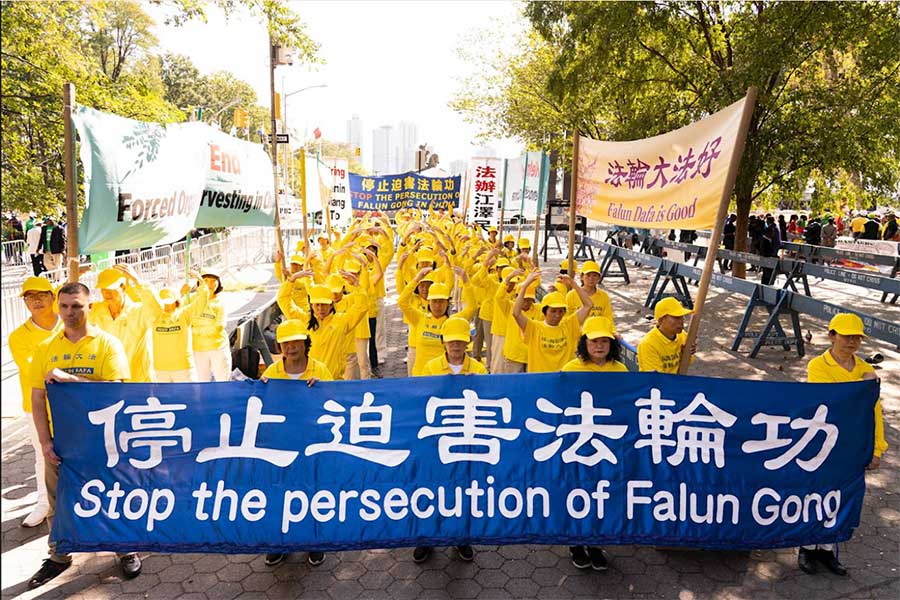
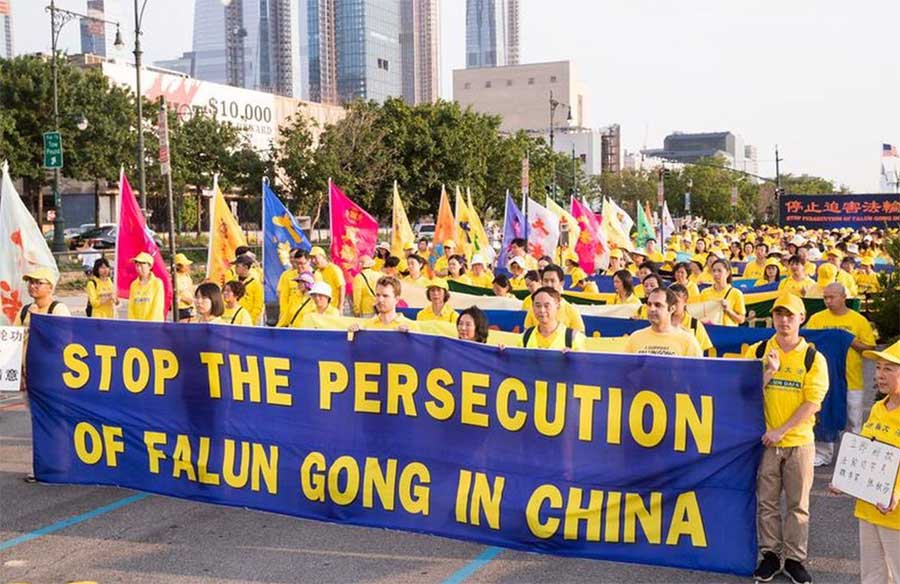
Imagine a dual crisis strikes: the real estate bubble bursts, youth unemployment can no longer be hidden, and the people’s faith in the government’s promises is completely exhausted. Then, internal power struggles will intensify. There will be no armed uprising, but there will be simmering protest movements that spread, which the regime cannot suppress. It will stem from a prolonged economic recession, from a loss of faith even within the ranks of mid-level cadres, who no longer see a future in the system. Or it could be triggered by a ‘political accident,’ such as a major scandal being leaked, or the covert spread of religious or moral movements, like Falun Gong, Christianity, or the revival of Confucianism.
In this scenario, the regime will be forced to restructure deeply, perhaps by changing leadership, or sharing power. China will no longer be a centralized authoritarian model. It will transform into a multi-centered system of power, perhaps like Taiwan in the post-Chiang Kai-shek era. A beginning for cultural reconciliation, with slower but more sustainable growth.
(He paused, his gaze distant, as if looking toward a future he most hoped for.)
And the final scenario, the least likely, with only about a 10% probability, but it is slowly increasing.
And this is also the scenario I hope for the most.
I call it “Moral Renaissance – A New China.”
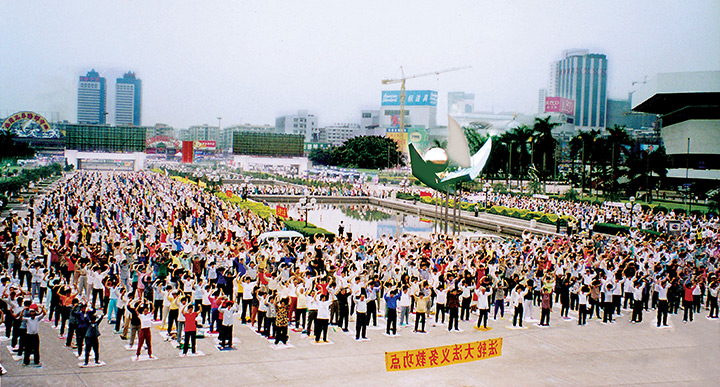
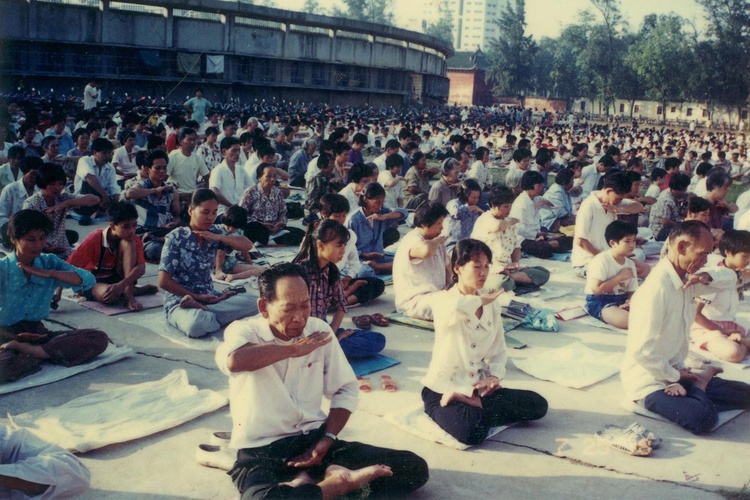
This is a great awakening, which usually only happens after a cataclysmic event, perhaps a natural disaster, a war, or a complete economic collapse. A shock strong enough to make the entire society stop and return to their ancient values: Truthfulness-Compassion-Forbearance, morality, and self-awareness.
It requires almost miraculous conditions: the emergence of a leader with spiritual stature, a “21st-century Enlightened Ruler” not assimilated by power; the quiet spread of spiritual cultivation, forgiveness, and inner transformation among the masses; and a state where the people have completely lost faith in politics, but they do not choose violence, but the path of ‘spiritual reflection.’
Then, the political regime may still exist in form, but it will be operated by a moral rule of law, not just by force.
The result will be a new China. Still a superpower, but a superpower with a soul. A nation admired by the world, not for its money, but for its Tao.
(He looked directly at me, his voice firm as a conclusion.)
So what is the undercurrent flowing beneath all these scenarios?
China will not collapse because of its economy.
They will only collapse if they continue to build their glory on the suffering of the silenced.
And if they dare to face the truth about their past—from Tiananmen, to Falun Gong, to Xinjiang and Tibet—then they will not need to expand outward, and they will still become the keeper of the cultural roots for the entire East.
Would you like me to analyze the third scenario, the Moral Renaissance, in more detail?
Julian Lee:
Yes, I very much like the third scenario. It is good for the Chinese people in particular and for all of humanity in general.
But that scenario… will it unfold with a specific roadmap or event?
The Former President:
(He nodded, his eyes shining with a distant hope.)
I believe so too.
The third scenario is the only hope for a great civilization like China not only to survive, but to become a light for humanity.
But like all “miracles” in history, it does not come naturally.
It only comes when suffering has hit rock bottom, and when the spiritual essence of the nation is awakened at the right time, by the right people, and in the right place.
So let us look at a possible roadmap, and the events that could trigger that “moral renaissance scenario.”
This is a psychological and social progression, not just a political one.
The first stage, which could take place from now until around 2030, is a crisis of faith hitting rock bottom.
The people will completely lose faith in the “Chinese Dream” painted by the government. The economy will experience negative or prolonged stagnant growth, the real estate bubble will collapse, the population will age, and unemployment will become an undeniable problem. Repression will continue, but it will no longer be effective ideologically. The people will not rebel, but they will also no longer be afraid. It will be a period where people have “nothing left to lose,” no longer fearing the government, nor the future.
(He paused, as if to let me imagine that emptiness.)
Next, is the stage of a silent spiritual movement rising, possibly from 2030 to 2035.
Falun Gong, primordial Taoism, true Buddhism, or a new form of faith without a church organization, will begin to spread in society. Cultivation groups will not be political, but will gather around self-improvement, preserving morality, and transforming their destinies. Many low-level officials and intellectuals will begin to “quit the Party in their hearts,” even if they remain silent on the surface. The core of this stage is “turning the heart back,” not “resistance.” People will not fight the system, but will seek to “escape from it from within.”
And then, there will be a major event, a shock that awakens the entire population. This is an almost unavoidable variable, which could occur between 2035 and 2040.
It could be a new large-scale health crisis, whose covered-up origins enrage the public in a conscious way.
Or a serious natural disaster, like an earthquake or flood, that makes people believe it is “retribution,” that “Heaven is displeased.”
Or a leak of information or a betrayal from within, revealing genocidal crimes like forced organ harvesting, concentration camps, or strategic lies that have lasted for decades.
Or even, an influential figure within the government will “awaken” and publicly repent.
(His voice grew more solemn.)
Then, we will enter the final stage: the keepers of the Tao step into the light.
At this time, moral principles will be listened to more than resolutions.
The people will not need anyone to carry a banner. They will follow those with true virtue.
One or a few true spiritual practitioners, with no title, no organization, will lead society by their own actions, not by slogans. Moral communities will be re-established, and private schools teaching Benevolence, Righteousness, Propriety, Wisdom, and Faith will rise.
The government will no longer be able to suppress them, as the people’s faith will have transformed into a powerful “social field.”
And then, a mandatory choice will occur.
Either the government must reform itself according to the people.
Or it will disintegrate on its own, and be replaced by a natural moral order.
(He looked at me, his eyes as if seeing these signs in the present.)
What are the signs that this roadmap is beginning?
It’s when people start caring more about “cultivating the heart” than “cultivating talent.”
When spontaneous models of moral living spread, even within the government environment.
When many low-level officials begin to secretly help the people, not following the Party’s directives.
When books, films, and teachings about Kindness, Forbearance, Virtue, and the Tao begin to regain vitality, despite being censored.
And when someone appears, with no title, making no calls, just living righteously in silence, yet possessing an extraordinary appeal.
(He concluded with a hopeful smile.)
And if that happens…
China will not need to invade anyone, nor fight for superpower status.
The whole world will turn to learn from them, as they did in the time of Confucius, Lao Tzu, and the Buddha.
Then, you will see.
America has technology.
Europe has the rule of law.
But China, will have the Tao.
Julian Lee:
Yes, that scenario is very appealing, but it also seems like it would be a long story.
Let’s set aside the topic of China for now.
I’d like to ask a little more about developing countries that have relations with both China and the U.S., for example, Vietnam or Taiwan.
When China “has a situation,” how will that affect these countries?
And what is America’s stance towards them?
The Former President:
(He nodded in agreement.)
Your question is very discerning, and highly strategic.
Because truly, the future of countries “caught in the middle” like Vietnam, Taiwan, the Philippines, or Thailand, will not just depend on themselves.
They will also be swept up in the “China quake” if it happens.
The closer you are to the dragon, the more likely you are to be swept by its tail.
And the more likely you are to become a “sacrificial pawn” on the chessboard of the big players, if you lack strategic fortitude.
Look at Vietnam.
They are at a dangerous intersection of three dimensions: China, the U.S., and themselves.
When China has a situation, whether it’s an economic collapse or internal strife, the impact on Vietnam will be immense. Economically, Vietnam is currently “semi-dependent” on China for raw materials and supply chains. If China’s economy fails, Vietnam’s manufacturing sector will have its “backbone broken” in the short term. Socially, a wave of Chinese labor could cross the border, bringing instability. And in the South China Sea, when there is domestic instability, China tends to become more aggressive offshore to “divert the fire outward.” Vietnam could become a place for Beijing to “flex its muscles.”
So what is America’s stance on Vietnam?
We see Vietnam as a “discreet strategic partner.”
An important pillar to “anchor” the Southeast Asian region.
But we do not expect Vietnam to become a “political colony” like the Philippines. Washington respects Hanoi’s independence, because we know that Vietnam will never fully take a side, but will always play the “bamboo diplomacy” strategy, flexible but knowing when to bend.
Within the U.S. government, Vietnam is often assessed as a “disobedient but necessary partner, and reliable if not coerced.”
(He paused for a moment, then shifted direction.)
As for Taiwan, their position is even more sensitive.
They are the heart of Asia, and the potential flashpoint of a new world war.
If China has a situation, Taiwan will face extreme scenarios.
First, hardliners in Beijing, in a moment of collapsing power, might launch a “quick strike” on Taiwan to re-establish their legitimacy.
Second, if China falls into prolonged chaos, Taiwan will have an opportunity to declare independence legitimately.
And third, Taiwan could be “set up” by Washington into a premature confrontation if we push them too hard down an anti-China path.
America’s stance on Taiwan is one of “strategic ambiguity.”
We will never abandon them, but we will not fully commit to defending them with all our might.
Taiwan is a deterrent card, not quite a “blood brother” like Japan or the UK.
And if forced to choose between a world war and abandoning Taiwan, Washington will choose the less bloody option.
(He looked at me, as if to summarize the issue.)
In short, when China has a situation, neighboring countries will be pulled into a state where they “can no longer stand aside.”
And each nation will face different risks and have a different position in America’s calculations.
Vietnam is a “silent strategic partner.”
Taiwan is both a “symbol of democracy” and an “important chess piece.”
The Philippines is an “official military ally,” but very susceptible to being drawn in and causing internal division.
And Thailand is always caught in an increasingly polarized ASEAN, making them a “semi-reliable partner.”
If you wish, we can discuss Vietnam’s role in more depth.
And whether there is a path for them to “escape China” without falling under American control.
This article is an excerpt from the book “AFTER POWER: THE LEGACY” – which includes the complete exclusive interview by journalist Julian Lee with a former US President.
If you wish to experience the full journey of thought and the unpublished insights of the work, please click the button below to own the complete book.
To explore more works from THE LIVES MEDIA, visit our book collection.