The following article is the full text of Chapter 1, excerpted from the book “THE UNIVERSE BEYOND THE BIG BANG”.
This chapter serves as the premise for the entire work, focusing on examining the limitations of empirical science when confronting the question of the universe’s origin. It is a critical perspective, essential for anyone interested in the intersection of physics, philosophy, and consciousness. We invite our readers to follow along.
* * *
Author: Aiden Lee, Founder of THE LIVES MEDIA
Chapter 1: THE GREAT QUESTION ON THE FRINGES OF SCIENCE – THE NET AND THE SILENCE OF THE OCEAN
1. The Theory’s Breaking Point
The story of the Big Bang is built upon an undeniable observation: the universe is expanding. Galaxies are hurtling away from each other like fragments from a primordial explosion. From this fact, scientists did something very logical: they “rewound the film.” If everything is moving apart, then in the past, they must have been closer together. The further back in time we go, the more the universe shrinks, becoming hotter and denser.
Let’s keep rewinding that film. Back one million years, one billion years, then thirteen billion years. Eventually, the film will lead us to a starting point, a single frame before everything began. Physicists call that point a “singularity.” It is a concept that overwhelms the human mind: all the matter, energy, space, and even time of our universe, compressed into a single point—a point with no dimensions and infinite heat.
And it is right here that the grand story of science abruptly stops.
Because at the singularity, all the laws of physics that we know—from Einstein’s theory of relativity to quantum mechanics—collapse. The equations that once described the universe with perfection suddenly become meaningless. They cannot calculate, cannot predict, and cannot provide any answers whatsoever. Everything becomes indeterminate.
When we ask, “What came before the Big Bang?” we are actually asking about something outside the film. But to physics, there is no “before” when time itself had not yet been born from the explosion. Time and space are part of the universe; they were created along with the Big Bang, they did not exist before it. Therefore, according to the logic of this model, the question “before the Big Bang” is a meaningless one, like asking “what is north of the North Pole?”
This is not an evasion. It is a profound and honest confession from science. It is telling us: “My tools, the laws of physics and mathematics, are only valid from the moment 0.000…1 seconds after the explosion and onward. What happened at time zero, or before time zero, lies beyond the scope of my understanding. My map begins here.”
The place where the laws of physics fall silent is not a barrier, but a threshold. It shows that there is a foundational reality that our space-time-based theories cannot reach. It does not deny the existence of a primary cause; it only admits that this cause is beyond the reach of our current tools.
And it is precisely where the map ends that our journey truly begins.
2. The Extended Senses
From the dawn of time, humans have always yearned to transcend their own limits. We have no wings, so we built airplanes. We cannot swim in the deep sea, so we built submarines. And because our naked eyes cannot see through the cosmos, we have built greater eyes.
When Galileo first aimed his crude telescope at the sky, he did something revolutionary: he “extended” humanity’s vision. Optical telescopes help us see farther. Microscopes help us look deeper into the microworld. Every great invention in observational science is, in essence, an amplification, an extension of our five existing senses.
The giant radio telescope at Arecibo was not an eye; it was a pair of giant ears, listening to the radio-wave whispers of the early universe. The LIGO gravitational wave detector neither sees nor hears; it “feels” the minuscule vibrations of spacetime itself, like a hypersensitive finger touching the surface of rippling water.

We have created extraordinary instruments, but they still operate on the same fundamental principle: they receive a physical signal from the environment and convert it into information that one of our five senses can process. And this is the crucial point that is often overlooked.
A radio telescope does not “see” a nebula or a quasar. It only records dry data streams about the intensity of radio waves coming from a certain direction. That raw data, by itself, is meaningless to us. It must go through a step called “translation.” Scientists use computers to assign different colors to different energy levels and frequencies. Red for low-energy regions, blue for high-energy regions, for example. The brilliant, magnificent cosmic images we admire in science magazines are not what the human eye would see if we flew there. They are color maps, interpretations, translations from the language of radio waves into the language of sight.
Raw data is always a foreign language. Radio waves, X-rays, gamma rays… they have no color, no sound. They are merely oscillations of the electromagnetic field. We, as creatures who evolved to perceive an extremely narrow spectrum of light, have had to “invent” ways to visualize them. We have colored the invisible to understand it.
This does not diminish the value of those images. On the contrary, it is a testament to human creativity. But it also reveals a profound truth about our limitations. No matter how sophisticated our tools become, we are still bound to the world of the five senses. All data, all information about the universe outside, must ultimately be converted into something we can see, hear, touch, taste, or smell. We are like a person who knows only one language, and every book in the world, no matter what language it is written in, must eventually be translated into his native tongue.
Our instruments are brilliantly designed to explore the material world—the world of particles, waves, and interacting forces. They are perfect tools for that purpose. But the question arises: If there is a reality that exists beyond that material world, a reality that does not emit radio waves, reflect light, or create physical vibrations, how could we possibly know of it?
We are like a person born colorblind, trying to understand the concept of “red.” He can build a machine that accurately measures the wavelength of red light. He can know everything about the physics of red. But he can never experience it.
Could it be that, when faced with great questions like “What came before the Big Bang?”, humanity is in a similar situation? Could it be that we are trying to use a ruler to measure an emotion, a scale to weigh a thought?
Perhaps the silence we receive from the universe before the moment of the Big Bang is not because there was nothing there. It is because the reality there is “speaking” a language that all of our extended senses were not designed to hear.
3. Names for the “Blind Spot”
In science, one of the bravest things to do is to admit, “I don’t know.” But in reality, human instinct is to name everything, even our own lack of understanding. When our instruments point out to the cosmos and fail to receive the expected signal, we don’t call it “the blind spot of our observational method.” Instead, we give it names that sound very scientific and mysterious.
Consider one of the greatest mysteries of modern cosmology: Dark Matter. The story began when astronomers observed spiral galaxies. Based on the amount of visible matter (stars, gas, dust), they calculated that stars on the outer edges should be rotating much more slowly than stars near the center, otherwise they would be flung out of the galaxy. But the reality was shocking: they were rotating at an absurdly fast speed, almost as if some invisible force was holding them in.
The gravitational theories of Newton and Einstein, which had been proven correct in countless other cases, seemed to fail on the galactic scale. Faced with this contradiction, the scientific community had two choices: one, to admit that perhaps our theory of gravity is incomplete; or two, to assume that there must be something there that we cannot see.
They chose the second option. They named this invisible substance “Dark Matter”—a strange type of matter that does not emit light, reflect light, or interact with any kind of electromagnetic radiation. It is completely “invisible” to all our telescopes. Its existence is only inferred indirectly through the gravitational effect it exerts on ordinary matter. According to current calculations, this mysterious matter accounts for up to 85% of the total mass of matter in the universe. That means everything we can see—every star, galaxy, and planet—is just the tiny visible tip of a colossal, submerged iceberg.
A similar story happened with Dark Energy. When scientists discovered that the expansion of the universe was not slowing down but was, in fact, accelerating, they faced another perplexing puzzle. There had to be some kind of energy acting as an “anti-gravity,” pushing everything apart. Once again, instead of questioning the current cosmological model, they named this mysterious repulsive force “Dark Energy.”
And of course, there is the Black Hole. It is a region of spacetime where gravity is so strong that nothing, not even light, can escape. By definition, we cannot directly observe a Black Hole. We can only infer its existence by observing its effect on surrounding stars and matter. It is a name for a dark region, a point from which no information can return to us.
Dark Matter, Dark Energy, Black Hole. These names create the impression that we have identified specific entities. But if we take a step back and look at the nature of the problem, we see a common denominator. All three are names given to “effects” that we observe but cannot explain with what we can “see.”
“Dark” in physics essentially means “we don’t understand.”
Could it be that “Dark Matter” is not a new particle, but just a name for the shortcomings in our understanding of gravity or the dynamics of the universe? Could it be that “Dark Energy” is not a mysterious energy, but simply a manifestation of large-scale laws that we have yet to discover? And could it be that the “Black Hole,” with its image of an infinite collapse of matter, is just a hasty conclusion of a theory pushed to its limits, while the true nature of the phenomenon is a state of matter or a dynamic structure we have never imagined?
When our net catches nothing, there are two possibilities: either there is truly nothing there, or something has slipped through the mesh. Modern science, with its faith in the completeness of its material net, tends to conclude that there must be a special kind of “invisible fish.” But perhaps, we are simply trying to catch a stream of water with a fishing net.
4. The Parable of “The Net and the Fish”
There is an old parable about a marine biologist who dedicated his entire life to studying life in the ocean. He used only one type of net, with a fixed mesh size. After decades of collecting specimens, from giant tunas to small schools of herring, he confidently announced one of the fundamental laws of oceanography. In his life’s work, he wrote: “After a comprehensive survey of the Earth’s seas, I can conclude with certainty that no sea creature smaller than 5 centimeters exists.”
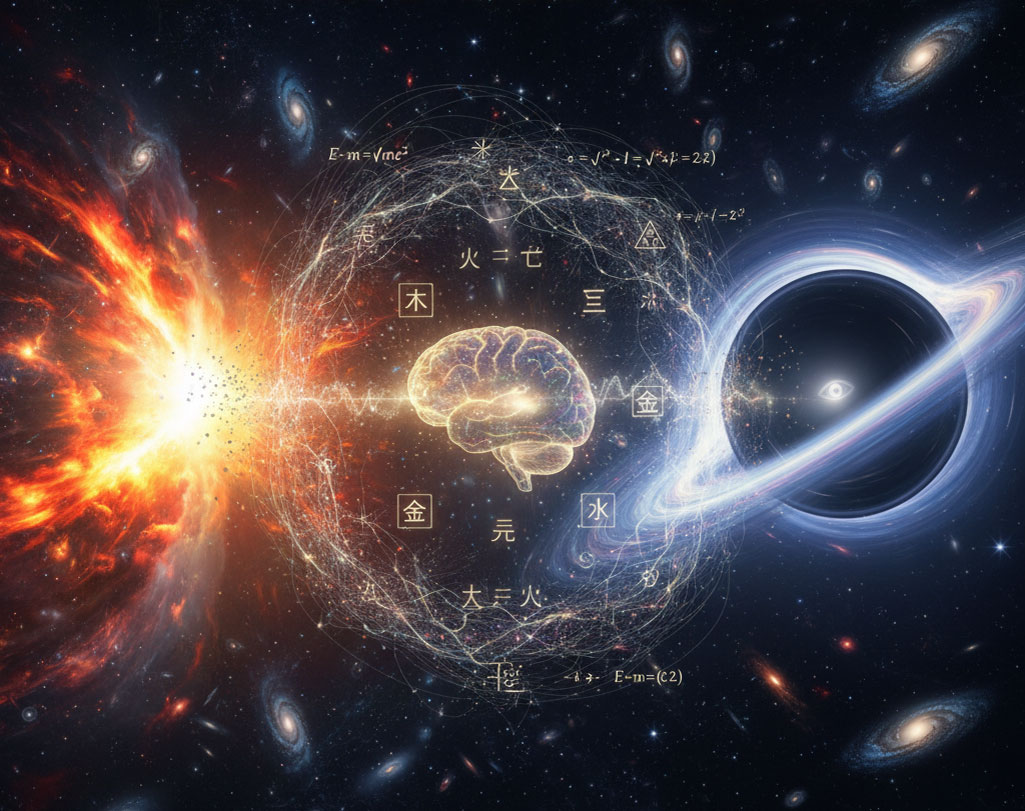
Was his conclusion wrong? Based on his methods and the data he collected, it was perfectly correct. All the “evidence” he had supported his theory. He had never caught a fish smaller than 5 centimeters. To him, they did not exist.
This parable is a perfect reflection of the methodology of modern science. Our “net” is the entire system of physical instruments and laws based on material observation. The “fish” we catch are the measurable phenomena: particles, waves, forces. And from those “fish,” we have built an incredibly successful model of the universe.
But just like that marine biologist, we have made a subtle logical fallacy. We have confused “what our net catches” with “all that exists in the ocean.” We conclude that because our instruments do not detect anything “non-material,” things like consciousness, the soul, or other realms are merely products of the imagination. We assume that because we cannot measure anything before the Big Bang, the question itself is meaningless.
We have forgotten that a method can only find what it is designed to find. A thermometer is designed to measure temperature; it will never measure weight. A telescope is designed to collect light; it will never capture a thought.
Science is not wrong when it says: “Within the observational range of our physical instruments, we find no evidence for the existence of a non-material reality.” That is an honest and accurate statement. But it becomes a dogma when it is interpreted as: “Therefore, non-material reality does not exist.”
That is the moment science ceases to be a journey of discovery and becomes a belief system. It has imprisoned itself within what its net can catch and declared that the entire ocean consists of only that.
But the ocean of reality is far vaster. It is teeming with plankton, bacteria, and microscopic life forms that our coarse net has missed. Perhaps, consciousness is not a big “fish” we have yet to catch. Perhaps, it is the water itself—the medium in which all the material “fish” are swimming. And no net can catch the ocean.
5. The Glider Pilot Who Dreamed of Flying to the Moon
So where are we after this journey of re-examining these limits? We have a science that has reached the pinnacle of sophistication in its field. It is like a master glider pilot, an artist of the wind currents. He has spent his life understanding the invisible thermals rising from the earth, learning to dance with the winds that blow over the mountainsides. With his fragile silk wings, he can soar for hours, conquering the highest peaks from the air, seeing the world below him like a living map. In the world of Earth’s atmosphere, he is a king.
But then one day, while gliding over a high peak, he looks up at the deep blue sky, sees the faint moon visible even in the daytime, and he yearns to touch it.
With all his confidence and skill, he begins to plan. He believes that all he needs is a better glider and a stronger wind. He builds a pair of wings from ultralight materials, with perfect aerodynamics. He studies the weather, waiting for the strongest wind in history, hoping that if he catches just the right updraft, he can fly higher, and higher still, until he escapes the atmosphere and drifts to the Moon.
We all know this effort is doomed to fail. The problem is not the pilot’s talent, nor the quality of the glider. The problem is that he is using the wrong tool and the wrong method for a goal that lies completely outside their scope. To escape Earth’s gravity and fly in a vacuum, he does not need a better glider. He needs something entirely different: a spaceship with a rocket engine.
Modern science, when trying to answer fundamental questions about consciousness, about the origin of the universe from nothingness, about the meaning of existence, is like that brilliant pilot. It has mastered the “atmosphere” of the material world. It has used laws and equations to “glide” spectacularly through the visible realm. But when faced with the Moon—a reality of a completely different nature—it is still trying to build a better “glider.”
It has pushed its physical equations to the point of singularity, hoping to find an answer. It has built larger and larger particle detectors, hoping to find the “particle of consciousness.” It has tried its best, but it is still gliding in the same atmosphere, still limited by the same gravitational pull of a materialistic worldview.
This does not mean we should abandon our aspiration to reach the Moon. It only means we need to recognize the limits of the glider, no matter how beautiful and efficient it may be. We need to start searching for a new set of tools, a new approach.
If the universe is not just matter, if reality is deeper than what the five senses can perceive, then perhaps the “spaceship” we need is not a physical machine built externally. Perhaps it is an instrument of perception already available within each of us, just waiting to be discovered.
Our next journey in this book is the journey to find the blueprint for that spaceship.
* * *
This article is an excerpt from the book “The Universe Beyond the Big Bang” – a journey to explore the origin and profound meaning of the cosmos.
- Continue reading other chapters from the same work:
- Chapter 1: THE GREAT QUESTION ON THE FRINGES OF SCIENCE – THE NET AND THE SILENCE OF THE OCEAN
- Chapter 2: CONSCIOUSNESS AND MATTER – A TWO-WAY RELATIONSHIP
- Chapter 3: THE IMPLICATE ORDER AND THE QUANTUM UNIVERSE
- Chapter 4: THE MAP OF STRUCTURE – THE PERIODIC TABLE OF ELEMENTS
- Chapter 5: THE MAP OF FLOW – THE FIVE ELEMENTS AND ENERGY
- Chapter 6: THE MAP OF TRANSFORMATION – THE WORLDVIEW OF SPIRITUAL CULTIVATION
- Chapter 7: THE MULTIDIMENSIONAL MAP – FROM STRING THEORY TO THE BERMUDA TRIANGLE
- Chapter 8: THE REALMS OF EXISTENCE
- Chapter 9: DREAMS – GATEWAYS TO OTHER REALITIES
- Chapter 10: INSPIRATION – ECHOES FROM OTHER REALITIES
- Chapter 11: SPIRIT POSSESSION – WHEN CONSCIOUSNESSES FIGHT FOR THE SAME BODY
- Chapter 12: SUPERNORMAL ABILITIES – WHEN CONSCIOUSNESS BENDS THE LAWS OF PHYSICS
- Chapter 13: EXTRATERRESTRIAL LIFE: A MULTIDIMENSIONAL PERSPECTIVE
- Chapter 14: THE BIG BANG – A BUBBLE BURSTING ON THE OCEAN?!
- Chapter 15: THE GALAXY – A LIVING CIRCUIT OF THE UNIVERSE
- Chapter 16: BLACK HOLES, DARK MATTER, AND DARK ENERGY – A REINTERPRETATION
- Chapter 17: FRACTAL ARCHITECTURE – FROM THE MICROCOSM TO THE MACROCOSM
- Chapter 18: TRANSCENDING THE BOUNDARY OF OBSERVATION
- Chapter 19: THE UNIVERSE IS A MIRROR – WHAT IS YOUR MEANING?
If you wish to experience the full journey of thought and the unpublished insights of the work, please click the button below to own the complete book.
To explore more works from THE LIVES MEDIA, visit our book collection.