1. The Worldview of the Mechanic
In the endless journey to understand the universe, humanity has developed one of its most effective methods: disassembly. Like a curious child taking apart a watch to see what’s inside, or a diligent mechanic disassembling a machine piece by piece to understand how it works, we have approached reality with a profound belief: to understand the whole, one must first understand the parts that constitute it.
This is the worldview of an analyst, a mechanic of the universe. It sees everything around us—from a stone, a river, to a distant star—as complex machines assembled from basic “bricks.” The task of the intellect is to find the smallest, most fundamental bricks, understand their properties, and from there, deduce the operating principles of the entire structure.
After centuries of searching, we have found those “bricks.” We call them the chemical elements, and the great map that describes them is the Periodic Table of Elements. This is one of humanity’s most brilliant intellectual achievements. It is not just a list, but a system of profound order, revealing the relationships between carbon, oxygen, iron, gold… the components that make up every material thing we can touch.
With this map in hand, we have become master mechanics. We have learned how to combine these “bricks” at will to create new materials: from plastics and stainless steel to the silicon for computer chips. We understand the chemical reactions that allow us to create medicines, fertilizers, and energy. This map of structure is the foundation of the entire industrial revolution and technological revolution that have shaped the modern world. Its power is undeniable. It has given us the ability to analyze, control, and recreate the physical world in a way unprecedented in history.
2. The Question the Map Answers
Every map is created for a purpose, to answer a specific type of question. A traffic map tells you how to get from point A to point B. A cadastral map tells you the boundaries of a piece of land. So, what question was this map of structure, the Periodic Table of Elements, created to answer?
It answers a very basic and powerful question: “What is this thing made of?”
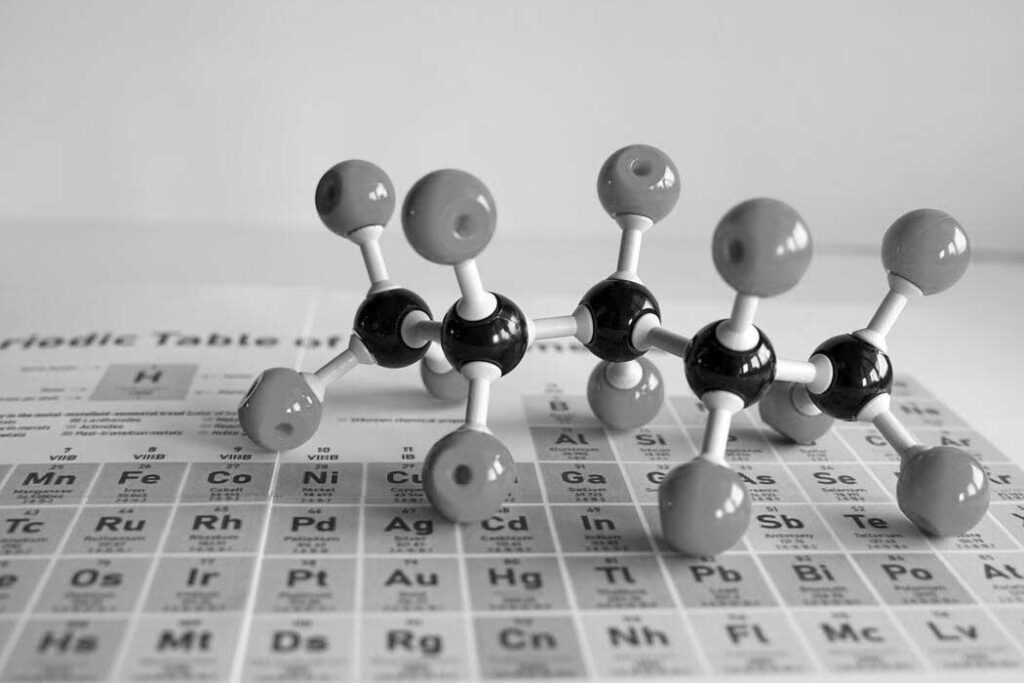
When looking at a glass of water, this map gives us a precise answer: it is composed of H₂O molecules, which is a combination of two hydrogen atoms and one oxygen atom. When looking at a gold ring, it tells us it is a collection of gold (Au) atoms. When analyzing the air we breathe, it tells us it is a mixture primarily of nitrogen (N₂) and oxygen (O₂).
This way of thinking has permeated every aspect of our lives. When a person is sick, a doctor analyzes their blood to see if there are any abnormalities in its chemical components. When a building collapses, an engineer analyzes the materials to see if there was a problem with its structure. The answer always lies in the components, the parts, the constituent “bricks.”
This is an incredibly useful lens. It allows us to see through the apparent surface of things to the microscopic structure within. It transforms the world from a mysterious place full of elusive qualities into a system that can be analyzed and predicted. In the world of this map, nothing is a mystery once we know its chemical formula. Its power lies in its clarity, precision, and practical applicability. It has helped us build sturdy bridges, launch ships into space, and cure countless diseases. It is a great legacy.
3. When the Map is No Longer the Territory
However, for all its power, this map of structure also has its borders, territories that it cannot fully describe. It is extremely effective at disassembling a machine, but it struggles when trying to explain a living organism.
Think about a cake. This map can give you a precise list of its ingredients: 200g of flour, 150g of sugar, 3 eggs, 50g of butter… But does that list capture the essence of the cake? It cannot describe the rich aroma wafting from the oven, the joy of the baker, or the warm feeling of sharing the cake with loved ones. It describes the parts but misses the vibrancy of the whole.
This limitation becomes even clearer when we look at ourselves. We often hear that the human body is about 70% water. That is a fact when viewed from the map of molecules. But if we “disassemble” further, not looking at the molecules but at the elemental “bricks” that form them, we discover another surprising fact. Because a water molecule (H₂O) is composed of one oxygen atom, which is much heavier than two hydrogen atoms, the majority of water’s mass is actually oxygen. Therefore, by mass, our bodies are up to 65% oxygen, 18.5% carbon, 9.5% hydrogen, and small amounts of other elements.
But whether it’s the molecular or elemental formula, the question remains: Are those formulas “you”? Do they explain love, courage, creativity, sorrow, or your own sense of existence? This map perfectly describes the “corpse,” but is completely silent about the “soul.”
The map of structure is excellent at answering the question “What?”, but it often struggles with the questions “How?” and “Why?”. It can analyze the notes in a symphony, but it cannot explain why that melody moves us. It can describe the chemical reactions in the brain, but it cannot explain the nature of a thought. It is good with static systems, but it grapples with dynamic systems, energy flows, and the complex interactive relationships that constitute life.
And this is where we must remember a fundamental principle of cognition, articulated by the philosopher Alfred Korzybski: “The map is not the territory.”
The Periodic Table of Elements is a wonderful map, one of the most useful maps humanity has ever created. But it is only a map, a description, a lens through which to view reality. It is not reality itself. Confusing the map with the territory is the most subtle fallacy of materialistic thinking—believing that because everything can be described by its material components, it is nothing but its material components.
Realizing this is not to diminish the value of the structural map. On the contrary, it is to put that map in its proper place. It is an indispensable tool, but it is not the only tool. To understand the vast territory of reality, especially its vibrant and energetic aspects, we need other maps, drawn from entirely different perspectives.
This article is an excerpt from the book “The Universe Beyond the Big Bang” – a journey to explore the origin and profound meaning of the cosmos.
- Continue reading other chapters from the same work:
- Chapter 1: THE GREAT QUESTION ON THE FRINGES OF SCIENCE – THE NET AND THE SILENCE OF THE OCEAN
- Chapter 2: CONSCIOUSNESS AND MATTER – A TWO-WAY RELATIONSHIP
- Chapter 3: THE IMPLICATE ORDER AND THE QUANTUM UNIVERSE
- Chapter 4: THE MAP OF STRUCTURE – THE PERIODIC TABLE OF ELEMENTS
- Chapter 5: THE MAP OF FLOW – THE FIVE ELEMENTS AND ENERGY
- Chapter 6: THE MAP OF TRANSFORMATION – THE WORLDVIEW OF SPIRITUAL CULTIVATION
- Chapter 7: THE MULTIDIMENSIONAL MAP – FROM STRING THEORY TO THE BERMUDA TRIANGLE
- Chapter 8: THE REALMS OF EXISTENCE
- Chapter 9: DREAMS – GATEWAYS TO OTHER REALITIES
- Chapter 10: INSPIRATION – ECHOES FROM OTHER REALITIES
- Chapter 11: SPIRIT POSSESSION – WHEN CONSCIOUSNESSES FIGHT FOR THE SAME BODY
- Chapter 12: SUPERNORMAL ABILITIES – WHEN CONSCIOUSNESS BENDS THE LAWS OF PHYSICS
- Chapter 13: EXTRATERRESTRIAL LIFE: A MULTIDIMENSIONAL PERSPECTIVE
- Chapter 14: THE BIG BANG – A BUBBLE BURSTING ON THE OCEAN?!
- Chapter 15: THE GALAXY – A LIVING CIRCUIT OF THE UNIVERSE
- Chapter 16: BLACK HOLES, DARK MATTER, AND DARK ENERGY – A REINTERPRETATION
- Chapter 17: FRACTAL ARCHITECTURE – FROM THE MICROCOSM TO THE MACROCOSM
- Chapter 18: TRANSCENDING THE BOUNDARY OF OBSERVATION
- Chapter 19: THE UNIVERSE IS A MIRROR – WHAT IS YOUR MEANING?
If you wish to experience the full journey of thought and the unpublished insights of the work, please click the button below to own the complete book.
To explore more works from THE LIVES MEDIA, visit our book collection.