1. The Worldview of the Conductor
If the map of the Periodic Table belongs to the mechanic, who sees the world as a machine assembled from parts, then there is another map drawn from a completely different perspective. This is the worldview of a strategist, a farmer, or a conductor. They are not overly concerned with the “material” of each individual part. Instead, they look at the interaction, the movement, and the dynamic balance of the entire system.
For the conductor, what matters is not what kind of wood the violin is made of, but how its sound blends with the flute and the drums to create a symphony. For the farmer, what matters is not just the seed, but the harmony between the soil, water, light, and weather to produce a bountiful harvest.
This worldview does not see things as static entities, but as processes, as phases of energy in motion. It does not ask “What is this?” but rather “What is this doing? How is it interacting with other things?”
The most ancient and quintessential map for this worldview comes from Eastern wisdom: the Five Elements (Wu Xing).
To many modern people, the Five Elements are often misunderstood as a primitive material system, a less developed version of the Periodic Table, suggesting that the world is made of five “substances”: Metal, Wood, Water, Fire, and Earth. But this is a misinterpretation that stems from imposing the mechanic’s lens onto a completely different map.
To truly understand the Five Elements, we must take off our “structural” glasses and put on our “functional” ones. Then, we will see that the Five Elements do not describe five “substances,” but rather five “states,” five fundamental “phases of movement” of energy in all natural processes.
Wood (木) is not just trees. It is the state of growth, rising, and expansion. Like a sprout breaking through the earth in spring, it represents upward energy, beginnings, and expansion.
Fire (火) is not just flame. It is the state of radiation, expansion, and reaching a peak. Like the brilliant sunshine of summer, it represents outward energy, passion, and powerful transformation.
Earth (土) is not just soil. It is the state of stability, nourishment, and gathering. Like mother earth receiving all things and allowing fruit to ripen in late summer, it represents central energy, balance, and transition.
Metal (金) is not just metal. It is the state of condensation, contraction, and consolidation. Like the frost of autumn and metal forged in a furnace, it represents inward energy, sharpness, structure, and the end of a cycle.
Water (水) is not just water. It is the state of flow, latency, and sinking. Like water flowing to the lowest point and a seed lying dormant through winter, it represents downward energy, stillness, deep wisdom, and the accumulation for a new beginning.
These five states do not exist in isolation. They continuously generate and control each other in a dynamic dance of balance called “Mutual Generation and Mutual Control.”
The Generation Cycle is the cycle of nurturing and promoting:
- Water generates Wood (water nourishes trees)
- Wood generates Fire (wood burns to create fire)
- Fire generates Earth (fire burns things to ash, returning them to the earth)
- Earth generates Metal (the earth produces metals and minerals)
- Metal generates Water (metal, when melted, becomes liquid, or metal can condense water vapor)
Alongside this, the Control Cycle is the cycle of checking and restraining, ensuring no single Element becomes excessive:
- Water controls Fire (water extinguishes fire)
- Fire controls Metal (fire melts metal)
- Metal controls Wood (metal cuts wood)
- Wood controls Earth (tree roots penetrate the earth)
- Earth controls Water (earth dams the flow of water)
The combination of Mutual Generation and Mutual Control creates a perfect self-regulating system, a network of reciprocal relationships that helps all things operate in harmony. This is not a physical model, but a model of the dynamics of life.
2. The Question the Map Answers
If the Periodic Table answers the question “What is this thing made of?”, the Five Elements answer a completely different one: “What is the energetic dynamic at play?”
It is not concerned with static components, but with dynamic relationships. This lens is not only applied to nature but is also used to understand the most complex systems, such as the human body and the living environment.
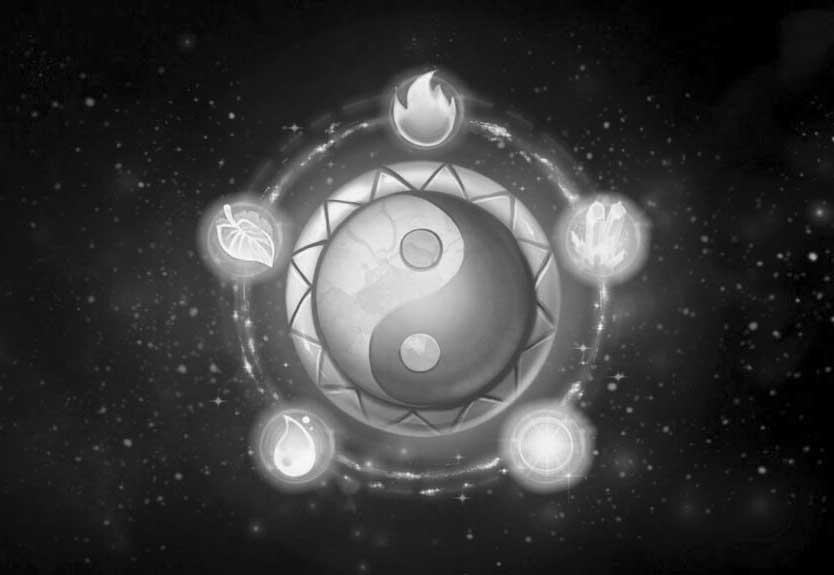
In traditional Eastern medicine, the human body is not seen as a biological machine with separate organs. It is seen as a microcosm, an ecosystem in which the five major organs (Liver, Heart, Spleen, Lungs, Kidneys) correspond to the five Elements (Wood, Fire, Earth, Metal, Water). Health is not the absence of bacteria or viruses, but the balance in the flow of energy (Qi) among the organs.
When a person is ill, a practitioner of this school will not just ask, “Which part is broken?” They will ask, “Where has the balance been disrupted?” For example, if a person is often angry, with red eyes (associated with Liver Wood), and suffers from insomnia and a rapid heartbeat (associated with Heart Fire), they might diagnose it as “Liver Wood is overactive, excessively generating Fire,” meaning the Wood energy is flaring up too strongly, causing the Fire energy to also go out of control. The treatment is not to “fix” the heart, but to “soothe” the liver, helping the Wood energy return to harmony, which will then allow the Fire to balance itself. They are adjusting the “energetic formation,” not replacing “components.”
Similarly, in Feng Shui, a house is not just a physical structure of bricks and mortar. It is a space where the energy flows of the environment (wind, light, water, Earth’s magnetic field…) converge and interact. The goal of Feng Shui is not to decorate beautifully, but to arrange the living space so that the energy flow is harmonious, avoiding stagnation or conflict. They will consider the direction of the wind (Wood), the intensity of sunlight (Fire), the stability of the ground (Earth), the presence of metal objects (Metal), and the location of water sources (Water) to create an environment that best supports the health and prosperity of its inhabitants.
In both fields, the Five Elements serve as a strategic map, helping people to identify energy patterns, predict their development, and intervene skillfully to restore lost balance.
3. Two Maps, One Territory
When placing the two maps—the Periodic Table of Elements and the Five Elements—side by side, many people tend to see them as opposites, one being “scientific” and the other “mystical.” This is a very natural way of looking at it, but it perhaps misses the bigger picture. They are not in conflict. They are simply describing the same territory of reality from two complementary viewpoints.
Let’s return to the metaphor of a soccer match.
The Periodic Table of Elements is like the report of a technical analyst. It gives you detailed information about each player: height, weight, muscle composition, maximum running speed. This information is very precise and useful for understanding individual capabilities.
The Five Elements are like the tactical diagram of a coach. It is not concerned with the striker’s weight, but with how he moves to coordinate with the midfielder, how they create space, and how the entire team formation shifts from defense to attack. It describes the relationships and the flow of the entire game.
A brilliant analyst who doesn’t understand tactics will not see the whole picture. A brilliant coach who knows nothing about the players’ physical condition cannot make the right decisions. Both perspectives are necessary.
Likewise, the Periodic Table describes the structure of matter, while the Five Elements describe the function and dynamics of energy. One is anatomy, the other is physiology. One map gives us the ability to disassemble and reconstruct, while the other gives us the ability to diagnose and heal.
Wisdom does not lie in choosing one and discarding the other. Wisdom lies in knowing when to use which map, and in understanding that both are just tools, lenses that help us perceive a part of the incredibly rich and multidimensional territory of reality. Both are useful, but both have their limits. And to go beyond the limits of both structure and energy flow in this realm, we need a third map, a map of transformation.
This article is an excerpt from the book “The Universe Beyond the Big Bang” – a journey to explore the origin and profound meaning of the cosmos.
- Continue reading other chapters from the same work:
- Chapter 1: THE GREAT QUESTION ON THE FRINGES OF SCIENCE – THE NET AND THE SILENCE OF THE OCEAN
- Chapter 2: CONSCIOUSNESS AND MATTER – A TWO-WAY RELATIONSHIP
- Chapter 3: THE IMPLICATE ORDER AND THE QUANTUM UNIVERSE
- Chapter 4: THE MAP OF STRUCTURE – THE PERIODIC TABLE OF ELEMENTS
- Chapter 5: THE MAP OF FLOW – THE FIVE ELEMENTS AND ENERGY
- Chapter 6: THE MAP OF TRANSFORMATION – THE WORLDVIEW OF SPIRITUAL CULTIVATION
- Chapter 7: THE MULTIDIMENSIONAL MAP – FROM STRING THEORY TO THE BERMUDA TRIANGLE
- Chapter 8: THE REALMS OF EXISTENCE
- Chapter 9: DREAMS – GATEWAYS TO OTHER REALITIES
- Chapter 10: INSPIRATION – ECHOES FROM OTHER REALITIES
- Chapter 11: SPIRIT POSSESSION – WHEN CONSCIOUSNESSES FIGHT FOR THE SAME BODY
- Chapter 12: SUPERNORMAL ABILITIES – WHEN CONSCIOUSNESS BENDS THE LAWS OF PHYSICS
- Chapter 13: EXTRATERRESTRIAL LIFE: A MULTIDIMENSIONAL PERSPECTIVE
- Chapter 14: THE BIG BANG – A BUBBLE BURSTING ON THE OCEAN?!
- Chapter 15: THE GALAXY – A LIVING CIRCUIT OF THE UNIVERSE
- Chapter 16: BLACK HOLES, DARK MATTER, AND DARK ENERGY – A REINTERPRETATION
- Chapter 17: FRACTAL ARCHITECTURE – FROM THE MICROCOSM TO THE MACROCOSM
- Chapter 18: TRANSCENDING THE BOUNDARY OF OBSERVATION
- Chapter 19: THE UNIVERSE IS A MIRROR – WHAT IS YOUR MEANING?
If you wish to experience the full journey of thought and the unpublished insights of the work, please click the button below to own the complete book.
To explore more works from THE LIVES MEDIA, visit our book collection.