The story of the Big Bang is an epic of science. It has organized the chaos of the cosmos into an orderly timeline, reinforced by compelling observational evidence. But like any great epic, when the stage curtain falls, unanswered questions linger in the darkness.
1. The Great Questions at the Starting Point
The standard Big Bang model, while highly successful in describing the universe after it began, becomes awkwardly silent when faced with the moment of creation itself. Its core concept—the “singularity,” a single point containing all the matter and energy of the universe—when scrutinized, gives rise to fundamental questions that science has yet to answer:
1) The Philosophical Problem of Origin: The theory states that the entire universe was compressed into a single point. But where did that point come from? What existed before it appeared? Common logic tells us that nothing can arise from absolute nothingness. The question of the “first cause” remains a vast void.
2) The Physical Problem of “Compression”: Let’s try to visualize the structure of matter. Even in the most solid object, the distance between atomic nuclei relative to their size is immense, analogous to the distance between the Sun and the nearest star. So, what does a “singularity” mean? Does it mean that all the hundreds of billions of galaxies, with their trillions of stars, were somehow compressed to the point where every atom was touching, and even beyond that? What force could be so monstrous as to overcome all repulsive forces and compress the entire universe into a space smaller than a grain of sand? And if such a force existed, why did it suddenly “let go” to allow the explosion to happen?
3) The Problem of the Nature of Matter: Or perhaps there is another possibility, that the “singularity” was not composed of the atomic particles we know. Perhaps it was made of particles at a much smaller level, particles that the periodic table does not describe. But if so, that means the laws of physics we have built based on the atomic world would be completely useless in describing it. We would be using a map of the Earth to try to navigate the Sun.
These questions are not mere nitpicking. They show that the concept of a “singularity” may not be a description of a physical reality, but merely a point at which our mathematical equations cease to have meaning. It is a wall that our theory has crashed into. Perhaps, instead of trying to see through the wall, we should ask ourselves if the path we are on is the right one.
2. The Core Metaphor: The Ocean of Reality and the Cosmic Bubble
Let’s try changing our fundamental assumption. What if what we call the “Universe” is not, in fact, the entirety of reality?
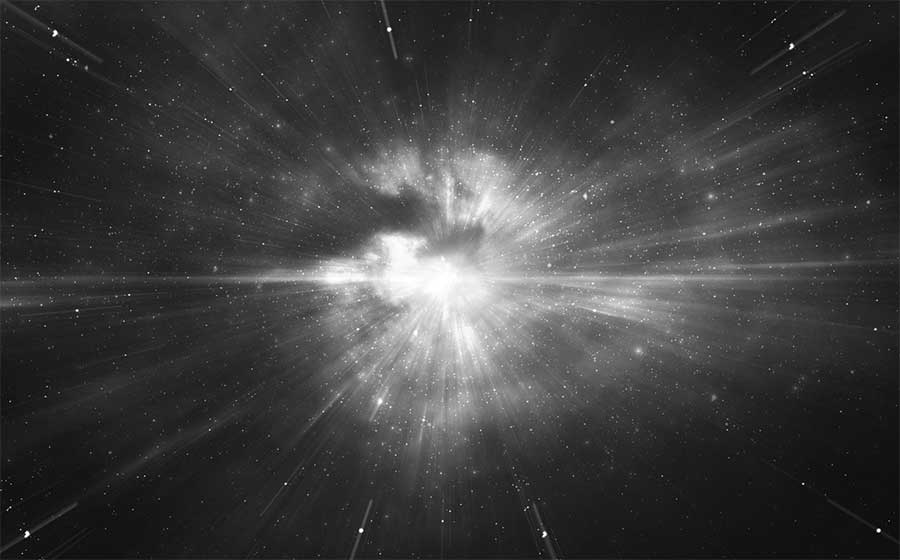
Imagine all of Reality as a great ocean of existence. The life cycle of this ocean, if it has one, must also follow greater laws, but its timescale is not in the billions, but perhaps in the quadrillions of years—a number the human intellect cannot possibly measure or comprehend.
And our entire “observable universe,” with its brief history of just 13.8 billion years, is merely equivalent to the moment a tiny bubble forms, expands, and then pops on the surface of that ocean.
With this metaphor, the entire story of our universe is redefined:
Science observes that galaxies are moving away from each other and calls this the “expansion of the universe.” This is an undeniable piece of observational data. But how that data is interpreted is another story entirely. The Big Bang model suggests this is the aftermath of a primordial explosion.
But is that the only explanation?
The “expansion” we see can be visualized in countless different ways:
- It could be the inflation of a local “bubble” on the surface of an ocean of reality.
- It could be the breath of some great entity, and we are only observing one half of the “exhale” cycle.
- It could simply be thermal expansion, like a tire inflating in the midday heat that will contract when night falls.
- Or it could just be the relative motion of our local cluster of universes within an even larger structure.
Whatever the explanation, they all have one thing in common: they are all local events, occurring on the scale of a “bubble.” The existence of a bubble and its internal laws are not sufficient to describe the existence of the vast and eternal ocean.
Science, with its greatest telescopes, may only be studying the physics of that bubble in great detail. They measure its rate of expansion and offer an interpretation. They are not wrong. But they are studying the physics of the bubble, and may have mistaken it for the entire ocean.
3. Changing the Question, Instead of Finding the Answer
When we change our perspective, viewing the cosmic expansion not as the beginning of everything but as a local phenomenon, the thorny questions at the point of origin suddenly lose their weight.
The question “What came before the Big Bang?” is no longer a question about the absolute beginning of Reality. Instead, it becomes a question about a local event: “What caused this expansion phenomenon?” Whether the answer is a “bubble,” a “breath,” or a cycle of “expansion and contraction,” they all imply the existence of a larger context, an “ocean” that was always there.
The energy for this phenomenon comes from that foundational “ocean” itself. The “singularity,” if it existed, was not a point born from absolute nothingness, but just a temporary convergence of energy within a reality that has always existed.
This perspective completely eliminates the concept of “creation ex nihilo,” a concept that has baffled both philosophy and physics. It replaces a single, lonely, and incomprehensible beginning with the idea of a process occurring within a larger, more natural, and much more logical system. Instead of searching for an answer to an unanswerable question, we simply change the question.
4. The Life Cycle of a World: Formation-Stasis-Degeneration-Destruction
The idea that our universe is just a local entity with a beginning and an end is not a new one. It is an echo that has resounded in the wisdom of humanity for thousands of years.
In Eastern wisdom, the life cycle of a world, a universe, or any entity, follows a universal law known as Formation-Stasis-Degeneration-Destruction (成住壞滅, cheng-zhu-huai-mie). This is not an endlessly repeating cycle, but a process of birth and death with an endpoint:
- Formation: The stage of coming into being, corresponding to the birth of a world.
- Stasis: The period of stability, when galaxies and life flourish.
- Degeneration: The period of decline, when order begins to collapse and energy is depleted.
- Destruction: The stage of disintegration, when that world comes to an end and is completely dissolved.
From this perspective, the “Big Bang” may not be the beginning of everything, but just the “Formation” moment of our local universe. And the expansion we observe is just a manifestation of the “Stasis” phase we are living in.
But this raises an even bigger question: If our universe is just an entity with a finite life cycle, what created it?
This is where we need to connect with an idea mentioned in previous chapters, an idea that seems to be present in all ancient religions and legends: the creation by Gods.
Many scriptures describe how a being at an extremely high realm can create an entire world—with its own physical laws and countless beings—with a single thought. The legend of the god Pan Gu creating the heavens and the earth may not just be a myth. It may be describing a truth from another level of perception: that the entire space we call the Three Realms was created by such a great being.
And this is the key to understanding the structure of Reality. Our “observable universe” may be just a small universe. Countless such small universes in turn make up a universe at a higher level. And so on, layer upon layer, ad infinitum. The birth of a universe at one level is, perhaps, the result of a creative thought from a being at the level immediately above it.
Therefore, the echo of the universe is not “cyclical,” but “creative” at every level. The Big Bang, if it happened, was not a random accident, but could be the moment a grand Idea manifested into matter, marking the “Formation” of the world in which we exist.
5. The Consequence: One Frame in a Long Film
When we accept this possibility, our perspective on the universe changes completely.
The expansion of the universe is no longer evidence for a single beginning of everything from nothing. Instead, it is simply a single slice, a moment that we are observing in a long life cycle from “Formation” to “Destruction.”
It is like taking a photograph of someone inhaling; we cannot conclude from that single image that their entire life consists only of inhalation.
The number 13.8 billion years, which science has calculated, is also just an inference based on “rewinding” that very moment of expansion, assuming it started from a single point and applies to everything we see. But what if our “universe” is not a uniform block created all at once? What if different systems—like the Milky Way, the Solar System, and Earth itself—were created at different times, for different purposes? In that case, the number 13.8 billion years, even if correct, could only be the age of a certain structure, not the age of the entire world in which we exist.
This realization brings both humility and a profound sense of meaning. Our existence is not a lonely accident. We are part of a living, purposeful process, of which we are only witnessing a single frame. And the red light of distant galaxies is not necessarily the echo of a bygone explosion, but perhaps, just the expression of a grand rhythm whose full scope we cannot yet see.
Câu chuyện về Big Bang là một bản anh hùng ca của khoa học. Nó đã sắp xếp lại sự hỗn loạn của vũ trụ thành một dòng thời gian có trật tự, được củng cố bằng những bằng chứng quan sát thuyết phục. Nhưng giống như bất kỳ bản anh hùng ca vĩ đại nào, khi bức màn sân khấu khép lại, vẫn còn đó những câu hỏi chưa được trả lời, lơ lửng trong bóng tối.
This article is an excerpt from the book “The Universe Beyond the Big Bang” – a journey to explore the origin and profound meaning of the cosmos.
- Continue reading other chapters from the same work:
- Chapter 1: THE GREAT QUESTION ON THE FRINGES OF SCIENCE – THE NET AND THE SILENCE OF THE OCEAN
- Chapter 2: CONSCIOUSNESS AND MATTER – A TWO-WAY RELATIONSHIP
- Chapter 3: THE IMPLICATE ORDER AND THE QUANTUM UNIVERSE
- Chapter 4: THE MAP OF STRUCTURE – THE PERIODIC TABLE OF ELEMENTS
- Chapter 5: THE MAP OF FLOW – THE FIVE ELEMENTS AND ENERGY
- Chapter 6: THE MAP OF TRANSFORMATION – THE WORLDVIEW OF SPIRITUAL CULTIVATION
- Chapter 7: THE MULTIDIMENSIONAL MAP – FROM STRING THEORY TO THE BERMUDA TRIANGLE
- Chapter 8: THE REALMS OF EXISTENCE
- Chapter 9: DREAMS – GATEWAYS TO OTHER REALITIES
- Chapter 10: INSPIRATION – ECHOES FROM OTHER REALITIES
- Chapter 11: SPIRIT POSSESSION – WHEN CONSCIOUSNESSES FIGHT FOR THE SAME BODY
- Chapter 12: SUPERNORMAL ABILITIES – WHEN CONSCIOUSNESS BENDS THE LAWS OF PHYSICS
- Chapter 13: EXTRATERRESTRIAL LIFE: A MULTIDIMENSIONAL PERSPECTIVE
- Chapter 14: THE BIG BANG – A BUBBLE BURSTING ON THE OCEAN?!
- Chapter 15: THE GALAXY – A LIVING CIRCUIT OF THE UNIVERSE
- Chapter 16: BLACK HOLES, DARK MATTER, AND DARK ENERGY – A REINTERPRETATION
- Chapter 17: FRACTAL ARCHITECTURE – FROM THE MICROCOSM TO THE MACROCOSM
- Chapter 18: TRANSCENDING THE BOUNDARY OF OBSERVATION
- Chapter 19: THE UNIVERSE IS A MIRROR – WHAT IS YOUR MEANING?
If you wish to experience the full journey of thought and the unpublished insights of the work, please click the button below to own the complete book.
To explore more works from THE LIVES MEDIA, visit our book collection.