Having journeyed through the greatest mysteries of the universe, from the origin of the Big Bang to the nature of galaxies, let’s take a step back and squint at the whole picture. Is there an architectural principle, a design pattern, that governs everything, from a tiny speck of dust to the grandest structures?
Perhaps the answer lies not in complex equations, but in the familiar images of nature all around us.
1. The Creator’s Fingerprint: The Beauty of Self-Repetition
Look at a snowflake. Each of its branches looks like a smaller snowflake. Look at a fern. Each large frond is made up of smaller fronds of the exact same shape. Look at the lightning bolts in the sky; their shape is repeated in the tiny blood vessels in our bodies, and in the branching rivers winding their way to the sea.
All these images are examples of a mathematical and natural principle called a fractal. A fractal is a structure in which basic shapes are repeated at ever-smaller (or larger) scales. Its most magical characteristic is this: a small part of the structure, when magnified, looks identical to the whole structure.
For decades, mathematicians viewed fractals as mere mathematical “monsters,” with no practical application. But then we realized that Mother Nature seems to be a master fractal artist. From jagged coastlines and mountain ranges to the structure of a cauliflower, the fingerprint of this self-repeating principle is everywhere. It is an incredibly efficient way to create infinite complexity from very simple rules.
2. The Universe as a Great Fractal
Now, let’s try to apply this fractal lens to the universe itself. What if we re-examine the familiar structures of cosmology?
- An atom: Electrons orbit a central nucleus.
- A Solar System: Planets orbit a central star.
- A galaxy: Billions of solar systems orbit a galactic center.
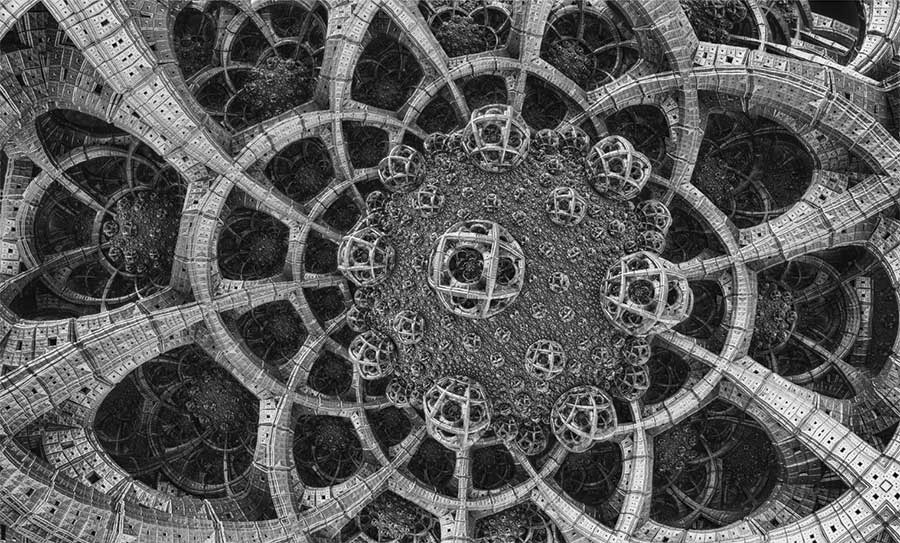
At three completely different scales, we see the same basic pattern repeat: smaller entities orbiting a larger central core.
This similarity goes even deeper. Even when we look inside the atomic nucleus itself, the image of protons and neutrons stuck together like marbles may not be entirely accurate. In the subatomic world, these particles are also in constant motion within their own space. It’s very possible that the structure of the nucleus is also a microcosm, with even smaller particles orbiting an even smaller center.
If this is true, then the structure of “a central system with orbiting satellites” appears to be a universal design, repeating from the infinitely small to the infinitely large. It suggests that the universe, at its deepest architectural level, is built on fractal principles.
And if so, this structure would continue to repeat in both directions:
- The Macrocosmic Direction: Galaxies are not randomly distributed in space. They gather into galaxy clusters. Galaxy clusters form superclusters. And these superclusters arrange themselves into enormous filament-like structures, forming the “cosmic web.” Each level seems to be a larger version of the one before it.
- The Microcosmic Direction: Below the atom are the nucleus, protons, neutrons, quarks… As we have speculated, there could exist countless levels of micro-particles unknown to us, each level being a world with its own structure, mirroring the structure of the world larger than it.
3. The Microcosmic and Macrocosmic Hierarchy: Particles and Systems
To easily visualize this fractal structure, we need a clear hierarchy. Let’s try to establish a convention: a “Level” is defined by its type of nearly spherical “Fundamental Particle.” And a “Fundamental Particle” of one level is always composed of countless “Fundamental Particles” from the level immediately below it.
Level +1: The Fundamental Particles are Celestial Bodies.
Stars, planets, with their characteristic spherical shape, are the “fundamental particles” of this level. A celestial body is composed of countless particles from a lower level.
From these “particles,” more complex intermediate structures are formed: Solar Systems, Galaxies, Galaxy Clusters…
So, what is the Fundamental Particle of Level 0?
The journey to find the Level 0 Fundamental Particle is the journey of particle physics. We have discovered the atom, but it is clearly an “intermediate structure” like a Solar System. We go deeper and find protons, neutrons, electrons. Are they the Level 0 Fundamental Particles?
According to our logic, if a celestial body (Level +1) is made of countless Level 0 particles, then a Level 0 particle must also be made of countless Level -1 particles.
But here, we encounter a contradiction with current science. Physics states that a proton is made of only 3 quarks. If so, the proton cannot be a “Fundamental Particle” by our definition, but only a very small “intermediate structure.” And the quark, since only 3 of them form a larger structure, cannot be the “Fundamental Particle” of the level just below.
This does not mean our fractal model is wrong. It only suggests an incredible possibility: that modern science, even with its most powerful particle accelerators, has probably not yet reached the true “Fundamental Particle” of Level 0, let alone the Fundamental Particle of Level -1. Protons, neutrons, electrons, and even quarks may all be just complex “intermediate structures” on the journey into the microcosm.
The true “Fundamental Particles” of Level 0 and lower levels remain an unknown, microcosmic worlds we have never known.
With this clarified hierarchy, the picture becomes consistent. It does not deny science but places science in its proper context: a journey of discovery that is still ongoing, and has perhaps only taken the first few steps on an infinite path into the microcosm.
4. “As Above, So Below”
This fractal principle is not just a physical description. It carries a profound philosophical meaning, one that was encapsulated by ancient sages in the saying: “As above, so below.”
This saying means that the laws governing the macrocosm (above) are also reflected in the microcosm (below). The entire universe is not something foreign and separate from us. Instead, every part, no matter how small, contains the information and image of the whole.
In a fractal universe, nothing is truly isolated. Every atom, every cell, every living being is a mirror, in some way, reflecting the entire architecture and laws of the universe. The macrocosm and the microcosm are not two separate entities. They are two expressions, at two different scales, of the same single blueprint.
5. The Human Being: A Universe in Miniature
And this finally leads us back to ourselves. In this grand structure, where do humans fit?
We are not just creatures living on the surface of a planet (a Level +1 particle). Our body, with its trillions of cells, its complex system of energy meridians, and a brain with more neural connections than there are stars in the galaxy, is itself a universe.
The human being is a universe in miniature.
The layered structure of micro- and macro-levels does not only exist outside of us; it is replicated right within us. Each of us is a point of intersection, where the infinitely large and the infinitely small meet.
This is not a poetic comparison. If the fractal principle is true, then within each of us truly lie the laws and information of the entire macrocosm. We are not passive observers. We are living expressions of the very universe we are trying to understand.
This realization completely changes the meaning of exploration. The next great frontier lies not only in distant galaxies but also in the stillness of the mind, in every breath we take. To understand ourselves is, perhaps, the shortest path to understanding the universe.
This article is an excerpt from the book “The Universe Beyond the Big Bang” – a journey to explore the origin and profound meaning of the cosmos.
- Continue reading other chapters from the same work:
- Chapter 1: THE GREAT QUESTION ON THE FRINGES OF SCIENCE – THE NET AND THE SILENCE OF THE OCEAN
- Chapter 2: CONSCIOUSNESS AND MATTER – A TWO-WAY RELATIONSHIP
- Chapter 3: THE IMPLICATE ORDER AND THE QUANTUM UNIVERSE
- Chapter 4: THE MAP OF STRUCTURE – THE PERIODIC TABLE OF ELEMENTS
- Chapter 5: THE MAP OF FLOW – THE FIVE ELEMENTS AND ENERGY
- Chapter 6: THE MAP OF TRANSFORMATION – THE WORLDVIEW OF SPIRITUAL CULTIVATION
- Chapter 7: THE MULTIDIMENSIONAL MAP – FROM STRING THEORY TO THE BERMUDA TRIANGLE
- Chapter 8: THE REALMS OF EXISTENCE
- Chapter 9: DREAMS – GATEWAYS TO OTHER REALITIES
- Chapter 10: INSPIRATION – ECHOES FROM OTHER REALITIES
- Chapter 11: SPIRIT POSSESSION – WHEN CONSCIOUSNESSES FIGHT FOR THE SAME BODY
- Chapter 12: SUPERNORMAL ABILITIES – WHEN CONSCIOUSNESS BENDS THE LAWS OF PHYSICS
- Chapter 13: EXTRATERRESTRIAL LIFE: A MULTIDIMENSIONAL PERSPECTIVE
- Chapter 14: THE BIG BANG – A BUBBLE BURSTING ON THE OCEAN?!
- Chapter 15: THE GALAXY – A LIVING CIRCUIT OF THE UNIVERSE
- Chapter 16: BLACK HOLES, DARK MATTER, AND DARK ENERGY – A REINTERPRETATION
- Chapter 17: FRACTAL ARCHITECTURE – FROM THE MICROCOSM TO THE MACROCOSM
- Chapter 18: TRANSCENDING THE BOUNDARY OF OBSERVATION
- Chapter 19: THE UNIVERSE IS A MIRROR – WHAT IS YOUR MEANING?
If you wish to experience the full journey of thought and the unpublished insights of the work, please click the button below to own the complete book.
To explore more works from THE LIVES MEDIA, visit our book collection.