Having looked at the big picture of the universe’s origin, let’s now narrow our focus to a grand yet more intimate structure: the galaxy. They are magnificent islands of light, where hundreds of billions of stars congregate, dancing together in a ballet that lasts for billions of years. But when we observe this dance closely, an absurdity emerges, a severe misstep that challenges our deepest understanding of the laws of physics.
1. The Flat Rotation Curve Problem: The Impossible Dance
The standard model of cosmology views a spiral galaxy as a giant Solar System. The majority of its visible mass (stars, gas, dust) is concentrated in the central bulge. According to Newton’s law of universal gravitation, the gravitational force should weaken with distance from the center.
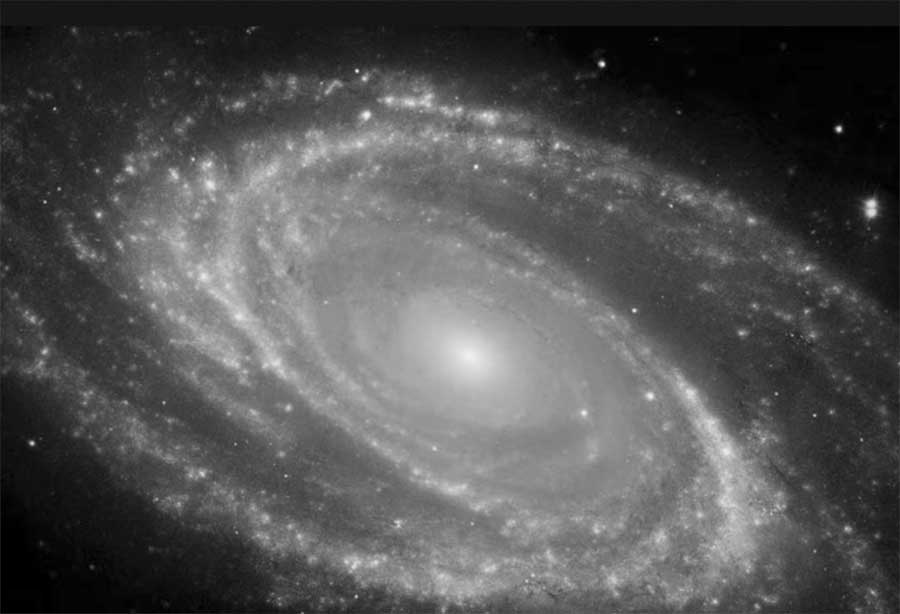
This means that stars on the outer edge of the galaxy, where the gravitational pull is weaker, should rotate much more slowly than stars near the center. If they were to rotate too fast, gravity would not be strong enough to hold them, and they would be flung out into intergalactic space, just as the outer planets in our solar system (like Neptune) move much more slowly than the inner planets (like Mercury).
That is the theory. But when astronomers, led by Vera Rubin in the 1970s, measured the actual rotation speeds of galaxies, they discovered a shocking truth. The speeds of the stars did not decrease at the outer edges as predicted. On the contrary, they maintained an absurdly high rotation speed, remaining nearly constant as they moved away from the center.
If one were to plot the rotational speed of stars against their distance from the center, instead of a downward-sloping curve, scientists found a line that was nearly flat. This phenomenon was given the rather dry name “the flat rotation curve problem.” Its essence is this: the stars on the outer edges are moving too fast for the amount of visible matter to hold them in. The dance of the stars seems to defy the very law that wrote its script.
2. “Dark Matter”: A Patch for a Cracked Model
Faced with this blatant contradiction, the scientific community had two options. One was to admit that perhaps our theory of gravity is incomplete or not the only force governing at the galactic scale. The other was to assume that there must be something there that we cannot see.
They chose the second option.
They proposed the hypothesis that each galaxy is enveloped in a huge, invisible halo of matter, called “dark matter.” This halo of matter does not emit light, does not reflect light, and is completely invisible to all telescopes. Its existence is only inferred indirectly through the immense gravitational force it generates, a force strong enough to “hold on” to the fast-moving stars at the outer edge, preventing them from flying off.
According to current calculations, to explain the flat rotation curve, the amount of dark matter must account for up to 85% of the total mass of matter in the universe. This means that everything we can see—every star, galaxy, and planet—is just the tiny visible tip of a colossal, submerged iceberg.
“Dark matter” became a perfect patch, saving the gravitational model. But after decades of searching with the most sensitive detectors, we have yet to find a single dark matter particle. It remains a “ghost” in the equations. This raises a question: Are we obsessively searching for a ghost, while the real answer lies in another law of physics that we have inadvertently overlooked?
3. The “Plasma Universe” Solution: When Electricity Speaks
In its quest to understand the universe, science has often focused solely on gravity. But we forget that there is another force, billions upon billions of times stronger: the electromagnetic force. We also often imagine the universe as an empty void, but in reality, over 99% of its matter exists in a plasma state.
What if we looked at a galaxy not as a mechanical machine, but as an electromagnetic phenomenon in a plasma universe?
Plasma physicists, such as Nobel laureate Hannes Alfvén, have proposed a completely different model. In the “Plasma Universe” model, space is filled with enormous electric currents and magnetic fields, forming invisible “filaments” of energy that connect galaxies.
In this scenario, galaxies are born at the very points where these cosmic energy “filaments” intersect and twist together, much like vortices forming in a river. The shape of the galaxy would depend on the nature of that intersection:
- When the energy currents swirl in an orderly and stable manner, they create the beautiful spiral galaxies we often see, with stars moving in a synchronized dance.
- When the energy currents intersect more chaotically and intensely, they can form elliptical galaxies (egg-shaped or spherical), where stars do not rotate on a single plane but move in random orbits, like a giant swarm of bees.
- And where complex collisions or interactions between energy currents occur, irregular galaxies with strange shapes are born.
Whether an orderly vortex or a chaotic swirl, all these forms of galaxies can be seen as manifestations of the same energetic principle: they are great plasma vortices, formed and sustained by electromagnetic forces.
4. A Natural Explanation for a Synchronized Dance
When we see the galaxy as a plasma vortex, the flat rotation curve problem is no longer a mystery. It becomes a natural property of the system.
In a structure dominated by electromagnetic forces, stars and gas clouds are no longer independent marbles subject only to the gravitational pull from the center. Instead, they are “swept along” by the energy flow of the entire structure, like leaves caught in a whirlwind.
The galaxy’s immense magnetic field acts like invisible “strings,” compelling the stars to move together. Therefore, it is entirely natural for stars at the outer edge to rotate nearly as fast as those in the interior. They are not “trying” to fly out; they are simply following the collective flow.
With this model, we do not need “dark matter” to explain the synchronized dance of the stars. What we call the “effect of dark matter” is simply the manifestation of plasma dynamics that our purely gravitational model has not yet fully grasped.
5. The Galaxy as a Living Circuit
Thus, the image of the galaxy has completely changed.
It is no longer a discrete collection of material marbles held together loosely by gravity.
Instead, it is an integrated entity, a self-organizing system, a living energy structure. The black hole at the center is not a monster, but the calm “eye of the storm.” The spiral arms are not random clusters of stars, but huge currents of plasma, where stars are caught and carried along.
The galaxy is not like a mechanical machine. It is more like a living electrical circuit.
And this leads to a bold speculation. If the galaxy is an electrical circuit, could the luminosity of a celestial body be not just an internal nuclear process, but also an interaction with the circuit itself? Just as a rock in space only ignites into a meteor when it enters the atmosphere at a sufficient velocity, perhaps a celestial body is only “activated” and shines brightly when the combination of its material composition, its speed of movement, and its size (mass) reaches a certain threshold within the galaxy’s energy flow.
If this is true, then the images of galaxies we see are only their brightest “cores.” Surrounding them could be a “dark halo” many times larger, filled with ordinary celestial bodies—dwarf stars, rogue planets—that are moving too slowly or do not have enough mass and velocity to “turn on their lights.” And perhaps, the “dark matter” that science is searching for is not a mysterious particle, but the immense mass of these ordinary celestial bodies that have fallen into silence and cold.
This article is an excerpt from the book “The Universe Beyond the Big Bang” – a journey to explore the origin and profound meaning of the cosmos.
- Continue reading other chapters from the same work:
- Chapter 1: THE GREAT QUESTION ON THE FRINGES OF SCIENCE – THE NET AND THE SILENCE OF THE OCEAN
- Chapter 2: CONSCIOUSNESS AND MATTER – A TWO-WAY RELATIONSHIP
- Chapter 3: THE IMPLICATE ORDER AND THE QUANTUM UNIVERSE
- Chapter 4: THE MAP OF STRUCTURE – THE PERIODIC TABLE OF ELEMENTS
- Chapter 5: THE MAP OF FLOW – THE FIVE ELEMENTS AND ENERGY
- Chapter 6: THE MAP OF TRANSFORMATION – THE WORLDVIEW OF SPIRITUAL CULTIVATION
- Chapter 7: THE MULTIDIMENSIONAL MAP – FROM STRING THEORY TO THE BERMUDA TRIANGLE
- Chapter 8: THE REALMS OF EXISTENCE
- Chapter 9: DREAMS – GATEWAYS TO OTHER REALITIES
- Chapter 10: INSPIRATION – ECHOES FROM OTHER REALITIES
- Chapter 11: SPIRIT POSSESSION – WHEN CONSCIOUSNESSES FIGHT FOR THE SAME BODY
- Chapter 12: SUPERNORMAL ABILITIES – WHEN CONSCIOUSNESS BENDS THE LAWS OF PHYSICS
- Chapter 13: EXTRATERRESTRIAL LIFE: A MULTIDIMENSIONAL PERSPECTIVE
- Chapter 14: THE BIG BANG – A BUBBLE BURSTING ON THE OCEAN?!
- Chapter 15: THE GALAXY – A LIVING CIRCUIT OF THE UNIVERSE
- Chapter 16: BLACK HOLES, DARK MATTER, AND DARK ENERGY – A REINTERPRETATION
- Chapter 17: FRACTAL ARCHITECTURE – FROM THE MICROCOSM TO THE MACROCOSM
- Chapter 18: TRANSCENDING THE BOUNDARY OF OBSERVATION
- Chapter 19: THE UNIVERSE IS A MIRROR – WHAT IS YOUR MEANING?
If you wish to experience the full journey of thought and the unpublished insights of the work, please click the button below to own the complete book.
To explore more works from THE LIVES MEDIA, visit our book collection.