After Chapter 1 pointed out the limitations of the scientific map, Chapter 2 begins to build a new foundation. If consciousness and matter are not two separate entities, what is their true relationship?
Excerpted from the “THE UNIVERSE BEYOND THE BIG BANG”, this chapter explores Monism through the metaphor of “water, ice, and steam.” From the placebo effect to a thought that raises a hand, the author will demonstrate that consciousness and matter are an inseparable two-way interactive system.
We invite you to read the full content of Chapter 2 below.
* * *
Author: Aiden Lee, Founder of THE LIVES MEDIA
Chapter 2: CONSCIOUSNESS AND MATTER – A TWO-WAY RELATIONSHIP
1. Water Vapor, Liquid Water, and Ice: The Theory of Monism
Having stood at the edge of modern science’s map and gazed into the vast voids, we need a new foothold, a compass to guide us as we begin our exploration. That foothold is not a new invention, but one of the most profound and ancient ideas of humanity, an undercurrent that has flowed through both Eastern and Western civilizations. It is the Theory of Monism.
It may sound complex, but its core idea is incredibly simple: all things in the universe, though manifesting in countless different forms—from a lifeless stone to a fleeting thought, from a distant galaxy to a deep emotion—originate from a single substance, a single foundational reality.
According to this view, consciousness and matter are not two separate entities, one “subject” and one “object” as dualistic thinking often assumes. They are not in opposition. They are simply two different states of manifestation of the same truth.
To visualize this, think of water. Water can exist in the liquid form we drink every day, soft and fluid. When heated, it becomes invisible water vapor, spreading through the air, seemingly without form or limit. When cooled, it freezes into solid ice, with a clear structure and entirely different properties.
Water vapor, liquid water, and ice. Three states that look completely different. Yet no one doubts that their underlying essence is one and the same: H₂O.
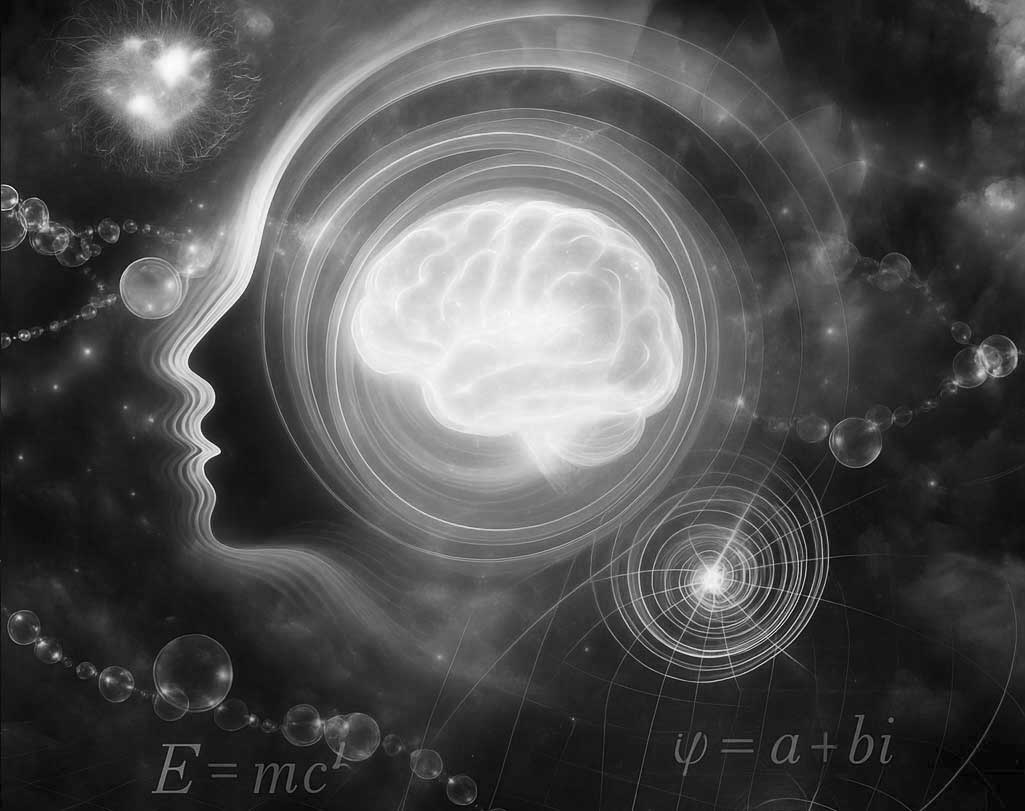
The Theory of Monism suggests that consciousness and matter are just like that. Could it be that matter is simply the “ice” state of reality? It is condensed, tangible, and structured. And could it be that consciousness is the “water vapor” state of reality? It is subtle, pervasive, and formless. If this is true, then the endless debate of “which came first, which determines which?” suddenly becomes meaningless. It is like asking, “Which came first, water vapor or ice?” The answer is that neither came first. They are just different manifestations of the same original substance, depending on the energy conditions of the environment.
In the West, the philosopher Baruch Spinoza spoke of a single “Substance,” of which both “thought” (consciousness) and “extension” (matter) are merely attributes. In the East, Lao Tzu wrote of the “Tao”—an invisible, unnamable principle, yet the source from which all things arise.
Specifically, at the very beginning of the Tao Te Ching, Lao Tzu wrote: “The nameless is the beginning of heaven and earth; The named is the mother of ten thousand things.”¹
Here, we find an astonishing parallel. Could “the nameless”—the primordial, formless, unidentifiable state—be another name for the realm of Ideas, for the “water vapor” state of reality? And could “the named”—when all things have names, forms, and can be distinguished—be the “condensed” material world, the “ice” state? The words of this ancient sage seem to be not just philosophy, but a description of a cosmic creation process: from the Nameless to the Named, from Consciousness to Matter.
When we accept this possibility, even as a hypothesis, an incredible door of perception opens. It allows us to ask an even bolder question: If consciousness and matter are just two states of the same thing, can there be a process of “transformation” between them?
In other words, can a thought become matter?
This is no longer a purely philosophical question. It leads us to examine the very real evidence that unfolds within our own bodies and lives every day.
2. The Footprints of Ideas on the Body
If consciousness and matter are two sides of the same reality, then their connection cannot be an abstract theory. It must be an observable truth, a tangible experience. And indeed, the most perfect laboratory for observing this interaction is our own body. Every day, every hour, every minute, we witness the miracle of consciousness controlling matter, but because it is so familiar, we take it for granted.
Let’s start with the simplest evidence. Right now, try to think: “I want to raise my right hand.” Almost instantly, a complex chain of physical events takes place. An electrochemical signal is sent from the brain, travels down the nerves to the muscles in your arm, causing them to contract in a precise sequence, and your arm—a physical object with mass, subject to the law of gravity—moves exactly as you willed it to.
A thought, something completely invisible and non-material, has initiated a specific physical action. We do this thousands of times a day without thinking. But if we pause to contemplate it, this is truly a phenomenal event. “Will” has become “movement.” Consciousness has directly commanded matter.
Let’s go a little deeper. Many of us can control biological processes that are considered automatic. Monks, yogis, or long-term qigong practitioners can intentionally slow their heart rate, lower their blood pressure, and even change their body temperature. Through the focus of their consciousness, they can intervene in the workings of the autonomic nervous system, something modern medicine once thought impossible. Focused “intention” has changed “physiological function.”
Going further, we can see thoughts creating measurable physical traces. When you are happy, sad, or concentrating, your brain emits different types of brainwaves (alpha, beta, theta, delta) with entirely different frequencies and amplitudes. These waves are real electromagnetic oscillations that can be recorded by an electroencephalogram (EEG). A mental state, an emotion, has been “materialized” into a measurable electrical signal.
And perhaps the most convincing evidence for the power of consciousness lies in a phenomenon that science has always had to acknowledge, even without a complete explanation: the placebo effect. A patient is given a sugar pill but is told it is a powerful pain reliever. After taking it, a significant percentage of patients report that their pain has substantially decreased. Their belief—a purely conscious state—has activated real healing mechanisms within their bodies. Their nervous system has produced its own endorphins, a natural “painkiller,” simply because they believed they were being treated. Consciousness not only controls matter, but it can also change the state of matter, shifting it from a state of “illness” to a state of “health.”
Finally, look in the mirror. Eastern wisdom has a saying, “xiang you xin sheng,” meaning one’s appearance gradually changes according to one’s inner disposition. A person who is always cheerful, kind, and tolerant often has a gentle and benevolent face. A person who is frequently scowling, resentful, and envious will, over time, have those negative emotions etched onto their face as wrinkles and harsh lines. This is not superstition. Prolonged states of consciousness affect the contraction and relaxation of hundreds of small facial muscles, influence blood circulation and hormonal balance, and over many years, sculpt our physical appearance.
From the simple act of raising a hand to changing one’s appearance over a lifetime, this chain of evidence all points in one direction. Consciousness is not a passive passenger in the vehicle of the body. It is the driver, holding the reins and deciding the direction. The footprints of ideas are imprinted on matter, clearly and undeniably.
3. The Echo of the Machine: When Matter Speaks
If the story ended with consciousness having full control over matter, our worldview would be simple, but perhaps incomplete. Reality shows that this relationship is much more complex and bidirectional. Just as a masterful driver still depends on the condition of their car, our consciousness, in this realm, is also profoundly influenced by the state of the physical “machine” it inhabits: the brain and the body.
The clearest evidence comes from chemical effects. Just a small amount of alcohol in the bloodstream changes our judgment, emotional control, and reaction time. A cup of coffee can increase alertness and focus. Certain medications can soothe anxiety or combat depression by directly intervening in the balance of neurotransmitters in the brain. In these cases, a purely material change (chemistry) has produced a marked change in the state of consciousness (mood, perception).
Similarly, physical brain injuries can have astounding consequences. A blow to the frontal lobe can turn a gentle person into someone irritable and impulsive. A tumor in a specific location can completely alter personality or impair memory. The classic story in neuroscience of Phineas Gage, a 19th-century railroad worker who had an iron rod pierce through his brain, is a tragic testament to this. He survived the accident, but from a calm and reliable man, he became rude, impatient, and entirely different. The “machine” was broken, and the “driver” seemed to have changed as well.
And now, humanity stands on the threshold of an even more profound revolution: the direct integration of consciousness and machine. Pioneering projects like Elon Musk’s Neuralink are developing brain-computer interfaces, with the goal of implanting microscopic chips into the brain. In its early stages, this technology promises to help paralyzed individuals control computers or prosthetic limbs with just their thoughts. This is still an example of “consciousness controlling matter.”
But their long-term vision goes much further. They envision a future where humans can download knowledge directly into the brain, or even connect their consciousness to artificial intelligence. When that happens, the boundary will blur. A physical chip, an electronic device, will have the ability to directly enhance or alter the capabilities of consciousness, such as memory and processing speed. If that becomes a reality, it will be irrefutable proof that interfering with the physical structure of the brain can change the very nature of the conscious experience.
These examples do not contradict what we discussed earlier. On the contrary, they complete the picture. They show that while consciousness is the initiator, the one who gives commands, it also listens to the “echo” from the very physical tool it uses.
The relationship between consciousness and matter is not a one-way street between a master and a servant. It is more like a dialogue, a continuous dance of interaction. Consciousness can shape matter, but matter also creates the conditions, limitations, and potentials for the expression of consciousness. The two seem bound together in a causal loop with no clear beginning or end.
4. The Artist and the Piano: An Interactive System
Imagine a genius pianist performing. His will and emotions flow through his ten fingers, gliding across the keys, creating melodies that stir the soul. In that moment, the artist appears to be the sole creator, and the piano merely a passive tool for expressing his ideas. This is the image of “consciousness controlling matter.”
But there is more to the story. The piano itself has its own structure and rules. It has 88 keys arranged in a strict harmonic order, a limited range, and a characteristic tone that cannot be changed. The artist, no matter how talented, must play within the framework of those rules. He cannot make a C key produce the sound of an A note. And more importantly, if the piano is broken—if a string is snapped, a key is stuck—then no matter how beautiful the idea in his mind, the music that comes out will be dissonant and unpleasant. This is the image of “matter influencing consciousness.”
The artist and the piano. This metaphor helps us escape the dualistic thinking of “which determines which.” They are not two separate entities, but an inseparable interactive system.
The artist did not create the piano, and the piano did not create the artist. They came together, each with its own qualities, and together they create a symphony. Whether the music is good or bad depends not only on the artist, nor only on the piano. It depends on the harmony and interaction between the two.
In this universe, consciousness and matter are also creating the symphony of existence together. We can see consciousness as the artist and matter as the piano. They are in constant dialogue, constantly shaping each other in an endless creative dance. This picture is harmonious and logical, but it is built on inference and observation from our perspective. Is there any confirmation from a higher level of perception, a direct affirmation rather than just a philosophical metaphor?
5. An Affirmation from a Higher Level of Perception
The arguments we have walked through, from raising a hand to the placebo effect, from the metaphor of the piano to Eastern and Western philosophies, are all attempts by the human mind to approach a profound truth. We use logic, observation, and reason to conclude that consciousness and matter seem to be a unified system. But this is still the result of a process of “looking from the outside in.”
However, in ancient systems of spiritual cultivation, this issue is approached in a completely different way: “looking from the inside out.” They hold that there are higher states of consciousness, achievable through the cultivation of one’s character and meditation, that allow a person to directly perceive and enlighten to the nature of reality, rather than just reasoning about it.
From this level of perception, the answer is no longer a complex philosophical theory, but a self-evident truth.
In a profound system of spiritual cultivation, it is taught that matter and spirit are, in essence, one and the same; they possess a “oneness.” They don’t say they “interact” or “influence” each other as two separate entities. They say they are one. Like the front and back of a piece of paper, they cannot exist without each other and are in fact just two aspects of the same thing.
This affirmation carries immense significance. It is not a philosophical conclusion drawn after weighing evidence. It is presented as a truth directly seen by those who have reached a realm of perception beyond that of ordinary people. It is the difference between a scientist analyzing the chemical composition of ice and water and concluding they are the same, and an ordinary person witnessing a block of ice melt into water. One is inference, the other is direct observation.
This affirmation of “oneness” is the final piece of the puzzle, the most solid foundation for this entire chapter. It elevates our entire line of reasoning from a plausible philosophical hypothesis to a truth that has been enlightened to at a higher level.
With this foundation in hand—that consciousness and matter are inseparable, merely two expressions of the same substance—we are ready to explore the deeper mechanisms. If reality is a unified whole, how is it organized? What orders are operating behind the apparent world we see? That is the journey we will begin in the next chapter.
* * *
This article is an excerpt from the book “The Universe Beyond the Big Bang” – a journey to explore the origin and profound meaning of the cosmos.
- Continue reading other chapters from the same work:
- Chapter 1: THE GREAT QUESTION ON THE FRINGES OF SCIENCE – THE NET AND THE SILENCE OF THE OCEAN
- Chapter 2: CONSCIOUSNESS AND MATTER – A TWO-WAY RELATIONSHIP
- Chapter 3: THE IMPLICATE ORDER AND THE QUANTUM UNIVERSE
- Chapter 4: THE MAP OF STRUCTURE – THE PERIODIC TABLE OF ELEMENTS
- Chapter 5: THE MAP OF FLOW – THE FIVE ELEMENTS AND ENERGY
- Chapter 6: THE MAP OF TRANSFORMATION – THE WORLDVIEW OF SPIRITUAL CULTIVATION
- Chapter 7: THE MULTIDIMENSIONAL MAP – FROM STRING THEORY TO THE BERMUDA TRIANGLE
- Chapter 8: THE REALMS OF EXISTENCE
- Chapter 9: DREAMS – GATEWAYS TO OTHER REALITIES
- Chapter 10: INSPIRATION – ECHOES FROM OTHER REALITIES
- Chapter 11: SPIRIT POSSESSION – WHEN CONSCIOUSNESSES FIGHT FOR THE SAME BODY
- Chapter 12: SUPERNORMAL ABILITIES – WHEN CONSCIOUSNESS BENDS THE LAWS OF PHYSICS
- Chapter 13: EXTRATERRESTRIAL LIFE: A MULTIDIMENSIONAL PERSPECTIVE
- Chapter 14: THE BIG BANG – A BUBBLE BURSTING ON THE OCEAN?!
- Chapter 15: THE GALAXY – A LIVING CIRCUIT OF THE UNIVERSE
- Chapter 16: BLACK HOLES, DARK MATTER, AND DARK ENERGY – A REINTERPRETATION
- Chapter 17: FRACTAL ARCHITECTURE – FROM THE MICROCOSM TO THE MACROCOSM
- Chapter 18: TRANSCENDING THE BOUNDARY OF OBSERVATION
- Chapter 19: THE UNIVERSE IS A MIRROR – WHAT IS YOUR MEANING?
If you wish to experience the full journey of thought and the unpublished insights of the work, please click the button below to own the complete book.
To explore more works from THE LIVES MEDIA, visit our book collection.