After Chapter 2 affirmed that consciousness and matter are one, Chapter 3 seeks an answer to the question: how is that unified reality structured?
Excerpted from the book “THE UNIVERSE BEYOND THE BIG BANG”, this chapter will take us into the strange world of quantum physics, exploring concepts such as David Bohm’s ‘Implicate Order’ and the shocking evidence of ‘quantum entanglement’. This is the bridge connecting pioneering science and ancient wisdom, showing that they may be describing the same truth.
We invite you to read the full content of Chapter 3 below.
* * *
Author: Aiden Lee, Founder of THE LIVES MEDIA
Chapter 3: THE IMPLICATE ORDER AND THE QUANTUM UNIVERSE
1. David Bohm’s Explicate World and Foundational Flow
Our journey in the previous chapter led to a foundational conclusion, confirmed by both philosophy and spiritual wisdom: Consciousness and Matter are not two separate entities, but two manifestations of a single, unified substance. This is an idea that may seem foreign to the conventional materialistic worldview. But what is astounding is that, right in the heart of the science considered the most “hard” and objective—physics—there have been pioneering thinkers who arrived at a similar conclusion, just through a completely different path.
One of them was David Bohm, a brilliant American theoretical physicist and one of Albert Einstein’s most distinguished students. Bohm was dissatisfied with the standard interpretations of quantum mechanics, which were rife with paradoxes and perplexing randomness. He believed that the chaos and fragmentation we see at the quantum level are merely the surface of a much deeper and more orderly reality. From this, he developed one of the most beautiful and profound models of the universe ever proposed.
Bohm proposed that reality exists on two levels: the “Explicate Order” and the “Implicate Order.”
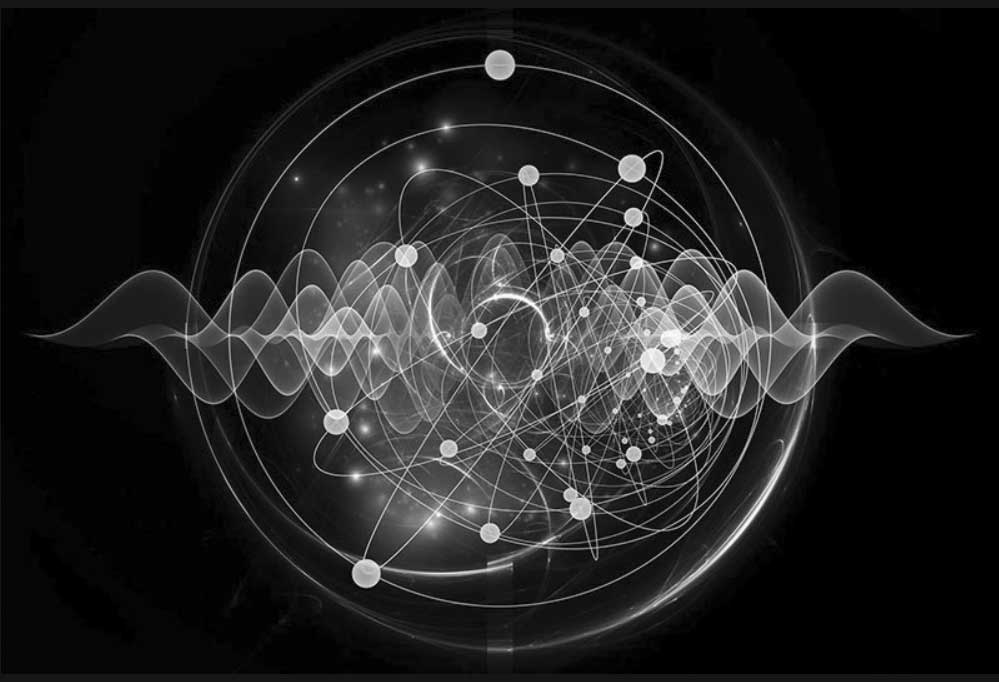
The Explicate Order is the world we experience every day. It is the world of separate objects with clear positions in space and time. The table is here, the chair is there. The apple falls to the ground due to gravity. Everything seems separate, operating according to linear cause and effect. This is the world that classical physics describes perfectly, and it is also the world our senses perceive.
But according to Bohm, this order is just an illusion, an outward manifestation. Its foundation is a deeper, more whole reality called the Implicate Order. This is a level of reality of undivided wholeness, where things are no longer separate “parts,” but are “enfolded” into one another in a continuous flow. In the Implicate Order, there is no separation between particles, between space and time, or between the observer and the observed. Everything is one.
To help us visualize this abstract concept, Bohm offered a unique thought experiment based on a real phenomenon in fluid dynamics. Imagine a transparent glass cylinder filled with a very viscous liquid like glycerin. Inside that cylinder is a smaller, rotatable cylinder. We place a drop of black ink into the liquid. Initially, the ink drop is a distinct, clear entity—it is in the Explicate Order.
Now, we begin to slowly turn the inner cylinder. The ink drop is stretched into a long thread, then gradually dissolves and seems to disappear completely into the liquid. The order of the ink drop is no longer visible; it has been “enfolded,” “hidden” within the entire volume of glycerin. It has moved into the Implicate Order.
At first, this might seem more like a magic trick than physics. How can something that has dissolved be reassembled? The key is that because the liquid is very viscous and the motion is very slow, its flow is laminar—a state where layers of fluid slide past each other in an orderly fashion instead of mixing chaotically. Under these conditions, the ink drop is not randomly “mixed,” but is “stretched” along predictable paths. Its order is only dispersed, not destroyed.
And because this process is reversible, something magical happens when we turn the cylinder back in the opposite direction at the same speed. From the transparent liquid, the thread of ink begins to reappear, then gradually contracts, and finally, the ink drop miraculously re-forms at its exact original position.
The ink drop never disappeared. Its order was merely hidden within a larger order.
According to Bohm, our entire universe operates in this way. The world we experience, with its separate galaxies, stars, and people, is just an “Explicate Order” being “unfolded” from a much deeper “Implicate Order,” where all things are one. It is like ripples on the surface of an infinite ocean, and we, because we only see the ripples, mistakenly believe they are separate entities, forgetting that they are all expressions of the same single ocean.
2. The Holographic Universe: When the Whole is in Every Part
David Bohm’s model of a foundational, whole, and interconnected reality is a beautiful idea, but it is also difficult to visualize. How can the entire universe be “enfolded” within each of its parts? Fortunately, a 20th-century invention provides an almost perfect physical metaphor for this concept: the hologram.
Most of us have seen a hologram. It is a three-dimensional image that appears to float in space, generated from a flat, two-dimensional film. You can walk around it and see different angles of the object, as if it were really there. This magic is created by shining a laser beam through a special film, which has recorded not the image of the object, but the complex interference patterns of light waves that have reflected off it.
But the most magical and extraordinary property of a hologram lies elsewhere. If you take a regular photograph and tear it into ten pieces, each piece will contain only 1/10th of the original picture. You will have a piece with an eye, a piece with a smile, a piece with the hair. You cannot reconstruct the whole face from a single fragment.
But if you take the holographic film and shatter it into ten pieces, something unbelievable happens. When you shine the laser through any fragment, no matter how small, it will not just reconstruct 1/10th of the image. It will reconstruct the entire original image.
The whole horse, the whole flower, the whole face will appear from the smallest fragment. Of course, the image will be dimmer and have lower resolution than the one created from the whole film, but the essential point remains: the information of the whole is encoded in every part.
This is precisely where David Bohm saw a perfect parallel with his model of the universe. He called it the “Holographic Universe.”
The complex interference patterns recorded on the two-dimensional film, where information about the entire image is distributed and “enfolded” invisibly, is the image of the Implicate Order.
The clear, specific three-dimensional image that appears when light shines on it, is the image of the Explicate Order—the material world we experience.
According to this model, the universe is not made of fundamental “bricks” that build a house. Instead, it is like a giant hologram, where each “brick”—each atom, each cell, each living being—contains, in some way, the information of the entire “house.” “As above, so below” is no longer just a philosophical saying; it may be a description of the deep physical structure of reality.
This leads to a startling implication: each of us, every entity in this universe, is not an isolated and separate individual. We are “fragments” that contain the image of the whole. Each of us is a mirror reflecting the universe.
But is this just a beautiful philosophical metaphor, a random coincidence? Or does the universe itself, at its most fundamental level, operate according to these holographic principles? To answer that question, we must delve into the strange world of quantum physics, where these seemingly crazy ideas find their most stunning experimental evidence.
3. “Spooky Action at a Distance”: Evidence of a Unified Reality
The model of a Holographic Universe, where each part contains the whole, sounds more like philosophy than physics. But when we dive into the subatomic world, the world of elementary particles, we discover that the universe operates this way not just metaphorically, but in a very real and measurable way. The clearest evidence comes from one of the most mysterious and shocking phenomena in the entire history of science: quantum entanglement.
Imagine you have a pair of gloves. You put each one in a separate box, shuffle them so you don’t know which box contains the left and which contains the right. Then, you keep one box and send the other to a friend on the opposite side of the Earth. When you open your box and see it’s the left glove, you know instantly and with 100% certainty that your friend is holding the right glove. There is nothing mysterious here. The information was determined from the start; we just didn’t know it until we observed it.
But in the quantum world, things happen in an unimaginable way.
Physicists can create a pair of particles (like two photons) from the same event, causing them to have an intrinsic connection. Like the pair of gloves, they have opposite properties, such as “spin” (a form of intrinsic angular momentum of a particle, which we can loosely imagine as its direction of rotation). If one particle has “spin up,” the other must have “spin down.”
The core and bizarre difference is this: according to the laws of quantum mechanics, before being measured, each particle does not actually have a definite spin. It exists in a “fuzzy” state, a superposition of both “up” and “down” possibilities at the same time. The “quantum glove” is not “left” or “right”; it is both “left and right” simultaneously.
Now, let’s repeat the experiment. We separate these two entangled particles and send them to opposite ends of a galaxy, thousands of light-years apart. Then, a scientist at one end measures particle A. Suppose, at the very instant of measurement, particle A randomly “chooses” the state of spin “up.” The unbelievable happens: at the other end of the galaxy, particle B, instantly, in the very same moment, will take on the state of spin “down.”
This change happens instantaneously, with no time delay, seemingly faster than the speed of light. How did particle B “know” that its twin, thousands of light-years away, had just been measured and had chosen spin “up”? No signal can travel that fast according to Einstein’s theory of relativity. It was this strangeness that led Einstein, who never fully accepted quantum mechanics, to sarcastically call it “spooky action at a distance.”
For decades, scientists debated this. But since the breakthrough experiments by Alain Aspect in the 1980s and subsequent experiments with ever-increasing precision, quantum entanglement has been proven to be a real phenomenon.
This phenomenon can only be explained in one way: those two particles, no matter how physically distant, are not two separate entities. They are still part of a single, indivisible system. The spatial separation we see in the “Explicate Order” is just an illusion. At a deeper level of reality—Bohm’s “Implicate Order”—they were never apart.
Quantum entanglement is no longer a philosophical idea. It is the most powerful experimental evidence that the universe, at its most fundamental level, is not a collection of discrete parts, but a non-local, interconnected whole. It is the physical manifestation of the “Single Substance” spoken of by the sages, a living testament to a holographic universe.
4. When Observation Changes Reality
If quantum entanglement revealed an invisible connection between particles, another phenomenon goes even further: it suggests a link between our own consciousness and the material world we observe. This is the “Observer Effect,” one of the most misunderstood and misinterpreted aspects of quantum physics.
To understand it, we need to return to the most famous experiment in this field: the double-slit experiment.
Imagine you are firing small marbles at a wall with two parallel slits. The marbles that pass through a slit will hit the back wall, creating two corresponding lines. This is simple and easy to understand.
Now, let’s replace the marbles with water waves. When the waves pass through the two slits, they will interfere with each other, creating higher peaks and stiller regions. On the back wall, you will see a completely different pattern: a series of alternating light and dark bands, known as an interference pattern. This is the characteristic behavior of waves.
The strangeness begins when we perform this experiment with entities from the quantum world, like electrons. Electrons are considered “particles” of matter. So, it was expected that when firing electrons one by one through the double slits, they would behave like marbles and create two lines. But the result was shocking: even when fired one at a time, the electrons still created an interference pattern, just like waves.
It seemed as if each electron, somehow, passed through both slits at the same time and interfered with itself. This is the “superposition” state we’ve mentioned, where a particle can exist in multiple states or locations at once.
But the craziest part was yet to come. The scientists, intensely curious to know which slit the electron “really” went through, decided to place a detector at the slits to “peek.” And the moment they did, the magic vanished.
At the very instant the act of “observation” or “measurement” took place, the interference pattern disappeared. The electrons suddenly stopped behaving like waves and started behaving like ordinary marbles, creating just two lines on the back wall. It was as if the electrons knew they were being watched, and they “decided” to choose a single path to go through. The “fuzzy” state of a wave had “collapsed” into the “real” state of a particle.
For many years, it was thought that this collapse was due to the physical interaction of the detector with the electron. But later, more sophisticated experiments showed that merely having the information about the electron’s path become potentially available, even without any direct physical interaction, was enough for the effect to occur.
What does this mean? It suggests that the act of observation—an act we normally consider passive, merely recording a pre-existing reality—seems to play an active role in creating that reality itself. The quantum world does not seem to exist in a definite state until we interact with it, observe it. Before that, it is just a sea of possibilities.
This is the point where science touches the border of philosophy. What is the act of “observation” in essence? Must it be a machine, or does it originate from the consciousness of the experimenter? Could it be the act of consciousness itself, the act of “wanting to know,” that forces the universe to give a definite answer, to abandon its potential state and become a concrete reality?
Whatever the final interpretation, the Observer Effect shatters the clear division between subject and object, between the observer and the observed. It shows that we are not spectators watching a pre-written cosmic play. We seem to be the actors, and every act of “looking” on our part helps to write the script for the next scene.
5. The Bridge Between Wisdom and Science
Now, let’s take a step back and look at the entire picture we have painted in this chapter.
We started with David Bohm’s model of the Implicate and Explicate Orders, a purely physical model that nevertheless describes a foundational reality of wholeness and indivisibility. We saw this model perfectly mirrored in the metaphor of the hologram, where each part contains information about the whole.
Then, we moved to experimental evidence. Quantum entanglement showed that particles, no matter how far apart, remain part of a single, inseparable system—proof of non-locality and unity. The Observer Effect went even further, suggesting that the act of consciousness itself seems to be an integral part of that system, playing a role in turning potential into reality.
When we put all these pieces together, what do we see?
We see a pioneering physics that, after a century of delving into the nature of matter, has reached a startling conclusion: the apparent world of separate objects is just the surface of a deeper reality, a reality that is interconnected, whole, and in which consciousness seems to be no longer an outsider.
And then, we realize that the most brilliant quantum physicists, with their complex equations and sophisticated experiments, seem to be merely rediscovering a truth that ancient sages had enlightened to thousands of years ago.
Is David Bohm’s “Implicate Order” fundamentally different from Spinoza’s “Single Substance” or Lao Tzu’s “Tao”? Are they not just different languages, different paths, to describe the same foundational ocean from which all the ripples of apparent reality arise?
Modern science, in its effort to understand the world “outside,” seems to have inadvertently drawn a map that leads back to the world “inside.” It has built a sturdy bridge across the seemingly impassable chasm between matter and spirit, between science and wisdom.
This bridge is the foundation for our next steps. With the confidence that we are not going against science, but are aligning with its deepest aspects, we will begin to explore more detailed “maps of reality,” ways of describing the universe based not only on structure, but also on the flow of energy and transformation.
* * *
This article is an excerpt from the book “The Universe Beyond the Big Bang” – a journey to explore the origin and profound meaning of the cosmos.
- Continue reading other chapters from the same work:
- Chapter 1: THE GREAT QUESTION ON THE FRINGES OF SCIENCE – THE NET AND THE SILENCE OF THE OCEAN
- Chapter 2: CONSCIOUSNESS AND MATTER – A TWO-WAY RELATIONSHIP
- Chapter 3: THE IMPLICATE ORDER AND THE QUANTUM UNIVERSE
- Chapter 4: THE MAP OF STRUCTURE – THE PERIODIC TABLE OF ELEMENTS
- Chapter 5: THE MAP OF FLOW – THE FIVE ELEMENTS AND ENERGY
- Chapter 6: THE MAP OF TRANSFORMATION – THE WORLDVIEW OF SPIRITUAL CULTIVATION
- Chapter 7: THE MULTIDIMENSIONAL MAP – FROM STRING THEORY TO THE BERMUDA TRIANGLE
- Chapter 8: THE REALMS OF EXISTENCE
- Chapter 9: DREAMS – GATEWAYS TO OTHER REALITIES
- Chapter 10: INSPIRATION – ECHOES FROM OTHER REALITIES
- Chapter 11: SPIRIT POSSESSION – WHEN CONSCIOUSNESSES FIGHT FOR THE SAME BODY
- Chapter 12: SUPERNORMAL ABILITIES – WHEN CONSCIOUSNESS BENDS THE LAWS OF PHYSICS
- Chapter 13: EXTRATERRESTRIAL LIFE: A MULTIDIMENSIONAL PERSPECTIVE
- Chapter 14: THE BIG BANG – A BUBBLE BURSTING ON THE OCEAN?!
- Chapter 15: THE GALAXY – A LIVING CIRCUIT OF THE UNIVERSE
- Chapter 16: BLACK HOLES, DARK MATTER, AND DARK ENERGY – A REINTERPRETATION
- Chapter 17: FRACTAL ARCHITECTURE – FROM THE MICROCOSM TO THE MACROCOSM
- Chapter 18: TRANSCENDING THE BOUNDARY OF OBSERVATION
- Chapter 19: THE UNIVERSE IS A MIRROR – WHAT IS YOUR MEANING?
If you wish to experience the full journey of thought and the unpublished insights of the work, please click the button below to own the complete book.
To explore more works from THE LIVES MEDIA, visit our book collection.